
How to Evaluate Tokenomics: A Ten-Test Scorecard

In short
Ten tests, in order, for judging whether a token model holds up: what the business earns, why the token exists, who holds the supply, when it unlocks, where value reaches holders, and what breaks in a bad market. Score your own model before an investor scores it for you.
To evaluate tokenomics, test ten things: what the business earns, why the token is needed, who holds the supply, when it unlocks, how value reaches holders, what happens in a bad market, what governance can change, where liquidity comes from, what is disclosed, and whether the model was stress-tested. Weak answers on the first two make the rest moot.
Most evaluations start at test 3 because supply tables are the part that is published. Concentration and unlock charts are easy to pull, they look analytical, and they tell you almost nothing about whether the thing underneath earns money.
Which is the actual question. A token is a record and a set of rules about who holds what. The business is what produces something a customer pays for. If you only have an afternoon, spend it on test 1, because a model can be flawless and still be a claim on nothing.
We have advised 100+ companies through this work, and the ranking of the ten below is not arbitrary. It is the order in which a weak answer destroys the value of every answer after it.
#Start with the business, not the token
Here is the pattern worth internalizing. Token design moves value around. It cannot create value, and it cannot manufacture a buyer who was not there.
So when you read a token model, the first thing to locate is the revenue. Who pays this business, for what, and how much of that payment ends up somewhere a token holder can reach. Projects that cannot answer that question tend to answer a substitute one instead, usually about emissions, incentives or a growth loop, and the substitute answer is always more elaborate. Elaborate is the tell.
The token is infrastructure. The business is the engine. Every test below is a way of asking whether somebody confused the two.
#The ten tests
Each test is one question, what a sound answer sounds like, and where the long version lives.
#1. What does the business earn?
Name the revenue, the payer and the unit. A sound answer is a number with a customer attached, even a small one, plus the cost of serving them. A weak answer describes a market size, a total addressable opportunity, or revenue that begins once the token launches. Our catalogue of tokenomics design mistakes opens here for the same reason.
#2. Why does the token need to exist?
A sound answer states something the token does that the business could not do without it, and names who has to hold it to get that thing. A weak answer is governance alone, since people buy upside and then vote like people who bought upside. Long version: token utility design.
#3. Who holds the supply?
A sound answer breaks allocation down by group with the reasoning written next to each slice, and tells you what share of circulating supply sits with the ten largest holders. A weak answer gives a pie chart with "community" as the biggest wedge and no definition of community. See token allocation and circulating versus total supply.
#4. When does it unlock?
A sound answer is a month-by-month schedule for the first three years, with the amount becoming sellable in each month compared against expected float and liquidity. A weak answer is a cliff date and a vesting period in words. Long version: vesting design and schedules and how unlocks move circulating supply.
#5. How does value reach holders?
Trace the path from a customer payment to the holder, and name every step. A sound answer has fewer steps than you expect and a source of funds that is revenue. A weak answer pays rewards in newly issued supply and calls it yield, which is a transfer from future holders to current ones. See burn mechanisms and crypto dividends.
#6. What happens in a bad market?
A sound answer is a written run with named assumptions: revenue well under plan, the worst-positioned unlock date, thin liquidity, and what breaks first. A weak answer is a sensitivity slider nobody has pushed. Long version: token supply modeling.
#7. What can governance change?
A sound answer lists the parameters a vote can move, who can propose, what the quorum is, and which parameters are outside governance entirely. A weak answer is that the DAO decides. If a simple majority can change total supply, supply is not a constraint. See governance token design.
#8. Where does liquidity come from?
A sound answer names who provides it on day one, what they were paid, and how long they are committed. A weak answer is a market maker with undisclosed terms, or an assumption that an exchange listing produces depth. Long version: protocol-owned liquidity.
#9. What is disclosed, and what is not?
A sound answer makes the assumptions visible and says what happens when they fail. A weak answer has a whitepaper that reads as marketing, no definitions a lawyer could work from, and no parameters a developer could build against. Our data room checklist is the inventory, and what investors check before they fund is the same ground from the other side of the table.
#10. Was the model stress-tested, by someone other than its author?
A sound answer produces the run, the inputs and the date. A weak answer is that the model has been reviewed internally, which usually means the person who built it read it again. Long version: modeling approaches.
#The scorecard
Mark each test pass, partial or fail. No weights, no total, no grade. The pattern of the fails is the useful output.
| Test | Strong sign | Weak sign |
|---|---|---|
| 1. Business earns | Revenue with a named payer and a unit cost | Market size, or revenue that starts at launch |
| 2. Token is needed | A job the business could not do without it | Governance as the only use |
| 3. Supply held by whom | Allocation by group, with reasoning, plus top-ten concentration | A pie chart with an undefined "community" |
| 4. Unlock timing | Month-by-month sellable supply against float | A cliff date described in prose |
| 5. Value reaches holders | A traced path funded by revenue | Rewards paid in new issuance, called yield |
| 6. Bad-market run | A written run with named assumptions and outputs | An untouched sensitivity slider |
| 7. Governance reach | Parameters in scope, quorum, and what is off limits | "The DAO decides" |
| 8. Liquidity source | Named providers, terms, commitment period | A listing, assumed to produce depth |
| 9. Disclosure | Assumptions stated, and what breaks when they fail | A whitepaper written to impress |
| 10. Stress-tested | A dated run by somebody other than the author | Reviewed internally |
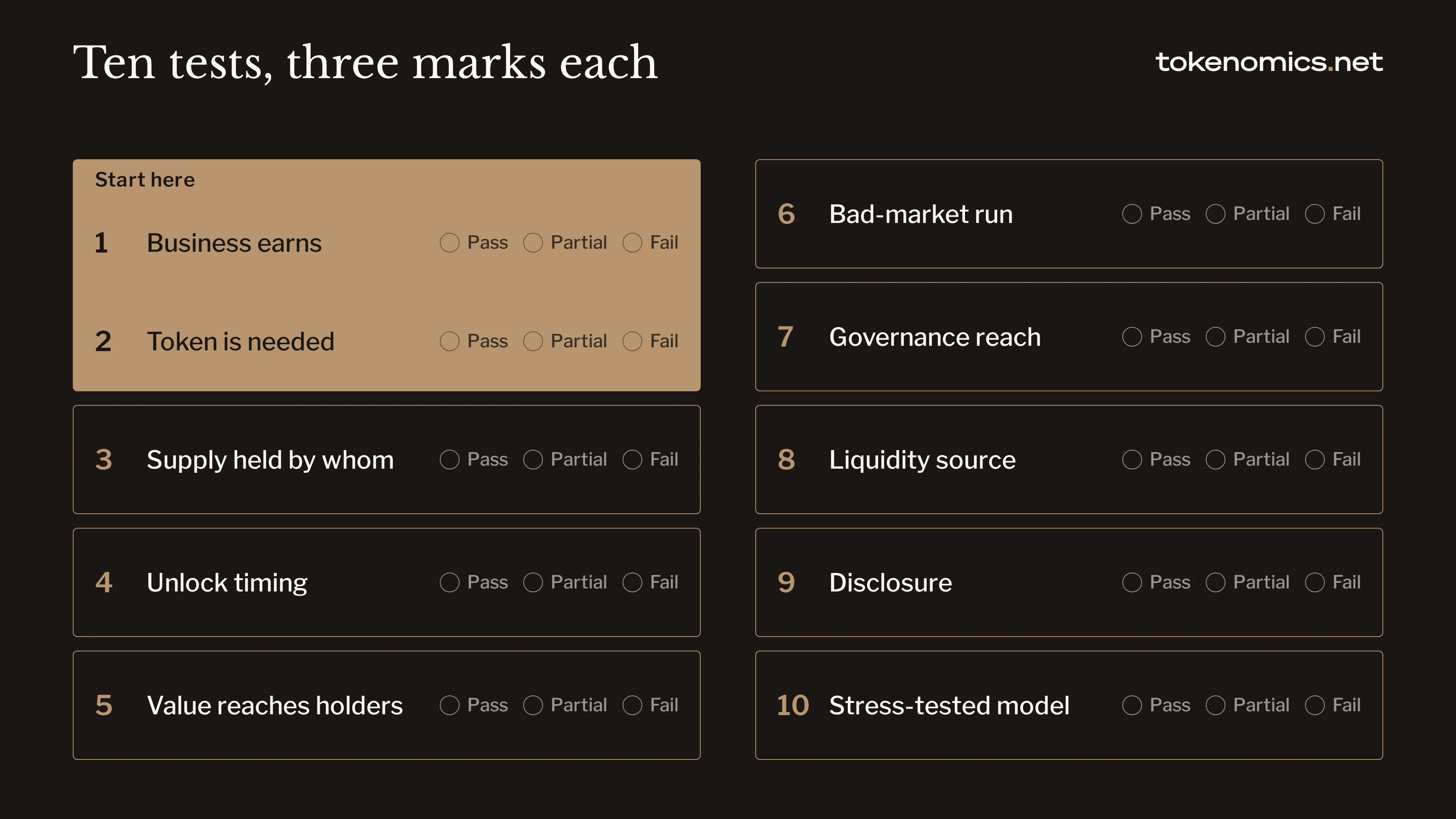
One thing the scorecard will not give you, and we would rather say so than let it imply otherwise: ten passes is not a verdict that a token is sound. It means nothing visible is broken on the ten things we know how to check. Execution, timing, the market and the team are not on this card, and the honest version of any scorecard is that it rules things out rather than clearing them.
#What to do with a low score
It depends which side of the table you are on.
If you run the project, fix in order. Tests 1 and 2 first, always, because a fail there means the rest of the model is solving the wrong problem and you will redo it anyway. Then 4 and 6, since unlock timing and the bad-market run are the two that produce the most expensive surprises after launch. Then the documents, because documents record decisions and you need the decisions first.
That sequencing is the whole of our Tokenomics Data Room engagement, which runs design, modeling, stress testing and documentation in one piece of work rather than across three vendors who each assume somebody else did that part. The five failures that page names are, in scorecard terms, tests 3 and 4, test 8, test 1, test 9 and test 6. If you recognize two of your own in that list, you have your starting point.
If you are assessing somebody else's project, convert each fail into a document request. Not a question in a call, a document. "What is the month-by-month sellable supply for the first three years" is answerable with a file, and whether the file exists tells you more than the numbers in it. A team that has done test 6 can send you the run the same day. A team that has not will send you a paragraph.
#Frequently Asked Questions
#How do you evaluate tokenomics?
Run ten tests: business revenue, why the token exists, supply concentration, unlock timing, how value reaches holders, the bad-market run, governance reach, liquidity source, disclosure, and whether the model was stress-tested. Mark each pass, partial or fail, and fix the first two first.
#What is good tokenomics in crypto?
A design where the token does a job the business could not do without it, the supply schedule does not hand early holders a reason to exit into thin liquidity, and value reaching holders traces back to something the business earns.
#How do I evaluate a token project?
Start with the business, not the token. Ask what it earns, from whom, and whether the token makes that easier. A model that only works while the chart works has answered a different question.
#What are red flags in tokenomics?
Patterns we see repeatedly: most of the float held by a handful of addresses, unlocks clustered in one quarter, rewards paid in freshly issued supply with no revenue behind them, governance that can change supply by simple majority, and a model with no bad-market run in it.
#Can a good model fix a weak business?
No. Token design changes who holds what and when, and it cannot create a customer who pays. The token is infrastructure and the business is the engine, which is why test 1 comes first.
#Where to start
Score your own model this week, on paper, before anyone else does it for you. Be harsh on tests 1 and 2 and the rest gets easier to read.
If you want the method rather than the checklist, the free course publishes all of it, 67 lessons and 11 finished deliverables, which open with a free account. When the gaps are structural rather than cosmetic, our Tokenomics Data Room team does this work start to finish.
Tokenomics.net is an advisory and education firm for token issuers and asset owners. Ten tests. Two of them decide the other eight.
Bring the question to a call
Thirty minutes with the team that wrote this, on your token or your asset. You leave knowing what to fix first.