
Tokenization Training for Banks, Law Firms and Advisors

In short
Your clients are asking about tokenizing buildings, loan books and fund interests, and generic blockchain training does not answer them. This sets out what each client-facing role has to explain in a meeting, what each should hand off, and how to tell good training from a conference talk.
A bank, law firm or advisory team needs training that lets each client-facing role answer a tokenization question accurately: how the asset is held, which law applies, how ownership gets recorded, and how a buyer exits. Generic blockchain training rarely reaches any of those, so train by role and teach from live deals.
The reason is simple enough. A client calls about a building, a loan book or a fund interest. They want to know whether they can raise money against it without selling it outright, what it would cost them, and who would buy. Nobody on that call is asking how consensus works.
So the business question your team is being paid to handle is the client's financing question, not a technology question. Why do they need the money, what are the ordinary routes, and does this one beat them. A team that can hold that conversation keeps the relationship. A team that cannot refers it out, and the referral tends to take the rest of the mandate with it.
#The gap between blockchain training and client questions
Most available training is built for a different buyer. It explains distributed ledgers, smart contracts, consensus and wallets, and it is usually accurate. It is also answering a question your clients are not asking.
Walk through what actually arrives. A property owner wants to know whether their mortgage lender has to consent. A fund manager wants to know whether their limited partnership agreement permits the transfer. A family office wants to know who the buyers are and how one of them sells again in three years. Those are documents-and-consents questions with a ledger somewhere behind them, and the ledger is the part closest to solved.
That is the gap. Not knowledge of blockchain, but the ability to say what the token represents in law, who holds the asset, what restricts a transfer, and where the exit comes from. Our live training and course building from Tokenomics.net exists because that gap kept showing up in client-facing teams who had already sent people on a blockchain course.
#What each role must be able to answer
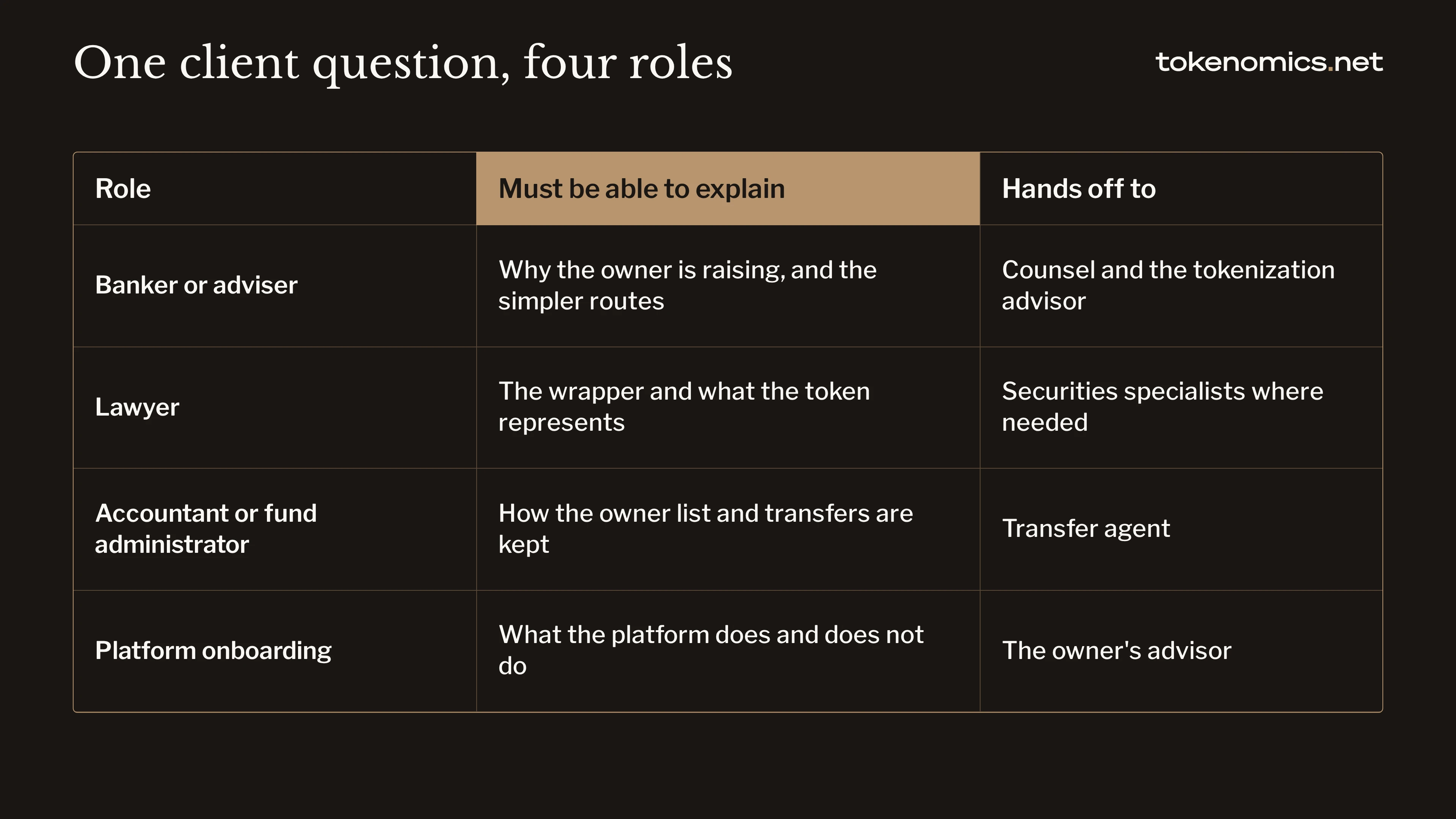
Four roles, three questions each, and one thing each role should recognize as outside its scope. Treat the hand-off as part of the competence, because a confident wrong answer is the expensive failure mode here.
#Relationship banker or adviser
In a first meeting, they should be able to answer:
- Why do you need the money, and what would a loan, a share sale or a straight sale cost you instead?
- Who do you think would buy a slice of this, and how would they sell it again?
- Who else has to say yes: your lender, your co-owners, your board?
Outside scope: whether the offering is a security, and which exemption or regime might apply. That goes to counsel, and the adviser's job is to raise it early rather than to answer it.
#Lawyer
- What does the token actually represent: shares in an entity, a debt claim, a beneficial interest under a trust, or something else?
- Which entity holds the asset, and what happens to the token holders if that entity fails?
- What in the existing documents restricts a transfer: the mortgage, the shareholder agreement, the fund documents, a ground lease?
Outside scope: the token standard and what the contract does at runtime. That belongs with the owner's tokenization advisor and the engineers, and the lawyer's role is to state what the documents have to achieve, not to pick the mechanism.
#Accountant or fund administrator
- Who keeps the owner list, and is the onchain register the official record or a mirror of one?
- How does a transfer get recorded, and who approves it before it settles?
- How are distributions calculated and paid, in what currency, and on whose instruction?
Outside scope: the legal character of the instrument, and any valuation opinion the structure depends on.
#Platform sales or onboarding
- What does the platform do, and what does it explicitly not do?
- Who holds the asset, and who holds the keys?
- What happens to the owners if the platform stops operating?
Outside scope: advising the asset owner on whether to proceed at all. That goes back to the owner's own advisor, and a platform that answers it anyway has just become the advisor without the mandate.
| Role | Must be able to explain | Hands off to |
|---|---|---|
| Banker or adviser | Why the owner is raising, and the simpler routes | Counsel and the tokenization advisor |
| Lawyer | The wrapper and what the token represents | Securities specialists where needed |
| Accountant or fund administrator | How the owner list and transfers are kept | Transfer agent |
| Platform onboarding | What the platform does and does not do | The owner's advisor |
Where the firm itself is the advisor on the deal rather than the referrer, that is a different engagement, and our tokenization advisory work is where it sits.
#What good training looks like
Five criteria. They are worth applying to any provider, including us.
Taught by people who do the work. Ask what the person teaching did last quarter. If the answer is teaching, the examples in the room will be from reading rather than from a deal somebody had to get done.
Built on live deals, including the ones that went badly. The useful content is the consent that arrived three weeks late and what it cost. A curriculum with no failures in it has been sanded down for comfort.
Role-based. A single session for everyone is a conference talk with a calendar invite. The banker and the fund administrator need different things, and both know it within twenty minutes.
Current, and dated. Ask when the material was last revised and what changed. Jurisdictional treatment of these structures moves, and undated material is the most expensive kind.
Leaves a reference behind. Something the team opens during a client call six months later. A recording nobody rewatches is not that.
Here is the part worth saying plainly, since it argues against our own larger service. Most firms do not need everyone trained live. Train the two or three people clients already call, give the rest a published course to read, and wait until you know which questions actually turn up before you buy anything bigger. Buying breadth first is how learning budgets get spent on people who never field the question.
#Build or buy: three ways this gets delivered
Self-paced, from a published course. The cheapest thing you can do this week, and the right first move for breadth. Our own method is published as the free course, 67 lessons and 11 finished deliverables, which open with a free account. Send people there before you commission anything.
Live, with your own team on your own deals. We read the files you are actually working on first, then teach live and take interruptions, and your team talks more than we do. Any headcount, your office or virtual. Your people keep the worked examples and the notes, which is the reference criterion above. We teach out of our own studio when it is remote, twelve feet of glass board, written on live.
A course published to your market. If the audience is your market rather than your staff, we build the course and hand it over to publish under your name: short videos, worksheets, certificates. Every month you get starts, completions, scores and calls booked, so it reports as pipeline rather than as content spend. Associations and platforms tend to want this one, and the reason is that their members ask the same four questions every week.
One caveat on live training, and it is ours to own. Our examples come out of the advisory work, which means they skew to the asset types we handle most. If your book is concentrated somewhere else, say so when you scope it, and make us bring the examples closer to your deals. Otherwise you will get a very good session about property and private credit.
#Frequently Asked Questions
#What training do bankers need for tokenization?
Enough to hold the first conversation: why the client wants the money, who would buy a slice, how a buyer sells it again, and who else has to consent. The technical layer can wait, because it is not what the client is asking about.
#Is generic blockchain training enough?
Rarely, because it teaches how a ledger works and your clients are asking who owns the building. The parts that decide a deal are the legal wrapper, the consents and the exit, and a general blockchain course usually covers none of the three.
#Who should be trained first in a firm?
The two or three people clients already call. Train them properly, give everyone else a published course to read, and revisit the rest once you know which questions actually arrive.
#Can training be built for our own platform or association?
Yes. We build the course and hand it over to publish under your name, with short videos, worksheets and certificates, and you get starts, completions, scores and calls booked reported every month.
#How is progress measured?
By what a role can answer unaided. Write the client questions each role must handle, ask them cold before the training and again after, and keep the list as the standard rather than a score.
#Next step
Audit the teaching before you buy any of it. The free course is the whole method, and you can read about the instructors first, which is the order we would use ourselves.
When you know who has to learn this, your team or your market, book a call about live training and course building from Tokenomics.net. Bring the roles, the scale and two live deals you would want in the room.
Tokenomics.net is an advisory and education firm for token issuers and asset owners. The test of training is whether your people can answer in the meeting, without you in it.
Bring the question to a call
Thirty minutes with the team that wrote this, on your token or your asset. You leave knowing what to fix first.