The Most Common Tokenomics Design Mistakes (And Why Teams Keep Making Them)
The biggest tokenomics design mistakes are not careless oversights. They are rational choices that become fatal under pressure. Here is what actually breaks token models.


What counts as a tokenomics design mistake? A design mistake is a structural flaw baked into the token model before launch. Execution failures -- slow product-market fit, poor marketing, bear market timing -- are different problems. This post covers only structural design errors: choices embedded in supply schedules, demand drivers, and governance rules that generate compounding damage over time regardless of execution quality.
Most tokenomics failures are not accidents. The teams that built them were rational, often experienced, and they chose each structural element for reasons that made sense in the context of the moment. The circular demand loop looked like a clever bootstrapping mechanism. The fixed vesting schedule looked like a fair commitment to early backers. The governance token looked like a path to decentralization.
Then the market changed, adoption stalled, or a competitor emerged -- and each reasonable design choice became a structural trap.
Here are the five patterns we see most often, why they survive to launch, and what a corrected design looks like.
#The Real Pattern Behind Tokenomics Failures
Before the specific mistakes, the pattern: nearly every tokenomics failure traces back to one of three root causes.
Misaligned incentive horizons. Designers think in quarters. Markets think in days. Governance holders think in years. When vesting schedules, emission curves, and fee capture mechanisms operate on different time horizons, the system pulls apart under stress.
Circular demand. The token creates demand for itself by distributing more tokens. This works during growth phases and collapses when growth stalls, because the only new buyers are existing holders diluting themselves.
Governance capture. Voting rights concentrate in the hands of actors with short time horizons or misaligned incentives, and the governance mechanism becomes a mechanism for extraction rather than stewardship.
Every mistake described below is a specific instantiation of one of these three root causes.
#Mistake 1: Circular Demand (Tokens That Only Exist to Fund the Token)
The pattern: The protocol distributes tokens to users as a reward for participation. Users receive tokens. Those tokens have value because the protocol distributes them. The value of the distribution is the only source of demand for the token.
This is circular demand. The token creates demand for itself. There is no external revenue source -- no protocol fees, no service fees, no asset income -- flowing into the system from outside.
Circular demand works during growth phases. When new users are entering faster than tokens are being distributed, buy pressure from new participants absorbs supply. The moment user growth decelerates, existing holders look at their distribution rewards, see the price falling, and sell. That sell pressure reduces the apparent reward value, which reduces the incentive to participate, which reduces new user inflow. The spiral is reflexive.
Why it survives to launch: At design time, the protocol has no revenue yet. Distributing tokens to bootstrap participation is the mechanism for getting to revenue. The mistake is not the bootstrapping logic -- it is building no path from circular demand to external demand before the bootstrapping phase ends.
The fix: Revenue-first supply design. Emission rates must be budgeted against projected fee revenue, not projected token price. Buy-and-burn mechanics should be tied to transaction volume, not governance votes. If the protocol cannot articulate a specific path from today's circular demand to external fee-based demand within a defined timeframe, the token model is not ready to launch.
#Mistake 2: Emissions Schedules Divorced From Adoption Curves
The pattern: The team writes a vesting schedule at Series A valuation pace. Tokens unlock on a calendar. The product ships. Adoption is lumpy, seasonal, and market-dependent. The vesting schedule is not.
The result is supply overhang: significant token supply enters circulation before sufficient demand exists to absorb it. This happens most often at 12-month cliff events, when early investor and team allocations unlock simultaneously.
Why it survives to launch: Fixed schedules feel fair to all parties at negotiation time. A 12-month cliff plus 36-month linear vest is a standard commitment signal. The problem is that it assumes a smooth adoption ramp that almost never materializes.
The fix: Milestone-gated emissions. Instead of calendar-based unlocks, design emissions that trigger against measurable protocol metrics: active users, TVL thresholds, revenue milestones. This aligns token supply expansion with actual value creation. Investors who understand tokenomics support milestone-gating because it reduces cliff-event sell pressure that destroys the asset value of their own holdings.
Adaptive cliff design is a second tool: rather than a single 12-month cliff event, structure a rolling cliff series at 6, 9, 12, and 18 months, with each tranche sized to expected demand at that phase. The aggregate unlock schedule is the same, but the per-event supply pressure is smaller.
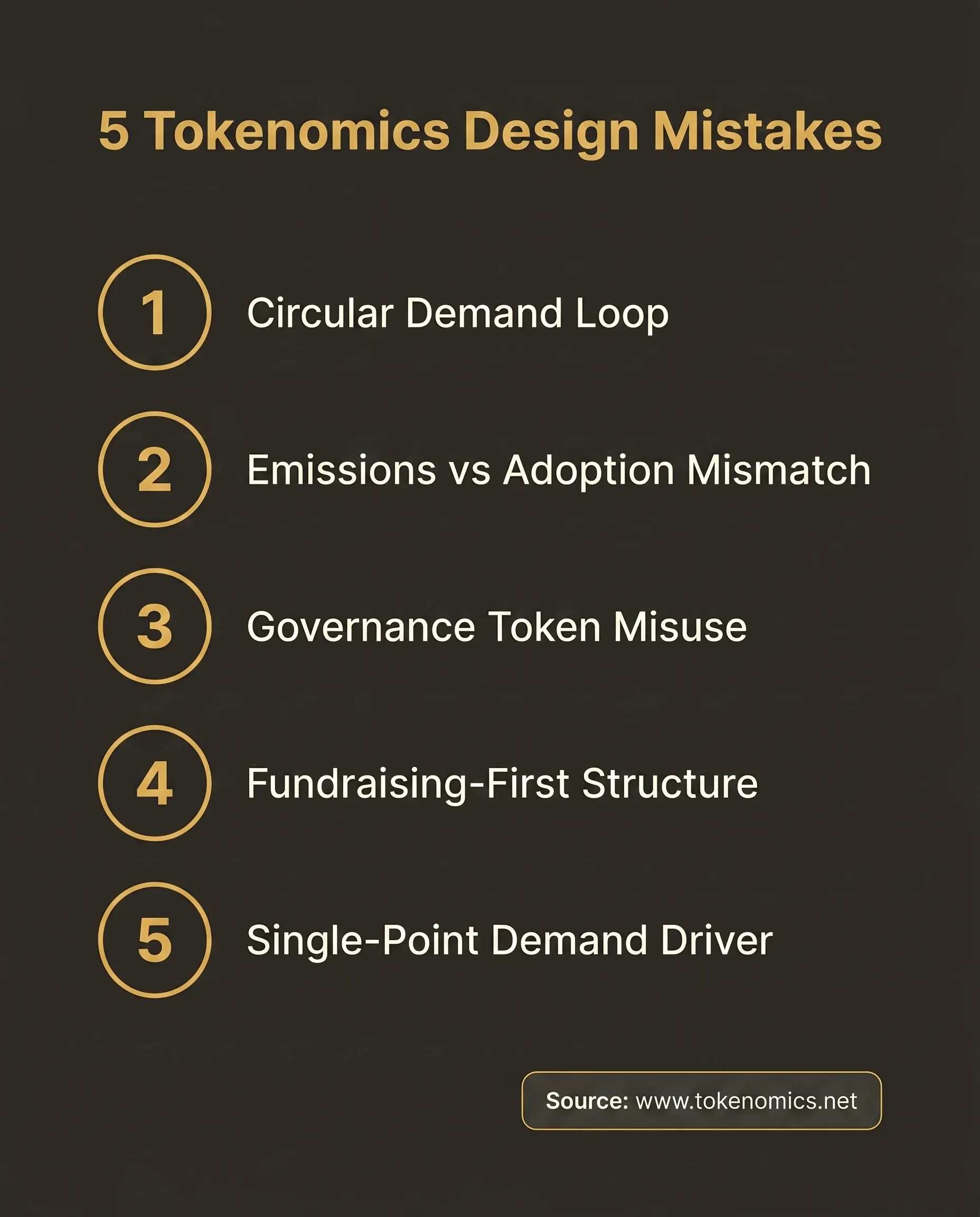
#Mistake 3: Governance Token Misuse
The pattern: Governance rights are assigned to holders whose economic stake is disconnected from governance quality. A token holder with a short time horizon and a large position can pass proposals that extract value from the protocol before their position unwinds. Long-term ecosystem participants have smaller positions and insufficient voting weight to block extraction.
This is not a hypothetical. Governance capture has resulted in treasury raids, parameter changes that accelerated protocol death, and liquidity incentive programs designed to benefit a specific counterparty at the expense of the broader user base.
Why it survives to launch: At launch, the founding team holds a large share of governance tokens and can prevent capture. The problem manifests after the team's vesting completes, after secondary market purchases redistribute holdings, and after the team's attention shifts to building rather than governance monitoring.
The fix: Structural anti-capture mechanisms. Time-locked voting -- requiring tokens to be locked for a defined period before votes count -- reduces the power of short-horizon holders. Conviction voting -- weighting votes by the duration tokens have been committed to a position -- aligns voting power with long-term stake. Quorum rules that require skin in the game -- holding tokens plus active protocol participation -- reduce plutocracy concentration.
None of these mechanisms are perfect. All of them are better than a one-token-one-vote system with no participation constraints.
#Mistake 4: Treating the Token as a Fundraising Vehicle First
The pattern: The token sale is designed to maximize near-term capital raised. Seed rounds price tokens at a discount accessible only to insiders. Private rounds stack another layer of insider access. Public sales price tokens at a premium to private rounds. Retail buyers pay the highest price and receive the shortest lockups.
This structure extracts maximum value from the most risk-exposed buyers -- retail participants -- and transfers that value to the least risk-exposed buyers -- institutional early buyers. When the cliff events arrive, institutional holders sell into retail demand. The price chart follows a predictable pattern. Retail loses confidence. Liquidity exits. The protocol's on-chain activity metrics collapse alongside price.
Why it survives to launch: The team needs capital to build. Institutional investors provide larger checks and faster decisions. The discount-and-lockup structure is the market standard for managing institutional risk. None of this is wrong individually. The mistake is not correcting the retail extraction dynamic with compensating design choices.
The fix: Community bootstrapping mechanisms that give early retail participants comparable terms to institutional buyers, or that compensate for price disadvantage with longer vesting alignment. Lockup periods matched to the team's own vesting schedule signal genuine alignment. Milestone-based token releases rather than time-based releases ensure that buyers at every price tier are unlocking against the same protocol metrics.
#Mistake 5: Single-Point Demand Driver
The pattern: The entire demand structure for the token rests on one mechanism. Staking APY is the most common single-point demand driver. Governance voting rights is another. LP farming rewards is a third.
Single-point demand drivers work when the mechanism is novel or when the APY is high enough to attract new capital. Both conditions are temporary. Novel mechanisms get replicated by competitors. High APYs attract mercenary capital that rotates to the next high APY. When the single demand driver saturates or becomes uncompetitive, there is no second layer of demand to hold price.
Why it survives to launch: Single-point demand drivers are easy to model, easy to communicate to investors, and easy to understand in marketing materials. "Stake to earn" is a complete tokenomics story for most retail audiences. The fragility is not visible until the mechanism saturates.
The fix: Layered demand architecture. A defensible token model has at least three distinct demand drivers, each drawing from a different type of holder. Fee-sharing attracts protocol revenue participants. Governance rights attract holders with long-term ecosystem alignment. Deflationary burns create mechanical buy pressure tied to actual usage. Utility access -- using the token to unlock services or discounts -- creates demand from the protocol's own customers rather than from speculation.
Designing layered demand is harder. It requires the team to define who the protocol's customers are, what those customers value beyond yield, and how to structure token utility around genuine service delivery. That constraint is the point. If you cannot articulate three distinct demand sources, the token model is not finished.
#How to Know If Your Token Model Has These Mistakes
Three diagnostic questions to run before finalizing any token model:
One: Where does external revenue enter the system? If the answer involves any circular logic -- the token creates demand for the token -- map the path from that circular mechanism to an external revenue source and verify it exists in the design.
Two: Does the supply schedule assume a specific adoption pace? If yes, model what happens at 40% of projected adoption. If that scenario produces a supply overhang cliff event, redesign the unlock schedule.
Three: Can the token lose 80% of its market cap while the protocol continues operating? If the answer is no -- if the protocol's operations depend on the token price staying above a certain threshold -- the token model has a structural dependency that should be resolved in design.
These questions do not replace a full tokenomics audit. They identify the highest-probability failure points quickly. If any answer reveals a structural problem, that problem will be significantly cheaper to fix in design than after launch.
#The Honest Version
Most tokenomics design mistakes are not careless. They are expedient choices that trade long-term structural integrity for short-term capital, speed, or simplicity. The circular demand loop gets the protocol launched. The fixed vesting schedule closes the institutional round. The single-point demand driver makes the marketing deck readable.
None of those trade-offs are inherently wrong. The mistake is making them without acknowledging the structural cost and designing compensating mechanisms before launch.
The teams that build durable protocols are not necessarily smarter. They are more willing to slow down at the design phase and ask what happens when the expedient choice stops working.
Sometimes the answer is uncomfortable. We prefer finding out in design.
#Frequently Asked Questions
What is the most common tokenomics design mistake? Circular demand is the most structurally common mistake. When the only source of demand for a token is the distribution of more tokens, the model collapses when growth stalls. Every token that distributes rewards without a corresponding external revenue source has a circular demand problem to some degree.
Why do tokenomics fail even when teams are experienced? Most tokenomics failures stem from expedient choices at design time -- a fixed vesting schedule that closed the institutional round, a staking APY that made the marketing deck readable -- that become structural traps when conditions change. Experience reduces but does not eliminate the pattern because the pressures driving expedient choices are real.
What is a supply overhang in tokenomics? A supply overhang is excess token supply entering circulation faster than the market can absorb it. It typically occurs at cliff events -- when locked allocations unlock on a calendar schedule -- and produces significant sell pressure that depresses price and erodes protocol confidence.
How do you fix governance token misuse? The three most effective structural fixes are time-locked voting (requiring tokens to be committed for a period before counting), conviction voting (weighting vote power by duration of commitment), and participation-weighted quorum rules (requiring active protocol use alongside token holding). None eliminates governance capture risk entirely; all reduce the power of short-horizon holders.
What is a single-point demand driver and why is it dangerous? A single-point demand driver is a token model with one dominant source of buy pressure -- staking APY, governance voting, or LP farming. When that mechanism saturates or becomes uncompetitive, there is no second layer of demand to hold price. Layered demand architecture -- combining fee-sharing, governance rights, deflationary burns, and utility access -- is the structural fix.
How can I tell if my token model has circular demand? Ask where external revenue enters the system. If every answer involves tokens distributing to holders and holders buying tokens, the model is circular. Map the path from today's distribution mechanism to a fee-based external revenue source and verify that path exists in the design before launch.
What is the difference between a tokenomics design mistake and an execution failure? A tokenomics design mistake is a structural flaw embedded in the token model before launch: supply schedules, demand drivers, governance rules. An execution failure is a performance gap -- slow product-market fit, poor go-to-market, bear market timing. The distinction matters because design mistakes compound structurally over time regardless of execution quality, while execution failures can be corrected with improved operations.
Want a structured review of your token model before launch? We run tokenomics audits for protocol teams at the design stage, when problems are still fixable. Book a strategy call to discuss your token model.