Crypto Dividends Explained: How Token Distribution Works
Crypto dividends aren't real dividends. This guide breaks down staking rewards, fee-share tokens, buybacks, and airdrops, and why the label creates legal risk.


Do crypto tokens pay dividends? Mostly no, not in the legal sense the word implies, and the gap between what people mean when they say "crypto dividends" and what actually happens onchain is where a lot of confusion, and a lot of regulatory risk, gets built into token designs before anyone notices. Four different mechanisms get called a dividend: staking rewards, fee-share tokens, buybacks, and airdrops. Only one of them comes close to the real thing.
This is a mechanism-by-mechanism breakdown of what each one actually does, how it differs from a traditional dividend, and why the word "dividend" is loaded enough that founders designing a token should treat it as a legal signal, not a marketing line. What separates the four, underneath the legal question, is a business question: does the protocol generate real, recurring revenue it can route to holders, or is the mechanism standing in for revenue that does not exist yet.
#What people mean by "crypto dividends" (and why the term causes confusion)
In traditional finance, a dividend is specific: a board declares it, it gets paid pro rata to shareholders based on equity ownership, and it is funded out of realized company profit. That structure does not exist in crypto. There is no board, no equity, and usually no legally defined profit-sharing right attached to a token. What exists instead is a set of mechanisms that move value toward token holders in ways that superficially resemble a payout, and the word "dividend" gets borrowed to describe all of them at once.
That borrowing is doing more work than most people realize. Staking rewards, fee-share distributions, buyback programs, and airdrops are structurally different from each other and from a real dividend, but they all get flattened into the same search query and the same casual conversation. Naming that upfront matters, because every section below is really answering the same question from a different angle: does this mechanism create a recurring, pro-rata claim on real business value, or does it just look like one from a distance.
#Staking rewards: yield, not a dividend
Staking rewards are the mechanism most often mistaken for a dividend, mostly because the reward shows up automatically and repeats on a schedule. The problem is where the reward comes from. In most protocols, staking rewards are funded by new token emissions, meaning the protocol mints additional supply and distributes it to stakers. That is not a share of realized business revenue moving to holders. It is new supply being created and handed out.
When emissions fund the reward, existing holders who are not staking get diluted to pay the holders who are. That is close to the opposite of what a dividend does. A dividend transfers already-earned value from the business to the owner. Emissions-funded staking transfers value from non-participating holders to participating ones, funded by dilution rather than by profit. The reward can still be a reasonable, even necessary, design choice for bootstrapping network security or participation. It is just not a dividend, and calling it one obscures where the reward is actually coming from. That distinction only holds cleanly when the reward is emissions-funded. When the reward is instead funded by real protocol revenue, the picture changes, which is exactly the next mechanism.
#Fee-share and revenue-share tokens: the closest real analog
This is the mechanism people are usually reaching for when they search "crypto dividends," and it is also the one structurally closest to a real one. A fee-share or revenue-share token routes a cut of actual trading fees, protocol usage fees, or other realized revenue to token holders, typically pro rata to how much they hold or stake. Unlike emissions-funded staking, this reward is not diluting anyone. It is real value generated by the protocol's operations moving to holders.
That is also exactly why fee-share tokens draw the most regulatory scrutiny of the four mechanisms covered here. A recurring, pro-rata distribution of business revenue to a passive holder is a textbook fact pattern for a securities analysis, not a footnote to one. The mechanism only makes economic sense in the first place when there is a real, sustained revenue stream underneath it. A protocol without meaningful recurring revenue that builds a fee-share mechanism anyway is not creating a dividend, it is creating a distribution with no underlying business to fund it and a securities profile it did not need to take on.
That question of whether the underlying value is real enough to support a mechanism connects to a broader one: what makes a token necessary in the first place, covered in how value accrues to a token.
#Buybacks and burns: returning value without a distribution event
Buy-and-burn programs take a different route entirely. Instead of paying holders directly, the protocol uses revenue or treasury funds to buy tokens on the open market and permanently remove them from supply. No cash or tokens change hands from protocol to holder. Value returns indirectly, through reduced supply pushing against the same or growing demand, rather than through a payment.
That indirection is the point. A buyback sidesteps the legal shape of a dividend because there is no distribution event to characterize; nobody receives anything. But the tradeoff is real: value return through a burn is indirect and price-dependent, not a contractual cash flow the way a dividend payment is. A holder cannot point to a specific amount received on a specific date. They can only point to a smaller supply and hope the market prices that correctly. Buybacks and burns are a legitimate value-return mechanism. They are just a different kind of mechanism than a dividend, with a different risk profile attached.
The mechanics of that indirection, and when a burn actually functions as a supply reduction rather than a marketing line, are covered in when a token burn creates value.
#Airdrops and retroactive rewards: not dividends, but often mistaken for them
Airdrops are the weakest analog of the four, and the section on them stays short because there is not much design nuance to add. An airdrop is a one-time or episodic distribution, usually tied to past usage or contribution, not a recurring pro-rata payment funded by ongoing business activity. It happens once, or occasionally, not on a schedule tied to earnings.
The conflation with dividends is mostly behavioral rather than structural. Receiving tokens for having used or held something earlier feels emotionally like getting paid for holding, which is the same feeling a dividend produces. But the mechanism underneath is unrelated: an airdrop is a distribution decision made once by a team, not a recurring claim on business revenue. It closes the confusion more than it introduces new design guidance, which is why the other three mechanisms carry the real weight of this comparison.
#Mechanism-by-mechanism comparison
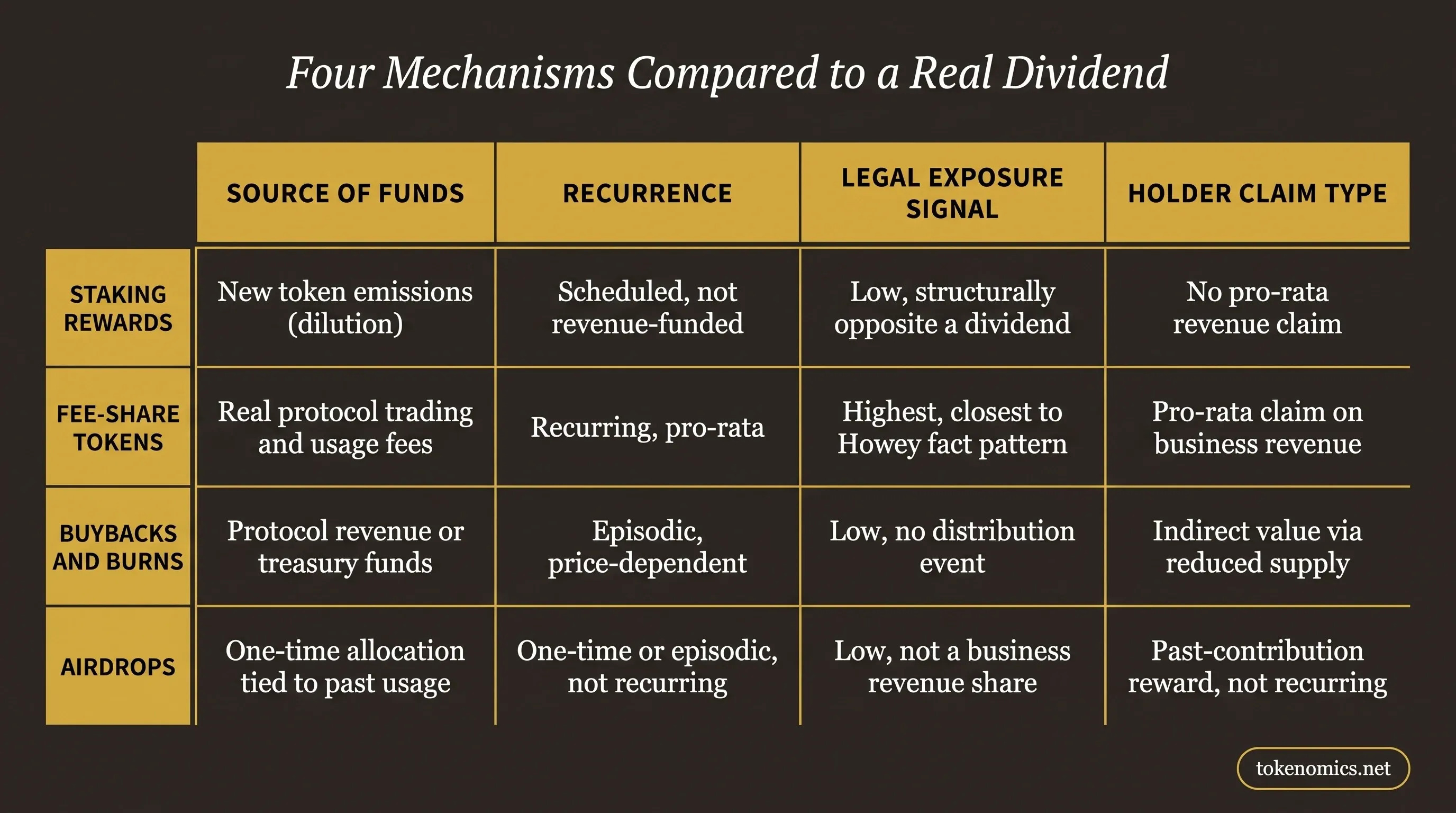
The table below lines up all four mechanisms side by side: where the funds come from, whether the payment recurs, what kind of legal exposure signal it creates, and what claim, if any, a holder actually has. The one-sentence takeaway is worth stating before the table does the rest of the work: only fee-share tokens create a genuine pro-rata claim on revenue, and that is exactly the pattern regulators scrutinize hardest.
#Why "dividend" is a loaded word under securities law
This is the highest-risk section in this post, so every claim here is labeled as either an established fact or a clearly flagged firm opinion, not blended together.
As an established fact: the Howey test is the framework U.S. courts and the SEC use to determine whether an arrangement is an investment contract, and its later prongs ask whether investors expect profit derived from the managerial efforts of others. A recurring, pro-rata distribution funded by the ongoing efforts of a central team is close to the exact fact pattern those prongs are built to probe. Crypto dividends, in the fee-share sense specifically, sit closer to that fact pattern than any of the other three mechanisms covered above.
As the firm's opinion: founders often reach for "we don't pay dividends" as a defense, treating the word itself as the thing being regulated. In our view, that framing understates the risk, because the legal analysis looks at the substance of the arrangement, not the label attached to it. A mechanism that behaves like a pro-rata profit share does not stop looking like one just because nobody calls it a dividend. That view is the firm's read on the substance-over-form principle, not a summary of current SEC guidance, and it should not be treated as settled law. Regulatory posture on this specific point shifts over time, so any team weighing a fee-share mechanism should confirm current guidance with counsel before relying on this analysis.
The full Howey analysis, including how courts and the SEC apply each prong to a token specifically, is covered in how token classification works.
#What founders should actually design for (if not literal dividends)
The mechanism choice should follow from one question: does the protocol have real, recurring revenue to route to holders, or does it not. That question, answered honestly, does most of the design work before a single parameter gets set. A protocol with genuine, sustained fee revenue has an actual case for evaluating a fee-share mechanism, carefully, with legal counsel involved from day one rather than bolted on after the token design is otherwise finished. A protocol without that revenue has no real case for one, regardless of how much the community wants to hear the word "dividend."
This closes back to the same thesis that runs through every mechanism covered here: the token is infrastructure for value the business already creates, not a device for manufacturing a dividend narrative where none exists. Staking rewards, fee-share tokens, buybacks, and airdrops are four different tools with four different tradeoffs. None of them are dividends in the legal sense, and treating any of them as if they were, in a pitch deck or in a design decision, is how a defensible mechanism turns into an undefensible one.
The related question of how voting rights and distribution rights get separated in a token's design is covered in governance token design, and teams that want that separation reviewed against their own structure can start with our Tokenomics Consulting service.
Teams closer to locking in a fee-share or distribution mechanism typically move that work into a structured tokenomics design service engagement, with counsel involved before the model is finalized rather than after.
If your team is weighing a fee-share or distribution mechanism and wants a second read on where it lands before the design gets locked in, that is worth a conversation before the structure is set, not after.
Book a strategy call and we'll look at where your mechanism lands before the structure is set.