Token Utility Design: Making a Token Genuinely Necessary
Token utility is the function a token performs inside a product. Learn the necessity test, demand drivers, and design patterns that make one truly needed.


Token utility is the specific, non-speculative function a token performs inside a product or protocol: paying for access, settling fees, securing the network through staking, or carrying real governance weight. It is the reason someone needs to hold or spend the token that has nothing to do with hoping the price rises. A token has genuine utility when removing it would break something the product actually does.
Token utility is a design property, not a marketing claim. It is the concrete job the token does inside a working system, decided at the design table long before anyone trades the asset. Get it right and the token has a reason to exist. Get it wrong and you have shipped a speculative instrument wearing a product's clothing.
The distinction that trips up many teams is utility versus value. Utility is what you design. Value is what the market decides. Conflating the two is the root cause of a large share of failed token models, because a team convinced its token is valuable stops asking the harder question underneath.
That harder question is a business question. Does the product underneath the token actually generate value the token can plausibly capture? A token without a real business beneath it is a countdown timer. Genuine utility is how you tie the token to that business so the two move together instead of drifting apart.
#What Is Token Utility?
Token utility: the specific, non-speculative function a token performs inside a product or protocol, the reason a participant needs to hold or spend it independent of price appreciation.
Token utility describes what the token is for. It answers a plain question: if I never expected the price to move, would I still need this token to use the product? When the answer is yes, the token has a functional role. When the answer is no, the token is decoration, and the market tends to figure that out faster than the team hoped.
Utility shows up in a few recognizable forms. A token can gate access to a feature or dataset, serve as the required medium for paying fees, act as the collateral a participant stakes to perform a role, or carry weight in decisions that change how the protocol runs. Each of these is a job, and a job is what separates a utility token from a bet. For a precise entry, see what token utility means in the glossary.
#Token Utility vs. Token Value
Utility and value are related, but they are not the same thing, and treating them as interchangeable produces bad designs.
Utility is a property you engineer into the system. Value is a market outcome that depends on utility, supply, demand, liquidity, and conditions no designer controls. You can build strong utility and still see the price fall in a bad market. You cannot reliably manufacture value by asserting it in a deck.
So design for utility, because it is the part you control, and let value follow from real usage. A token with a clear functional role has a foundation under any value it accrues. A token with no functional role has nothing holding up its price except sentiment, and sentiment is not a mechanism.
#The Token Necessity Test: Does This Need to Be a Token?
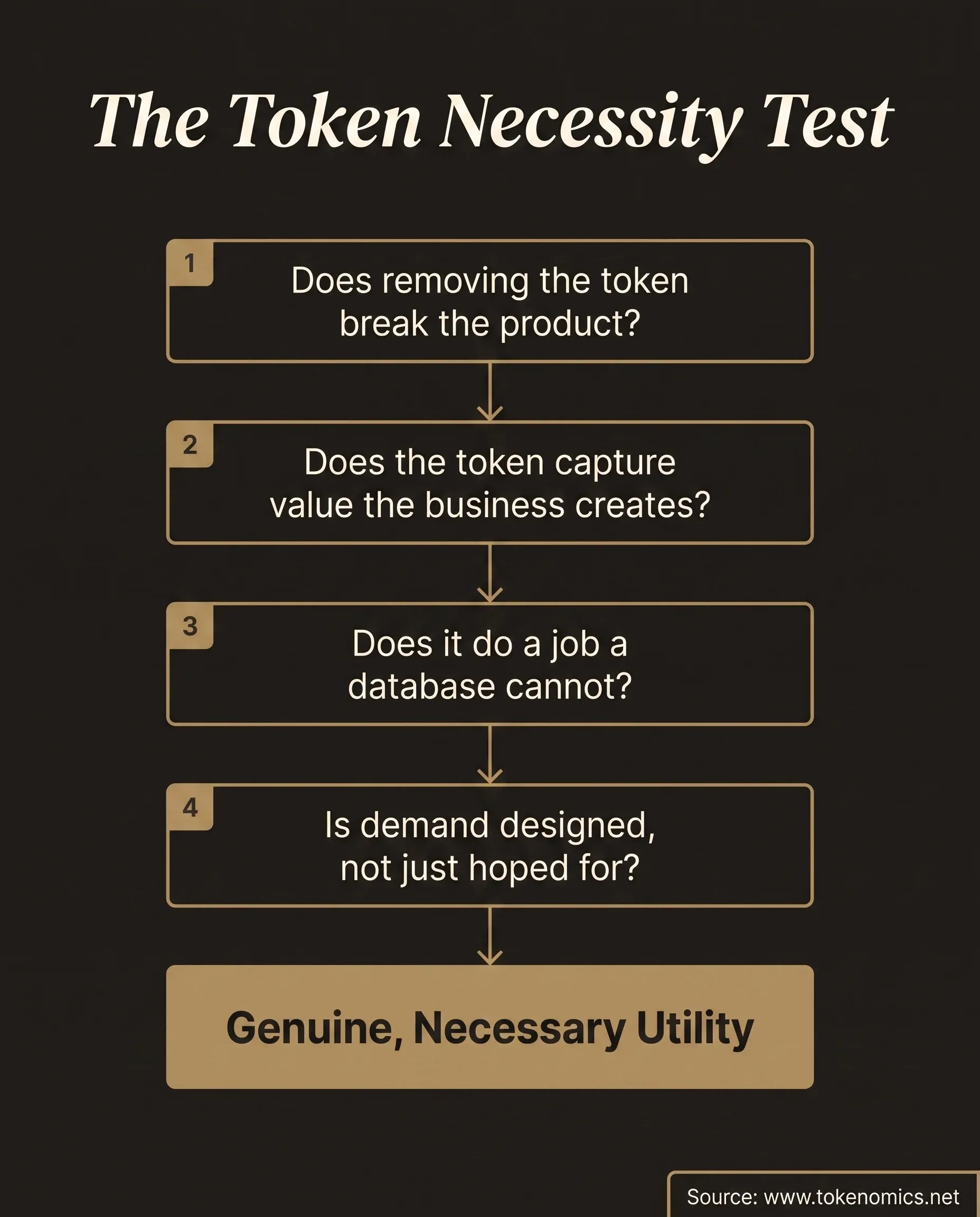
Before committing to token mechanics, run what we call the token necessity test. It is a short set of questions a founder can answer honestly in an afternoon, and it saves projects from building an asset they did not need.
Ask four things. Would a permissioned database, an allowlist, or an ordinary subscription accomplish the same access control without a token? Does the token capture value the business itself creates, or is it bolted on beside the real product? Does removing the token break the product's actual function, or does the product run fine without it? And is demand for the token designed into how the system works, or merely hoped for once it launches?
A token that fails these questions tends to become one of the common tokenomics design mistakes we see repeatedly across the firm's project history: a token added because the category expected one, then quietly ignored by the product it was meant to power.
There is a regulatory reason to take this seriously, handled here as fact, not legal advice. The SEC's framework for analyzing digital assets weighs, among other factors, whether purchasers are led to expect profits from the efforts of others. In our view, a token built around a real functional job is easier to reason about than one built around price expectation, though whether a specific token is a security is a determination for your legal counsel and the relevant regulator, not something a design choice settles on its own. Read the full token necessity test definition for the checklist in one place.
#Token Demand Drivers: What Creates Sustained Demand
Demand for a token is either designed or wished for. Designed demand comes from a mechanism that makes using the product require the token. Wished-for demand comes from launching the token and hoping people want it. The first is a system; the second is a hope.
Real token demand drivers fall into a few categories. Access and permission rights make the token the key to a feature, tier, or dataset. Fee payment or fee discounts route required spending through the token. Staking and collateral requirements ask participants to lock the token to perform a role, which removes supply from circulation while it is at work. Governance weight tied to genuine decision-making power gives the token a say that matters to holders with something at stake.
These mechanisms are concrete. Access control and staking are implemented as on-chain logic, often built on audited primitives like OpenZeppelin's contract libraries, so a demand driver is only as real as the mechanism enforcing it. A demand driver that lives in the whitepaper but not in the contract tends to correlate with disappointment.
#Utility Token Design Patterns
Utility token design is largely a matter of matching a pattern to the shape of the product. There is no single correct pattern, only a menu of tradeoffs. Here are the common ones.
#Access and Permission Tokens
The token gates a specific feature, tier, or dataset. Holding or spending it unlocks something the product does. This fits products where access itself is the value, and it fails when the same gate could be a login and a database row.
#Work and Contribution Tokens
The token is required to perform a productive role, such as staking to run infrastructure or to provide a service the network consumes. The token becomes a work permit backed by economic stake. Many of these patterns implement fungible logic on top of the ERC-20 standard, which defines how the token moves and is accounted for.
#Fee-Capture and Discount Tokens
The token is the required payment medium for a function, or it reduces protocol fees when used. This ties token demand directly to product usage, the connection many models are trying to build.
#Governance-Utility Hybrids
The token carries both a functional role and a vote. This pattern is powerful and also the one with a well-known failure mode: governance weight handed out without real economic stake behind it, which tends to produce voter apathy or capture. Design the stake and the vote together, not the vote alone.
#Value Accrual: Connecting Utility to Token Value
Value accrual is the mechanism by which real usage shows up as economic value captured by token holders, rather than leaking entirely to the treasury or to no one. Utility and demand drivers create activity; accrual decides where the value from that activity lands.
A few mechanisms do this work. A fee switch directs a share of protocol revenue toward holders or stakers. Buyback-and-burn style mechanics use revenue to reduce supply. Staking yield funded by genuine protocol revenue accrues value; yield funded only by new emissions does not, because it pays holders with dilution rather than earnings. The test is whether the revenue exists, which is why on-chain fee and revenue data matters more than a narrative about future adoption.
Even a well-designed accrual mechanism can be undermined by token velocity. When a token changes hands quickly and is never held, the value passing through it does not stick to holders. High velocity is the quiet reason a token with real utility can still fail to hold value, and reducing it is part of the same design job as building the utility.
#How to Know Your Token Has Real Utility
You can pressure-test your own model with a few signals. If your engineers can describe the exact function the token performs without mentioning price, that is a good sign. If your product would keep working after you deleted the token, that is a warning. If demand comes from a mechanism you can point to in the contract, the utility is designed; if it depends on people believing the token will be worth more later, the utility is speculative, whatever the deck says.
The honest version of this assessment depends on where your product actually is, which is a conversation rather than a self-graded checklist. The teams whose tokens hold up under scrutiny answered the necessity question before launch, not after.
Token utility is not a label you attach to a token; it is a job you design into a system, and the necessity test is where that job either survives scrutiny or does not. Start with whether the token needs to exist at all, then design the demand drivers and value accrual that make it hold up. If you want the build side handled in one place, this is how we design token utility and value accrual together.
If you are building onchain and need your token model to hold up under engineering and investor scrutiny, book a strategy call. We'll assess your project and tell you whether we're the right fit. Sometimes we're not. We'll tell you that too.