
Token Investor Due Diligence: What Investors Check Before They Fund

In short
Investors check six areas before funding a token. See each one, the documents they ask for, and how a data room answers them. Start with the course.
Token investors check six areas before they commit: who is behind the project and what they hold, what the token does and how value reaches holders, who gets what supply and when it unlocks, the legal position, how the model behaves in a bad market, and whether the numbers can be checked onchain.
If you are raising with a token, the thing being underwritten is a business that happens to have a token on it. That is the frame every serious check comes from. An investor is asking whether the company earns money, and then whether the token helps or hinders that. Teams who arrive with a beautiful allocation chart and no answer to the first half of the question get a polite second meeting and no third one.
What follows is the six checks in the order they usually get asked, with the document each one wants. We have advised 100+ companies through $100MM+ in combined raises and the pattern is consistent: founders lose diligence rounds on missing documents far more often than on bad design.
#Why investors check the model, not the pitch
A pitch tells an investor what you intend. The model tells them what happens whether you intend it or not.
Vesting is the clearest example. A founder can describe a long-term commitment in a deck and still be sitting on an unlock schedule that puts a large block of insider supply into a thin market in the same quarter. Nobody has to be acting in bad faith for that to hurt everyone holding the token. The schedule does it on its own. So investors stop reading the deck and start reading the documents, and your job is to have the documents say the same thing your deck does.
This is also where the Tokenomics Data Room earns its keep. Getting your house in order before diligence starts means the answers are written down once, consistently, and the same for whoever asks.
#Check 1. Who is behind it and what do they hold
The first question is not about the token. It is who benefits if this goes well and who is exposed if it does not.
Investors want the legal entity and where it sits, the people actually doing the work, and the holdings of founders, team, advisors and early backers. Then the lock-ups on those holdings, in writing. An advisor holding a meaningful allocation with no lock-up is a different risk from the same allocation locked for years, and the allocation table alone will not tell them which one you are.
Documents asked for: the cap table and the token holder agreements.
#Check 2. What the token does
Remove the token from the business and ask whether the business still works. The answer is the whole of this check.
If the business still works, you have a token that adds something to a going concern, and the investor's next question is what it adds and how value reaches the people holding it. Fees, access, staking rights against real revenue, governance over something that matters. If the business stops working without the token, the token is the product, and in our view that is the hardest kind of project to underwrite, because its value has nowhere to come from except the next buyer.
Be specific about the path. "The token captures value from protocol growth" is not a mechanism, it is a hope with a diagram. Our post on token utility design works through what a real path looks like.
Documents asked for: a utility and value-flow memo, written in sentences a lawyer can read.
#Check 3. Who gets what, and when
The allocation table says who owns the supply. The unlock calendar says when they can sell it. Investors read the second one more carefully than the first.
| Document | Question it answers | Red flag |
|---|---|---|
| Allocation table | Who holds what share of total supply | Categories that overlap, or a table that does not add to 100 percent |
| Vesting schedule | When each allocation becomes transferable | Cliffs for several large holders landing in the same month |
| Unlock calendar | How much supply arrives per month, cumulatively | No calendar at all, only percentages |
| Circulating versus total supply | What the quoted valuation rests on | A valuation built on a circulating figure that is a small fraction of total supply |
Each of those is an observation about mechanism, not a view on any token's price. For the detail behind the second and fourth rows, see token vesting design and schedules and circulating supply versus total supply.
#Check 4. The legal position
What an investor wants here is not reassurance. It is counsel's written view, dated, with the reasoning visible.
That means the offering terms, the jurisdictions involved, and your lawyers' own analysis of how the token is classified. The analysis is fact specific and jurisdiction specific, and it is counsel's call rather than ours or yours. We do not write that a token is or is not a security, and a founder who says it casually in a diligence call has created a document the other side keeps.
For general context on where the question comes from: the Supreme Court set the investment contract test in SEC v. W.J. Howey Co. in 1946, defining it as a transaction where a person invests money in a common enterprise and is led to expect profits solely from the efforts of the promoter or a third party. The Court also held that it is immaterial whether the shares in the enterprise are evidenced by formal certificates or by nominal interests in the physical assets, which is the part that keeps the test relevant to tokens eighty years later. That is general information. The application to your offering belongs to your counsel.
Documents asked for: counsel's written classification view and the offering terms.
#Check 5. How the model behaves in a bad market
In our experience this is the check most teams have not run, and it is the one where a good answer lands hardest, precisely because so few people turn up with one.
A stress run takes the model and asks what happens when demand falls, liquidity thins and the unlock calendar keeps going anyway. The output is specific: which allocations become sellable at which dates, how much supply that is against the depth actually available, and how long the treasury funds operations if no further capital arrives. Investors are not expecting the answer to be pretty. They are checking whether you have looked.
Documents asked for: stress-test results and treasury runway.
#Check 6. Whether the numbers can be verified
Every number you present should be checkable by someone who does not trust you. That is not cynicism, it is the job.
Contract addresses, so holdings and supply can be read directly. Audit reports with the auditing firm named and the scope stated, because an unnamed audit is a claim rather than a document. Onchain dashboards with the queries behind them, so the figure and its derivation travel together. Secondary coverage of your own project is not evidence. Primary records are.
Documents asked for: contract addresses and named audit reports.
#How a data room answers all six
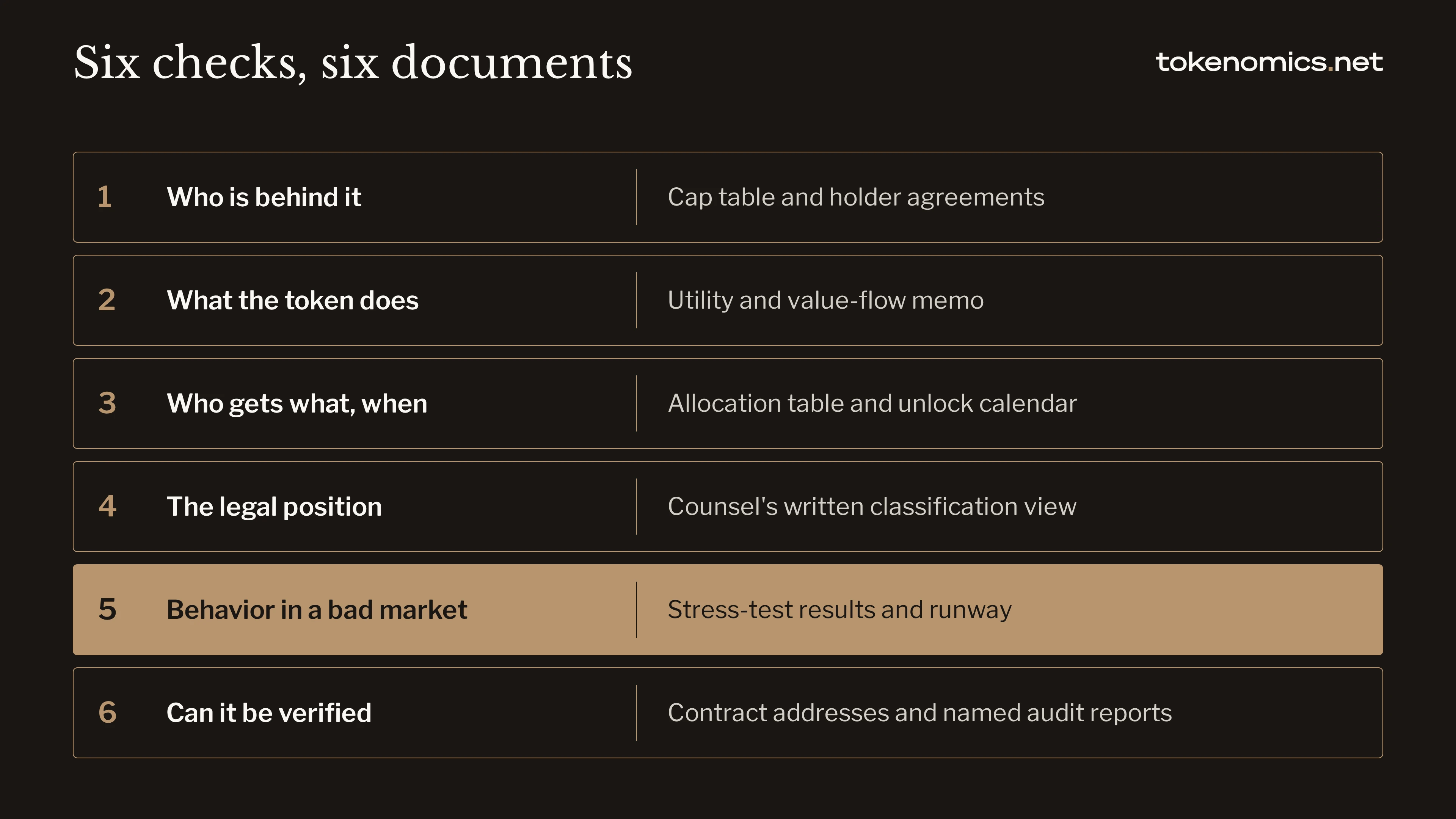
A data room is these six checks in one document set, assembled before anyone asks.
The practical difference is time. In a diligence process without one, each of the six checks turns into a request, a scramble, a partial answer and a follow-up, and the version of your allocation table that reaches the lead investor is not always the version that reached the analyst. The gaps are what create doubt, more than the contents of any single document.
Our tokenomics data room checklist lists the documents. What a tokenomics data room is covers the shape of the package, and why investors are asking for them covers the shift in expectations. If you want to build it yourself, the free tokenomics course publishes the method as 67 lessons, free with an account, including the data room module.
#Frequently Asked Questions
#What is token due diligence?
Token due diligence is the review an investor runs before funding a token project. It covers the team and their holdings, the token's role in the business, supply and unlocks, the legal position, behavior under stress, and whether the numbers can be verified onchain.
#What documents do token investors ask for?
A cap table and holder agreements, a utility and value-flow memo, an allocation table with an unlock calendar, counsel's written classification view, stress-test results with treasury runway, and contract addresses with named audit reports. Our tokenomics data room checklist lists the full document set.
#How do investors evaluate a token project?
They work through the six checks: who is behind it and what they hold, what the token does, who gets what supply and when, the legal position, behavior in a bad market, and whether the numbers can be verified. Each check has a document, or a gap.
#What are the red flags in token allocation?
Large insider allocations whose unlock dates cluster together, a circulating supply so small that the quoted valuation rests on tokens nobody can trade yet, and an allocation table that does not add to 100 percent. Each is a mechanism observation, not a view on any token's price.
#Does a project need a data room to raise?
No. A data room makes the six checks faster to answer and keeps the answers consistent between everyone asking. In our experience that saves most of the document scramble during diligence. It does not make funding more likely on its own.
#Where to start
Work through the six checks on your own project first. The free tokenomics course covers the method, and the Tokenomics Data Room is the finished document set if you would rather we built it with you.
Tokenomics.net is an advisory and education firm for token issuers and asset owners. We have advised 100+ companies through $100MM+ in combined raises, and the six checks above are what we build against.
Bring the question to a call
Thirty minutes with the team that wrote this, on your token or your asset. You leave knowing what to fix first.