Circulating Supply vs Total Supply: What the Numbers Mean
Circulating supply vs total supply: what each term means, why they rarely match, and why the gap between them predicts future sell pressure.


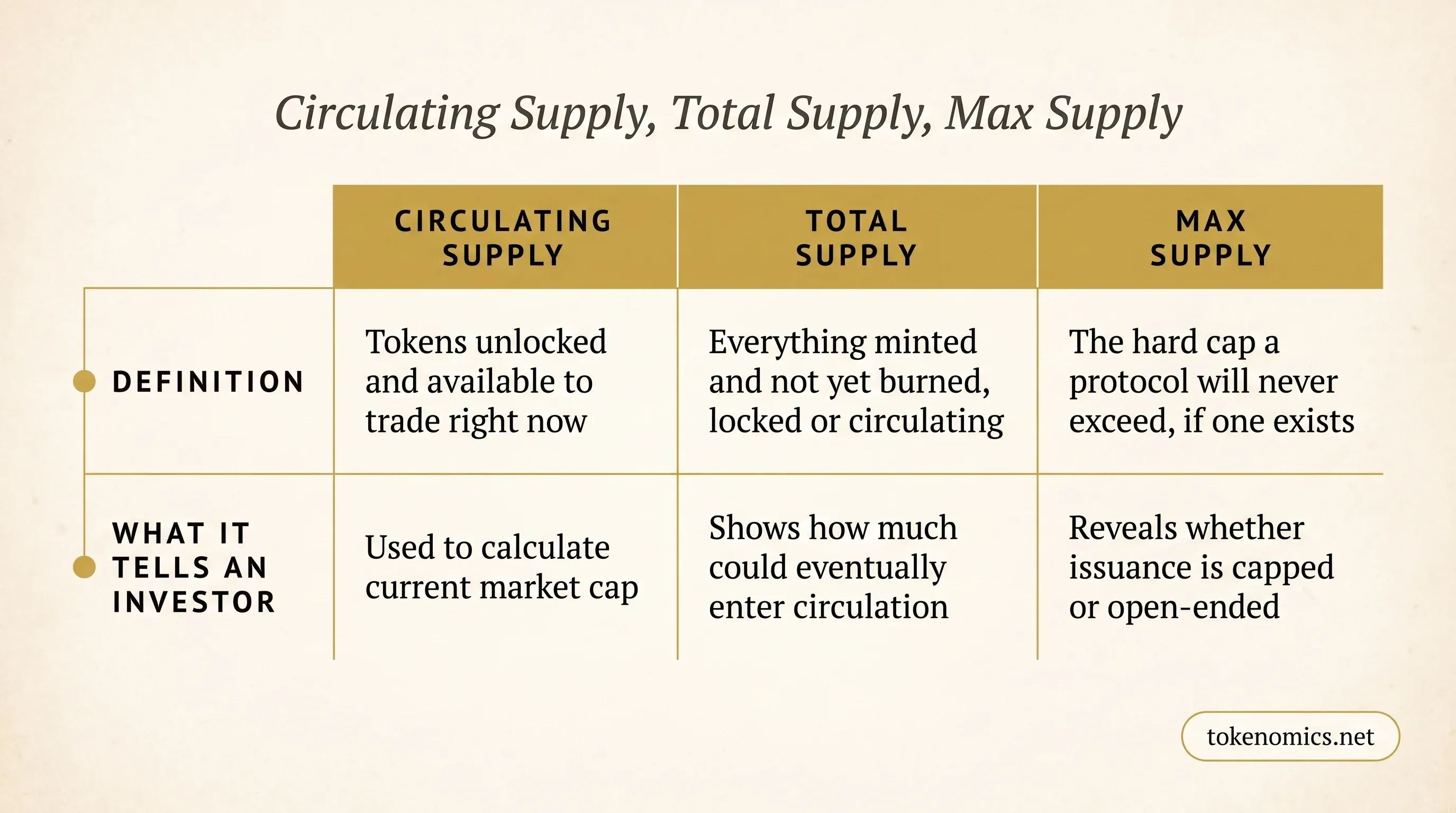
A token's supply numbers are only as meaningful as the business or protocol creating value behind them. Circulating supply is the number of tokens unlocked and available to trade right now. Total supply is every token that currently exists on-chain, minted and not yet burned, whether locked or circulating. Both numbers claim to answer "how much of this token exists," and on most data pages they sit two lines apart with no explanation of why they are different.
That gap, not either number by itself, is what this post is actually about. It reflects how much of the token's eventual supply the underlying business has not yet had to prove it can absorb: does the venture generate enough real usage and revenue to give the still-locked tokens a reason to be worth holding once they unlock, or does the supply schedule outrun what the business actually creates. Understanding circulating supply vs total supply means understanding why the two diverge and what that divergence signals about the token's future.
#The two-number problem on every token page
#Why these numbers rarely match, and why that's normal
Open any token's page on a data aggregator and you will usually see circulating supply and total supply listed as separate figures, often with a third number, max supply, sitting nearby. All three sound like they should be the same thing. They are not, and the mismatch is not a data error or a red flag on its own; it is a reminder that the token sits downstream of the business, and the business is what has to keep creating value as more of the supply unlocks.
A token launch typically reserves allocations for the team, early investors, a treasury, or future ecosystem incentives. Those tokens exist the moment they are minted, so they count toward total supply immediately. But they are usually locked under a vesting schedule and released over months or years, so they do not count toward circulating supply until they actually unlock. The two numbers start apart at launch and only converge over time, if they converge at all.
#What circulating supply means
#The plain-language definition
Circulating supply is the count of tokens that are unlocked, liquid, and could theoretically be bought or sold on the open market right now. This is the number used to calculate market cap: circulating supply multiplied by current price.
#What counts as "circulating" and what doesn't
Circulating supply excludes anything not yet freely tradable. That means vested-but-locked team and investor allocations, tokens burned and removed from existence, and treasury or foundation reserves that have not been released into the market. A token can exist on-chain and still not count as circulating if it is contractually or technically restricted from trading.
This lock-versus-liquid distinction is one of the fundamentals a tokenomics consulting engagement documents before a token ever reaches a live market.
#What total supply means (and how it differs from max supply)
#The plain-language definition
Total supply is everything currently minted and not yet burned, full stop. It does not care whether a token is locked, vested, held in treasury, or freely trading. If it exists on-chain right now, it counts toward total supply.
#Total supply vs max supply, a third term that gets conflated with both
Max supply is a different concept again: it is the hard cap a protocol has committed to never exceeding. Some proof-of-work networks are built around a fixed, hard-capped max supply that the protocol will never issue beyond once fully mined. Other protocols, particularly inflationary designs that mint new tokens indefinitely to fund staking rewards or mining incentives, have no max supply at all. A token can have a circulating supply, a total supply, and still have no max supply, because the protocol never defined a ceiling on how many tokens can eventually exist. Naming all three terms together, in one place, is usually what resolves the confusion a reader arrives with.
#Why the gap between the two numbers is the number that matters
#The gap as a forward-looking sell-pressure signal
A small gap between circulating supply and total supply means most of the token's eventual supply is already trading. Future dilution risk is comparatively low, because there is not much left to unlock. A large gap means a meaningful share of supply is still locked and will eventually enter circulation. That future unlock is a structural sell-pressure event, independent of how strong the underlying project is, because newly-liquid holders now have the option to sell where they did not before.
This matters directly for valuation. Market cap is calculated on circulating supply alone. When the gap between circulating and total supply is large, market cap can understate a token's real, dilution-adjusted size, since a large share of the eventual supply is not yet reflected in that number at all.
#Comparison table: reading the gap correctly
The comparison that matters is not circulating supply against total supply in isolation. It is the ratio between them, expressed as a percentage. A token with 90 percent of its total supply already circulating carries a very different risk profile than a token with 20 percent circulating, even if their market caps look identical today.
For a closer look at how a locked allocation actually releases over time, see reading a token unlock schedule once you understand what the gap represents.
#A worked example: reading the gap on a real token page
#Walking through the math without citing a live, time-sensitive figure
Take an illustrative token, not a real one, with 400 million tokens circulating against a 1 billion total supply. The gap is 600 million tokens, or 60 percent of total supply, still locked and outside circulation. That 60 percent figure, expressed as a percentage of total supply rather than a raw token count, is what makes this comparable to a different token of a different size.
If a second illustrative token shows 900 million circulating against a 1 billion total supply, its gap is only 10 percent. Same total supply, same order of magnitude in circulating tokens on paper, but a materially different amount of future supply still waiting to unlock. This same math is exactly what a rigorous read of an unlock schedule builds on: the schedule tells you when that remaining percentage becomes circulating, not just how large it currently is.
If you are building your own token's supply schedule rather than evaluating someone else's, modeling supply under stress walks through the same mechanics from the design side.
#Common mistakes when comparing supply figures across projects
#Comparing market cap across tokens without checking the gap first
Comparing two tokens' market caps without first checking their circulating-to-total ratios produces a misleading, apples-to-oranges comparison. A token with 90 percent of its supply already circulating and a token with 20 percent circulating can show similar market caps today while carrying very different amounts of future dilution baked in.
#Treating a low circulating supply as automatically bullish
A low circulating-to-total ratio is not automatically a bad sign, and it is not automatically a good one either. It is a flag to go check the unlock schedule before assuming the current price reflects where the token will eventually settle once the rest of the supply enters circulation. Whether that unlock schedule is a problem depends on the pace and size of future unlocks, not on the ratio alone.
#Where to check accurate, live supply data
#Why a static blog post is the wrong place to look up today's number
Circulating and total supply figures change as tokens unlock, burn, or get minted, so any specific number in a published post is stale within weeks. For a current read, use a live on-chain explorer or a data aggregator that pulls directly from the protocol's contracts, not a cached figure repeated across secondary sources. Treat these as reference and tracking tools rather than as endorsements of any specific token they display.
If you are a founder trying to get your own project's supply figures investor-ready before a raise or a listing, a tokenomics audit is a lower-commitment way to get an independent read on where your current numbers and schedule stand.
Circulating supply vs total supply is a definitional question with a practical payoff: the gap between them is what tells you whether a token's current valuation reflects most of its eventual reality or only a fraction of it, and whether the business behind the token is creating enough value to justify what is still to come. If you are a founder who needs your own supply figures documented and investor-ready rather than just evaluating someone else's, book a strategy call to walk through where your numbers currently stand.