Protocol Owned Liquidity: How It Works
A mechanism-level guide to protocol owned liquidity: what it is, how the bonding mechanism works, its trade-offs, and when it fits a protocol launch.


Protocol owned liquidity is when a protocol's own treasury holds the liquidity provider tokens for its trading pairs, instead of renting that depth from external market makers or liquidity mining programs. The protocol typically acquires this liquidity through a bonding mechanism, and it depends on the protocol already generating real revenue to sustain the program over time.
If you are designing a token model and trying to decide whether to bootstrap liquidity through emissions or through a treasury-owned position, this is the mechanism-level explanation to read before you decide. No pitch, just how the thing actually works and what it costs.
#What protocol owned liquidity means
Protocol owned liquidity, often shortened to POL, is when a protocol's treasury holds the LP tokens for its own trading pairs directly, rather than renting that liquidity from external depositors chasing a yield. That single distinction, ownership versus rental, is what separates POL from the liquidity mining model most token holders already recognize: pay depositors in your own token to sit in a pool, and hope they stay.
The rest of this post works from that contrast: how POL is acquired, what it costs, and when it makes sense, all trace back to the treasury holding the asset instead of a rotating pool of yield farmers.
Protocol owned liquidity, defined: A protocol's treasury permanently holds the LP tokens for its own trading pairs, typically acquired through a bonding mechanism, instead of renting that liquidity from depositors who can exit at any time.
#The rented liquidity problem POL was built to solve
#Why liquidity mining creates a treadmill, not an asset
Liquidity mining pays depositors in the protocol's own token to sit in a pool and provide depth. It is a rental agreement, not a purchase. The protocol never ends up owning the liquidity it is paying for, and every emission that goes out the door dilutes the token supply a little further in exchange for depth the protocol has no lasting claim on.
#What happens when the emissions stop
The depositors behind that liquidity are frequently described as mercenary capital, and the label fits. Yield is the only reason they are there, and the moment a higher-yield farm opens up somewhere else, the capital moves. When emissions slow down or stop, the liquidity that was propping up the trading pair often leaves with them, sometimes within a single transaction. The protocol is left holding an expanded token supply and a pool that is shallower than it was when the program started.
Protocol owned liquidity is a direct structural response to this specific failure mode, not a generic upgrade layered on top of liquidity mining. It exists because renting depth turned out to be an expensive way to never actually own any.
For a deeper walkthrough of how these liquidity decisions fit into the broader token model, see our Tokenomics Design service.
#How the protocol owned liquidity mechanism works
#The bonding mechanism (discount for LP tokens, not cash)
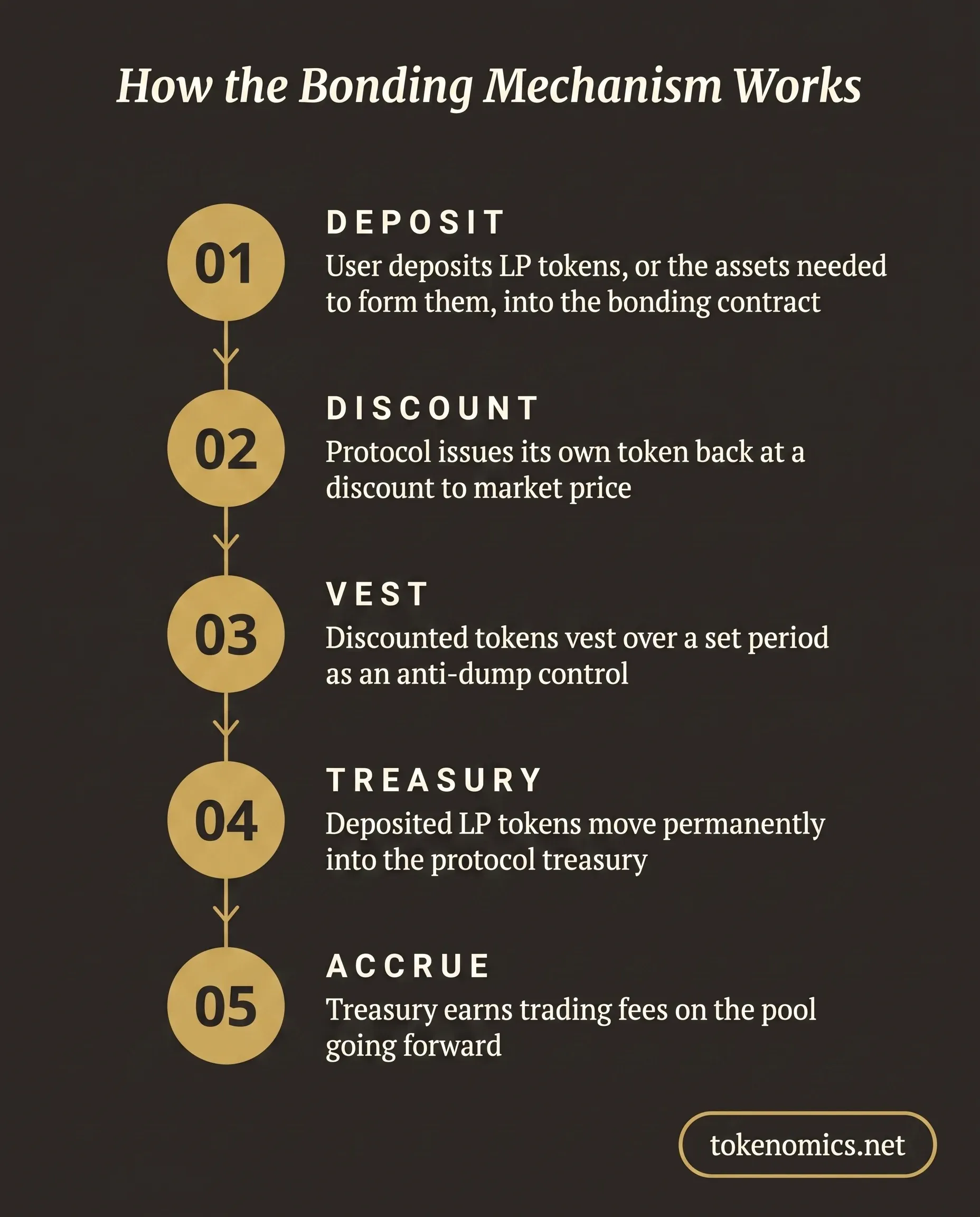
Most protocols acquire protocol owned liquidity through bonding. Instead of buying the protocol's token on the open market, a user deposits LP tokens, or the paired assets needed to form them, and receives the protocol's token back at a discount to the current market price. The discount is the incentive. It is what makes bonding attractive relative to buying on an exchange.
#Vesting and treasury accrual
The LP tokens a bonder deposits move into the protocol's treasury, where they stay. That is the mechanism in one sentence: the treasury now owns liquidity it previously had to rent. The discounted tokens issued to the bonder vest over a set period rather than unlocking all at once, which is the mechanism's built-in anti-dump control. Once the liquidity sits in the treasury, trading fees on that pair accrue to the protocol directly, not to a rotating cast of transient farmers.
#Protocol owned liquidity versus traditional liquidity mining
#What each model actually costs the protocol
Neither model is free. Liquidity mining costs continuous token emissions, paid out for as long as the protocol wants the liquidity to stay in place, with nothing durable left over when the payments end. Protocol owned liquidity costs an upfront discount plus the dilution that comes with each bond, concentrated at the moment the bond is issued rather than spread across an indefinite emissions schedule.
#What each model gives back
The difference shows up in what remains after the incentive period. Liquidity mining leaves the protocol with whatever liquidity happens to still be there, which can evaporate in a single transaction the moment yields fall behind a competing pool. Protocol owned liquidity converts into a permanent treasury asset. It keeps earning trading fees long after the bonding program that acquired it has wound down, and it cannot leave the pool unless the protocol itself chooses to unwind the position.
That distinction between temporary rental and permanent ownership is really a liquidity design decision inside the broader token distribution model, not a separate program bolted on afterward.
#The risks and trade-offs of owning your own liquidity
#Treasury concentration and single-asset exposure
Owning your own liquidity is not free of risk simply because it is not rented. A treasury that holds mostly its own token, paired against a single other asset, is concentrated exposure, not a diversified reserve. If the paired asset or the protocol's own token moves sharply, the treasury's balance sheet moves with it in a way a more diversified reserve would not.
#The failure mode a bonding program can create
Read bonding purely as a mechanism, rather than through any one protocol's history. The structural point is this: a bonding rate set faster than the protocol's actual revenue can support creates sell pressure the treasury was never sized to absorb. That is a statement about mechanism design, not a comment on any project's current token value or standing.
#When protocol owned liquidity makes sense for a launch
#The revenue-generation prerequisite
POL suits protocols that already generate, or can credibly project, real revenue or fee flow. That revenue is what justifies the bonding discount over time. It is what eventually pays the treasury back for the dilution each bond costs at the moment it is issued.
#Signals a founder should check before adopting POL
It is a weaker fit for a pre-revenue protocol whose only real source of value is the token itself. Bonding against nothing but speculative demand for that token tends to recreate the same treadmill POL was built to escape, just with a different mechanism underneath it. Before adopting POL, a founder should check whether the protocol can sustain a bonding program through a full market cycle, not only through the enthusiasm of a launch window.
If you are not sure whether your protocol clears that bar, our Tokenomics Audit service is built to answer exactly that question before you commit treasury capital to a bonding program.
#Designing a POL model: the core parameters to set
#Discount rate, vesting length, and treasury allocation target
Three levers sit in a founder's control here. The bond discount rate sets how much value is given up per bond. The vesting schedule sets how quickly the resulting dilution can reach the open market. The target percentage of total liquidity the treasury aims to own outright sets the pace of the whole program. These levers interact with the protocol's broader vesting and distribution design, so they should be modeled together, not bolted onto a liquidity strategy after the fact. Getting protocol owned liquidity right is a design problem that spans the entire token model, not a single parameter to tune in isolation.
For a closer look at how vesting schedules are typically structured across team, investor, and bonding allocations, see token vesting design.
Book a strategy call to walk through the specifics with our team.
If you are modeling a protocol owned liquidity design against your own revenue projections and want a second opinion on the discount rate, vesting length, or treasury allocation target before you commit to a bonding program, that is a conversation worth having before launch, not after.