How to Read a Token Unlock Schedule: Circulating Supply and Cliff Walls
A token unlock schedule is the timeline that moves locked tokens into circulating supply. Here is how to read cliff walls, float, and sell pressure.


A token unlock schedule is the fixed timeline that moves locked tokens into circulating supply, one release at a time. This post reads one from the investor's seat: cliff walls, the gap between circulating and total supply, how unlocks feed sell pressure, and how to evaluate a schedule you did not design.
A token unlock schedule is the predetermined timeline that governs when locked tokens, held by teams, investors, treasuries, or other early stakeholders, become transferable and enter circulating supply. It is a supply-release mechanism, not a price chart and not a roadmap. It tells you when new tokens arrive, not what the market will do when they get there.
This post is written for the investor or analyst reading someone else's schedule, not the founder building one. It covers three parts in order: cliff and continuous unlock mechanics, the difference between circulating supply, total supply, and fully diluted valuation, and how scheduled unlocks translate into sell pressure and effective sellable float.
Here is the part that gets skipped. An unlock schedule is a supply-side variable, and it interacts with whatever the underlying business actually does. A token can carry a clean schedule and still fail with no value engine underneath it. A messy schedule can be absorbed if the business creates enough real demand. The schedule is infrastructure. The business is the engine.
#What Is a Token Unlock Schedule? (Direct Answer)
A token unlock schedule is the predetermined timeline that governs when locked tokens, held by teams, investors, treasuries, or other early stakeholders, become transferable and enter circulating supply.
Two words in that definition do real work. Predetermined means the schedule is set at or before the token generation event, usually written into smart contracts and disclosed in the project's documentation. Transferable means the tokens can actually move, be sold, staked, or sent, rather than sitting frozen in a vesting contract.
This matters because the schedule is one of the few forward-looking, knowable facts about a token's supply. Price is a forecast. Demand is a forecast. The token unlock schedule is written down, and you can read it before you commit capital.
For the compact reference-card version, our token unlock glossary entry covers the term on its own.
#Cliff vs. Linear Unlocks: Understanding the Cliff Wall
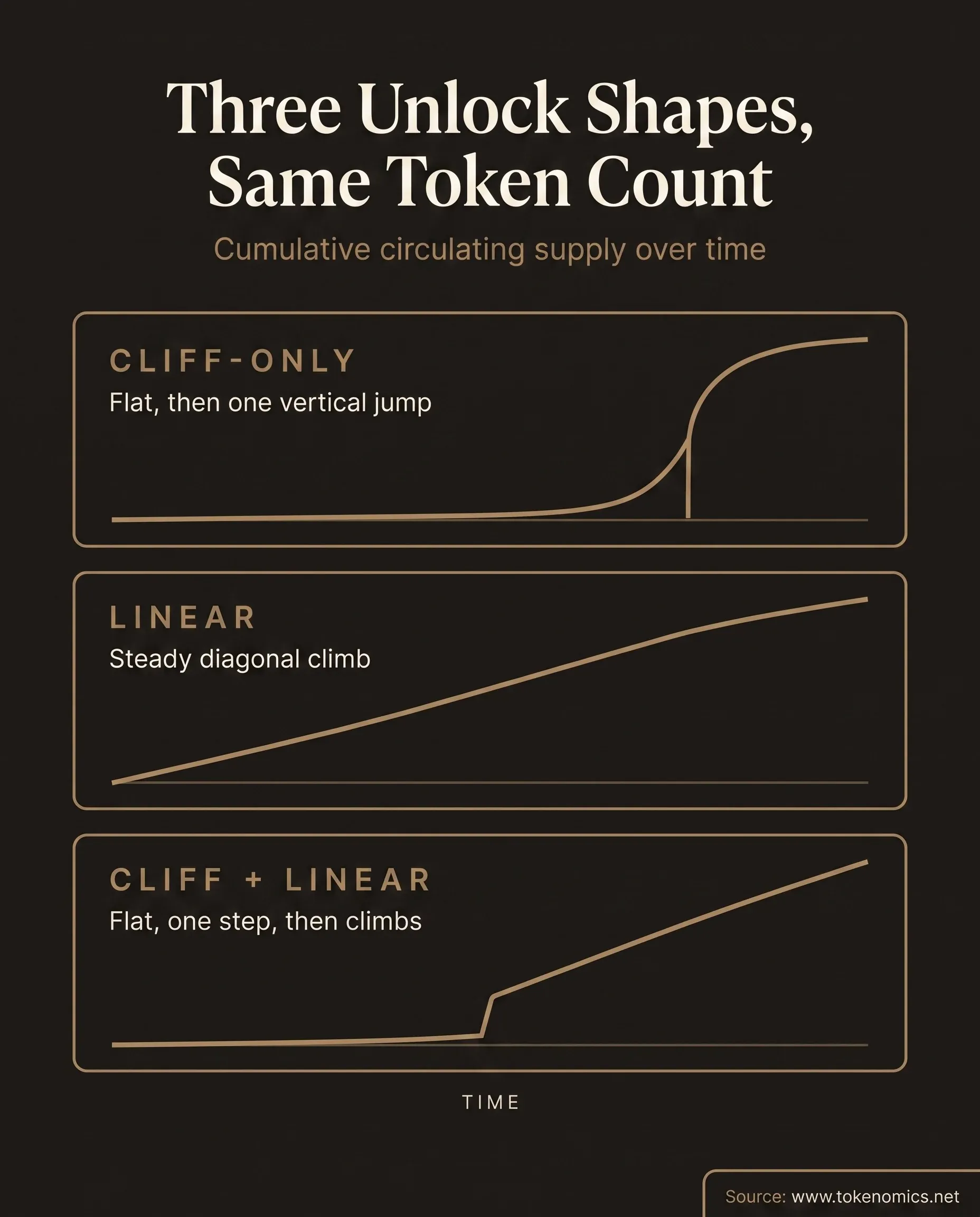
Two shapes cover the bulk of what you will see, and they behave differently even when they release the same number of tokens.
#What a cliff unlock does
A cliff unlock is a period with zero token releases followed by a single large release on a fixed date. The common pattern for team and investor allocations is a one-year cliff: nothing unlocks for twelve months after the token generation event, then a substantial block becomes transferable at once.
That single-date event is what the market calls a cliff wall. The same quantity of tokens a gradual schedule would drip out over months arrives in one moment. A cliff wall changes the sell-pressure profile of a release even when the total token count is identical to a gradual schedule.
#What a linear (continuous) unlock does
A linear or continuous unlock releases tokens incrementally, often daily, weekly, or monthly, across a defined vesting window. Many schedules combine the two: an initial cliff, then linear vesting after it. The market absorbs a linear release in small pieces, which spreads any selling across time rather than compressing it into one date.
On the contract side, audited vesting patterns in this category, like OpenZeppelin's vesting contracts, typically implement both shapes programmatically: a cliff timestamp before which nothing is claimable, then a release curve that vests tokens over time. Naming the pattern says nothing about any specific token's contract.
The tradeoff: a cliff wall concentrates the supply event on one date, which makes it visible in advance. A linear release smooths the supply impact but runs quietly across the whole window. Neither shape is good or bad on its own. What matters is the size of the release relative to the supply already trading.
For the standalone definition, our cliff wall glossary entry covers the term where it lives on its own.
#Circulating Supply vs. Total Supply vs. Fully Diluted Valuation
The circulating supply vs total supply distinction is where a lot of investors misread a token, and fully diluted valuation is the number that ties the two together.
Circulating supply is the count of tokens currently transferable and trading in the open market. Total supply is every token that currently exists, including the locked and unvested tokens sitting in vesting contracts. Fully diluted valuation, or FDV, is what the market capitalization would be if every token that will ever exist, per the maximum supply, were circulating today at the current price.
These figures trace back to the token contract itself. The ERC-20 token standard, defined in its Ethereum Improvement Proposal, exposes a totalSupply function and a balanceOf function, and the supply figures you see are typically computed from those on-chain values. That is a statement about how the standard works, not a claim about any token's classification or compliance status.
Here is why the ratio matters. A token can launch with a small fraction of its total supply circulating and a large FDV built on tokens still locked. That gap is what future unlocks draw down over time. A low circulating-to-FDV ratio at launch is a structural signal worth understanding, not a buy or sell trigger, and it carries no forward price.
#How Unlocks Translate to Sell Pressure and Effective Sellable Float
The question every analyst asks is token unlock impact on price. The honest answer: unlocks do not set price on their own. An unlock changes the supply side of the equation, and what happens next depends on demand, liquidity depth, and market conditions on the day the tokens land.
Raw circulating supply is a blunt instrument here, so use a sharper metric. Effective sellable float is the portion of circulating supply that is realistically liquid and available to sell at a given moment. It nets out exchange-held reserves, long-term holder wallets, protocol-owned liquidity, and tokens that are technically unlocked but not actually for sale. Two tokens can report the same circulating supply and carry a materially different sellable float.
Concentrated supply releases are recognized outside crypto too. A comparable dynamic in traditional markets is the lockup and resale treatment under the SEC's Rule 144, which governs when restricted securities can be resold after an offering. It is a structural analogy for why a jump in sellable supply draws attention, not a claim that any token unlock is legally equivalent to a Rule 144 event or that a given token is or is not a security.
The mechanism is easy to state and hard to predict. More sellable supply entering the market at once, absent offsetting demand, has historically correlated with price pressure around large unlock dates. That is an observation about supply mechanics, not a forecast for any specific token, and no percentage or directional call belongs here.
For the term on its own, our effective sellable float glossary entry defines it in isolation. If you are approaching this from the other side, as a founder shaping the release curve rather than reading one, our guide to designing a vesting schedule covers that angle.
#How to Evaluate a Token's Unlock Schedule as an Investor
Reading a schedule is one thing. Evaluating it is another. An analyst looking at a token they do not control works through a short, repeatable set of questions.
#Where to find the data
Start with the raw schedule. Some projects publish their own unlock calendar and vesting terms. Others require you to reconstruct it from the token contract and third-party trackers. DefiLlama's unlocks data is one public source analysts use to track scheduled unlocks and circulating-supply changes across many tokens. Use it as a data-access point, not a verdict on what the data implies.
#Red flags worth flagging, not verdicts to render
A few factors are worth weighing before drawing any conclusion. None is a signal to act. Each is a question to answer.
Upcoming cliff size relative to circulating supply. A cliff that adds a large percentage to the tokens already trading is a bigger supply event than the same count against a deep float. An analyst reviewing this pattern would want to understand how the cliff interacts with current liquidity depth before drawing a conclusion.
Circulating supply to FDV ratio. A small circulating supply against a large FDV means the bulk of supply is still ahead of the market, a structural setup to understand rather than a judgment.
Wallet concentration of unlocking tokens. Tokens unlocking into a handful of team or investor wallets behave differently from tokens vesting to a broad community. Concentration is a factor to weigh, not a red card.
Schedule transparency. A project that publishes its schedule plainly is easier to evaluate than one that requires third-party reconstruction, worth understanding before you act rather than a verdict in itself.
Close the loop back to value creation. An unlock schedule is a supply mechanic layered on top of whatever the protocol actually does. A clean schedule attached to a business with no real usage is not a safer bet. It is the same underlying risk with tidier bookkeeping.
Supply is the one part of a token's future you can read before you commit. The token unlock schedule is written down, and the investors who read it carefully price in supply events others discover on the day they land. That edge is available to anyone willing to do the reading.
If you're building onchain and need your token allocation and vesting work to hold up under institutional scrutiny, book a strategy call. We'll assess your project and tell you whether we're the right fit. Sometimes we're not. We'll tell you that too.