Token Burn Mechanisms: When Burning Supply Creates Value
A token burn permanently removes coins from supply. Here is how burns work, buyback-and-burn versus fee burn, and when cutting supply creates value.


A token burn permanently removes coins from circulation by sending them to an address no one holds the keys to, or by calling a burn function that reduces total supply. Burning raises value only when the reduction is tied to real demand or protocol revenue, so the same tokens meet genuine buying interest against a smaller float. A burn with no demand behind it changes the supply number and little else.
Token burns are one of the more misread mechanics in tokenomics. A project announces that it destroyed a few million tokens, the community reads it as bullish, and the price does whatever it was going to do anyway. The gap between the announcement and the outcome is the subject of this post.
A burn is a supply lever, not a demand lever. It can make a token model tighter, and it can make one look tighter without changing anything real. The difference is mechanism: which burn method a project uses, what funds it, and whether the demand side pulls the same way. Below: how burns work, the main mechanisms, the buyback-and-burn versus fee-burn split, and when cutting supply accrues value.
#What Is a Token Burn?
Token burn: the permanent removal of tokens from circulating supply, executed by sending them to an unspendable address or calling a burn function that reduces the total supply figure on-chain.
A token burn is the deliberate destruction of coins so they can no longer move or be sold. Because the reduction is recorded on-chain, anyone can verify that the tokens left circulation rather than moving to a treasury wallet. That verifiability separates a burn from a lockup: a locked token can come back, and a burned token cannot. The glossary covers a token burn in one screen if you want the compact reference.
Burns draw attention because of scarcity. Fewer tokens against the same demand means each remaining token represents a larger share of the network. The catch is in that second clause. The scarcity only matters if the demand side holds.
#How Token Burns Work
There are two common ways to execute a burn. The first sends tokens to a burn address, a wallet with no known private key, often written as a string of zeros or an address ending in "dead." Coins that land there are stranded for good. The second calls a burn function written into the contract, which reduces the holder's balance and the total supply variable in the same transaction. On an ERC-20 token, that function is a standard pattern, so the behavior is predictable and auditable.
Either way, the on-chain result is the same: total supply drops, and the change is public. What neither method does is add buyers. A burn adjusts the denominator. Whether that shows up in price depends on the numerator, which is demand, and a burn touches none of it.
#The Main Token Burn Mechanisms
Burns fall into a few structural categories, and the category tells you more than the headline number does.
Manual or one-off burns. A team destroys a fixed batch of tokens, often unsold allocation from a sale or a scheduled reduction. These are discrete events, announced and then finished. They tighten supply once and do nothing on their own afterward.
Buyback-and-burn. The protocol uses revenue to run a buyback of its own token on the open market, then burns what it bought. This ties the reduction to a funding source and to real buy pressure, because the buyback itself is a purchase. Revenue funds the burn.
Transaction-fee burns. A slice of every transaction fee is destroyed automatically as the network is used. The reduction scales with activity rather than a team decision, which makes it continuous and usage-linked instead of episodic.
The pattern is consistent: the further a burn sits from real economic activity, the more it leans on narrative. Manual burns lean hardest on the announcement. Usage-linked burns lean on the network being used.
#Buyback-and-Burn vs. Fee Burn
This is the comparison that decides whether a burn is structural or cosmetic. Both destroy supply, but they answer to different forces.
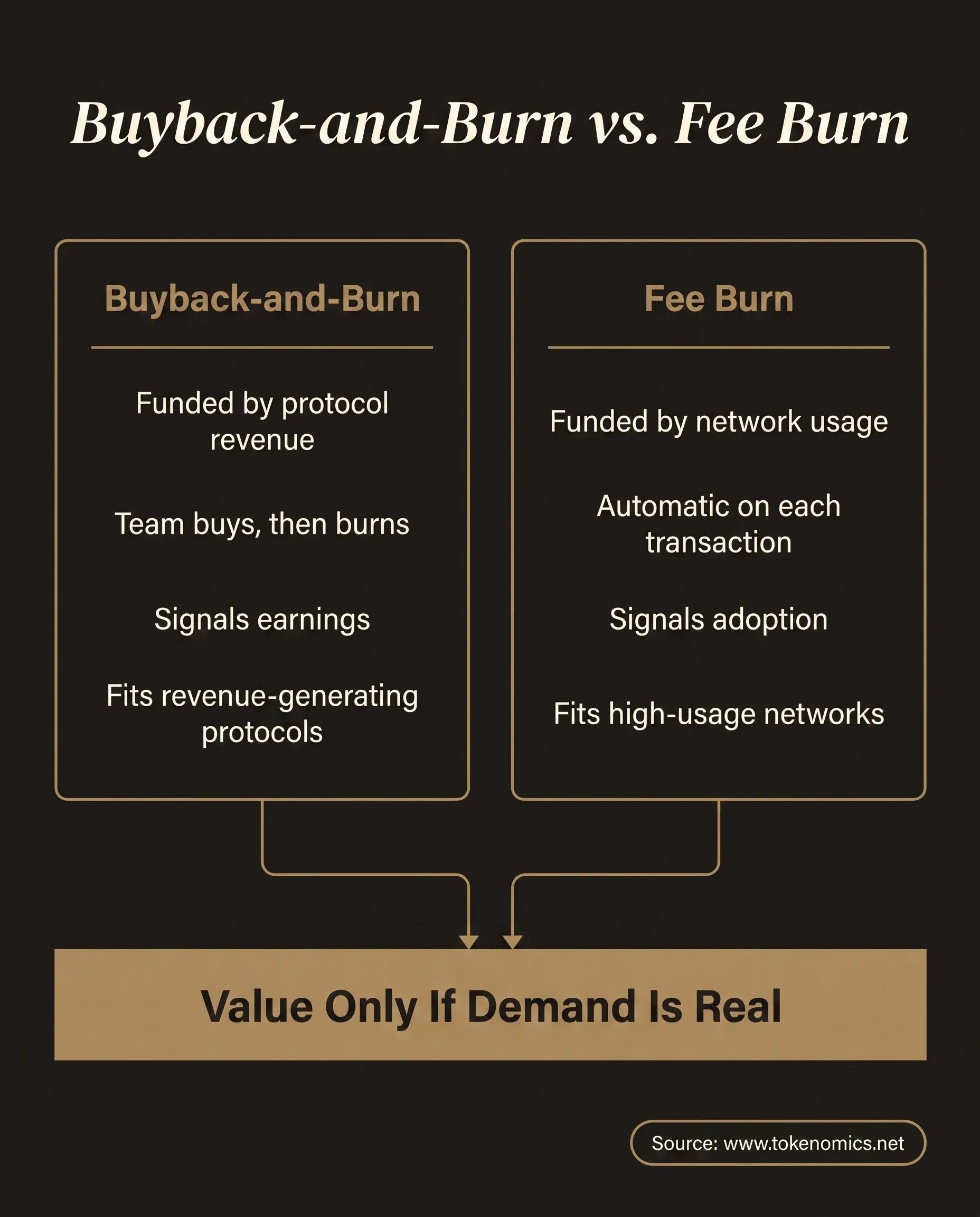
A buyback-and-burn is funded by protocol revenue. The team collects fees or income, spends it buying the token, and burns the result. The burn is a downstream signal that the protocol earns something and returns part of it by reducing supply. It resembles a corporate share buyback in shape, and it stops the moment revenue stops.
A fee burn is funded by usage. Ethereum's EIP-1559 is the reference case: a base fee is charged on every transaction and destroyed rather than paid to validators, a design Ethereum's gas documentation lays out in detail. The reduction rises and falls with demand for blockspace, so heavy use burns more and quiet periods burn less. No team decision sits in the loop.
The practical read: a buyback-and-burn signals earnings, and a fee burn signals adoption. Neither creates value by itself, but both attach the burn to something a reader can verify.
#When Burning Supply Creates Value
Here is the condition, stated plainly. A burn creates value when the supply reduction is paired with demand that would exist regardless of the burn. Revenue-funded buyback-and-burn works because the revenue and the buying are real; fee burns work because the usage is real. In both cases the burn is a consequence of economic activity, not a substitute for it.
Value per token is demand meeting supply. Cutting supply moves the ratio in a holder's favor only if demand stays put or grows. When a protocol earns, buys, and burns, the buying and the burning push the same way at once, and the burn is doing arithmetic on a base that is already sound.
#When a Burn Is Just Theater
The failure mode is a burn detached from demand. A team with no revenue and flat usage destroys tokens to produce a headline. Supply drops, the total-supply chart looks disciplined, and nothing changes underneath because no new buyer arrived and no economic engine funded the reduction.
Large burns of tokens the team held but did not intend to sell are a frequent version of this. Removing supply that was not going to reach the market does not reduce real sell pressure. It reduces a number. The tell is the funding question: if you cannot name where the burned value came from, the burn is a supply cut without an economic cause, and the market tends to price it as one.
#Does Deflationary Tokenomics Mean a Higher Price?
Deflationary tokenomics, meaning a supply that shrinks over time through burns, is a design choice, not a price outcome. It changes the shape of supply. It does not manufacture demand, and demand is the harder half of the equation to build.
A shrinking supply against rising demand is a strong combination. A shrinking supply against falling demand still falls, and it can fall while the burn keeps running, because the deflation was not the binding constraint. Scarcity amplifies whatever the demand side is already doing; it does not reverse the direction. Treating a deflationary label as a reason to expect appreciation skips the step that actually decides price.
#Where Burns Fit Among Supply Controls
A burn is one instrument in a wider set of supply tools, and it is rarely the right one to use alone. Emission schedules, vesting, staking locks, and burns each shape circulating supply at different points in a token's life. Burns remove supply after issuance; the others govern how and when supply enters. Reading them together is the point of a coherent inflation control mechanisms plan rather than reaching for a burn as a standalone fix.
There is also a demand-side reason burns are not a cure on their own. A token that circulates too fast, changing hands the moment it is received, holds little value regardless of supply. That is the token velocity problem, and no burn schedule solves it. Supply control and demand retention are separate jobs, and a burn only does the first.
#Designing a Burn That Holds Up
A burn that survives scrutiny is designed into the token model, not added as a marketing event once the token is live. That means naming the funding source, defining the trigger, and stress-testing the mechanism against low-revenue and low-usage conditions before it ships. Burn logic belongs in the token model design itself, where it can be simulated against the rest of the economy rather than bolted on later.
One compliance note. A revenue-funded buyback-and-burn can resemble a corporate share buyback in structure, and whether that resemblance carries securities implications for a given token is a determination for your legal counsel and the relevant regulator, such as the SEC, not something a burn schedule settles on its own. Mechanism design and legal classification are separate questions, and a clean design does not answer the second.
A burn is a supply mechanism, and supply is half the equation. Projects that treat a burn as a demand strategy tend to discover the gap when the headline fades and the chart does not move. The teams whose burns hold up funded the reduction with something real and designed the mechanism into the model before launch, not after.
If you are designing a token and want the burn logic to stand up to engineering and investor scrutiny, book a strategy call. We'll assess your model and tell you whether a burn earns its place in it. Sometimes it does not. We'll tell you that too.