The core engagement
Tokenomics Data Room. One engagement.
Mechanism design, supply-side modeling, liquidity analysis, a tokenomics audit, market research, a whitepaper and a launch roadmap, sequenced so each one feeds the next. Four to six weeks.
Sectors we have run it for
RWAs · DePIN · GameFi · Infrastructure · SocialFi · Collectibles · Digital assets · Payments · Identity · Privacy · Prediction markets · Stablecoins · Lending · Borrowing
Definition
What the Data Room is.
The Tokenomics Data Room is the complete tokenomics package: design, documentation and strategy in one engagement.
It gives a founder everything needed to get their house in order, raise capital and launch with confidence: mechanism design, supply-side modeling, liquidity analysis, an audit, market research, a whitepaper and a launch roadmap. It is a proven process, not a la carte consulting.
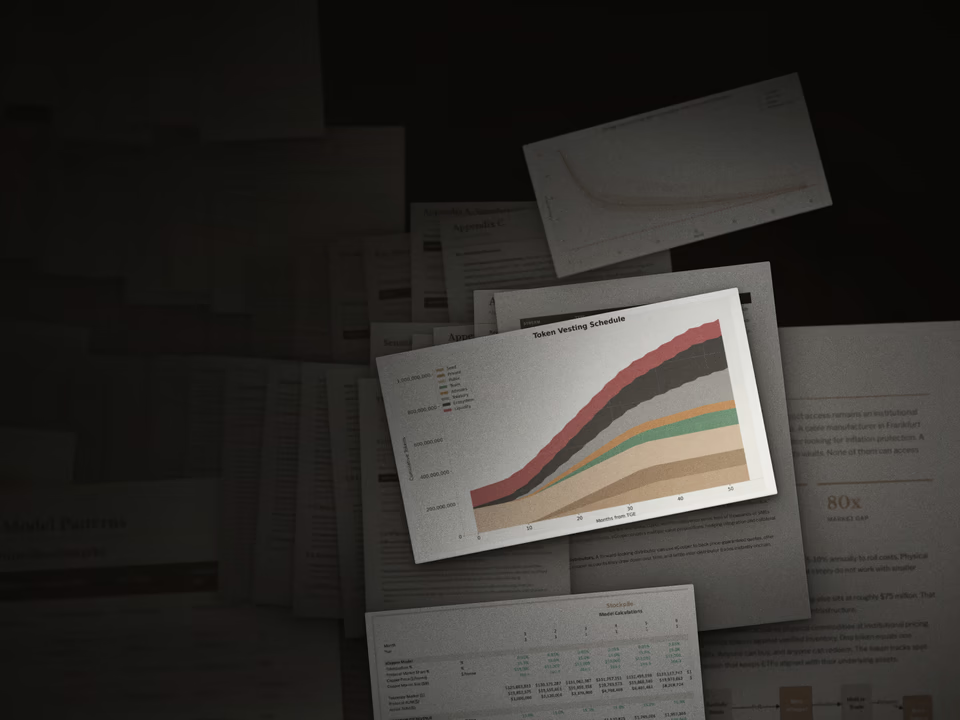
The disciplines are sequenced because each one changes the one after it. Market research reframes the value proposition before mechanism design starts. Mechanism design fixes the architecture the revenue model prices. The token allocation and vesting schedule set the supply the launch plan deploys, and the audit stress-tests that schedule month by month before an investor does. Where the simulation runs, its findings go back into the design.
Bought separately, the pieces do not fit together. That is the problem the Data Room exists to solve, and it is why the engagement is one scope rather than seven purchases.
The framework
Seven disciplines, in the order they run.
Discovery scopes the work, market research reframes the value proposition, mechanism design defines the architecture, and the rest build on that foundation. Each row below names what the discipline produces and what that output feeds.
| Number | Discipline | What it produces | What it feeds |
|---|---|---|---|
| 01 | Discovery | Project charter with named assumptions, exclusions, and an open-questions register | Scopes every discipline that follows |
| 02 | Market research | Market sizing, competitor health tiers, and fee benchmarks | Reframes the value proposition before mechanism design |
| 03 | Mechanism design | The 100-plus-page technical backbone: utility, flywheel, entity, risk | The architecture the revenue model prices |
| 04 | Token allocation and vesting | Full allocation table, vesting schedule, and constraint verification | The supply schedule the launch deploys |
| 05 | Token launch and liquidity | Pool sizing, range design, float stress test, launch sequence | The market-entry plan |
| 06 | Economic simulation | Revenue model plus Monte Carlo stress-testing across ~1,000 paths | Findings that feed back into mechanism design |
| 07 | Tokenomics whitepaper | The investor-ready synthesis of all of the above | The capstone every claim traces back to |
Every discipline ships as a deliverable a stakeholder can use, and each is also a service on its own: tokenomics design, token allocation and vesting, token launch strategy, tokenomics audit and the tokenomics whitepaper. The full scope is on the tokenomics consulting page.
The Tokenomics Data Room
Most tokens fail for predictable reasons. This is the work that prevents it.
- Eight phases. Nine documents. 96 pages previewed here.
- Three tiers, scoped to what the project needs.
- Delivered in a Notion data room, with a guide for each team.
Simulation Results and Simulation Setup · 27 preview pages
The full data room runs to hundreds of pages.
Explore the Data Room1 / 27Total AUM over time
The process
Four phases. Four to six weeks.
Each phase ends in a real artifact, not a status update, and each one is the input the next phase needs.
- 01Week 1
Discovery and research
Kickoff, data collection, and a project charter that names every assumption and exclusion. Market research runs in parallel: segment analysis, competitive landscape, usage metrics, and fundraising comparables.
Ends in the project charter - 02Weeks 1 to 2
Mechanism design
Business model analysis, revenue stream mapping, token role definition, demand mechanics, and the economic flywheel, with initial process maps and documentation.
Ends in the mechanism design document - 03Weeks 3 to 4
Supply side and modeling
Fundraising setup, allocation design, vesting and cliff structures, the full tokenomics audit, and revenue and economic modeling for Platinum and Diamond tiers.
Ends in the tokenomics audit report - 04Weeks 5 to 6
Documentation and delivery
Whitepaper production, two rounds of revisions, light branding, and final delivery in Google Doc and PDF formats, plus the Prep, Launch and Scale roadmap.
Ends in the whitepaper
Packages
Three tiers. One scope conversation.
Gold is the complete core package for a professional token issuance. Platinum adds one of two add-on packages. Diamond adds both. We quote on a call once we know the asset, the raise and the jurisdiction.
| Deliverable | GoldThe complete core package | PlatinumGold plus one add-onMost popular | DiamondGold plus both add-ons |
|---|---|---|---|
| Token design | |||
| Mechanism design | Included in Gold | Included in Platinum | Included in Diamond |
| Supply-side spreadsheet | Included in Gold | Included in Platinum | Included in Diamond |
| DEX budget and analysis | Included in Gold | Included in Platinum | Included in Diamond |
| Tokenomics audit report | Included in Gold | Included in Platinum | Included in Diamond |
| Documentation | |||
| Market research reports | Included in Gold | Included in Platinum | Included in Diamond |
| Tokenomics whitepaper | Included in Gold | Included in Platinum | Included in Diamond |
| Launch roadmap | Included in Gold | Included in Platinum | Included in Diamond |
| Handoff guides | Included in Gold | Included in Platinum | Included in Diamond |
| Add-on packages | |||
| Business model design and revenue model spreadsheet | Not included in Gold | One of the two | Included in Diamond |
| Monte Carlo simulations and simulation report | Not included in Gold | One of the two | Included in Diamond |
Platinum's choose-one add-on is the natural upgrade path to Diamond, for projects that need maximum rigor and defensibility.
What you receive
Working files, not a slide deck.
Every deliverable is built to be used. Formulas stay visible, source files stay editable, and the specs are ones your developers can build from.
- The data roomA Notion workspace holding everything below, with a handoff guide written for each team.
- Tokenomics whitepaperGoogle Doc and PDF, after two rounds of revisions, with light branding.
- Supply-side and revenue model spreadsheetsEvery formula visible and editable. Run your own scenarios and stress tests.
- Process mapsDiagrams of how each mechanism works and how value flows through the system, with editable source files.
- Smart contract specsPseudocode for implementation. Your developers build directly from it.
- Fee calculationsFee structures with their calculation methods, so your team can verify them.
- Tokenomics audit reportFourteen or more quantitative analyses, each with charts, insights and a severity-rated risk table.
- Market researchMarket sizing, competitor health tiers and fee benchmarks.
- Prep, Launch and Scale roadmapThe sequence from today to a live market, with the work each stage requires.
- Simulation report and simulator codeThe results report plus the GitHub repository with the simulator. Diamond, and Platinum with the simulations add-on.
In their words.
Tony is a world expert in tokenomics. His involvement was a game-changer for us.
Bruno Calabretta, DFINANCE His knowledge in Blockchain and Tokenomics is top notch. The leader you want on your team.
Pratik Kadam, Beezie We have used Tony for multiple services. A highly trustworthy and respected expert.
Damien Dau, FX1 He went well beyond the brief. A standout contributor to our ecosystem design.
Jordan Myers, EcoYield
Frequently asked
Common questions.
Scope, timing, tiers and what arrives at the end. Anything else, ask on the call.
What is included in the Tokenomics Data Room?
The Gold tier includes mechanism design, a supply-side spreadsheet, DEX budget and analysis, a tokenomics audit, market research, the whitepaper, a prep-launch-scale roadmap, and handoff guides. Platinum adds the client's choice of one add-on package. Diamond adds both add-ons: business model design with a revenue spreadsheet, and Monte Carlo simulations with a results report.
How long does the Data Room take?
Four to six weeks across four phases: discovery and research, mechanism design, supply side and modeling, then documentation and delivery. The timeline is built around the disciplines feeding each other in sequence, which is faster than separate teams waiting on each other to hand off piecemeal work.
How much does the Data Room cost?
Three tiers, Gold, Platinum and Diamond, scoped to what the project needs. We quote on a call once we know the asset, the raise and the jurisdiction. A bad tokenomics decision costs orders of magnitude more than the engagement, and projects that push hard on price are usually not a good fit for the work.
What is the difference between the Gold, Platinum, and Diamond tiers?
Gold is the complete core package for a professional token issuance. Platinum is Gold plus one add-on, either the business model package or the simulations package. Diamond is Gold plus both add-ons, for projects that need maximum rigor and defensibility. Platinum's choose-one mechanic creates a natural upgrade path to Diamond.
Who is the Data Room for?
Founders and business leaders building onchain who need complete tokenomics from scratch: typically preparing for a fundraise, planning a launch in the next 3 to 12 months, building something real rather than a speculation play, and ready to do it properly. It is not for pure speculation plays or teams looking for hype mechanics.
Why is it one package instead of buying the pieces separately?
Because the disciplines depend on each other. Market research reframes the value proposition before mechanism design starts. Mechanism design defines the architecture the revenue model prices. The simulation feeds findings back into the design. Buying the pieces separately means they do not fit together, which is the exact problem the Data Room solves.
What does the tokenomics audit cover?
The audit runs fourteen or more distinct quantitative analyses, each with charts, insights, and a severity-rated risk table. It models the vesting schedule month by month, flags cliff walls, separates the headline TGE unlock from the realistic float, computes the monthly buy pressure required to hold launch price, and models liquidity depth across trade sizes. Every recommendation ties back to the analysis that produced it.
What do I actually receive at the end?
A complete data room delivered as a Notion workspace, with the whitepaper in Google Doc and PDF, the supply-side and revenue spreadsheets, process maps with editable source files, the audit report, market research, the roadmap, and handoff guides for each team. Diamond and Platinum Option B clients also receive the simulation report and the GitHub repository with the simulator code.
Get your house in order before you go to market.
A discovery call with Tony. We assess the project, the goals and whether we are the right fit. No pressure, no commitment.
