DeFi Tokenomics: Four Mechanism Levers That Decide Protocol Value
DeFi tokenomics turns on four levers: liquidity incentives, governance architecture, fee routing, and token utility. Here is how each works.


DeFi tokenomics is the discipline of designing token incentives for protocols where the underlying product is financial infrastructure: lending markets, DEXes, stablecoin issuers, and restaking networks. Unlike general tokenomics, DeFi token design has a distinct set of constraints because the protocol's revenue, liquidity, and user behavior are all expressed onchain, in real time, and visible to anyone. This post breaks down the four mechanism levers that determine whether a DeFi protocol captures value or destroys it, and the failure patterns we see most often when those levers are designed backwards.
DeFi tokenomics is not a subset of tokenomics. It is its own design discipline with its own failure modes.
General tokenomics covers how a project structures supply, distribution, and incentives for a token-enabled product. DeFi tokenomics does all of that, but with one additional constraint: every mechanism is exposed to real-time market arbitrage. If your liquidity incentives are miscalibrated, the market tells you the same day. If your fee routing creates a governance conflict, the governance forum tells you within weeks. There is no soft landing in DeFi. The protocol works or it does not, and the token tells you which.
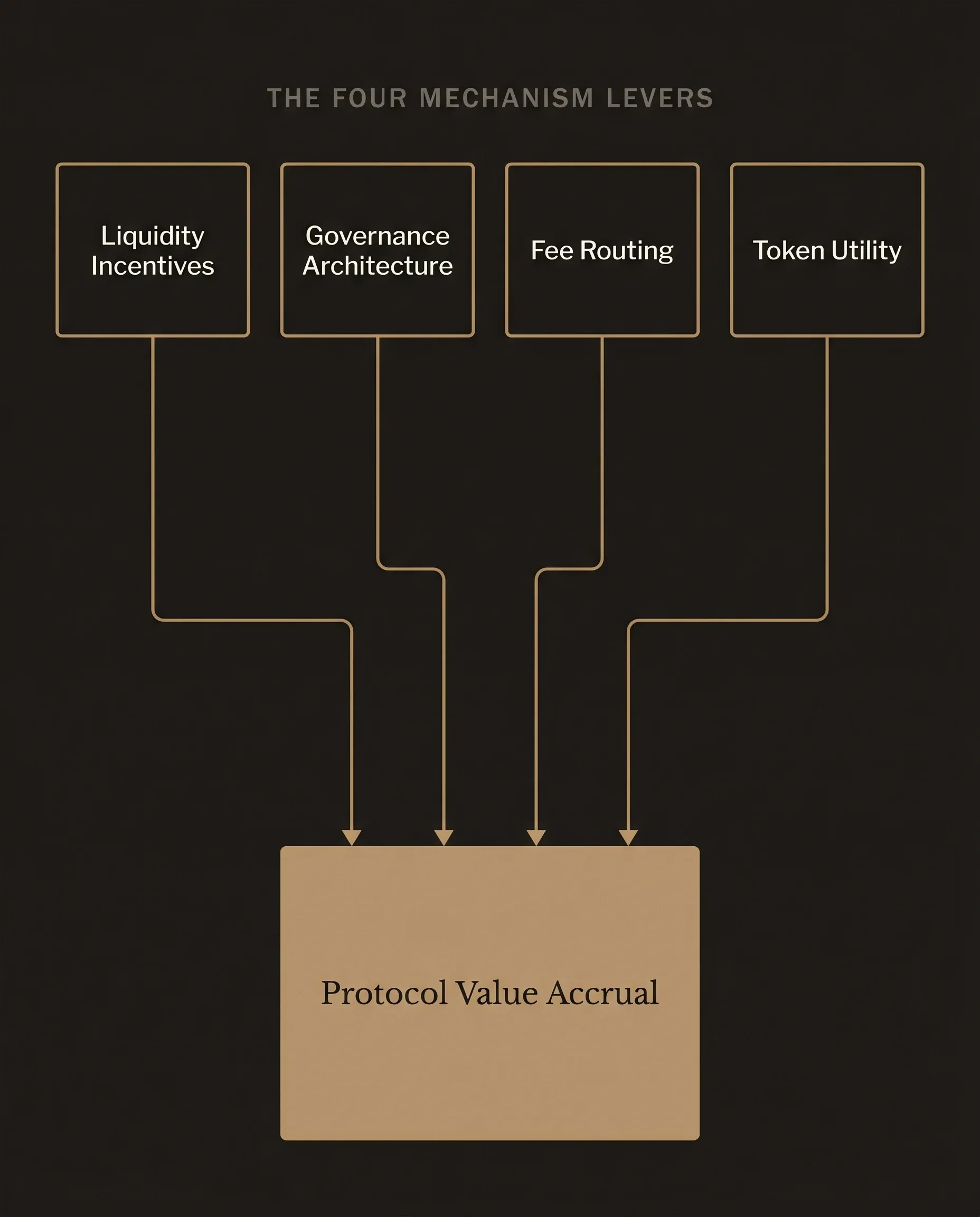
Four mechanism levers determine whether a DeFi protocol builds or destroys value: liquidity incentives, governance architecture, fee routing, and token utility. Get one wrong and the others cannot compensate. We've designed tokenomics across our engagements, and the failure patterns are consistent. Here is what they are and how to avoid them.
#What DeFi tokenomics is (and why it is not the same as tokenomics)
DeFi tokenomics: The design of token incentives for protocols where the product is financial infrastructure (liquidity provision, lending, stablecoin issuance, or restaking), and where protocol revenue, user behavior, and token mechanics interact onchain in real time.
That distinction matters for how you design. A consumer app token can tolerate some design ambiguity because user behavior is soft and slow to move. A DeFi protocol token cannot. Liquidity is purely mercenary. It goes where yield is. If your token mechanics don't anchor in real protocol economics, liquidity leaves and the mechanism unwinds.
The Four Levers framework is how we approach DeFi mechanism design in our engagements. The levers are not independent. Liquidity incentives determine who provides capital. Governance architecture determines who controls how fees are set. Fee routing determines who captures the protocol's revenue. Token utility determines whether any of those parties have a structural reason to hold the token. Design them sequentially, because each lever constrains the design space of the next.
Underneath the four levers sits a taxonomy of concrete mechanism types. Most DeFi tokenomics designs assemble some combination of these five. The taxonomy is worth naming because each mechanism carries its own failure mode.
| # | Mechanism type | What it does | Primary failure mode |
|---|---|---|---|
| 1 | Liquidity incentives | Pays LPs in emissions or fees to attract and retain capital | Mercenary capital exits when emissions drop |
| 2 | Fee distribution | Routes protocol revenue to LPs, stakers, or a treasury | Misaligned split creates LP-versus-holder conflict |
| 3 | veTokenomics | Locks tokens for time-weighted governance and fee rights | Early-locker concentration plus vote-buying markets |
| 4 | Bonding curves | Prices token issuance algorithmically against reserve assets | Reflexive price dynamics that amplify both rallies and crashes |
| 5 | Protocol-owned liquidity | The protocol owns its own liquidity instead of renting it | High upfront capital cost and treasury exposure to its own token |
#The DeFi-specific failure mode: when the token is the yield, not the protocol
DeFi protocols that make their governance or utility token the source of yield create a closed loop. The protocol needs the token price to stay high to deliver attractive yield. The yield is funded by token emissions. Token emissions inflate supply. Inflation puts downward pressure on price. Price drops, yield drops, liquidity exits. The mechanism unwinds.
This is not a theory. It is the mechanism that produced the Luna/Terra collapse. UST's yield was backstopped by LUNA emissions: the token was the yield, not protocol fee revenue. Once confidence in LUNA's price broke, the yield backstop disappeared and UST depegged. This is a mechanism failure, not a fraud allegation. The design created a closed loop that could not survive a confidence break.
The pattern repeats. We have seen emissions-backed yield structures across dozens of DeFi projects. The protocol offers 40% APY from token emissions with no underlying fee floor. It works while the token price is rising, because the emissions are worth something. It stops working when the token corrects, because the emissions are worth less and the APY collapses. The root cause is always the same: the token is the yield, not the protocol.
Revenue-first design means the protocol's tokenomics must anchor in real revenue: fees, spreads, liquidation proceeds, interest income. Token emissions can supplement real yield, but they cannot replace it. Any DeFi model that requires the token to stay at a certain price to deliver its promised yield is not a sustainable mechanism. The token velocity problem is the mechanical expression of this failure: when tokens circulate faster than the protocol generates value, price pressure is structural, not cyclical.
#Liquidity incentive design: how protocol fees and emissions interact
Liquidity incentives sit on a spectrum from pure emissions to pure fee-based rewards. Most DeFi protocols start somewhere in the middle and drift toward one end as they mature.
Pure emissions: the protocol mints tokens to pay liquidity providers. This bootstraps liquidity fast, but it attracts mercenary capital that exits when emissions drop. The protocol never develops a sustainable liquidity base because the LP economics are entirely dependent on the token price.
Fee-based rewards: LPs earn a share of the protocol's transaction fees. This is sustainable because it is anchored in real usage. The problem is that fee-based rewards are only attractive once the protocol has achieved real trading volume or borrowing demand, which typically requires bootstrapping with emissions first.
The design question every DeFi team faces: at what point does the protocol earn enough fees to reduce emissions without losing liquidity depth? There is no universal answer. The answer depends on protocol type (DEX fees are continuous; lending interest is less predictable), fee levels, and competitive liquidity alternatives.
The Uniswap fee switch debate illustrates the governance complication inside this lever. Uniswap's protocol generates substantial swap fees, but those fees flow entirely to LPs, not to UNI token holders. The fee switch is a governance proposal that would redirect a portion of fees to UNI stakers. LPs resist because it cuts their yield. UNI holders want it because it creates token value accrual. The mechanism creates a governance conflict that Uniswap has been unable to resolve for years, because the LP and governance interests are structurally misaligned.
Curve's veTokenomics model offers one alternative. Token holders lock CRV for veCRV, which grants governance rights and fee distribution. Lock mechanics reduce sell pressure by aligning long-term holders with fee income. The design creates a structural incentive to hold rather than sell, because holding the lock earns fees. The tradeoff: it introduced a vote-buying market (Convex, Bribe.crv) where protocols pay veCRV holders to direct emissions toward their pools, which adds a second layer of incentive complexity.
A third path is protocol-owned liquidity, where the protocol buys its own liquidity outright rather than renting it from mercenary LPs. Each of the three dominant liquidity strategies trades off against the others on the dimensions that matter most: how sticky the liquidity is, how much it costs to maintain, and how much governance complexity it drags in.
| Dimension | Liquidity mining | veTokenomics | Protocol-owned liquidity |
|---|---|---|---|
| Liquidity stickiness | Low; capital leaves when emissions stop | Medium-high; locks discourage exit | High; the protocol owns the position |
| Cost structure | Recurring token emissions, inflationary | Emissions plus fee redirection to lockers | High upfront capital, low recurring cost |
| Governance complexity | Low | High; lock weights and bribe markets | Medium; treasury and risk management |
| Sell-pressure profile | Continuous from emission recipients | Deferred to lock-expiry windows | Concentrated in treasury, protocol-controlled |
| Best fit | Early bootstrapping | Mature protocols with real fee revenue | Protocols with treasury depth and a long horizon |
The lesson: liquidity incentive design is not just about yield rates. It is about who captures the yield and whether that creates the governance and holding incentives you want. Design the incentive before setting the rate. Protocols with rebasing or exchange-rate token models, such as those running LST tokenomics design, handle the yield-distribution question through a different mechanic; understanding both architectures helps frame the tradeoffs.
#Governance token design in DeFi: delegation, capture, and the veToken alternative
Governance in DeFi is not just "who votes." It determines who captures protocol revenue, who can change fee parameters, and who can drain the treasury. The governance architecture is the mechanism by which the protocol's economic future is decided. Getting it wrong creates capture risk, voter apathy, or governance extraction.
Three governance failure modes appear across DeFi:
Whale capture: a small number of wallets accumulate enough governance tokens to control quorum. They can pass proposals that benefit themselves at the expense of other stakeholders. Compound's governance architecture produced a documented case: a whale accumulated enough COMP to pass self-serving proposals in 2023-2024. The mechanism allowed it because there was no time-weighting, no delegation friction, and no veto mechanism. This is not an indictment of Compound or COMP; it is a mechanism analysis. The governance architecture did not defend against concentrated accumulation.
Voter apathy: quorum thresholds are set at levels that require broad participation, but token distribution is diffuse and most holders are passive. Governance is theoretical rather than functional. The protocol cannot pass proposals that require broad agreement.
Governance extraction: a majority coalition votes to redirect fee revenue to themselves, at the expense of LPs, users, or the protocol's operational treasury. This can happen slowly across multiple proposals as a faction accumulates votes.
veTokenomics emerged as a response to the first and third failure modes. Time-weighted voting shifts governance power to holders who commit to a lock period, which correlates with long-term alignment. It reduces governance capture risk because short-term speculative accumulation is not as rewarded. The tradeoff is the vote-buying market: the Curve model's gauge votes can be influenced by protocols paying bribes, which is a new form of governance complexity.
The design principle: governance architecture should make it expensive to capture and cheap to participate. That means time-weighting (to align holders), delegation (to aggregate diffuse participation), and quorum thresholds set at realistic levels given actual token distribution.
#Protocol fee routing: who receives the fees and why it matters for token value accrual
Fee routing is the mechanism by which a DeFi protocol's revenue moves from users to stakeholders. It is the most consequential design decision in DeFi tokenomics, because it is where token value accrual actually happens.
Four routing architectures cover most DeFi protocols:
LP-only: all fees flow to liquidity providers. No fee revenue reaches governance token holders. The token's value is entirely governance and speculative. This is Uniswap's current architecture.
Staker fee split: fees are split between LPs and token stakers. This creates a structural reason to hold and stake the token, because staking earns real yield from protocol revenue. The split ratio determines the competitive tension between LP economics and token holder economics.
Treasury accumulation: protocol fees flow to a DAO treasury. The treasury is controlled by governance. Value accrues to the protocol as an entity rather than to individual token holders directly. Value to token holders is indirect: a well-funded treasury can build, acquire, or distribute at governance's direction.
Buyback-and-burn: protocol fees are used to buy back governance tokens on the open market and burn them. This creates buy pressure and reduces supply. It was the dominant DeFi design in 2019-2021. The problem: it creates speculative demand tied to the buyback rate rather than anchoring in sustainable revenue. When protocol fees drop, buybacks drop, and the deflationary pressure disappears.
The pattern is consistent: protocols that route fees to token holders in treasury-accumulation or staker-split structures perform better over longer time horizons than pure-emissions or pure-buyback models, because the fee connection anchors the token in real protocol economics.
One design caution: routing fees to token holders in certain structures can push a token toward a securities analysis under the Howey test. Whether a specific routing arrangement creates an investment contract is fact-specific and jurisdiction-specific. The firm designs to make compliance review smoother; the classification determination belongs to your legal team. This is not optional fine print. Build fee routing decisions alongside your legal analysis, not after it. The broader tokenomics compliance requirements, particularly in the post-FIT-21 era, make this sequence a standard part of any well-structured DeFi engagement.
#Token utility in DeFi: beyond governance and yield farming
Token utility in DeFi must anchor in something the user genuinely needs to interact with the protocol, not just speculative demand. Governance rights alone are weak utility. Fee discounts are moderate utility. Required collateral or network access is strong utility.
The utility spectrum:
Governance only: the weakest utility case for value accrual. The token grants voting rights but the DAO rarely passes consequential proposals, or the proposals do not create real economic value for governance participants. Many DeFi governance tokens sit here. They have theoretical governance power over a treasury that has no deployment mechanism.
Fee-discount tokens: token holders pay lower protocol fees when they hold or stake a minimum amount. This creates a practical reason to hold tied to protocol usage. The utility value scales with how much the user uses the protocol. Binance's BNB originally used this model on the exchange. Even Coinbase has examined fee-reduction structures as part of its institutional product architecture, illustrating that the mechanic extends beyond pure DeFi contexts.
Required collateral: the protocol requires the token as collateral for certain operations: borrowing, minting a stablecoin, or accessing a specific pool. This is the strongest utility anchor because the demand for the token is tied to protocol function, not speculation. MKR serves as a backstop in MakerDAO: MKR is minted to cover bad debt, which creates a structural demand relationship between MKR and DAI's solvency.
Network access: the token is required to perform a specific protocol operation: running a node, providing oracle data, or accessing a permissioned pool. The demand is functional, not speculative.
The pattern extends beyond pure DeFi. The clearest convergence is with DePIN, where physical infrastructure networks reward real-world resource provision with tokens. The same four levers apply, but the incentive surface is different because the supply side is hardware, not capital. The DePIN tokenomics mechanism design and DePIN tokenomics incentive design guides walk through how liquidity incentives and token utility translate when the thing being incentivized is bandwidth, storage, or compute rather than liquidity. Tokenized asset protocols like Ondo Finance tokenized treasury products face the same question: what is the governance token for if yield already accrues through the asset structure rather than through governance? The utility vacuum pattern appears frequently in newer DeFi governance tokens. The token grants governance rights over a DAO that has not passed any proposals that use those rights meaningfully. There is no fee discount, no collateral function, no network access gate. Governance rights with no economic consequence are not utility. The token's value is purely speculative, which means it cannot hold up under institutional scrutiny when valuations are stress-tested.
The design principle: every DeFi governance token needs at least one non-speculative utility function that creates structural demand tied to protocol operation. Governance alone is not enough.
#The DeFi tokenomics errors we see most often
After advising 100+ projects, the failure patterns in DeFi token design are predictable.
Emissions-backed yield with no fee floor. The protocol offers 40% APY from token emissions with no underlying fee revenue to anchor the yield. It works while the token price is rising. When the token corrects, APY collapses, liquidity exits, and the mechanism unwinds. There is no floor because the floor was always the token price.
Governance token with no real function. The token grants voting rights on proposals that have never been created and a treasury that has no deployment plan. Token price reflects pure speculation. When institutional investors stress-test the model, there is no utility case to make.
Fee routing to treasury with no deployment governance. The treasury accumulates fees but no governance mechanism has the authority or quorum to deploy them. The treasury grows, governance stays dormant, and eventually a whale accumulates enough tokens to extract the treasury in a hostile proposal.
Misaligned vesting and LP incentives. Team tokens unlock before the liquidity mining program ends. Team sell pressure arrives while the protocol is still dependent on emissions for liquidity depth. The LP market reads the unlock event correctly and reduces positions in advance.
Copying veTokenomics without the network effect. The Curve model works because of Curve's scale and the gauge vote market that has developed around it. Smaller protocols that copy the mechanic without the network effect get low lock participation, sparse gauge votes, and governance apathy. The mechanic requires a minimum level of DeFi ecosystem integration to function; below that threshold it adds complexity without adding value. Running a tokenomics audit checklist before launch is the structured way to catch these design errors before they reach the market.
#Frequently Asked Questions
What is DeFi tokenomics and how does it differ from general tokenomics?
DeFi tokenomics is the design of token incentives for protocols where the product is financial infrastructure: DEXes, lending markets, stablecoin issuers, and restaking networks. It differs from general tokenomics because every mechanism is exposed to real-time market arbitrage, and protocol revenue, user behavior, and token mechanics interact onchain. A miscalibrated liquidity incentive in a DeFi protocol corrects immediately through market behavior; a miscalibrated incentive in a non-financial application may take months to surface. The design constraints are fundamentally different.
What are the four main levers in DeFi tokenomics design?
The four mechanism levers that determine whether a DeFi protocol captures or destroys value are: liquidity incentives (how the protocol attracts and retains capital), governance architecture (who controls the protocol's economic parameters), fee routing (who receives the protocol's revenue), and token utility (what structural demand anchors the token beyond speculation). Each lever constrains the design space of the next, which is why they should be designed sequentially and reviewed together.
How do liquidity incentives work in DeFi protocols?
Liquidity incentives compensate providers of capital (liquidity providers in a DEX or lenders in a money market) for the opportunity cost and risk of locking capital in the protocol. Incentives can be pure token emissions (inflationary, temporary, mercenary), fee-based (sustainable, tied to real protocol revenue), or a combination. The design question is at what emission rate and fee level the protocol develops a sticky, fee-anchored liquidity base rather than a mercenary base that exits when emissions drop.
What is the fee routing problem in DeFi token design?
Fee routing determines who captures the protocol's revenue: LPs, governance token stakers, a treasury, or no one (all fees burned or left in the protocol). The problem is that different routing architectures create conflicting incentives between LPs and token holders, as the Uniswap fee switch debate illustrates. There is also a regulatory dimension: routing protocol fees to token holders in certain structures can create a securities analysis that is fact-specific and jurisdiction-specific. Fee routing decisions should be made alongside legal analysis, not in isolation.
What makes a governance token valuable in DeFi?
A DeFi governance token has structural value when it grants rights that have real economic consequences: control over fee parameters that affect significant revenue, authority over a treasury with a clear deployment mechanism, or required participation in a protocol function (collateral, staking for access, oracle provision). Governance rights over dormant parameters or an undeployable treasury are not structural utility; they are theoretical utility, which does not hold up under institutional scrutiny. The token needs at least one non-speculative function tied to protocol operation.
How do DeFi protocols handle governance token design?
DeFi protocols decide who controls fee parameters, who can change risk settings, and who can access the treasury. The architecture matters because governance is the lever that sets every other lever. The three failure modes are whale capture (a few wallets accumulate enough tokens to control quorum), voter apathy (quorum is set too high for a diffuse holder base to ever reach), and governance extraction (a coalition redirects fee revenue to itself). veTokenomics emerged as a partial answer to capture and extraction by time-weighting votes toward holders who lock tokens, though it introduces a vote-buying market in exchange. The design principle is to make capture expensive and participation cheap: time-weighting to align holders, delegation to aggregate diffuse participation, and quorum thresholds set against the protocol's actual token distribution rather than an aspirational one.
What are the most common DeFi tokenomics failures?
The recurring failures are predictable. Emissions-backed yield with no fee floor works while the token price rises and collapses when it corrects, because the floor was always the token price. Governance tokens with no real function reflect pure speculation and fail institutional stress-testing because there is no utility case. Fee routing to a treasury with no deployment governance lets the treasury grow dormant until a whale extracts it in a hostile proposal. Misaligned vesting unlocks team tokens before the liquidity mining program ends, so team sell pressure arrives while the protocol still depends on emissions. And copying veTokenomics without the network effect produces low lock participation and governance apathy, because the mechanic needs Curve-scale ecosystem integration to function. Each failure traces back to the same root cause: the token, not the protocol, was being treated as the source of value.
#Getting DeFi tokenomics right
DeFi protocol design is not a question of how clever the mechanism is. It is a question of whether the mechanism is grounded in real protocol economics. The protocols that survive market cycles are the ones where the token's value connects to actual fee revenue, actual governance over real parameters, and actual utility functions that users need. This is what tokenomics consulting is actually for: not to make a mechanism more complex, but to make it more defensible. Revenue-first design applied to DeFi means the protocol earns first and the token reflects that earnings power: the token is infrastructure, not the product.
The mistakes above aren't edge cases. They are the patterns we see across DeFi projects that raise capital on a thesis, deploy a mechanism, and then watch the mechanism fail when market conditions stress it. Getting the four levers calibrated before launch, and reviewing them against your legal analysis as you finalize fee routing, is what separates a sustainable model from a mechanism that looks sound until it isn't.
If you're building a DeFi protocol and need your tokenomics to hold up under institutional scrutiny, start with the complete data room or book a discovery call. We'll assess your project and tell you whether we're the right fit. Sometimes we're not. We'll tell you that too.