Tokenomics Consulting: What It Is and When You Need It
Tokenomics consulting: token model design, economic architecture, and compliance strategy. 100+ projects advised. See what it covers and when to hire.


Tokenomics consulting is a specialized advisory service that covers the design, documentation, and strategy of token economic models for blockchain projects. A tokenomics consulting engagement typically produces three categories of output: the token model itself, the institutional-grade documentation that legal teams, developers, and investors require, and the strategic guidance on how to deploy the model through fundraising and launch. The discipline sits at the intersection of mechanism design, financial modeling, and regulatory positioning. Founders engage tokenomics consultants when the token layer of their business has become a real decision point, not a marketing afterthought.
The market for tokenomics consulting has grown substantially as institutional capital has entered crypto. It has also become harder to evaluate. The range of quality across providers is wide, and the stakes for getting the work wrong are real: a poorly designed token model can freeze a fundraising round, create legal exposure, or destroy market cap in the months following launch. The consulting work only matters when the underlying business creates real value. Token infrastructure that amplifies a genuine revenue engine is what holds up; token infrastructure built on nothing does not survive contact with an investor or a regulator. This guide covers what tokenomics consulting actually includes, how to evaluate providers, when a full engagement makes sense, and what to watch for.
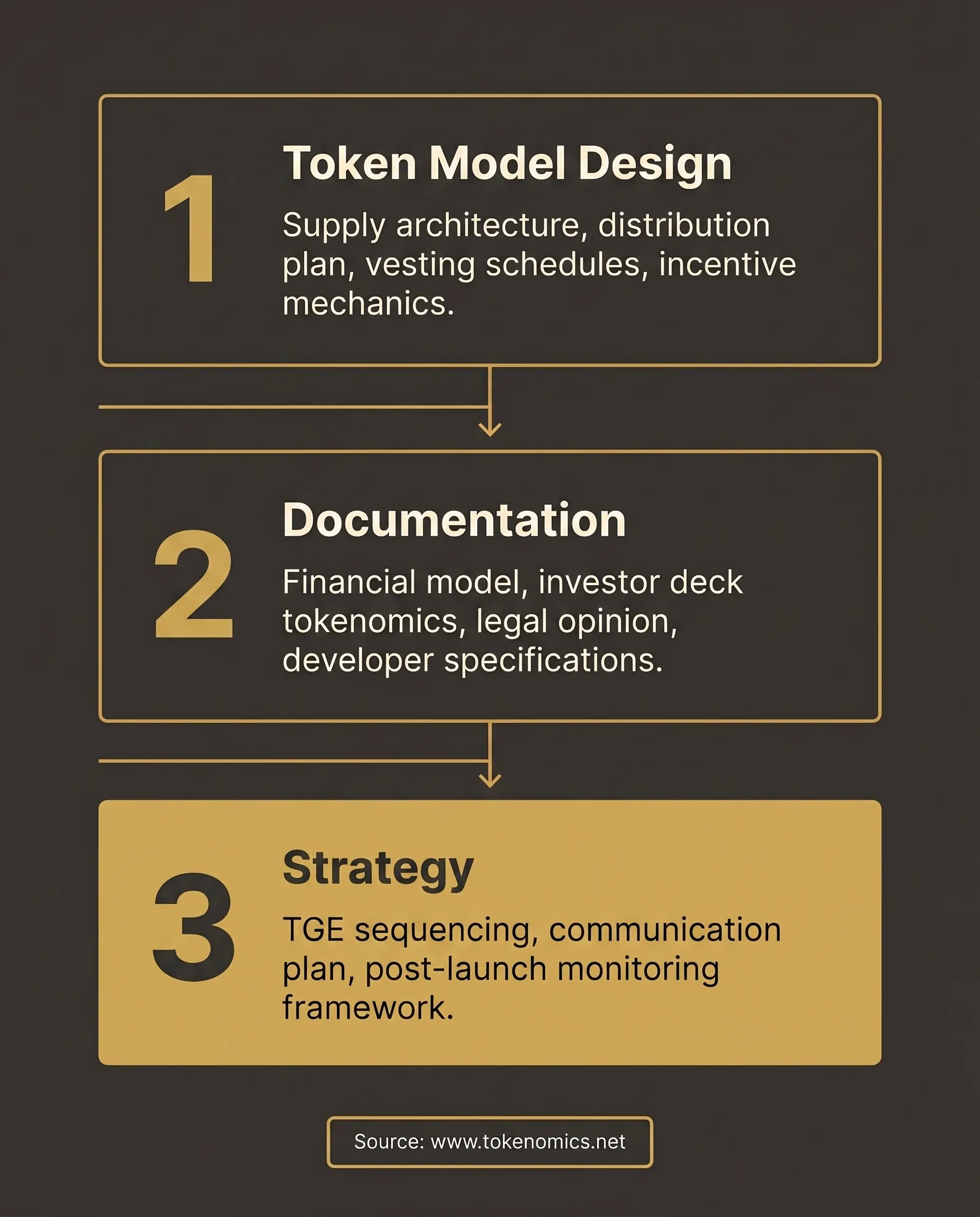
Tokenomics consulting is a professional advisory service that designs, documents, and develops token economic models for blockchain projects. Engagements typically cover three outputs: token model design (supply architecture, distribution, incentive mechanics), institutional-grade documentation for investors and legal teams, and strategic guidance on deployment and launch.
tokenomics consulting: A professional advisory service that designs, documents, and develops strategy for a project's token economic model, producing institutional-grade deliverables for investors, legal teams, and developers.
token model design: The process of defining a blockchain project's supply architecture, token distribution plan, vesting schedules, and incentive mechanisms in a way that connects the token's economic behavior to the project's underlying revenue model.
tokenomics audit: A structured review of an existing token economic model against a defined checklist of design dimensions, identifying structural weaknesses in supply mechanics, incentive alignment, distribution design, and regulatory positioning before a token generation event.
Revenue-First Design: Tokenomics.net's methodology for token model development, which requires that every design decision trace back to the project's actual revenue model. A token with no sustainable revenue mechanics underneath it is treated as structurally unsound regardless of mechanism sophistication.
#What Tokenomics Consulting Actually Covers
Tokenomics consulting is not one thing. The term gets applied to a range of services with very different scopes, from a 30-page whitepaper review to a six-week engagement that produces a complete design-documentation-strategy bundle. Understanding the difference matters because the deliverable you need depends on where your project is and what it's trying to accomplish.
A real tokenomics consulting engagement covers three areas:
Token model design. The design of the economic architecture itself: supply structure, distribution plan, vesting schedules, incentive mechanisms, and how the token model connects to the underlying business revenue. This is not a template exercise. The right design depends on your business model, your investor base, your regulatory posture, and your timeline.
Documentation. The written record that makes the model legible to every stakeholder who needs to evaluate it. Investors need a clear tokenomics section in the investor deck and a detailed financial model. Legal teams need a compliance-aware design rationale and, often, a legal opinion. Developers need specifications. The documentation layer is what turns a design into an actionable, reviewable artifact.
Strategy. Advisory on how to deploy the model. TGE sequencing, exchange listing approach, liquidity provision, communication strategy for different audiences, and post-launch monitoring. Strategy is the component most founders underestimate. Getting the model right is necessary but not sufficient. How you deploy it in the market is where most teams leave value on the table.
What is NOT tokenomics consulting: whitepaper writing with no underlying model, generic "crypto strategy" advice with no economic design output, smart contract auditing (that is a separate technical discipline), or a PDF review that gives you a letter grade without an actionable redesign.
#The Core Work: Token Model Design
Token model design starts with the underlying business. That is not a philosophical point; it is a practical one. A token model designed without a real revenue engine underneath it is just a countdown timer. Revenue-First Design is our methodology: every design decision traces back to how the business actually creates value and how the token captures or amplifies that value.
The core components of token model design:
Supply architecture. Total supply, circulating supply curve, emission schedule, and the decision between fixed and inflationary supply. Emission schedules that front-load supply create concentrated sell pressure in the early months after launch. The design should account for how supply interacts with your liquidity depth and market-maker agreements.
Distribution design. How tokens are allocated across team, investors, treasury, community, and advisors. Typical institutional investor allocation is 15-25% with 1-year cliff and 2-4 year linear vest. The cliff protects early investors from immediate dilution. The distribution design also covers liquidity provision: how much of the treasury is reserved for DEX and CEX liquidity from launch day.
Incentive design. Staking mechanics, utility hooks, burn mechanisms, fee distribution to holders. The question is always: what reason does a rational economic actor have to hold this token? If the answer is "price appreciation," the model has a velocity problem. The design needs to create genuine utility sinks that reduce circulating supply as the network grows.
Across 100+ projects, we see the same pattern: teams that treat token model design as a post-product task are designing into a constraints set they didn't choose. The earlier you design, the more options you have.
#Documentation: The Output That Actually Gets Reviewed
Most founders think of tokenomics documentation as the whitepaper. That view is about five years out of date.
Institutional investors and legal teams are not reading the whitepaper as their primary diligence document in 2026. They are asking for the complete tokenomics data room: a structured package that includes the financial model, supply and distribution documentation, compliance analysis, and the legal opinion on token classification.
The stakeholders who need to work from your tokenomics each need something different:
Legal team. They need a compliance-ready design rationale: documentation of why specific design choices were made with regulatory positioning in mind. If you are raising from accredited investors in the US, your counsel needs to understand how the token design interacts with Reg D or Reg S. They need the tokenomics audit checklist dimensions covered with source documentation.
Development team. They need technical specifications: vesting contract parameters, staking contract interfaces, treasury multisig governance specifications. Developers cannot implement what is not written down.
Finance team. They need a financial model with supply-demand projections, treasury runway analysis, and Monte Carlo stress testing across price scenarios.
Investors. They need a clear, coherent narrative that connects the business model to the token design and demonstrates that the team understands the economics they have built.
The complete tokenomics data room is the artifact that satisfies all of these simultaneously. It is what we produce at the end of a full engagement.
#Token Launch Strategy: Advisory Beyond the Model
A model design and documentation set is the foundation. Strategy is what you do with that foundation.
Token launch strategy covers the decisions that determine how the model performs in practice, not just how it looks on paper. The gap between those two things is where most launches lose value.
Pre-launch advisory covers TGE sequencing: the order of operations between private round, public sale, DEX listing, and CEX listings. Timing these incorrectly creates arbitrage windows that sophisticated actors exploit at the expense of retail participants. It also covers market-maker coordination: which markets to prioritize at launch, what spread and depth commitments are realistic, and how to structure the market-maker agreement.
Communication strategy covers how you explain the tokenomics to investors versus the community versus the press. These are different audiences with different frames. Investors want to see financial defensibility. Community members want to understand what holding the token earns them. Press wants a story, not a technical spec. The communication strategy bridges the design to all three audiences without creating inconsistent claims.
Post-launch monitoring covers distribution health: tracking concentration metrics (top-wallet percentage, wallet-count growth), velocity indicators, and treasury drawdown rates. Projects that lose sight of these metrics after launch often find they are managing a different token economy than they designed.
Strategy advisory is typically embedded in the main engagement but can also be a standalone service for projects that have an existing model and need deployment help.
#When Do You Need Tokenomics Consulting?
Not every project needs a full engagement. Here are the signals that suggest you do.
You're raising a round and investors are asking about tokenomics. This is the most common trigger. When institutional investors ask for your tokenomics documentation, they are asking for the full data room, not just a supply table. If your answers to their questions are incomplete, the round stalls.
Your legal team is asking about token classification. Questions about the Howey test, Reg D, Reg S, or MiCA classification are signals that you need a tokenomics design that is built with regulatory posture in mind, not retrofitted with disclaimers later.
You have a model and you want an audit before launch. Founders who have designed their own tokenomics often come to us for a stress-test before TGE. The tokenomics design mistakes we see most often are not difficult to find once you know what to look for. But they are expensive to fix after a public launch.
You have a real business and you are adding a token layer. If there is genuine value creation underneath the token, the design work is worth doing carefully. Token infrastructure that amplifies a real revenue engine is fundable and durable. Token infrastructure layered on top of nothing creates a question investors ask on every call.
Who does NOT need a full engagement: projects still pre-product with no business model defined, projects whose primary value proposition is token price appreciation, teams with an experienced tokenomics lead in-house who simply needs a second opinion.
#How to Evaluate a Tokenomics Consulting Firm
The quality variance in tokenomics consulting is significant. What a tokenomics audit covers is a useful frame here: the same rigor a firm applies to auditing an existing design is the same rigor they should apply when building a new one. Here is a practical framework for evaluation.
Ask for process documentation, not just a pitch deck. A serious consulting firm can walk you through their methodology: how they connect token design to business model, how they handle the regulatory positioning conversation, what their documentation deliverables include. If the answer is "we customize everything," press for examples. If they cannot produce sample artifacts, that tells you something.
Check their published content. The best indicator of consulting quality is what a firm publishes for free. If their blog posts make specific claims with primary sources and acknowledge regulatory complexity rather than minimizing it, that is a signal the work they do for clients will have the same standards. Content that overpromises or treats tokenomics as a template exercise is a red flag.
Ask about their ICP. A firm that takes every project is not a firm that's building deep expertise in your category. Ask directly: what does a good-fit client look like for you? If they can't answer that, they are selling capacity, not judgment.
Red flags in the process:
- They start designing the token before they understand your business model
- They promise specific market outcomes or raise amounts linked to their design
- They deliver a report and disappear; no iteration, no stakeholder alignment
- Their contract does not specify what deliverables you own
- They cannot explain how their design connects to your revenue model
Green flags:
- They ask about your legal team before they ask about your token supply
- They use primary sources in their public writing
- They can cite pattern recognition from comparable projects
- They tell you when something won't work before you've committed to it
#What the Engagement Process Looks Like
A standard tokenomics consulting engagement runs 4-6 weeks for a full design-documentation-strategy package. Here is the typical sequence.
Discovery. The first session covers your business model, the token's role in the business, your target investor base, your regulatory jurisdiction, and your timeline. This is not a formality; it is where we identify the constraints the design has to satisfy.
Audit (if applicable). If you have an existing tokenomics design, we run it through a structured checklist. The tokenomics audit covers supply mechanics, distribution design, incentive alignment, compliance posture, and documentation completeness. Most audits surface 3-5 issues that need resolution before the design is investor-ready.
Model design iteration. The design work happens in iterations. We produce a draft model, walk through it with the founder, and revise based on business reality and stakeholder constraints. Legal gets involved early in this phase if token classification is a live question.
Documentation production. Once the design is locked, documentation follows. The tokenomics section for the investor deck, the financial model, the compliance documentation package, and the legal opinion coordination.
Strategy handoff. The engagement closes with a strategy handoff: TGE sequencing, communication scripts for investor and community audiences, post-launch monitoring framework, and the market-maker brief.
We've run this process across 100+ projects. The founders who get the most value from it are the ones who treat the engagement as collaborative design work, not as a service they receive at the end.
#The Regulatory Context for Tokenomics Consulting in 2026
Tokenomics work has real regulatory stakes in 2026. This is not a background fact; it is the operating context for every design decision.
The post-FIT-21, post-Coinbase enforcement, post-Tornado Cash OFAC sanctions environment means that tokenomics design choices affect legal exposure. A token designed without regard for how it interacts with securities law, AML requirements, and emerging digital asset frameworks is not just a bad design; it is a design that can put your project and your team in a difficult position.
The Howey test remains the primary analytical tool for US token classification. Four factors determine whether an asset is an investment contract: an investment of money, in a common enterprise, with an expectation of profit, derived from the efforts of others. (Source: SEC v. W.J. Howey Co., 328 U.S. 293, 1946; applied repeatedly in SEC digital asset enforcement actions since 2017.) Token designs that distribute revenue to holders or give holders governance rights over profit-generating mechanisms sit close to the line. The firm's view is that you design to make the Howey analysis defensible, not to design around it. Whether the design is securities-compliant is the legal team's call, not ours.
MiCA (Markets in Crypto-Assets) is the EU's comprehensive crypto regulation framework, with its enforcement peak in Q2-Q3 2026. (Source: Regulation (EU) 2023/1114 of the European Parliament and of the Council, applicable from December 2024 with full enforcement from June 2025.) MiCA classifies tokens into categories (Asset Reference Tokens, E-Money Tokens, utility tokens, and other crypto-assets) and assigns different regulatory obligations to each. Token design choices affect MiCA classification: a token with stablecoin mechanics may be classified as an ART or EMT, which triggers reserve requirements, white-paper mandates, and CASP licensing obligations. In our view, any project with EU exposure needs MiCA classification analysis before the token design is finalized.
FIT-21 (the Financial Innovation and Technology for the 21st Century Act) passed the US House in 2024 and as of mid-2026 remains under Senate consideration. If enacted, FIT-21 would create a clearer framework distinguishing digital commodities (CFTC jurisdiction) from digital securities (SEC jurisdiction), with a "sufficient decentralization" test for the transition between classifications. The firm's interpretation: FIT-21 creates new optionality for projects that can demonstrate genuine decentralization, but the design work required to satisfy that test is real. Founders waiting for regulatory clarity before doing the design work will be behind when the clarity arrives.
A tokenomics consultant who is not thinking about the Howey test, MiCA, and FIT-21 from the first design session is designing in a vacuum. We are not lawyers. We design to make compliance review smoother. The legal opinion is your counsel's responsibility. But the design decisions we make together determine how difficult or straightforward that legal opinion is to obtain.
#Common Misconceptions About Tokenomics Consulting
"I can use a template." Templates provide structure, not judgment. Token model design is not fill-in-the-blanks. The right supply schedule for a DePIN protocol is not the right schedule for an RWA project. The vesting design that works for a VC-backed team at seed is not the right design for a community-first launch. Templates help you organize the question. They don't answer it.
"My CTO can handle this." Technical implementation and economic design are separate disciplines. Most CTOs are excellent at building what the specification says. Most are not token economists. The specification itself, the design that the CTO implements, is where most of the work lives. A well-implemented bad model is still a bad model.
"It's just the vesting schedule." Vesting is one component. Tokenomics consulting covers supply mechanics, incentive alignment across all stakeholder categories, distribution strategy, the complete documentation stack, and the regulatory posture of the design. Founders who treat vesting as the core question often discover after raise that the rest of the design has problems.
"We'll figure it out after we raise." Post-raise redesigns are expensive. They signal to follow-on investors that the founding team did not do the work before the first close. Redesigns also sometimes require renegotiating investor agreements. Get your house in order before you go to market.
"All tokenomics firms deliver the same work." Quality varies enormously. The difference is whether the deliverable holds up under investor and legal scrutiny, not just founder comfort. A deliverable that looks thorough but falls apart when a seasoned crypto lawyer asks the first hard question is not institutional-grade work.
#Frequently Asked Questions
How much does tokenomics consulting cost? Tokenomics consulting engagements start around $15,000 for a full design-documentation-strategy package covering token model design, financial modeling, compliance documentation, and strategy handoff. Project scope, complexity, and regulatory requirements affect the final figure. Lightweight audit-only reviews can run lower; ongoing advisory retainers run higher. Firms that quote substantially below this range typically deliver template-based output rather than an engineered model built around the project's revenue structure.
What is the difference between a tokenomics consultant and a tokenomics auditor? A tokenomics consultant builds the token model from scratch: supply architecture, distribution design, vesting schedules, incentive mechanics, and documentation. A tokenomics auditor reviews an existing model against a structured checklist, identifying weaknesses before launch. Many projects need both: a design engagement followed by a final audit before TGE. Some consulting firms offer both services within a single engagement.
Do I need tokenomics consulting before my fundraising round? If institutional investors are involved, you almost certainly do. Institutional investors in 2026 expect a complete tokenomics data room, not just a supply table and a vesting schedule. Projects that go into investor diligence without a defensible token model documentation package routinely stall. The consulting work should be completed before you begin serious investor conversations, not as a response to investor questions.
What does tokenomics consulting cover for regulatory compliance? Compliance-aware tokenomics consulting addresses how token design choices affect regulatory classification under frameworks including the Howey test (US), MiCA (EU), and, as of 2026, the developing FIT-21 framework in the US. A consultant does not replace your legal team; they design the token model to make your legal team's compliance analysis as straightforward as possible. That means avoiding design patterns that create unnecessary exposure, and documenting the design rationale in a form that supports legal opinion work.
Can I design my own tokenomics without a consultant? You can, and many projects do. The risks are well-documented: supply schedules that create concentrated sell pressure, distribution designs that create investor alignment problems, incentive mechanics that fail to create genuine utility sinks. If you have a strong in-house token economist and the time to develop a rigorous model, self-directed tokenomics design is viable. If your team is primarily technical or business-focused with limited token economics depth, the cost of getting it wrong at launch exceeds the cost of a consulting engagement.
How long does a tokenomics consulting engagement take? A full design-documentation-strategy engagement typically runs four to six weeks. Discovery and audit (if applicable) takes the first one to two weeks. Model design iteration takes two to three weeks, including stakeholder alignment sessions with legal, development, and finance. Documentation production and strategy handoff close the engagement. Projects with complex regulatory postures or multi-market distribution requirements can run longer.
What deliverables should I expect from a tokenomics consulting engagement? A complete engagement should produce: a token model specification (supply architecture, distribution schedule, vesting parameters, incentive mechanics), a financial model with Monte Carlo scenario projections, the tokenomics section for the investor deck, compliance documentation suitable for legal review, and a strategy brief covering TGE sequencing, market-maker approach, and post-launch monitoring. Any engagement that delivers a single report without these components is not a full consulting engagement.
#Getting Tokenomics Consulting Right
The token layer is infrastructure. The business is the engine. The consultant's job is to design infrastructure that amplifies the engine, not to build a structure that substitutes for one.
If you're at the point where the tokenomics layer is a real decision, a fundraising round, a TGE approaching, investors asking questions, you're probably ready for a real engagement. The firms worth working with will tell you whether your project is a fit before you sign anything. The ones worth avoiding will take every project regardless.
We've designed, documented, and stress-tested tokenomics for 100+ projects raising $100MM+ in combined capital. If you want to understand whether your project is at the stage where a full engagement makes sense, book a strategy call. We'll give you an honest assessment of where you are and what you actually need.
Sometimes we're not the right fit. We'll tell you that too.