ICO vs IDO vs IEO: What's the Difference and Which Fits Your Launch
ICO, IDO, and IEO are the three main models for launching a token. Compare ICO vs IDO vs IEO on custody, listing, KYC, cost, and investor access.


ICO, IDO, and IEO are the three primary models for launching a new token to the public. In an ICO, an initial coin offering, the project sells tokens directly to buyers through a smart contract it deploys and controls. In an IDO, an initial DEX offering, the sale runs through a decentralized exchange launchpad. In an IEO, an initial exchange offering, a centralized exchange hosts and administers the sale on its own platform. The whole ICO vs IDO vs IEO decision turns on one axis: who custodies the sale and controls listing access.
The launch model is a distribution mechanism. It decides how a token reaches its first holders. It does not decide whether the token, or the business underneath it, is worth holding. Get that order wrong and no launch venue fixes it. This post compares ICO, IDO, and IEO across custody, listing venue, KYC and compliance, cost, speed to market, and investor access, then covers a separate distinction founders often fold into the same list: fair launch versus presale.
#What Is an ICO (Initial Coin Offering)?
An ICO, an initial coin offering, is a token sale the project runs itself. The project deploys a smart contract, buyers send funds to it, and tokens are distributed on terms the project sets. No exchange or launchpad sits in the middle holding custody of the raise.
ICOs were the dominant launch model in 2017 and 2018, when the market was largely unregulated and the barrier to running a public sale was low. That period also produced the enforcement history the model now carries. Because the project itself is the counterparty, and the offering can resemble a direct sale of an investment, an ICO draws sharper securities-law scrutiny than the other two structures. In the United States, regulators and courts apply the SEC's Howey test to decide whether a given sale is an investment contract, and the SEC's own framework and its 2017 report on The DAO describe how that analysis runs.
The structural point is custody. In an ICO the project controls the sale contract, the funds raised, and the distribution timeline. That control is the source of both its flexibility and its regulatory exposure.
#What Is an IDO (Initial DEX Offering)?
An IDO, an initial DEX offering, moves the sale onto a decentralized exchange's launchpad. Instead of the project's own wallet, funds and token distribution run through the launchpad's smart contracts, and liquidity is commonly provisioned into a DEX pool at or near the token generation event.
The mechanics sit on public token standards. Tokens sold this way commonly follow the ERC-20 standard, the fungible-token interface documented at ethereum.org and specified formally as EIP-20. The standard defines how balances, transfers, and approvals behave, which is what lets a DEX and its launchpad interact with a new token without custom integration work.
Access is the other distinction. IDOs are commonly permissionless or lower-barrier for retail participation than an IEO's listing process, though the specific terms vary by launchpad. The structural difference from both an ICO and an IEO is custody: the launchpad's contracts hold and release the tokens, not the project's own wallet and not a centralized exchange's custody stack.
#What Is an IEO (Initial Exchange Offering)?
An IEO, an initial exchange offering, puts the sale inside a centralized exchange. The exchange hosts the sale on its own platform, applies its own listing review, and commonly requires KYC from every participant. It custodies both the funds raised and the sale mechanics. That is the IEO explained at the structural level: the exchange, not the project, runs the offering.
That changes the project's position. In an IEO the project does not directly control the sale contract the way it does in an ICO. The exchange runs the process, and its listing review functions as a filter buyers rely on. This is the trust proposition that separates an IEO from an ICO: a venue with a reputation to protect looked at the project before the sale opened.
One line matters here. Exchange listing review is a commercial due-diligence process, not a regulatory approval. An exchange clearing a token for its launchpad means the exchange was willing to list it. It does not mean a regulator reviewed or cleared the offering.
#ICO vs IDO vs IEO: Side-by-Side Comparison
Put ICO, IDO, and IEO side by side and the differences resolve into a few structural columns. The axis under all of them is custody and listing control, and the rest, cost, speed, and who can participate, follows from that. Here is the token launchpad comparison in one view.
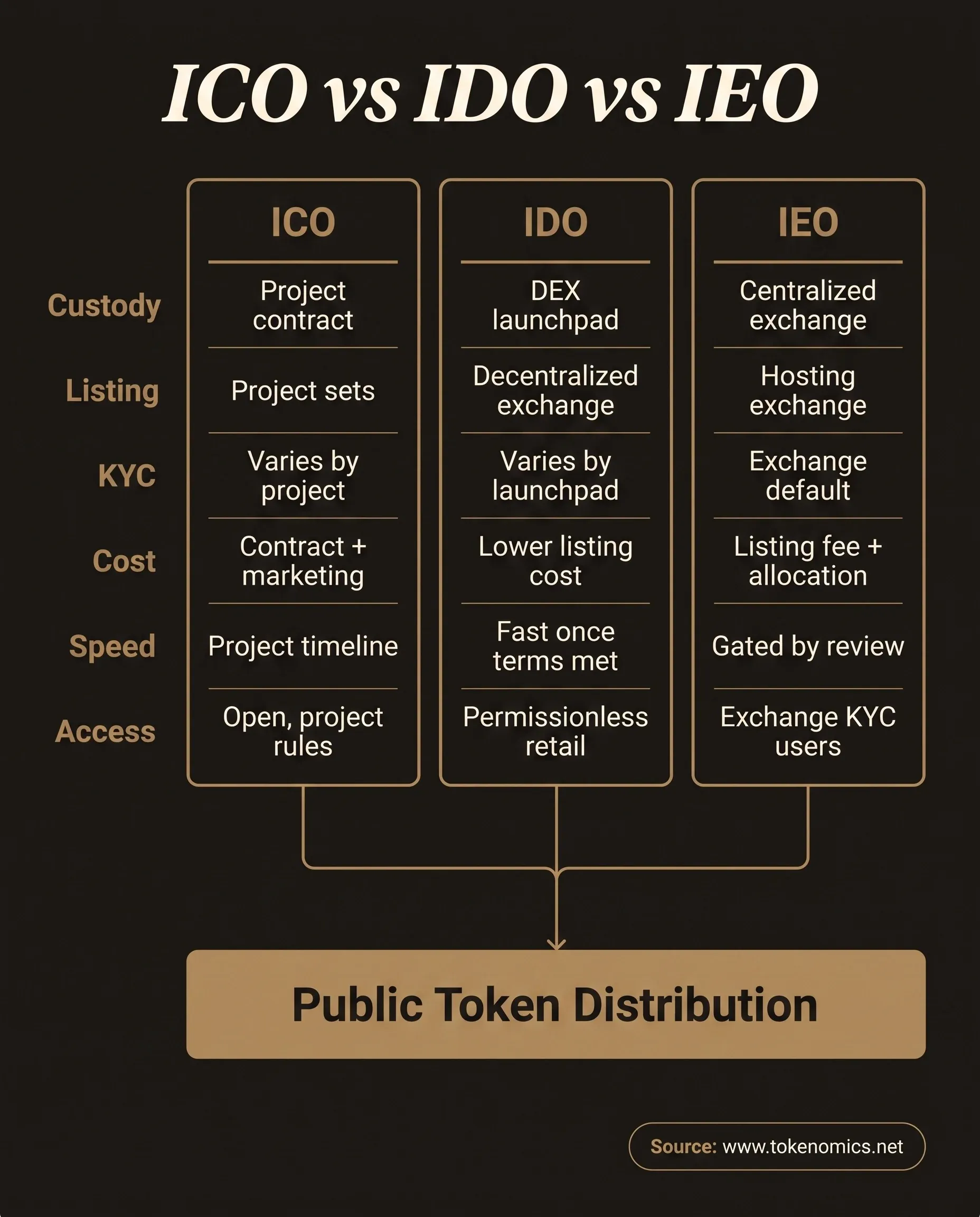
| Dimension | ICO | IDO | IEO |
|---|---|---|---|
| Custody of funds | Project's own contract | DEX launchpad contract | Centralized exchange |
| Listing venue | Set by the project | Decentralized exchange | The hosting exchange |
| KYC / compliance | Varies by project and jurisdiction | Varies by launchpad | Exchange applies KYC by default |
| Typical cost to launch | Contract and marketing costs, no listing fee | Lower direct listing cost, higher due-diligence load on the project | Exchange listing fee, often a token allocation |
| Speed to market | Set by the project's own timeline | Quick once launchpad terms are met | Gated by the exchange's review |
| Investor access | Open, subject to project rules | Commonly permissionless retail | Exchange's user base, gated by KYC |
The IDO vs ICO contrast draws the tradeoff into focus. An ICO gives the project full control and full exposure. An IDO commonly carries lower direct listing costs than an IEO, but it shifts the due-diligence work back onto the project and its advisors. An IEO commonly carries an exchange listing fee an ICO does not, and in return the exchange handles custody, KYC, and the listing itself, which reduces one set of tasks and adds a counterparty dependence.
Costs and activity shift with the market. A reader checking current launchpad activity and value locked by category can pull that from onchain data aggregators such as DefiLlama rather than relying on a launchpad's own marketing numbers. Treat every cost and speed figure here as directional, since terms vary by venue and by cycle.
#Fair Launch vs Presale: A Separate Distinction
Fair launch and presale describe when and how tokens become available. ICO, IDO, and IEO describe which venue and structure runs the sale. These are different axes, and a launch can pair either one with any of the three models.
A fair launch means no privileged early-access tier. Every participant reaches the token on the same terms at the same time, commonly with no pre-mine or insider allocation ahead of public availability. It removes the appearance of insider advantage. It also gives the project less control over early price discovery and less committed capital going in.
A presale is a defined earlier window, commonly at a discounted price or with vesting terms, offered to a specific group before the public sale opens: investors, an early community, or a whitelist. It gives the project committed early capital and more price stability. It also requires disclosure discipline around allocation and vesting, because a presale that quietly favors insiders is the pattern regulators and communities scrutinize closely.
The tradeoff: a fair launch optimizes for the perception of fairness, a presale optimizes for funded runway. Neither is superior in the abstract. The right choice depends on how much capital the build needs before launch, and on how the project wants its allocation to read.
#How Founders Choose Between ICO, IDO, and IEO
The choice between ICO, IDO, and IEO is a set of inputs a founder weighs, not a structure that is correct in the abstract. A handful of questions narrow the field.
Exchange relationships. Is a listing on a credible exchange realistic at launch? An IEO depends on one saying yes. If that relationship does not exist yet, the practical choice is between an ICO and an IDO.
Regulatory posture. What does the securities and KYC picture look like in the jurisdictions you are raising into? This is a question to answer with counsel, not a box a launch model checks. Each structure carries a different compliance load, and the answer shapes which one is workable.
Investor access. Do you want broad retail participation or a gated, accredited-leaning group? An IDO leans permissionless. An IEO gates by the exchange's KYC. An ICO sits wherever the project sets its own rules.
Operational readiness. Each model implies KYC and compliance overhead the project has to staff. An IEO shifts custody and listing to the exchange, which reduces one set of tasks and adds counterparty dependence. An ICO keeps everything in-house, the work and the exposure both.
These are the same inputs we work through with founders before a token generation event, because the launch venue sits inside a wider sequencing question that a full TGE process has to answer. Choosing the venue in isolation, ahead of supply planning and allocation, is how projects end up with a launch that contradicts their own cap table. A token launch strategy engagement works the model and the venue together, in that order.
#ICO vs IDO vs IEO in Context
ICO, IDO, and IEO differ in who custodies the sale and controls listing access. They do not differ in what the token is worth or how it performs. That part is set by the business the token is built on top of, not by the venue that sells it.
The instruments are settled. The compliance questions around them are not, and they tighten year over year. A launch model is infrastructure for distribution. It moves a token to its first holders. It is not a substitute for the value engine underneath, and a clean venue on top of a weak model just distributes the weakness faster.
If you're building onchain and need your token launch strategy to hold up under institutional scrutiny, book a discovery call. We'll assess your project and tell you whether we're the right fit. Sometimes we're not. We'll tell you that too.