
NOSANA
Tokenomics Redesign for Decentralized GPU Compute
Executive Summary
NOSANA operates a decentralized GPU compute network that connects underutilized GPUs worldwide with AI inference workloads. As a leading DePIN (Decentralized Physical Infrastructure Network) on Solana, NOSANA faced a critical challenge: their existing tokenomics were designed for an earlier era of the protocol and weren't optimized for their pivot to AI-focused compute.
Tokenomics.net partnered with NOSANA to redesign their token mechanisms, creating a comprehensive proposal that better aligns GPU provider incentives with network growth while driving sustainable demand for the $NOS token.
Certain figures have been adjusted for confidentiality while preserving the accuracy of relationships and ratios.
The Challenge
- Passive staking dominated: General stakers received disproportionate emissions without contributing to network utility
- No skin-in-the-game alignment: GPU providers weren't required to lock tokens proportional to their earning capacity
- Reputation wasn't rewarded: High-quality, reliable nodes received the same treatment as inconsistent providers
- Token demand leakage: Users could pay in stablecoins without any NOS exposure, limiting token utility
Our Approach
Tokenomics.net conducted a comprehensive analysis of NOSANA's economic model, combining on-chain data analysis with Machinations-based simulations to validate proposed changes before implementation.
Engagement Methodology
Tokenomics Audit → Data Analysis → Economic Modeling → Machinations Simulation → Policy Recommendations → Documentation
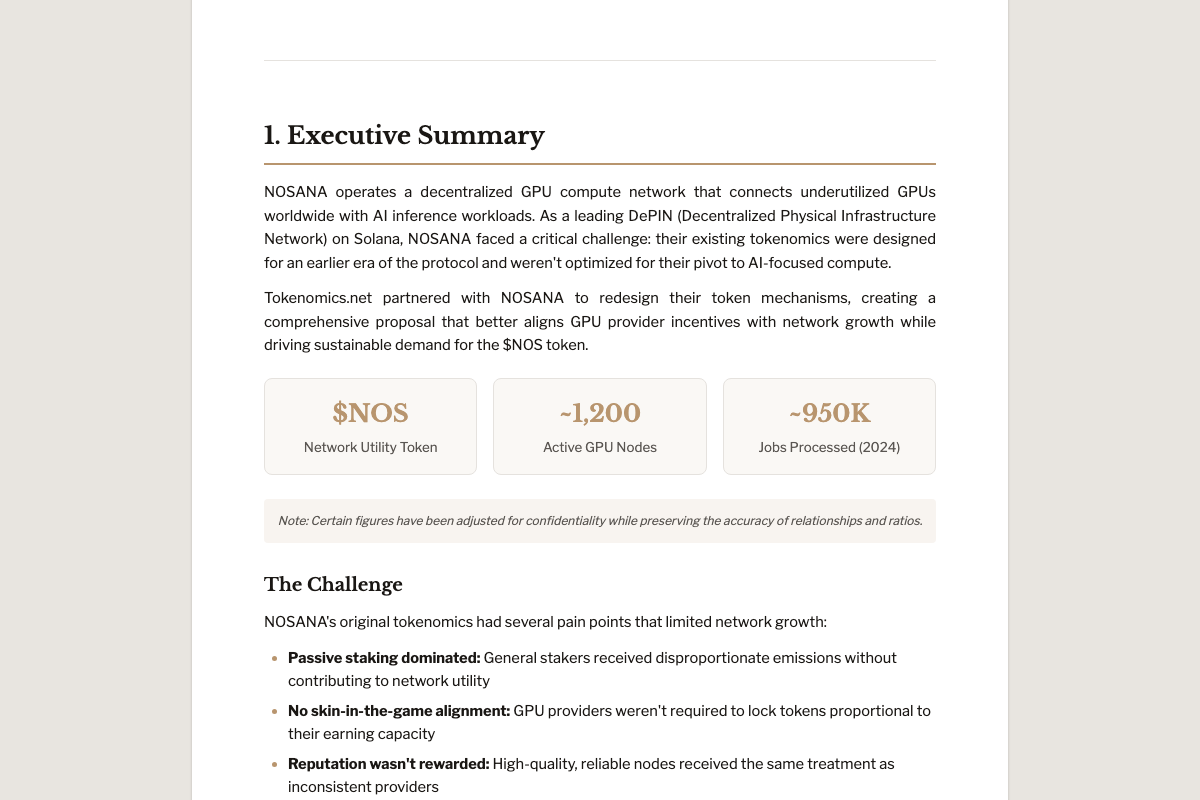
Our six-phase engagement methodology
Discovery Phase
We began by mapping NOSANA's existing token flows, staking mechanisms, and emission schedules. This revealed several inefficiencies in how value was being distributed across network participants.
Data-Driven Analysis
Using on-chain data and network metrics, we quantified the impact of proposed changes. Key inputs included:
- Historical GPU utilization rates across node tiers
- Staking concentration and distribution patterns
- Job completion rates and quality metrics
- Token velocity and holder behavior analysis
Simulation-Driven Design
All proposed changes were validated through Machinations simulations before being recommended. This allowed us to stress-test mechanisms under various market conditions and identify potential failure modes before they could occur on mainnet.
Policy Recommendations
Based on our analysis, we proposed five interconnected mechanism changes designed to create a more sustainable and growth-oriented tokenomics model.
1) Stake-Backed Node Access
Require GPU providers to stake $NOS proportional to their earning capacity. This creates skin-in-the-game and ties network supply growth to token demand.
2) Reputation-Weighted Rewards
Introduce reward multipliers based on uptime, job completion reliability, and performance consistency to favor high-quality operators.
3) Demand Capture via Payment Flow
Strengthen token demand by routing a portion of payments through $NOS, reducing stablecoin-only demand leakage.
4) Emissions Rebalancing
Shift emissions away from passive staking toward active network contributors, improving utility alignment.
5) Long-Term Sustainability Controls
Define guardrails for emissions, inflation, and incentive budgets under various growth scenarios.
Outcome: A cohesive tokenomics redesign focused on contributor incentives and durable token demand — with mechanisms validated before implementation.
Deliverables
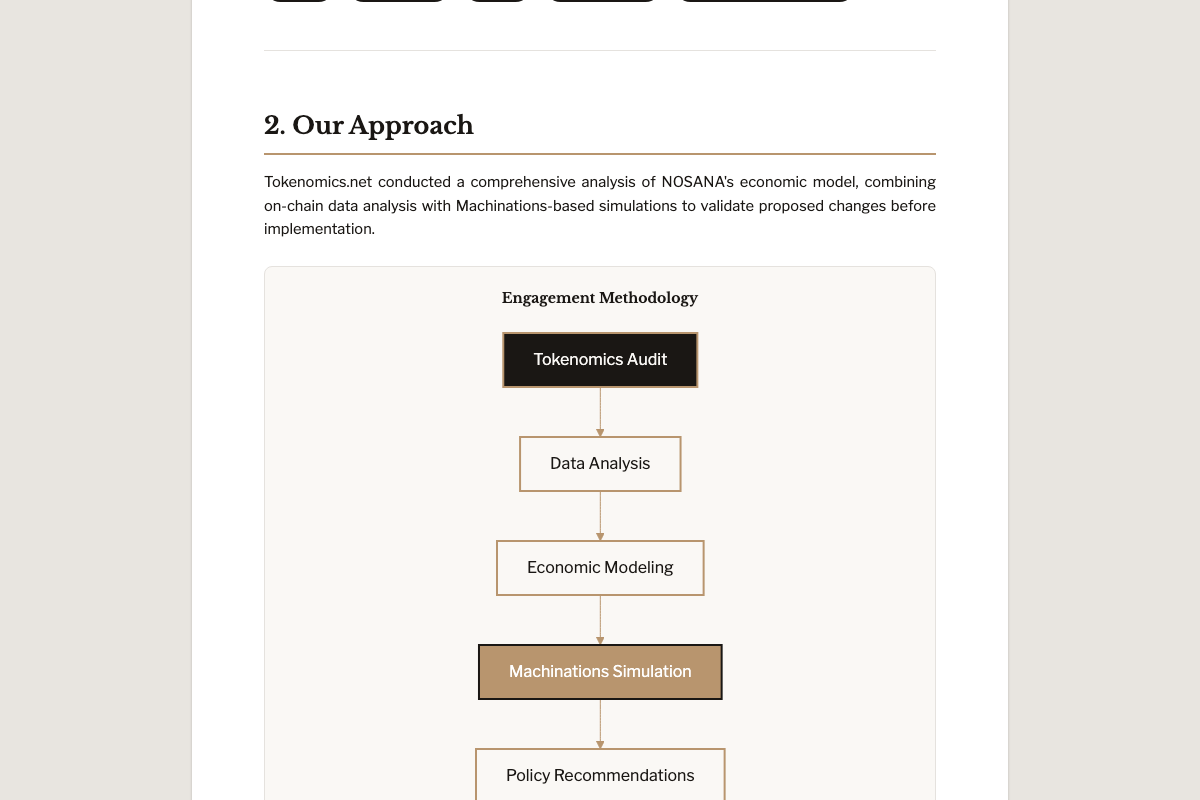
Token flow and incentive redesign summary
| Deliverable | Description | Why It Mattered |
|---|---|---|
| Tokenomics Audit | Assessment of current incentives and token flows | Identified misalignment and demand leakage |
| On-chain Data Analysis | Network and stakeholder behavior analysis | Anchored recommendations in real usage patterns |
| Machinations Simulation | Stress test proposed mechanisms | Validated outcomes under multiple scenarios |
| Mechanism Redesign Proposal | New incentive structure for GPU providers and demand capture | Improved sustainability and growth alignment |
| Implementation Roadmap | Phased plan and policy recommendations | Clear next steps for engineering + governance |
This case study focuses on the methodology and the structure of the redesign. Specific figures and certain details have been adjusted for confidentiality.
Book a Free Discovery Call
Get a clear plan for incentives, demand capture, and long-term sustainability — and see exactly what working together looks like.