Commodities vs. Securities: How Token Classification Works
Commodities vs securities: how the Howey test and a token's design choices shape its regulatory classification, explained for founders building onchain.


A commodity is a fungible asset valued for its own use or exchange. A security is an investment contract: money put into a common enterprise with an expectation of profit from someone else's effort. Whether a crypto token reads as one or the other turns on how it is designed, marketed, and used, measured against the Howey test, not on the label a team gives it.
Whether a crypto token is a commodity or a security is not a fixed property of the token. It depends on how the token is structured, sold, and promoted, measured against a legal standard called the Howey test. Design it one way and a token can read closer to a commodity. Load it with profit promises and centralized control, and the same token reads closer to a security.
The commodities vs securities question sits underneath almost every token launch, and founders keep treating tokenomics compliance as a paperwork problem to clean up after the fact. It is not. It is a design problem you decide months before launch.
Here is the part founders miss. A token built on top of a real revenue-generating business has more room to tell a use-and-exchange-value story than a token whose only function is trading itself. Revenue-first design is not just good economics. It shapes which side of the classification line your token can credibly sit on.
#Commodities vs. Securities: The Quick Answer
A commodity is a fungible asset that holds value because people use it or trade it, like a barrel of oil or an ounce of gold. In crypto, the label attaches to assets whose worth does not depend on one company's ongoing work. The Commodity Futures Trading Commission (CFTC) is the primary U.S. regulator when these assets trade as derivatives (Source: CFTC).
A security is a different animal. It is an investment contract: you put in money, the money pools into a common enterprise, and you expect profit from the effort of the people running it. The Securities and Exchange Commission (SEC) regulates securities (Source: SEC).
The tricky part is that a single token can move between these buckets over its life. A sale that looks like a securities offering at launch does not brand the underlying asset forever. Regulators and courts weigh the facts of each offering and each use, which is why security versus commodity classification is decided case by case rather than settled once.
#What Makes a Token a Security? The Howey Test Explained
The Howey test crypto founders keep hearing about comes from a 1946 Supreme Court case, SEC v. W.J. Howey Co. The SEC applies it to decide whether an arrangement is an investment contract, and therefore a security (Source: SEC, sec.gov/files/howey-test.pdf). Four prongs have to line up.
An investment of money. Someone pays for the token. Buying tokens in a sale satisfies this prong without much argument.
A common enterprise. Buyer funds pool together and their fortunes are tied to one project's success. A treasury that collects sale proceeds and funds one roadmap fits this description.
A reasonable expectation of profit. Buyers expect the token to gain value. This is where marketing does the damage. Language like "early buyers will see returns" signals profit expectation loudly.
Profit derived from the efforts of others. A team controls development, the roadmap, and the value drivers after the sale, and buyers rely on that team's work for their gains.
Run those four prongs against a typical token sale and you can see how a design tips toward the security side. Money goes in. Funds pool behind one team. Marketing promises appreciation. The team keeps control of everything that drives value.
Here is what founders miss. Promotional language alone can push a token toward the security side even when the underlying mechanism looks closer to a utility or a commodity. The words on your landing page are evidence. So when a founder asks "is my token a security," the honest answer starts with a second question: what did you promise, and who does the buyer depend on to deliver it?
#What Makes a Token a Commodity?
A commodity sits at the other end. Its value comes from use or exchange, not from a promoter's continued effort. It is fungible, one unit is interchangeable with another, and it does not lean on a common enterprise's profit expectation to be worth something.
Bitcoin and Ether have both been treated as commodities by U.S. regulators in various contexts, because their value is not tied to a single identifiable promoter's ongoing managerial work (Source: CFTC). No one company runs Bitcoin. There is no team whose quarterly effort you are betting on. That structural fact is what pushes an asset toward the commodity reading.
Fungibility is a technical property, not only an economic one. Commodity-leaning tokens are typically built on standard fungible-token specifications rather than bespoke instruments engineered around a promise of return. The ERC-20 standard, defined as EIP-20, is the common technical baseline for fungible tokens on Ethereum (Source: eips.ethereum.org). A token that behaves like a plain fungible unit tells a cleaner use-and-exchange-value story than one wired with share-like rights.
None of this settles the question for any specific token. These are characteristics regulators have weighed in specific matters, not a stamp that makes an asset a commodity by default. The facts of the sale and the use still govern.
#Commodities vs. Securities: Side-by-Side Comparison
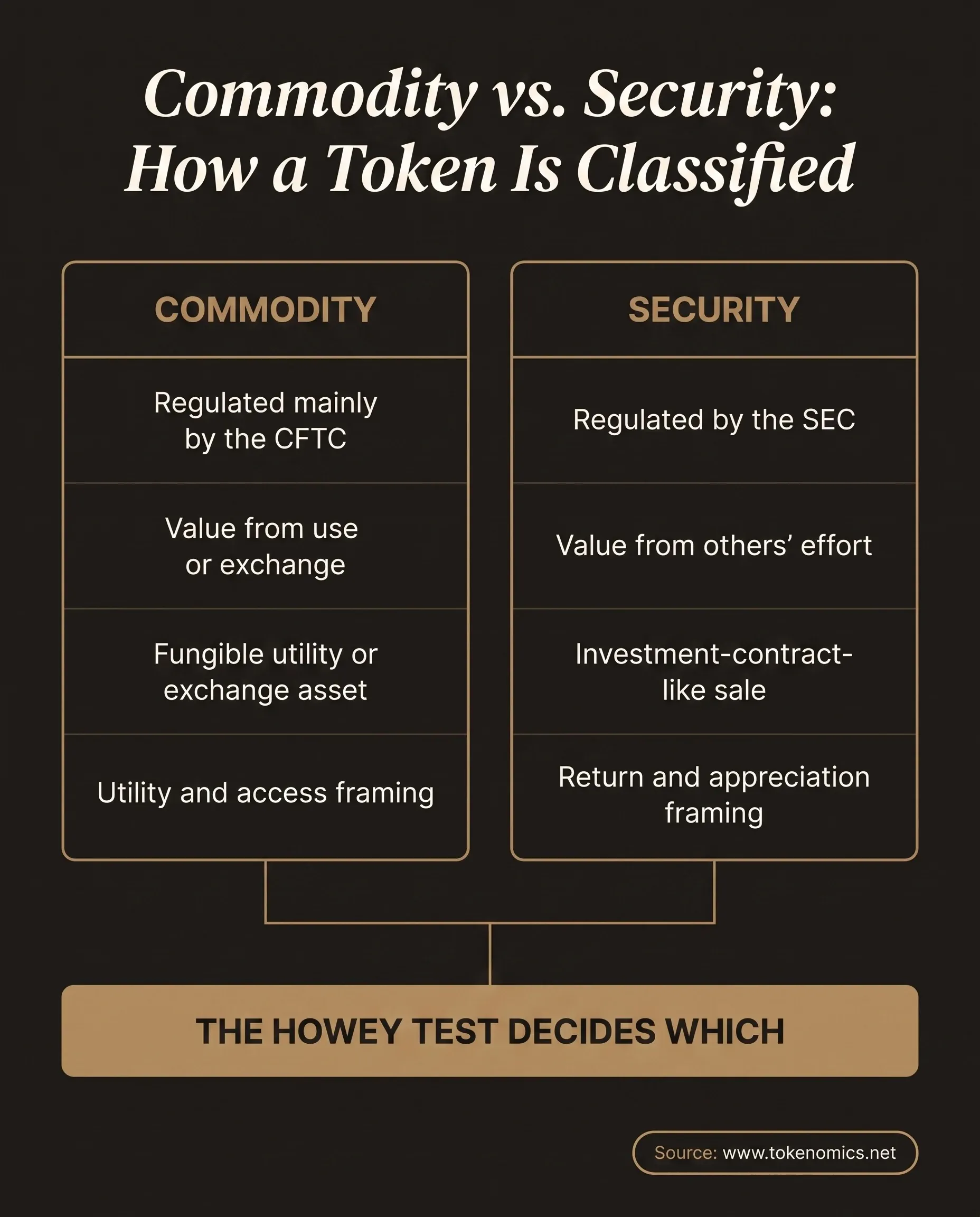
Commodities vs securities comes down to a handful of distinctions regulators keep returning to. Put them side by side.
| Dimension | Commodity | Security |
|---|---|---|
| Primary U.S. regulator | CFTC | SEC |
| What gives it value | Use or exchange | Expectation of profit from others' effort |
| Typical token structure | Fungible utility or exchange asset | Investment-contract-like sale |
| Typical marketing posture | Utility and access framing | Return and appreciation framing |
| Typical life-cycle behavior | Value stands apart from one promoter | Value tied to one team's continued work |
The table looks clean, and real tokens rarely are. Many display traits of both at different points in their life. A token can launch through what looks like a securities offering, then trade later as an asset whose value no longer depends on the original team. The offering event and the later trading get evaluated separately.
That is why founders who want a single yes-or-no verdict tend to walk away frustrated. Classification is a reading of facts that change over time, not a fixed tag. The value of the comparison is not a final answer. It is a map of which levers move a token toward one column or the other.
#How Token Design Choices Affect Classification
This is where token classification stops being abstract. Four design levers move a token toward one reading or the other, and founders control all four before launch.
Revenue-share and buyback mechanics. A token that routes protocol profit back to holders through revenue share or buyback-and-burn reads closer to "expectation of profit from others' effort." That is prong three and prong four working together. The mechanism itself signals an investment return.
Decentralization timeline. A token whose network, governance, and value drivers stay under a founding team's control at launch reads differently than one where control genuinely disperses over time. The SEC has referenced a "sufficient decentralization" concept in some public commentary (Source: SEC). Naming the framework matters here. No token gets to declare itself decentralized enough on its own say-so.
Marketing language. Promotional claims about price appreciation or "early investor" upside are a prong-three signal regardless of what the mechanism does under the hood. You can engineer a clean utility token and still talk your way into securities territory.
Token standard and fungibility. Standard fungible-token specifications support a use-and-exchange-value story more readily than bespoke, share-like structures. The technical layer these choices are implemented against is documented in Ethereum's own developer materials (Source: ethereum.org).
Tie all four back to the business underneath. A token designed around a real revenue-generating product has a legitimate use-and-exchange-value story to tell. A token whose only "utility" is trading itself does not, no matter how the paperwork is dressed. Revenue-first design gives you something honest to point at when the classification question arrives.
#Signals That Push a Token Toward "Security" Classification
Some patterns show up again when a token gets read as a security. None of them decides the legal outcome on its own. Together they paint a picture regulators and courts have weighed before.
- Pooled proceeds fund an unbuilt network. Sale money goes into building a product or network that does not exist yet, and buyers are funding that future work.
- Marketing leans on appreciation. Promotion emphasizes price upside, "early investor" framing, or comparisons to past token launches that went up.
- One team keeps central control. A single team or foundation retains control over the protocol's key value drivers well past launch.
- Holding is the only use. Token holders have no functional reason to hold the token other than waiting for its value to rise.
Read these as signals, not a scorecard. Avoiding all four does not place a token outside securities analysis, and showing one does not seal the verdict. The determination is fact-specific, and it belongs to a legal team applying the Howey test to your actual offering.
#Signals That Push a Token Toward "Commodity" Classification
The commodity side has its own signals, and they mirror the security list almost point for point.
- An independent use case. The token does something, network fees, resource access, governance participation, that exists apart from any expectation of price appreciation.
- Distributed control. Network control and value drivers are genuinely spread out, not concentrated in one promoter's ongoing effort.
- Standardized fungibility. The token trades as a fungible, standardized asset rather than a bespoke instrument tied to one entity's performance.
- Utility-first documentation. Marketing and docs describe function and access, not investment return.
The broader token market is tracked by function and use across thousands of assets, and aggregators like DefiLlama categorize protocols by what they actually do rather than by what they promise (Source: DefiLlama). That framing, function over promise, is the same lens the commodity reading applies.
The same caution holds as the security list. These are patterns regulators have weighed, not a checklist that decides the outcome. A token can show all four signals and still face securities analysis if the offering itself looked like an investment contract.
#How to Think About Classification When Designing Your Token
Regulators and courts answer the classification question in hindsight. Your influence sits upstream. Design choices, marketing language, and the decentralization timeline are all decided before launch, and they set the facts a lawyer later has to work with.
That reframes the whole exercise. Classification is not a legal cleanup task you run after the token ships. It is a design input you weigh while the model is still on the whiteboard. Legal counsel evaluates the specific facts, but the facts are yours to shape months earlier through your token launch strategy.
The tradeoff: a token engineered purely for appreciation gives your legal team a harder set of facts to work with than a token built on a real revenue-generating business. The second one has a genuine use-and-exchange-value story. The first one is asking the paperwork to do what the design would not.
Designing with the Howey test in mind does not make a token compliant, and it does not place it outside securities law. What it does is make the eventual legal review smoother, because the facts were set deliberately instead of by accident. That is the honest version of the promise. Nobody designs their way to a settled classification.
The core distinction is stable even when individual cases are not. A commodity's value stands on its own use and exchange. A security's value depends on an expectation of profit from someone else's continued effort. The Howey test is the framework regulators use to sort a token into one bucket or the other, and the commodities vs securities outcome is shaped by design choices you make before launch, not after. The facts a lawyer works with are set early, which is why early design decisions do the heavy lifting.
If you are building onchain and need your token design to hold up under regulatory scrutiny, book a strategy call. We'll assess your project and tell you whether we're the right fit. Sometimes we're not. We'll tell you that too.