The Tokenomics Audit Checklist: 7 Dimensions Founders Review Before Launch
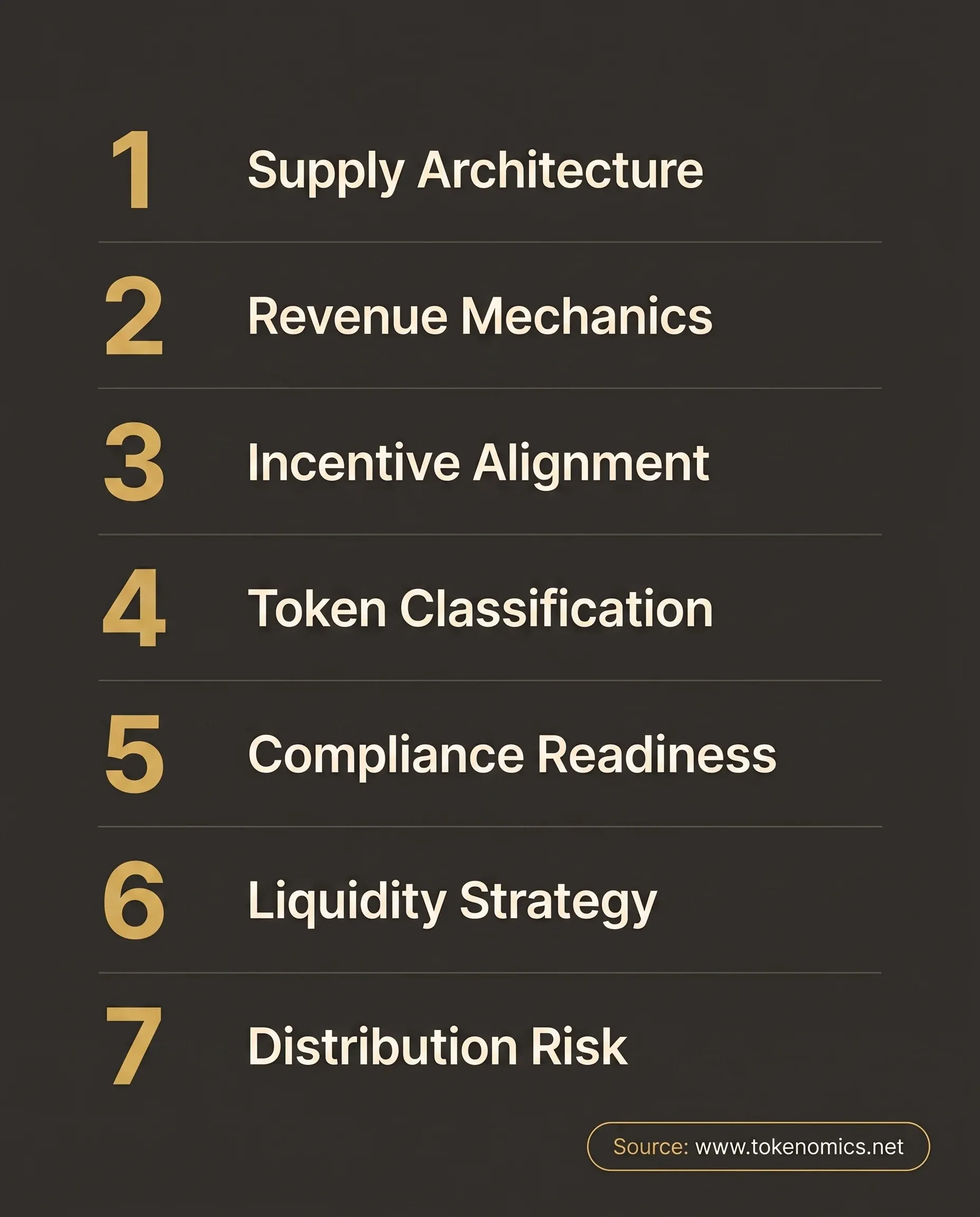
A tokenomics audit checklist covers seven dimensions: supply architecture, revenue mechanics, incentive alignment, token classification, compliance readiness, liquidity strategy, and distribution risk.


Tokenomics audit checklist: A structured review instrument covering seven dimensions of a token model, supply architecture, revenue mechanics, incentive alignment, token classification, compliance readiness, liquidity strategy, and distribution risk, used to generate documented findings and remediation steps before token launch.
A tokenomics audit checklist is a structured instrument founders use to evaluate their token model across seven named dimensions before entering investor review, exchange listing, or regulatory scrutiny. It is not a self-assessment form. It is a map of what institutional investors and exchange listing teams will ask about, framed as a systematic review process with defined pass criteria for each dimension.
Projects that ship without running through this checklist find the same categories of problems we see across 100+ engagements. Supply schedules that create systemic sell pressure in the wrong windows. Revenue mechanics that treat price appreciation as the product rather than an underlying business. Compliance postures that cannot survive a legal opinion review. How to audit tokenomics properly starts with knowing what each checklist dimension requires, not just whether you've touched the topic.
#Why a Checklist Without a Standard Is a False Assurance
Most projects review their tokenomics before launch. They assign a team member to look at the allocation table, run through the vesting schedule, confirm the emission curve is in the whitepaper. That's not a tokenomics audit. That's an internal pass on a document you wrote.
Exchange listing teams at Tier 1 and Tier 2 venues do not accept self-attestations. They request documented review output: specific findings by category, remediation steps taken, and a record that the review was conducted by someone other than the team that designed the model. Institutional LPs, particularly family offices and the structured-product arms of traditional finance firms entering crypto, have investment committees that require independent mechanism review before allocation. This isn't formality. The 53% failure rate on tokens launched since 2021 that are no longer actively trading has made independent review a prerequisite, not a preference (Source: CryptoRank token market data).
Revenue-First Design: A token model design methodology that starts with a documented, sustainable revenue source from real protocol activity and works backward to the incentive structure, rather than treating token appreciation as the revenue mechanism.
Token Generation Event (TGE): The moment a token is created and initially distributed to investors, team members, and the public, marking the start of the token's circulating supply trajectory.
The standard for each dimension isn't arbitrary. It's derived from what investors, exchanges, and regulators have been asking about in post-launch enforcement and listing disputes. The token audit checklist below maps each dimension to that standard.
#Dimension 1: Supply Architecture
A supply architecture review covers four questions.
Total supply and circulating supply trajectory. What is the hard cap? What percentage of total supply enters circulation at TGE, at 6 months, at 12 months, and at 36 months? A well-documented supply model shows the full trajectory, not just the TGE snapshot.
Emission schedule. Is the issuance rate inflationary, deflationary, or fixed? Does the emission schedule create a window where new token supply materially exceeds protocol revenue and new buying demand? Projects with aggressive early emission schedules tied to liquidity mining often create a structural sell wall that price action cannot absorb. That pattern shows up in 60%+ of the distressed-model reviews we conduct (Source: Tokenomics.net internal data, 100+ engagements).
Burn mechanics. Is there a token burn mechanism? What triggers it? What is the modeled net issuance rate after burns at various activity levels?
Concentration risk. What percentage of circulating supply is held by the top 10 addresses at TGE? Exchanges and institutional investors want this figure. A concentration ratio above 40% at TGE is a common flag.
What good looks like: a supply model document with a Monte Carlo simulation output showing net issuance across 1,000 scenarios, tested against three demand assumptions. The tokenomics data room is the standard packaging.
#Dimension 2: Revenue Mechanics and Sustainability
Revenue-First Design is the principle that sustainable tokenomics starts with a real revenue model and works backward to the incentive structure. A token without sustainable revenue mechanics is a countdown timer.
Revenue source. Does the protocol generate fees from user activity, or does it rely on token appreciation and new entrant capital? Fee-based revenue is auditable. Appreciation-based models are speculation.
Revenue routing. What percentage of protocol fees flows to the treasury, to token buy-backs, to liquidity providers, and to stakers? Is this routing documented in the smart contract, or is it a team decision each cycle?
Sustainability floor. At what level of protocol activity does the model cover operating costs without relying on treasury drawdown? Projects that cannot answer this question with a specific TVL or transaction volume figure have not modeled their token economics.
Investors ask: at what point does the protocol reach self-sustaining revenue, and what is the confidence interval? A Monte Carlo simulation across demand scenarios answers this. A token model review that skips revenue mechanics produces a checklist that misses the most important question the model has to answer.
#Dimension 3: Incentive Alignment and Vesting
Incentive alignment is the dimension investors read as a proxy for founder commitment and good-faith distribution.
Team allocation. The institutional standard range is 10-20% of total supply. Anything above 25% is a flag. Anything above 30% requires a specific narrative: if founders hold 35% of supply, an investor needs a compelling reason to believe that concentration is in the protocol's long-term interest.
Vesting schedule. Minimum standard: 12-month cliff, 36-month linear vest for the team. Investor allocations typically run a shorter cliff (6 months) with 24-month linear vest. TGE unlocks above 5% for team or early investors are a systemic sell-pressure flag. Anything above 10% TGE unlock for a combined team-and-investor bucket requires justification and will be questioned. A tokenomics review checklist that only confirms vesting exists without reviewing the unlock schedule against price-discovery windows is incomplete.
Unlock event timing. When do large unlock events occur relative to exchange listing dates and public market price discovery? Unlocks in the first 12 months post-listing are the highest-risk window. Founders should map unlocks against the projected liquidity profile to assess the sell-pressure scenario.
#Dimensions 4-7: Classification, Compliance, Liquidity, and Distribution
The final four dimensions address how the token interacts with legal frameworks, market infrastructure, and the broader holder distribution.
Dimension 4: Token Classification. Is the token a utility token, a security token, a governance token, or a payment token? Token classification is fact-specific and jurisdiction-specific. The Howey test applies in the US. MiCA (Markets in Crypto-Assets) applies in the EU. Offshore structures carry their own frameworks. A proper classification analysis requires a legal opinion; the audit dimension here is whether the project has done that analysis and can produce documentation. Projects that have not obtained a legal opinion on token classification before listing are one enforcement action away from a material legal liability.
Dimension 5: Compliance Readiness. For tokens that are or may be classified as securities, or that serve regulated financial functions: is KYC/AML integrated at the wallet level? Are transfer restrictions enforced in the smart contract architecture rather than at the application layer? Is there a whitelist for restricted jurisdictions? ERC-3643 or ERC-1400 token standards embed transfer compliance at the contract layer. ERC-20 tokens with compliance requirements applied only at the front-end layer have a structural gap that auditors flag.
Dimension 6: Liquidity Strategy. What is the initial liquidity pool depth at TGE? What is the target liquidity ratio relative to circulating supply? Are market maker agreements in place? What are the terms, and what happens at contract expiration? Liquidity strategy is one of the most commonly underdocumented dimensions. Founders often secure a market maker without understanding the agreement's implications for token price support and volatility.
Dimension 7: Distribution Risk. What is the breakdown of investor allocation by class (seed, private, strategic, KOL), public sale, ecosystem/community, and ecosystem development? What is the total allocation to non-team, non-treasury addresses unlocking in the first 90 days post-TGE? Distribution risk is a supply-side pressure model: it quantifies who can sell, how much, and when. Projects that cannot produce a documented distribution risk analysis cannot answer the investor's most important structural question.
#Frequently Asked Questions
What does a tokenomics audit checklist actually cover? A tokenomics audit checklist covers seven dimensions: supply architecture, revenue mechanics and sustainability, incentive alignment and vesting, token classification, compliance readiness, liquidity strategy, and distribution risk. Each dimension maps to documented deliverables, a supply model, a Monte Carlo simulation output, a classification analysis, a vesting schedule with unlock timing, and a liquidity plan. The checklist is a structured instrument for generating findings, not a self-assessment form.
How long does it take to run a tokenomics audit? A complete tokenomics audit across seven dimensions typically takes two to four weeks depending on the maturity of the project's existing documentation. Projects with a complete supply model, vesting schedule, and preliminary classification analysis move through faster. Projects that are early in their mechanism design require more foundational work before the audit dimensions can be reviewed against documented evidence.
What is the difference between a tokenomics audit and a smart contract audit? A smart contract audit reviews code. A tokenomics audit reviews mechanism design. The two are complementary but distinct. A smart contract audit confirms the code does what it says. A tokenomics audit confirms that what the code does produces a sustainable, compliant, investor-grade token model. Both are typically required before a Tier 1 exchange listing or an institutional funding round.
When should a project commission a tokenomics audit? The best time is before the token generation event, when findings can still be remediated without disrupting a live market. The second-best time is before seeking an exchange listing, when audit documentation is typically part of the listing review. Projects can also commission an audit after launch if they are seeing structural problems, inflation pressure, liquidity degradation, or unexpected vesting cliff sell events, but remediation options are more constrained post-launch.
Can a tokenomics audit replace a legal opinion on token classification? No. A tokenomics audit evaluates mechanism design and documents the classification analysis dimensions: what the token does, how it is structured, and how it scores against the Howey test and MiCA frameworks. That analysis provides the technical basis a legal team needs to render a legal opinion. The audit and the legal opinion are sequential: audit first, legal opinion second.
What does "distribution risk" mean in a tokenomics audit? Distribution risk quantifies who can sell how many tokens and when. It combines investor allocation by class, seed, private, strategic, public sale, with unlock timing relative to exchange listing dates. A high-distribution-risk finding means that a significant percentage of circulating supply will be unlocked in the first 90 days post-listing in the hands of investors who have already reached return targets. That creates predictable sell-pressure windows that affect price stability and secondary market confidence.
What happens if the audit finds a critical issue? Findings are remediation items. The audit report documents the issue, assigns a severity level, and specifies a recommended remediation path. Projects revise the token model, update documentation, and submit the remediation evidence. The auditor reviews the remediation before the report closes. Projects that complete remediation before seeking listings move faster through due diligence than projects that present findings without remediation records.
#What to Do With the Checklist Findings
Running through this token audit checklist produces a findings list. Findings require remediation steps and a documented record that remediation occurred before the report closes.
The output of a proper audit feeds into three downstream workflows. The investor data room: findings documented with remediation evidence are standard data room content for institutional LPs. The exchange listing package: Tier 1 exchanges request mechanism review documentation; a finding-and-remediation record is the expected format. The legal opinion workflow: the legal team reviewing token classification needs the auditor's classification analysis as the technical basis for their opinion.
How to audit tokenomics in practice: run the seven dimensions, document every finding, remediate what can be fixed before launch, and produce a report that shows the project understood its risk profile before entering the market. Projects that complete this sequence before seeking exchange listings outperform those that try to run the listing and audit processes in parallel.
The standard keeps rising. Post-FIT-21 digital asset legislation and post-enforcement, institutional expectations for documented mechanism review are not going back to the whitepaper era. Founders who build their documentation house in order before going to market move faster through due diligence, because the questions they'll face have already been answered.
If you're building onchain and need your tokenomics to hold up under institutional scrutiny, book a strategy call. We'll assess your project and tell you whether we're the right fit. Sometimes we're not. We'll tell you that too.