What Is a Token Whitepaper? A Founder's Guide to What Goes In One
A token whitepaper documents a token's supply, allocation, vesting, and utility so investors and exchanges can evaluate the design before it launches.


A token whitepaper is the document that specifies a token's economic design, its supply, allocation, vesting, utility, and distribution mechanics, so that investors, exchanges, and legal counsel can evaluate the token before it launches or lists. It sets out the terms under which someone reviewing your project can decide whether the design holds up. This post covers what goes in the document, how an investor-grade version differs from the marketing whitepaper many crypto projects publish, and what a diligence team actually checks.
That distinction matters more than it sounds. A token whitepaper is not the same thing as a general project whitepaper. The project whitepaper sells a vision: the product, the market, the reasons to care. A token whitepaper documents the mechanics, and it is written to survive scrutiny rather than to generate excitement. Confusing the two is where a lot of first raises stall.
One frame to hold onto before any of the sections. A whitepaper documents a token design. It does not substitute for the business the token sits on top of. The token is infrastructure. The business underneath it is the engine. A document that describes elegant mechanics with no connection to how the project makes money reads as thin to the people who fund these rounds.
This guide is written for founders approaching a raise or a token generation event who need to brief a writer, evaluate a draft, or understand what investors will pull apart. If someone told you that you need a whitepaper and you are not sure what belongs in one, start here.
#What Is a Token Whitepaper? (Definition and Purpose)
A token whitepaper is the reference document a project publishes to specify how its token works as an economic instrument. It covers total and circulating supply, how tokens are allocated across categories of holders, the vesting schedule that governs when those tokens become liquid, the token's utility inside the product, and the terms under which it reaches the market.
Four kinds of readers open that document, and each one is looking for something different. Investors run diligence: they want structure and figures they can verify. Exchanges evaluating a listing check the supply schedule and the compliance posture. Legal counsel reads for disclosure completeness, the risks that are named and the ones that are missing. Community members look at utility and whether the distribution is fair. A document written for only one of these audiences tends to fall short with the other three.
It also helps to separate three documents that get grouped together. A protocol or technical whitepaper documents the underlying technology, how the system works, not the token economics. A pitch deck sells the vision to a room. A token whitepaper sits alongside both and does neither job. It can reference the technology and it can support the pitch, but it is not a replacement for either, and it is not a marketing asset dressed up in mechanics.
The purpose is documentation, not persuasion. A credible token whitepaper describes a design so a reader can judge it. It does not exist to talk anyone into buying, and framing it that way is one of the tells that separates a marketing piece from an investor-grade one.
#What Goes in a Token Whitepaper (Core Sections Every Investor Expects)
What goes in a token whitepaper is fairly settled at this point, even if the depth varies by project. Ten sections show up in the investor-grade versions we review, and each one answers a question a diligence team will ask anyway.
Problem and product overview. What the underlying business or protocol actually does, in plain language, before any token mechanics appear. If a reader cannot tell what the project is from this section, the token sections will not save it.
Token utility. The specific, functional reason the token exists inside the product: access, governance, fee capture, collateral, or settlement. A vague claim that the token "powers the project" is a gap, not a utility.
Tokenomics: supply, allocation, and vesting. Total and circulating supply, allocation by category (team, investors, treasury, community), and a vesting schedule with cliff and unlock dates named explicitly. This is the section investors read first and question hardest when the numbers are vague.
Distribution and sale terms. How tokens reach the market, private sale, public sale, airdrop, liquidity provisioning, and on what terms each tranche is priced and locked.
Governance model. If the token carries governance rights, how holders participate in decisions, and what sits outside the scope of a vote. Governance that promises everything and defines nothing is a common weak point.
Technical specification. The token standard the contract is built on, commonly the ERC-20 standard defined in EIP-20 for a fungible utility token, or a security-token standard such as ERC-1400 or ERC-3643 where the token represents a regulated instrument. Name where the deployed contract can be reviewed, not just that it exists.
Roadmap. The sequence of token-relevant milestones, the TGE, scheduled unlock events, governance activation, kept separate from marketing-style product promises.
Team and advisors. Who is accountable for the design, with the same disclosure discipline a diligence team applies to any other section.
Legal and regulatory disclosures. A jurisdiction-aware description of the offering structure and the known risk factors. This section describes. It does not assert that the offering is compliant.
Risk factors. An honest, specific list rather than boilerplate. A risk section that reads as if it could belong to any project signals that nobody wrote it for this one.
Not every project needs all ten at full depth. A token whitepaper for an early-stage utility token carries less regulatory weight than one for a security token. The sections stay the same. The emphasis shifts with the token classification.
#Crypto Whitepaper Structure: Investor-Grade Document vs. Marketing Piece
Here is where crypto whitepaper structure gets misunderstood. Search for a token whitepaper today and what ranks is a project's own marketing whitepaper, written to sell a vision. That is a fine document for its purpose. It is a poor model to copy if your goal is a document that survives diligence, because the two are built to different standards.
An investor-grade document is structured around verifiable numbers rather than persuasive language. It names risk factors instead of omitting them. It keeps figures consistent across every place they appear, the whitepaper, the pitch deck, and the data room, because a diligence team cross-checks those documents against each other and treats a mismatch as a red flag.
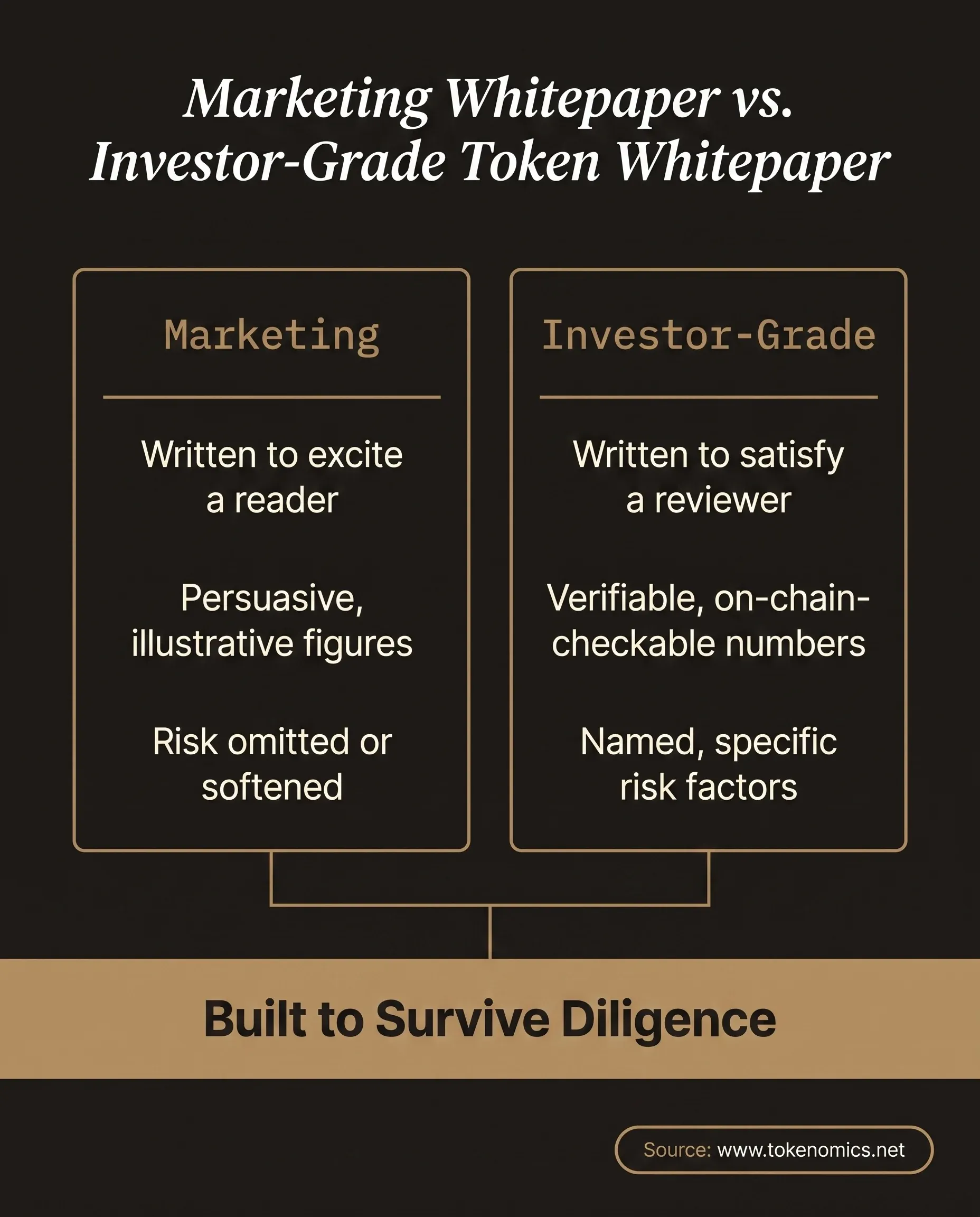
The structural difference comes down to who the document is written to withstand. A marketing whitepaper is written for a reader you want to excite. An investor-grade one is written for a reviewer you need to satisfy. In regulated capital-raising, disclosure documents are held to a completeness standard, and the SEC's framing of disclosure is a useful reference point for what that standard looks like: thorough, specific, and honest about risk. We are not saying a whitepaper makes an offering compliant. A document does not carry that weight, and claiming it does is its own kind of red flag. The point is narrower: the discipline that regulated disclosure demands is the same discipline that makes a token whitepaper hold up under review.
The tradeoff is real. A document written to survive scrutiny reads less like a sales pitch, and some founders resist that. The projects that get funded tend to accept it.
#What Investors Actually Expect From a Token Whitepaper (the Investor Tokenomics Document)
An investor tokenomics document earns its keep at the diligence stage, when a reviewer stops reading for interest and starts checking claims against reality. Here is what that check actually looks like.
Verifiable supply and unlock figures. A reviewer compares the circulating-supply and unlock numbers in the document against what is visible onchain. On-chain data sources like DefiLlama track circulating supply and unlock schedules directly, and a claim that does not match the chain is worse than no claim at all.
Vesting transparency. Named cliff and unlock dates, not "team tokens vest over time." Vague vesting language reads as either sloppiness or something being hidden, and neither helps you.
An audited-contract reference. Where the contract lives, which firm audited it, and whether the audit is public. A contract built on a reviewed, standards-based library such as OpenZeppelin's contract implementations gives a reviewer a known starting point, rather than a bespoke contract they have to reverse-engineer.
Consistency across documents. The same supply, allocation, and vesting figures in the whitepaper, the deck, and the data room. This is where a token whitepaper stops being a standalone file and becomes one document inside a larger investor package. If you have not assembled that package yet, our explainer on what a tokenomics data room is covers how the pieces fit together.
A visible tie to the business model. Investors increasingly discount a token design that has no connection to how the project makes money. Revenue-first design is not a slogan here. It is the question a reviewer asks when they finish the mechanics and want to know what backs them.
The through-line across all five is that an investor tokenomics document is checked, not read. Every figure is a claim someone can verify, so every figure has to be right. If you want the full set of documents a diligence team expects to see, our tokenomics data room checklist lays out the complete package.
#From Whitepaper to Launch: Common Mistakes and Where This Fits
A whitepaper does not stand at the start of the process, and it is not the finish line either. Mechanism design decisions come first. The whitepaper documents those decisions. Then the launch depends on the document's figures staying accurate all the way through. When the numbers drift between those stages, the whitepaper is where the gap shows up.
A few failure patterns show up across the projects we review.
Figures that drift between documents. Supply or allocation numbers in the whitepaper that no longer match the fundraising materials a few weeks later. A reviewer who spots one mismatch starts looking for others.
Utility that describes a feature the token does not enable. A utility section written for the roadmap rather than the current product. If the token does not do the thing today, the section has to say so.
Vesting schedules published without cliff dates. "Long-term aligned" is not a schedule. A reviewer wants the dates.
Legal disclosures copied from another project. A disclosure section lifted from a different token, in a different jurisdiction, without a review specific to this offering. Boilerplate here is worse than a shorter, honest section.
None of these are exotic. They are the ordinary ways a document falls out of sync with the project it describes. The fix is not elaborate, though it does take discipline: keep one source of truth for the figures, and update every document from it. The whitepaper sits upstream of the launch itself, so getting it right early makes the TGE process that follows far less fragile.
This is the work behind investor-grade whitepaper documentation: not writing a prettier document, but building one whose every figure holds up when someone checks it. Get the token whitepaper right, and the rest of the raise has a solid foundation to stand on.
#Where the Whitepaper Fits, and What to Do Next
A token whitepaper documents the economic design that investors, exchanges, and legal counsel will pull apart. It is not a marketing pitch, and it is not the business itself. The token is infrastructure. The business underneath it is the engine. The whitepaper's job is to document that infrastructure honestly enough to hold up under review. As diligence standards keep rising, the projects that treat the document that way are the ones that clear the bar.
The whitepaper is one piece of a larger set. It sits inside the complete data room a diligence team expects, alongside the financial model, the legal opinion, and the compliance artifacts.
If you're building onchain and need your token whitepaper to hold up under institutional scrutiny, book a discovery call. We'll assess your project and tell you whether we're the right fit. Sometimes we're not. We'll tell you that too.