MakerDAO Tokenomics Explained: MKR, DAI, and Sky's Endgame
A breakdown of MakerDAO tokenomics: how DAI and MKR work together, how the PSM and RWA collateral function, and what the Endgame restructuring into Sky changed.


MakerDAO's tokenomics only matter if the business underneath them creates real value: DAI holders trust the peg, borrowers pay a stability fee for access to liquidity, and the protocol converts that activity into revenue rather than manufacturing scarcity out of nothing. MakerDAO tokenomics is also one of the longest-running live tests of dual-token mechanism design in DeFi, and the protocol has run continuously since before most token models existed as a discipline, which makes it a useful reference point whether or not you are building anything remotely similar. This post looks at how the pieces fit together: the two tokens, the collateral mechanics, the levers governance actually pulls, and the 2024 Endgame restructuring that changed the protocol's name and token tickers without changing what it fundamentally does.
This is an observational read, not an evaluation of whether MKR, SKY, DAI, or USDS is a good asset to hold. Nothing here should be read as investment guidance. Tokenomics.net has no advisory, investment, or working relationship with MakerDAO, Sky, or any of its subDAOs; this is third-party mechanism analysis. Mechanism descriptions in this piece follow Sky's own protocol documentation at docs.sky.money; where a detail is not publicly documented, this piece treats it as general pattern rather than protocol-specific fact.
#What MakerDAO's Tokenomics Actually Coordinate
#Two tokens, two jobs
Strip away the branding and MakerDAO tokenomics comes down to two tokens doing two different jobs. DAI is the stable-value output: a decentralized stablecoin minted against collateral rather than held in a bank account. MKR is the governance-and-backstop token: it carries voting rights over the system's risk parameters, and it is also the instrument that absorbs losses if the system's collateral ever falls short. Neither token is redundant with the other, and neither one substitutes for the other's role.
#Why this protocol is a useful reference point regardless of your own token design
You do not need to be building a stablecoin to learn something from how MakerDAO structured this. The protocol has operated through multiple market cycles, several governance controversies, and one full structural rebrand, all while the underlying mechanism kept functioning. That track record is rare in this industry, and it is precisely why the design choices are worth understanding on their own terms before you decide whether any of them apply to your situation.
#The Dual-Token System: DAI and MKR
#DAI: the stability-fee-backed stablecoin
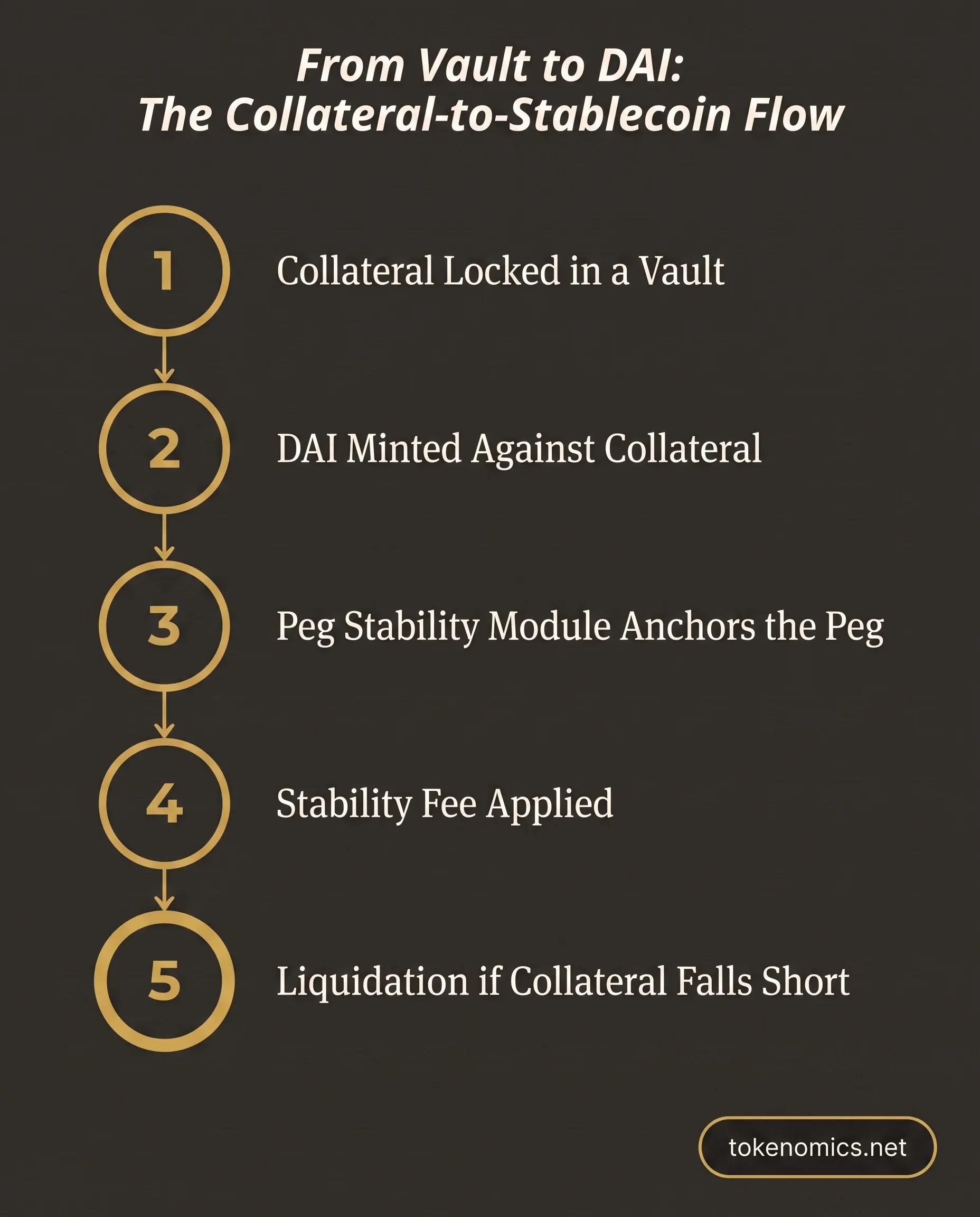
DAI is not backed by a reserve of dollars sitting in a bank account. Per Sky's protocol documentation, it is minted when a user locks approved collateral into a smart contract called a Vault and generates DAI against that collateral at a set liquidation ratio. This overcollateralized structure is the core difference between DAI and a fiat-backed stablecoin: DAI's backing lives entirely onchain and is verifiable at any time.
#MKR: governance rights plus the capital-at-risk backstop
MKR holders vote on the parameters that keep the system solvent: which assets qualify as collateral, how much DAI can be generated against each collateral type, and the stability fee charged on outstanding DAI. The part beginner explainers tend to skip is the backstop role. Per the protocol's documentation, if collateral value falls short during a shortfall event, governance can dilute MKR to recapitalize the system. MKR is not just a voting token; it is the instrument that absorbs tail risk on behalf of everyone holding DAI.
MakerDAO's dual-token approach is one expression of the same mechanism-design levers found across DeFi tokenomics more broadly: supply control, incentive alignment, and risk absorption working together. For a closer look at how voting power concentrates and what changes when protocols move to models like ve-tokenomics, see this breakdown of governance token design.
#How Vaults, Collateral, and the Stability Fee Work
#Opening and managing a Vault
A Vault locks approved collateral and lets its owner mint DAI against it, up to a ratio set by governance for that collateral type. As documented by Sky, if the collateral's value drops below the required threshold, the Vault becomes eligible for liquidation, and a penalty on the liquidated amount flows back into the system as revenue.
#The stability fee as a monetary-policy lever, not a fee in the retail sense
The stability fee is often described as an interest charge, and mechanically it is one, but its real function is closer to a central bank's policy rate. Per Sky's documentation, governance raises the stability fee to cool DAI issuance when demand for new DAI is running ahead of the system's risk appetite, and lowers it to stimulate minting when the opposite is true. It is a lever for managing DAI's peg, applied continuously rather than set once.
The same first-principles approach applies to stablecoin design more broadly, including the mechanisms that keep other pegs stable under stress.
#Where the Peg Stability Module and RWA Collateral Fit In
#The PSM as a 1:1 stablecoin swap mechanism
Per Sky's documentation, the Peg Stability Module lets users swap approved stablecoins for DAI at close to a 1:1 rate. This dampens peg volatility during periods of stress, since arbitrage through the PSM keeps DAI's market price anchored. The tradeoff is concentration risk: the PSM's stability depends on the health and custodial soundness of whatever stablecoin backs it.
#Real-world-asset collateral and what it changes about the risk model
A question worth answering against the protocol's own disclosures is how much of the collateral base now sits in real-world assets rather than purely on-chain collateral, because that mix is what determines the risk model. A purely crypto-collateralized system carries market and liquidation risk that lives entirely onchain and is transparent by design. A system that also holds traditional-finance collateral adds counterparty, custodial, and legal risk that sits partly offchain, outside the protocol's own code. It is the single mechanism in MakerDAO's design most directly comparable to real-world-asset tokenization more broadly, where the same tradeoff between onchain transparency and offchain dependency shows up again and again.
That same tradeoff, onchain transparency against offchain dependency, is the central design question in real-world-asset tokenomics generally, not just in MakerDAO's specific implementation.
#The Dai Savings Rate and MKR's Value Capture
#DSR as a yield lever on held DAI
Per Sky's documentation, the Dai Savings Rate lets DAI holders earn a yield directly from protocol revenue by locking their DAI in a dedicated contract. It functions as a second monetary-policy lever alongside the stability fee: raising the DSR makes holding DAI more attractive relative to spending or redeploying it, which pulls DAI out of circulation and supports the peg from the demand side rather than the supply side.
#The Smart Burn Engine and how protocol revenue reaches MKR
Per Sky's documentation, burn-and-reallocation designs like this route protocol surplus, generated from fees and yield on the protocol's own collateral, into a mechanism that reduces the governance token's circulating supply over time rather than distributing that surplus directly to holders. This is worth describing precisely: it is a supply mechanism built into a protocol's revenue design, not a promise about what any given governance token should be worth. How markets price that mechanism is a separate question this post does not address.
Whether a burn mechanism actually creates value or just looks impressive on a dashboard is worth examining on its own terms; see this breakdown of token burn mechanisms for the underlying logic.
#MakerDAO's Endgame Restructuring: subDAOs, NewGovToken, and the Sky Rebrand
#Why the protocol restructured
Per Sky's documentation, the Endgame plan restructures MakerDAO's governance into semi-independent subDAOs, each intended to specialize in a narrower set of risk decisions rather than routing every parameter change through a single, increasingly crowded governance process. The stated goal is to reduce single-point bottlenecks in a system that has grown considerably more complex than it was at launch.
#SubDAOs, MKR-to-SKY, and DAI-to-USDS at a glance
The most visible surface change is the parent-brand rename to Sky, alongside the MKR-to-SKY and DAI-to-USDS token migrations. This is also the part of the protocol most likely to be described inaccurately in older explainer content still written against the pre-Endgame single-token model. SubDAO rollout status and migration completion move as governance continues to execute the Endgame plan, so readers evaluating either should check MakerDAO's or Sky's own governance-forum documentation for the current state rather than relying on any single snapshot, including this one.
If you want to understand what a structured review actually checks before treating a protocol's mechanism design as sound, see what a tokenomics audit covers.
#Governance Risk and Regulatory Exposure
#Governance-concentration and voter-turnout risk
Voter turnout and delegate concentration are structural risks common to essentially every token-voted protocol, not a criticism specific to MakerDAO. A governance system built on token-weighted voting is only as decentralized as its actual participation, and that participation tends to concentrate among a relatively small number of active delegates in most protocols, MakerDAO included.
#Regulatory posture on RWA-collateralized DeFi
This is a factual distinction worth holding onto: a protocol that holds real-world assets like short-duration Treasuries as collateral has part of its risk surface sitting inside the same regulatory perimeter that governs tokenized securities and money-market products. That is an established structural fact about RWA-collateralized DeFi generally, and it is an area of active attention from securities regulators. Whether or how enforcement plays out for any specific protocol is not something this post speculates on.
If you are working through your own protocol's mechanism design, and want to know whether it is just elegant machinery or actually captures value the way MakerDAO's lending and collateral business does, that is worth a conversation before you finalize anything.