What Is a Tokenomics Audit? (And What to Expect When You Commission One)
A tokenomics audit is a structured review of your token model's mechanics, supply schedule, and compliance readiness. Learn what it covers, what you receive, and when to commission one.


Tokenomics audit: A structured technical review of a protocol's token model that evaluates supply architecture, revenue mechanics, incentive alignment, token classification, compliance readiness, liquidity strategy, and distribution risk, producing documented findings and prioritized remediation steps for use in investor due diligence, exchange listing applications, and legal opinion workflows.
A tokenomics audit is a structured technical review of a protocol's token model that evaluates supply architecture, revenue mechanics, incentive alignment, token classification, compliance readiness, liquidity strategy, and distribution risk. Unlike a whitepaper review, a tokenomics audit produces specific findings with remediation steps: it tells founders not just what the design says but whether the design holds up under institutional scrutiny from investors, exchanges, and legal teams. The output is a documented analysis that feeds directly into investor due diligence packages, exchange listing applications, and legal opinion workflows.
Projects that skip this step discover the same categories of problems we see across 100+ engagements: supply schedules that concentrate sell pressure in exactly the wrong windows, revenue mechanics that treat the token's price appreciation as the product rather than an underlying business, and compliance postures that legal teams cannot defend in a post-Coinbase enforcement environment. The cost of finding these issues before launch is bounded. The cost of finding them after is not. Read more on the blog.
#Why Tokenomics Audits Are Not Optional Anymore
Two years ago, a well-designed whitepaper and a reasonable allocation table could close a Series A. That window is closed.
Exchange listing teams at Tier 1 and Tier 2 venues now request audit documentation as a condition of the listing review, not as an optional attachment. Institutional LPs, family offices, crypto-native funds, and the early movers from traditional finance entering via structured products such as Ondo Finance tokenized treasury products, have internal investment committees that require independent mechanism review before they can allocate. This isn't due diligence theater. These teams have absorbed the lessons from $2B+ in post-TGE drawdowns tied to preventable tokenomics failures.
The enforcement environment reinforces this. Post-Coinbase, the Tornado Cash OFAC sanctions, and the FIT-21 digital asset legislation, the regulatory posture for token projects has hardened. Founders who cannot demonstrate that they understood their token's classification and compliance exposure before launch face a harder conversation with their legal team, their exchange, and potentially a regulator. An audit creates the paper trail showing the project analyzed these questions seriously.
What we see across a tokenomics review: the problems are rarely novel. The methodology has been refined over 100+ tokenomics engagements; book a strategy call if you want to walk through what an audit covers for your project. Founders who launch without an audit almost always have one or more of the same seven categories of structural risk in their model. The audit's job is to find which category the project is in before the market finds it for them.
#The Seven Dimensions of a Tokenomics Audit
A complete tokenomics audit runs across seven dimensions. Each dimension corresponds to a documented deliverable section in the audit report; a finding in any dimension is a remediation item before the report closes.
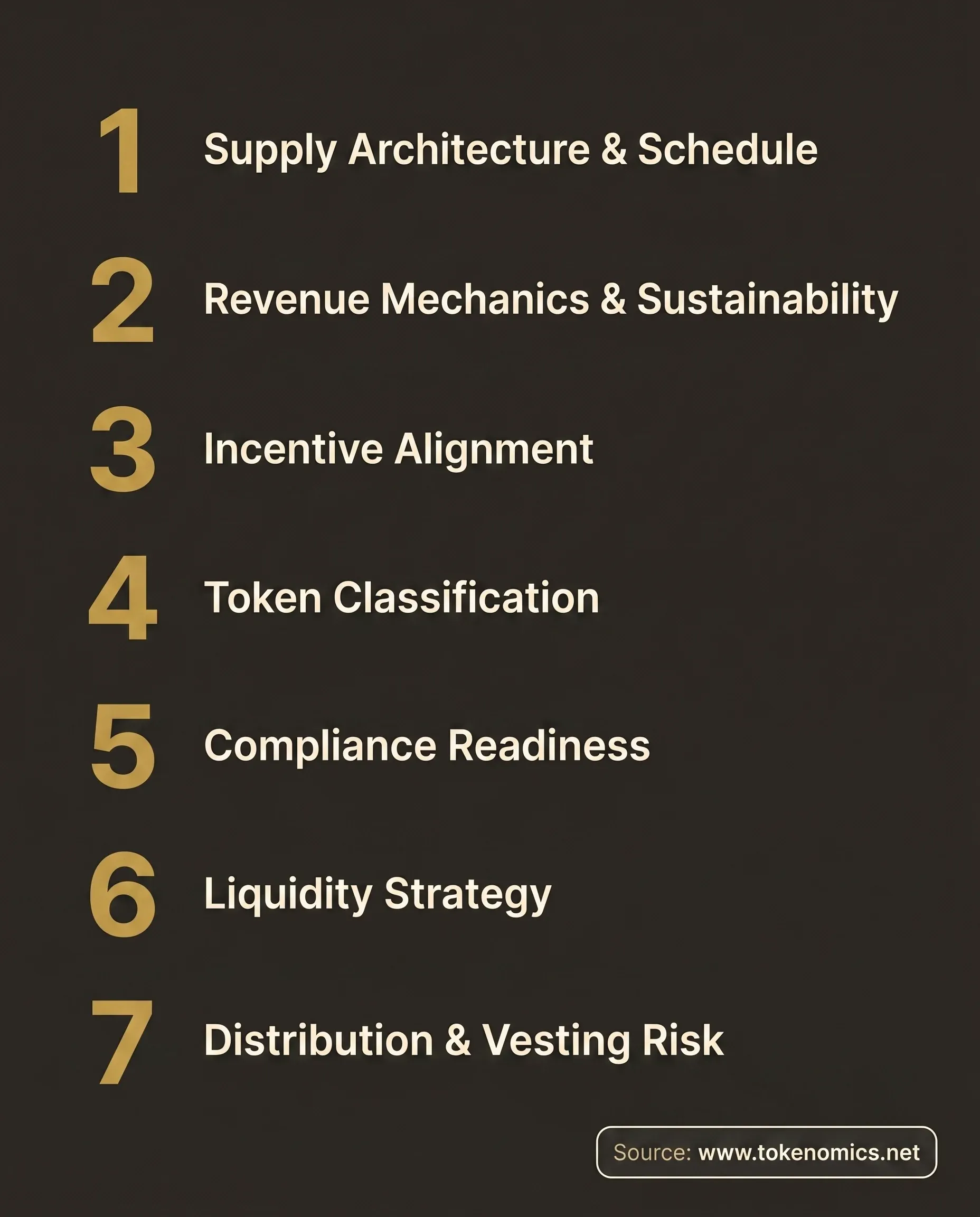
Supply architecture and schedule. This dimension maps total supply, vesting cliffs, unlock events, and the resulting circulating supply curve across the first 36 months post-TGE. The specific question: where are the concentrated sell windows? Unlock cliffs between months 12 and 18 have caused more post-TGE price failures than any other single factor we track across our portfolio. This is the most documented dimension in most tokenomics reviews, but documentation without analysis of the business's ability to absorb the sell pressure misses the point.
Revenue mechanics and sustainability. Most audits skip this dimension entirely. This is the most expensive mistake. A token model that relies on emissions, buy pressure from new entrants, or speculation as its primary value driver is a countdown timer. A sustainable token economy has an underlying business that generates revenue, and the token's mechanics create a durable relationship between that revenue and the token's value. If the protocol cannot articulate how the business makes money independent of the token's price action, the audit surfaces this as a first-order finding.
Incentive alignment. This dimension asks whether founder, investor, community, and team incentives are structurally compatible across the token's lifecycle. The most common failure pattern: founder and early investor vesting is back-weighted, creating a window where community token holders are most exposed to sell pressure exactly when the founders have maximum unlocked tokens. Alignment problems rarely appear in the whitepaper; they emerge when the allocation table, the vesting schedule, and the token's market cap trajectory are modeled together.
Token classification. Classification analysis determines whether the token functions as a utility token, a security token, a governance token, or a payment token under the applicable regulatory framework. This analysis is fact-specific and jurisdiction-specific; no audit report can declare a token "not a security" as a categorical finding. The applicable framework in U.S. contexts begins with the Howey test as interpreted by the SEC across enforcement actions and no-action letters. What the audit produces is a documented classification analysis showing which framework was applied, what factors were evaluated, and where the design sits relative to relevant regulatory tests. The legal team's opinion follows from this analysis; it does not replace it.
Compliance readiness. This dimension reviews the token's design for compliance with applicable frameworks: KYC/AML obligations, accreditation requirements where the token may constitute a security offering, MiCA registration requirements for EU-facing projects, and the emerging requirements under FIT-21 for U.S.-domiciled operations. The audit does not render a legal compliance opinion. It documents the design's compliance posture so the legal team can render theirs from a complete picture. The difference matters: design compliance readiness and legal compliance are related but distinct outputs.
Liquidity strategy and market-making provisions. This dimension reviews the protocol's plan for DEX liquidity, market-maker arrangements, and the token's ability to absorb sell pressure at key unlock events. Most projects arrive at the audit with a DEX launch plan that does not model the sell pressure from team unlocks and early investor unlocks occurring simultaneously. The audit models this explicitly.
Distribution and vesting risk. The final dimension synthesizes the supply architecture findings and the incentive alignment findings into a forward-looking distribution risk assessment. The specific output: a characterization of the top-five concentration risks in the protocol's token distribution and a prioritized remediation sequence.
#What a Tokenomics Audit Actually Delivers
The output is not a grade. It is a documented set of findings across each of the seven dimensions, with a remediation priority ranking, specific mechanism changes where applicable, and the evidence base the legal team and the investor DD team need to proceed.
A standard audit deliverable includes: a supply curve analysis with unlock event modeling, a revenue mechanics assessment with sustainability scoring, an incentive alignment map across all allocation buckets, a classification framework application memo, a compliance readiness summary by jurisdiction, a liquidity strategy analysis, and a distribution risk assessment with prioritized remediation steps.
This documentation feeds three downstream workflows simultaneously. The legal team uses the classification memo and compliance readiness summary to structure their legal opinion. The exchange listing team uses the supply analysis and distribution risk assessment to evaluate listing parameters. The investor DD team uses the full package to confirm the project has done the work. Projects that commission an audit before approaching any of these three parties save themselves the most common cause of deal friction: being asked for documentation that does not exist.
#When to Commission a Tokenomics Audit
The highest-leverage moment is pre-TGE. At this stage, every finding is a design change; nothing has been deployed, no community expectations have been set around allocations, and the cost of remediation is low. Projects that audit at this stage consistently report shorter legal review cycles and smoother exchange conversations.
The second-best moment is post-launch but pre-listing. The core token mechanics are deployed and most findings become operational adjustments rather than mechanism redesigns. The distribution and vesting terms cannot be changed, but the compliance posture, liquidity strategy, and the documentation package can all be strengthened before the listing application.
The hardest case is crisis triage: an audit commissioned because the protocol's price is exhibiting sell-pressure patterns the team doesn't understand, or because a regulator has asked questions the legal team cannot answer with existing documentation. Across our portfolio, these engagements are recoverable in roughly 70% of cases. The remaining cases have structural flaws in the mechanism that the audit can document but cannot design away retroactively.
The firm's standing advice: audit before you build the community, not after. Community token holders who have been given allocations based on an unreviewed supply schedule cannot be easily re-allocated. Founders who audit early avoid this constraint entirely.
#Common Mistakes We See in Tokenomics Audits
The failure patterns across 100+ tokenomics audits are predictable. They cluster into four categories.
Treating the audit as a rubber stamp. Projects that commission an audit specifically to produce a document they can show investors, rather than to find and fix structural problems, consistently receive the most critical findings. An audit that returns only minor findings against a poorly-designed model is not a clean result; it means the auditor's scope was too narrow. A thorough audit of most pre-TGE models will surface at least one finding in the supply architecture dimension and one in revenue mechanics. Zero findings against a novel mechanism design is a signal to re-examine the audit methodology.
Auditing supply schedules only. The token model audit scope should run across all seven dimensions. Projects that commission a supply schedule review and call it a tokenomics audit are skipping five of the seven dimensions where most production failures originate. Revenue mechanics, incentive alignment, and compliance readiness are not secondary concerns; they are the primary concerns in the current market.
Commissioning an audit from a team with no revenue-first design experience. An auditor who treats the token's price action as the product will miss the most important dimension of any audit: whether the underlying business justifies the token's value at all. The firm's methodology is explicit on this point: a token without sustainable revenue mechanics is a countdown timer. Auditors who don't start from this principle will not find the problems that originate there.
Treating the audit report as the final documentation. The audit report is a starting point for the project's investor-grade documentation package, not the end product. Projects that deliver the audit report to an investor without the remediation items resolved, without the legal opinion that incorporates the audit findings, and without the compliance documentation the audit surfaces as a gap are delivering an incomplete package. The audit's value is proportional to what the project does with the findings.
#Frequently Asked Questions
What does a tokenomics audit include? A tokenomics audit covers seven dimensions: supply architecture and vesting schedule analysis, revenue mechanics and sustainability assessment, incentive alignment across all allocation buckets, token classification analysis under applicable regulatory frameworks, compliance readiness by jurisdiction, liquidity strategy and market-making review, and distribution and vesting risk assessment. Each dimension produces specific findings with prioritized remediation steps.
When should a project commission a tokenomics audit? The highest-leverage moment is pre-TGE, when all findings are still design changes and the cost of remediation is lowest. Post-launch but pre-listing is the second-best moment. Crisis triage audits after launch are possible and are recoverable in roughly 70% of cases, but structural mechanism flaws identified at that stage are harder and more expensive to address.
What is the difference between a tokenomics audit and a whitepaper review? A whitepaper review evaluates what the design claims. A tokenomics audit evaluates whether the design holds up under institutional scrutiny. The audit adds quantitative modeling, supply curve analysis, unlock event pressure testing, revenue sustainability scoring, that a whitepaper review does not produce. The audit output feeds investor due diligence, exchange listing applications, and legal opinion workflows; a whitepaper review does not.
How long does a tokenomics audit take? A complete tokenomics audit across all seven dimensions typically runs four to six weeks, including the modeling, the review, and the documented findings with remediation steps. Crisis triage engagements can be scoped to a shorter window by narrowing the dimensions reviewed, but the core supply architecture and compliance readiness dimensions require a minimum of two weeks each for thorough analysis.
Can a tokenomics audit guarantee compliance? No audit can guarantee compliance, and any auditor who claims otherwise is misrepresenting the product. The audit produces a compliance readiness assessment that documents the design's posture relative to applicable regulatory frameworks, KYC/AML, Regulation D, MiCA, FIT-21, and surfaces gaps. The legal team's compliance opinion follows from the audit analysis; it is a separate product issued by a separate party accountable under legal professional standards.
What happens if the tokenomics audit finds serious problems? Serious findings are resolved through a remediation sprint. Supply architecture problems resolve at the design layer before any public allocation commitments. Revenue mechanics problems may require business model clarification. Compliance readiness gaps feed directly into the legal opinion timeline. In our experience, projects that find serious problems through the audit process and resolve them before launch consistently perform better post-TGE than projects that discover the same problems in the market.
Do exchange listing teams require a tokenomics audit? Tier 1 and Tier 2 exchange listing teams increasingly request audit documentation as part of the listing review process. This is not universal and varies by exchange and jurisdiction, but it is the direction the market is moving. Projects that arrive at the listing conversation with a complete audit package, a remediated design, and a legal opinion move through the review faster than projects that provide a whitepaper and an allocation table.
#What to Do With the Audit Findings
When a tokenomics audit returns findings, the remediation sequence matters as much as the findings themselves. Supply architecture findings typically remediate at the design layer (mechanism changes, vesting schedule adjustments) and should be resolved before any public allocation commitments. Revenue mechanics findings often require business model clarification that goes beyond the token design, if the protocol cannot articulate how the business makes money independent of price appreciation, the audit surfaces this as a business question, not just a tokenomics question.
Classification and compliance findings feed directly into the legal opinion timeline. Most legal teams working on token projects need four to six weeks to issue an opinion that incorporates the classification analysis. Remediating the audit findings before the legal team begins their review shortens that timeline and reduces the risk of the opinion returning conditional findings that require another round.
The projects that get the most from a tokenomics audit treat it as a structured diagnostic with a follow-on remediation sprint, not as a certification process. The audit answers the question "where are the structural risks?" The follow-on sprint answers "what do we do about them, and in what order?"
The bar for what institutional investors and exchange listing teams expect from a tokenomics audit package has risen significantly over the past 24 months. Projects that enter these conversations with a complete audit, a remediated design, and a legal opinion that incorporates the audit findings are arriving prepared. Projects that arrive with a whitepaper and an allocation table are arriving two steps behind.
If you're building onchain and need your tokenomics to hold up under institutional scrutiny, book a strategy call. We'll assess your project and tell you whether we're the right fit. Sometimes we're not. We'll tell you that too.