Huma Finance: What It Is and How the PayFi Protocol Works
Huma Finance is a PayFi protocol financing real-world payment flows onchain. What it does, how the model is structured, and where to verify it yourself.


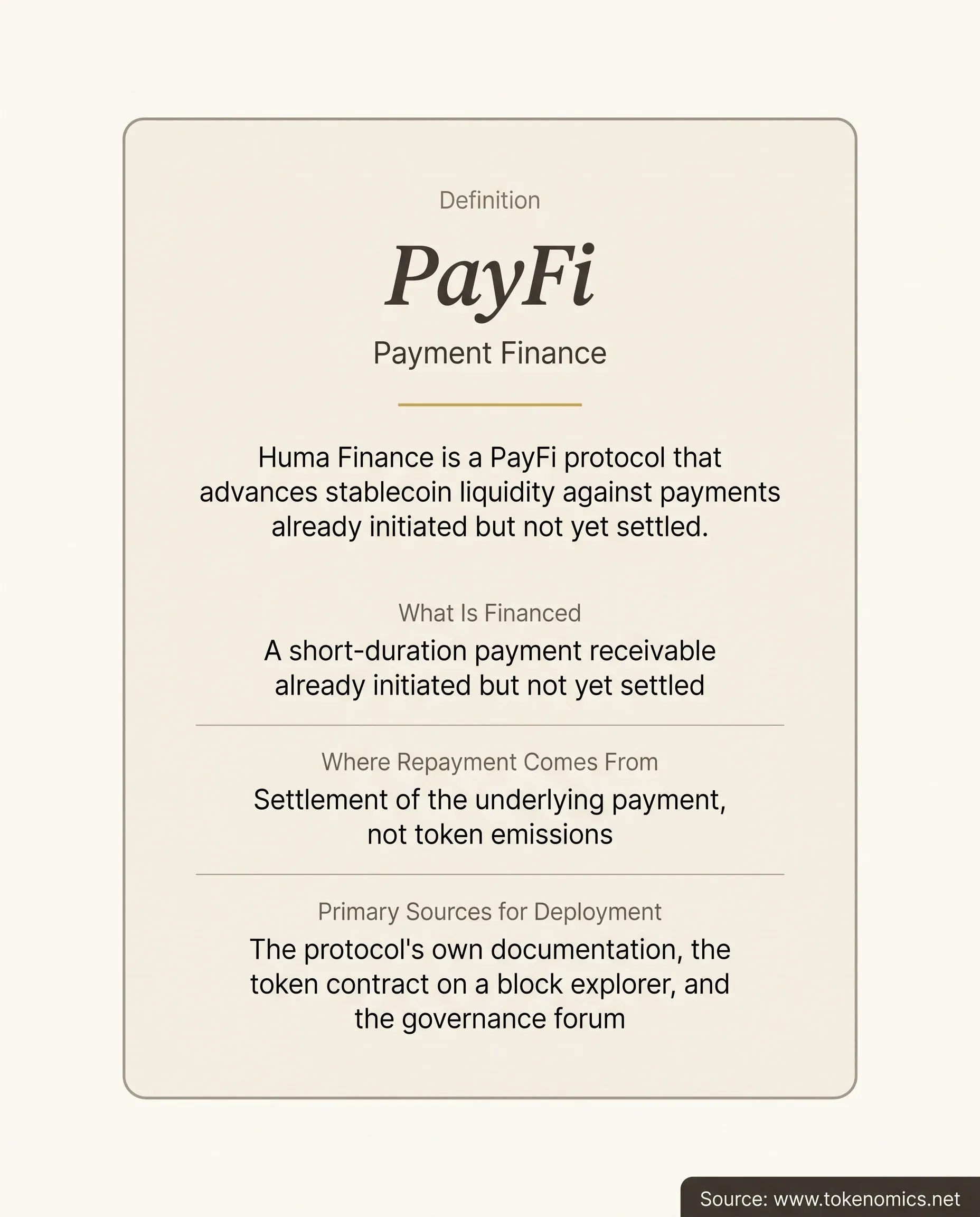
Huma Finance is a PayFi protocol that puts stablecoin liquidity behind real-world payment flows, advancing funds against payments that have been initiated but have not yet settled (Source: Huma Finance documentation). PayFi is short for payment finance: credit extended against receivables a payment business generates in the ordinary course of moving money.
Search any protocol by name and you get two kinds of results: the protocol's own marketing, and aggregator listings reporting supply and price. Neither answers the question an operator actually has: does this finance a real cash flow, or does the return come from token emissions? That question is answerable. The answer sits in primary sources.
#What Is Huma Finance?
Huma Finance: a PayFi protocol that advances stablecoin liquidity against payments already initiated but not yet settled, with repayment sourced from the underlying payment's settlement rather than token emissions.
Huma Finance is infrastructure for financing payments, not a lending market against crypto collateral. The distinction matters. A collateralized lender underwrites an asset you already hold. A payment-financing protocol underwrites an obligation someone else owes you, and repayment arrives when the underlying payment clears.
Which networks the pools run on, and which pools are open, changes. Protocols migrate and retire pools, and third-party listings lag by weeks. Read the current deployment off the protocol's own app and documentation.
#How Huma Finance's Model Works
#What actually gets financed
Start with the business activity, not the token. A payment institution moving money across borders has to fund the receiving side before the sending side's money arrives. That gap runs for days, and somebody carries it. Traditionally that meant pre-funded bank accounts sitting idle in every corridor. Huma Finance's documentation describes the protocol as financing that kind of short-duration, payment-linked receivable.
Repayment comes from the settling payment itself. That is the detail worth confirming, because it is what separates a financing protocol from a yield wrapper. A token without sustainable revenue mechanics is a countdown timer.
#Where the liquidity comes from
Liquidity providers deposit stablecoins into a pool. The pool advances against receivables. Repayment plus a financing fee flows back. That is the shape of it. The risk is credit.
Three questions decide whether a pool holds up: who the borrowers are and how they were vetted, who absorbs first loss when a receivable does not perform, and what happens on default. Those answers are documented per pool, not at the protocol level. For the same underwriting questions applied to a longer-duration credit category, see how tokenized private credit actually works.
#Does Huma Finance Have a Token?
The protocol's own token documentation and governance forum are the source of record. Whether a token is live, what it does, and how supply is scheduled are disclosed by the protocol or they are not established facts.
We are not reproducing supply, allocation, or unlock figures here. The numbers that circulate for any protocol token are typically copied from aggregator emissions charts, which are reconstructions rather than the issuer's disclosure. Pull total supply, circulating supply, and the vesting schedule from the published token documentation, then confirm the contract on the explorer for its deployed network.
What to read for: whether the token's function is governance, fee-related, incentive distribution, or some combination, and whether liquidity-provider returns come from financed payments or from emissions.
None of this is a view on whether to buy, hold, or sell anything. We describe what a token is designed to do. Receivables financing also sits close enough to securities-adjacent territory that the classification question is fact-specific and jurisdiction-specific.
#Who Runs the Protocol
Most projects make the mistake of accepting a crypto-media recap as sourcing on a team. It reads like reporting. It is usually a press release with a byline.
The team page, the entity disclosures, and a named investor's own published statement are the sources that hold up under scrutiny. Then the diligence question is not whether the names are impressive. It is whether the operating team has run payments before, and whether the capital behind it is fintech money or generalist crypto money.
#Where Huma Finance Fits in the RWA and PayFi Category
Huma Finance sits in the same broad category as Centrifuge on-chain credit markets and Maple Finance institutional lending. The three are not interchangeable. Across the RWA category, protocols typically differ by the collateral class they underwrite and how long that collateral stays outstanding, which is set out in each one's own documentation. PayFi narrows the duration: the receivable is a payment already in flight, and it resolves in days rather than months.
Duration changes the risk profile. Short-duration receivables turn over constantly, so pool performance shows up fast and a weak book cannot hide for a year.
The evaluation question is the same across all of them. Where does the return come from when token incentives are switched off? If the answer is a documented payment or credit flow with an identifiable obligor, there is a revenue engine underneath. If the answer is emissions, you are looking at distribution, not revenue. Answering that question for your own protocol is exactly what a Tokenomics Audit is for.
#Where to Go Next
The destination for anyone searching Huma Finance by name is the protocol's own site at huma.finance and the documentation linked from it, where the live app, open pools, and deployment details are published.
To verify anything in this post, three sources do the work: the documentation for mechanism and contract addresses, the block explorer for those contracts, and the governance forum for proposals carrying IDs and timestamps. If a figure cannot be traced to one of those three, treat it as a claim rather than a fact. If you need that same discipline applied to your own token model, that is what our Tokenomics Consulting service does.
Payment financing is one of the few onchain credit categories where you can name the underlying cash flow in a sentence and check it the same afternoon. That makes it a useful benchmark. If you can't say where your protocol's revenue comes from, and point a stranger to where they can verify it, the model is not finished.
If you're building onchain and need your tokenomics to hold up under institutional scrutiny, book a strategy call. We'll assess your project and tell you whether we're the right fit. Sometimes we're not. We'll tell you that too.