Pump.fun Revenue: How the Fee Model Works and Who Captures It
Pump.fun revenue comes from launch and trading fees. How the fee model works, who captures the value, and why public dollar figures are hard to verify.


Pump.fun revenue is fee income the platform collects across four points in its launch-and-trading flow: token creation, bonding-curve trading, migration to an automated market maker, and post-migration trading. The fee schedule is an operator-controlled parameter published in Pump.fun's own documentation, not a fixed protocol property.
Pump.fun revenue is fee income the platform collects on activity passing through its token-launch and trading infrastructure: creating a token, trading it against the bonding curve, migrating it to an automated market maker, and trading it there afterward. It is a toll on flow. The platform earns when tokens get launched and traded, whether or not any individual token goes anywhere.
That distinction matters more than the headline number, and the headline number is where most coverage stops. Search "pump fun revenue" and you get a cumulative dollar total lifted from a dashboard screenshot, with no stated methodology behind it. This piece works the fee mechanism through from Pump.fun's own documentation, traces where a fee goes, and explains why we are not handing you a headline figure.
Here is the frame underneath all of it. Fee capture on speculative volume is a real revenue mechanism, and it is not the same thing as value creation. A platform that monetizes the act of launching tokens earns from activity it never has to sustain. Whether that qualifies as a durable business is the question a founder studying this pattern actually needs answered, and it is a separate question from whether the number is large.
#What Pump.fun actually charges for
Pump.fun revenue: fee income the platform collects across four stages of its token-launch and trading flow, namely token creation, bonding-curve trading, market-maker migration, and post-migration trading.
Pump.fun fees attach to distinct events, not to one blended rate. Per Pump.fun's own documentation, the platform operates a permissionless launch mechanism on Solana where a token is deployed against an automated bonding curve, trades along that curve, and migrates to an automated market maker once it crosses a threshold. Each of those stages is a separate opportunity to charge.
Four touchpoints are worth separating when you model this:
Token creation. Deploying a token costs something, even if the platform's own cut at this stage is small relative to Solana network costs.
Trading against the bonding curve. A percentage of each buy and sell before migration. This is the highest-frequency event in the model.
The migration event. When a token crosses the graduation threshold and its liquidity moves to a market maker, that transition is itself a chargeable event.
Post-migration trading. Once a token trades on an automated market maker the platform operates, swap fees on that venue accrue to the venue.
Pump.fun revenue therefore has four sources, not one, and they respond to different conditions.
Now the part most write-ups skip. The fee schedule is a parameter the operator controls, which means it is subject to revision at the operator's discretion rather than locked at launch. Any percentage you read, including in an article published today, is a snapshot of a mutable setting rather than a fixed property of the protocol. Read the current numbers off the platform's live documentation and confirm them against the deployed program. That mutability is itself a fact about the Pump.fun business model: the operator can reprice its own toll.
#How Pump.fun revenue flows from trade to treasury
Before tracing the mechanism, it helps to fix what a revenue model actually describes: where money enters a protocol and who is entitled to it.
Follow one fee and the accounting question answers itself. A trader signs a transaction. The program routes a portion of that trade to a fee-recipient account defined in the program's instruction logic. That account accumulates. What happens next is where the claims start outrunning the evidence.
The methodology that holds up has three steps. Pull the program ID and the fee-recipient address from Pump.fun's own documentation or the deployed program. Load that address into a Solana explorer. Classify inflows against outflows, and label what you cannot classify as unclassified rather than assuming it.
That last step is where most public analysis breaks down. An account balance tells you what arrived. It does not tell you what the operator did with it afterward, or what obligations sit against it.
Which brings us to the highest-risk claim in this topic. Assertions circulate that Pump.fun revenue funds PUMP token buybacks, burns, or a holder revenue share. We are not repeating any version of that claim, because we have not verified one against a primary source. Two sources would settle it: the protocol's own announcement or governance post, and the on-chain record of outflows from the named fee account to a named buy-side or burn destination. A dashboard row labeled "buybacks" with no query behind it is not evidence.
#The pump fun revenue figures that circulate publicly
Public dollar totals for Pump.fun revenue vary widely between providers, and the variation is not noise. It is methodology.
At least four decisions sit behind any headline figure, and dashboards rarely publish which ones they made:
Gross or net. Total fees collected, or fees collected after whatever share is routed to token creators or other counterparties.
Protocol fee or all fees. Some trackers count every fee generated by activity on the platform. Others count only the portion the operating entity keeps.
Cumulative or trailing. Since-launch totals and trailing-30-day totals describe different businesses and are frequently presented in the same visual register.
Conversion timing. Fees are collected in SOL. A USD figure depends on whether each fee is converted at the SOL price at trade time or the whole balance is marked at a snapshot price. Those two methods diverge over any period where SOL moved, and this one is almost never disclosed.
CoinGecko, CoinMarketCap, DefiLlama, and Messari are useful for orientation. None of them is a primary source for how a protocol's fee mechanism works or for the methodology behind a revenue total, and we do not treat them as one.
So this analysis does not quote a headline figure for Pump.fun revenue. Not because the number is unknowable, but because a number without a published methodology is not information you can act on.
The qualitative pattern is the part that survives every methodology. Pump.fun revenue is a toll on activity, so it moves with launch and trading volume rather than resting on a recurring base, and that sensitivity is a property of the model rather than of any dashboard's accounting choices. The variance is the analytically important fact. The total is not.
#Who actually captures pump fun revenue
Three destinations are possible for Pump.fun revenue, or for fee income on any protocol, and they are frequently conflated:
The operating entity. Fees accrue to a treasury or company account controlled by the team. This is the default in the absence of any other mechanism.
Token holders, via a defined mechanism. Fees are routed to holders through an explicit, enforced distribution contract or an equivalent published mechanism.
No defined claim at all. Fees accrue somewhere, and no document gives any holder a claim on them.
The distinction that matters for anyone studying the Pump.fun business model is this: holding a token does not create a claim on a protocol's revenue. A claim exists only where a mechanism defines one and something enforces it. To know which of the three applies to PUMP, check the token's own documentation and the deployed program logic, not a dashboard row and not a thread.
Two things follow, and the second is opinion.
The observation: a fee-capture business and a token that trades against that business are separate objects. They can be connected by design. They are not connected by default.
The opinion: in our view, the closer a token sits to an enforced revenue-share mechanism, the more fact-specific the regulatory analysis becomes, and that analysis belongs to a legal team rather than to a blog post. Founders modeling a fee-share into their own design need to know that question exists before they build it.
#Is the pump fun revenue model sustainable
Most people read a large cumulative revenue figure as evidence that a business works. That reading is backwards. A cumulative total measures how much activity has passed through a mechanism. It says nothing about whether that activity recurs.
Structurally, Pump.fun revenue scales with one input: speculative launch volume. Not with recurring usage of a product that exists independent of the launch mechanism. Not with a subscription base, a contracted revenue line, or an asset under management. The revenue line and the speculation cycle are the same line drawn twice.
That creates a specific and nameable exposure. Revenue models this concentrated in launch-cycle activity have historically shown high sensitivity to shifts in speculative volume. What that means for any specific future period is not something this analysis predicts, and anyone telling you otherwise is selling something.
The honest version of the sustainability question is not "will volume hold." It is narrower and more useful: what does this business earn when launch activity is at its trough, and does that floor cover the cost of operating the platform? A high peak with no floor is a different asset than a modest peak with a durable floor, even when the cumulative totals look similar.
Founders designing a fee-capture mechanism into their own token should model that floor before launch, not after. Our Tokenomics Design service starts with exactly that floor.
#Fee capture is not a business model
A token without sustainable revenue mechanics is a countdown timer. That line applies to the token layer, and the same logic applies one level down, to Pump.fun revenue itself.
Monetizing the act of launching a token is a real revenue mechanism. It is also a mechanism whose input is other people's speculation rather than demand for a service that would exist if the speculation stopped. Revenue-first design asks a harder question than "does money arrive." It asks what the money is payment for, and whether the thing being paid for would still be wanted in a quieter market.
This is the line that separates the work we do from the pattern under examination. We design for sustainability, not for pump dynamics, and teams looking for hype mechanics are the wrong fit for the firm. Across 80+ projects, the failure mode we see most often is a team that built a fee switch before it built anything worth charging for. See the most common tokenomics design mistakes we catch before launch. The switch works. The demand underneath it was borrowed from a market cycle, and it left.
None of that is a judgment about Pump.fun specifically, and we have no advisory relationship with the platform to disclose. It is a category distinction, and it is the one a founder actually needs. Fee capture answers how money arrives. It does not answer why it keeps arriving.
If you want a second opinion on whether your own fee mechanics hold up, our Tokenomics Audit service is built for exactly that gap.
#How this compares to other protocol revenue mechanisms
Placed against other documented revenue mechanisms, Pump.fun revenue sits at one end of a spectrum defined by how much of the income depends on speculation.
| Revenue mechanism | Money comes from | Who holds a documented claim | Speculative dependency | Verifiability |
|---|---|---|---|---|
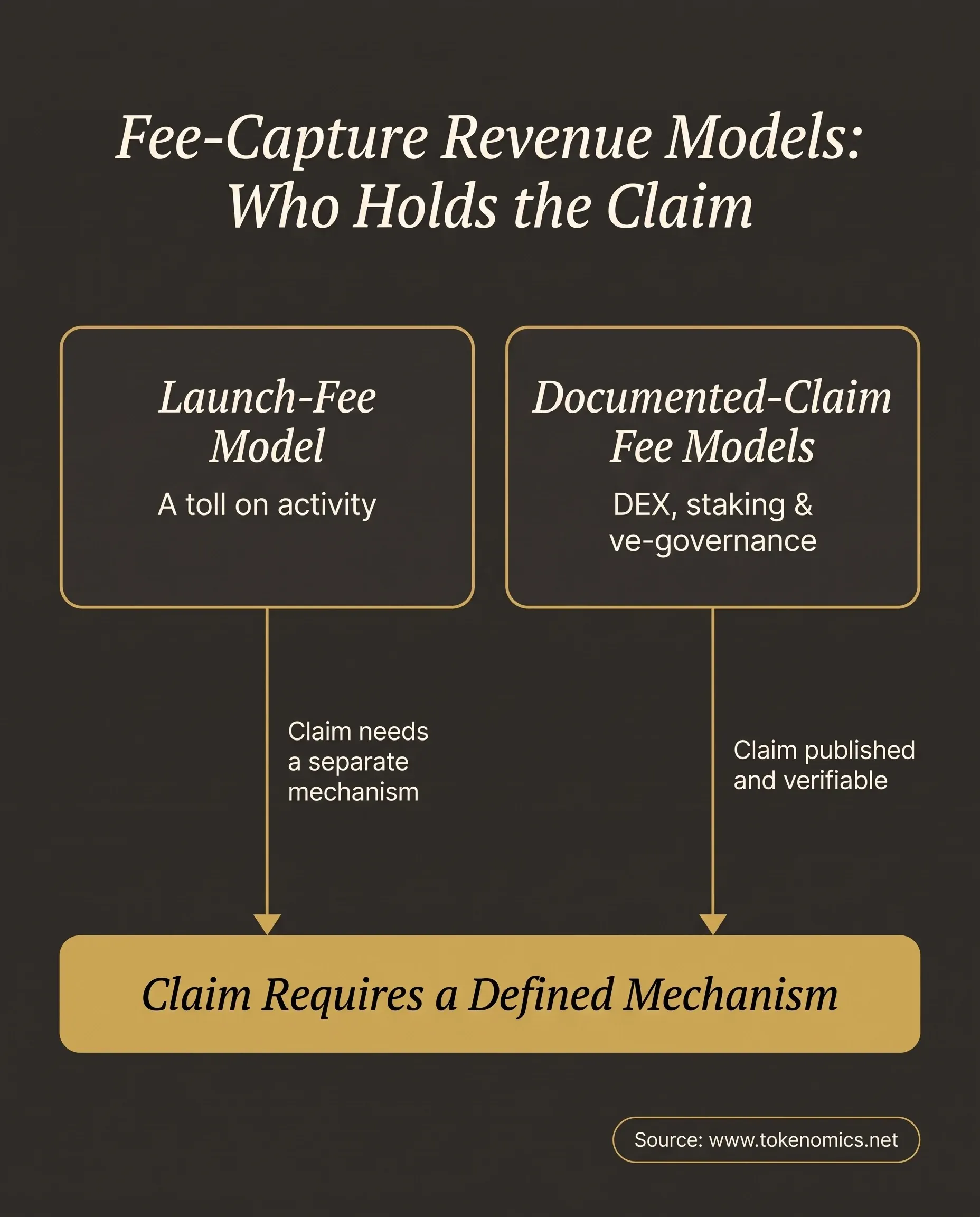
| Launch-fee model | Token creation, curve trades, migration, post-migration swaps | Operating entity by default; a holder claim must be separately defined | High. Tracks launch and trading volume directly | Fee schedule in platform docs; flows traceable if the fee account is known |
| DEX trading-fee model | A share of each swap routed through a pool | Liquidity providers and the protocol treasury, per published fee parameters | Medium. Tracks trading volume, which includes non-speculative flow | Fee parameters are typically on-chain governance variables |
| Liquid staking commission | A cut of staking rewards from the underlying validator set | Protocol treasury and the staker, per a published commission rate | Low. Tracks staked capital and network issuance, not trading | Commission rate is typically an on-chain parameter |
| ve-governance fee capture | Protocol fees routed to holders who lock tokens for a term | Lockers, through an explicit distribution contract | Medium. Depends on what the underlying protocol earns from | Distribution contract is on-chain and auditable |
Every row describes a mechanism class rather than a named protocol's specific rate, deliberately. Fee percentages are mutable parameters and belong to each protocol's own documentation, not to a comparison table that will age.
The pattern is consistent: the further down that table you go, the less of the revenue depends on someone speculating and the more of it depends on capital or usage that would still be there in a flat market. We take the liquid-staking row of that table apart in our LST tokenomics coverage.
#What this means if you are designing your own token
Pump.fun revenue is a real, verifiable fee mechanism sitting on top of a question nobody answered. The fees exist. The flows are traceable. The size of the number tells you how much activity passed through, not whether the business holds. Those two get collapsed constantly, and collapsing them is how founders end up designing a fee switch into a product that has nothing to switch on.
The token is infrastructure. The business is the engine. Build the engine first, then decide what the token is for.
If you're building onchain and need your revenue model to hold up under institutional scrutiny, book a strategy call. We'll assess your project and tell you whether we're the right fit. Sometimes we're not. We'll tell you that too.