Private Token Sale Structure: SAFT, Token Warrant, and Investor Terms
A private token sale runs on one of three instruments: SAFT, token warrant, or direct purchase agreement. Here is how each affects your cap table.


A private token sale is a pre-TGE capital raise in which a project sells token rights or tokens directly to a restricted pool of accredited investors under a securities exemption. Projects typically choose between three legal instruments: the SAFT, the token warrant, and the direct token purchase agreement. Each carries distinct regulatory premises, cap table effects, and investor-term expectations.
A private token sale is a fundraising event in which a project sells the right to receive tokens, or tokens directly, to a restricted set of investors before the public token generation event. This post walks through the three instruments most projects choose between, the investor terms institutional capital expects in each, and how the choice shapes your cap table on the day of your TGE.
Choosing the wrong instrument is not a hypothetical cost. Pick a SAFT when your token design pushes the delivered token toward a securities characterization, and you lock the project into a compliance posture that is hard to unwind later. Pick a direct purchase agreement without reading what institutional investors actually expect, and you fail the screen before the deal room opens.
The private sale funds your path to TGE. The instrument you choose determines what your cap table looks like on launch day, and the token model determines whether those investors ever make money. Build the model first, then raise against it.
#What a private token sale actually is
private token sale: A pre-TGE capital raise in which a project sells token rights to qualified investors under a securities exemption, before the public token generation event.
A private token sale, also called a pre-sale, a private round, or a SAFT round colloquially, is a capital raise conducted under a securities exemption before the public launch. In the US that usually means Reg D for accredited investors, with Reg S for non-US investors. This is not optional fine print. The exemption you raise under defines which instrument you can legally use.
It is not a public sale. An ICO or IDO sells to anyone; a private round sells to a restricted, qualified pool. It is also not a "strategic round" in the loose sense founders sometimes mean. A strategic partnership is a separate instrument. The private round is a capital raise, and conflating the two creates problems when investors ask what they are actually buying.
Three instruments cover most private rounds: the SAFT, the token warrant, and the direct token purchase agreement. Here's what most founders get wrong: they treat the instrument choice as the securities attorney's job and nothing else. It is the attorney's call. But founders who walk in without understanding the mechanical tradeoffs end up with an instrument that does not fit their token design, and the lawyer can only work with the structure the founder brought.
#The Simple Agreement for Future Tokens (SAFT)
A SAFT is an agreement in which the investor pays now and receives tokens at a future TGE, typically at a discount to the public price or under a valuation cap. The structure is designed to fit the Reg D exemption: the SAFT itself is treated as an investment contract during the agreement phase, and the token delivered at the TGE is intended to function as a utility token. That premise rests on the Howey test, the framework regulators apply to decide whether an arrangement is an investment contract. The premise is contested. Treat it as the regulatory framework, not as settled law, and understand that the characterization is fact-specific and jurisdiction-specific. It is your legal team's call.
The mechanical terms are where the negotiation happens. Discount rate, typically 10-30%. Valuation cap. Pro-rata rights. A Most Favored Nation clause. And a clearly defined delivery trigger, meaning what exactly counts as the TGE for the purposes of the agreement. Each of these is a lever, and each one has a downstream effect on your cap table at launch.
When does a SAFT fit? When the project has a defined TGE timeline, when the token's utility at delivery is genuinely non-speculative, and when the investor pool is accredited investors only. When is it the wrong instrument? When the token design includes revenue-sharing, profit-distribution, or governance-only mechanics without real utility, the regulatory bet the SAFT makes gets harder to defend. And when the timeline is uncertain, a future-delivery obligation becomes an operational liability.
Most teams default to the SAFT because it is the most commonly named instrument. That doesn't make it the right one. The SAFT makes a specific regulatory bet. If your token design doesn't support that bet, the SAFT is the wrong choice, no matter how often you have seen it used.
#Token warrants: when equity and token rights travel together
A token warrant is a right, usually attached to an equity investment, that entitles the holder to receive a set number of tokens at a future TGE, typically at a fixed or formula-based price. The mechanical difference from a SAFT is the equity link. The investor holds company equity and a token right at the same time. This is common in priced VC rounds where the fund wants traditional equity upside plus token optionality.
Token warrants fit when the project is raising a priced equity round alongside the token, when investors want both upside profiles, and when the path to TGE is long enough that deferring the token-delivery obligation is an advantage. The tradeoff: a token warrant creates a dual cap table, equity plus token, which adds real complexity at TGE. Anti-dilution provisions on the equity side can interact with token allocation in ways that need careful modeling before you sign anything.
The terms to negotiate are the strike price or formula, the delivery trigger, the allocation as a percentage of total supply, and whether anti-dilution protection on the equity follows through to token delivery. Teams often assume token warrants are only for US investors doing equity rounds. In practice, they are increasingly used as a standalone instrument in non-US contexts where the SAFT's regulatory premise is less clearly defined.
#Direct token purchase agreements: use cases and limitations
A direct token purchase agreement is exactly what it sounds like. The investor purchases tokens directly at the time of the agreement, taking immediate delivery or delivery on a specific near-term date. This is distinct from the future-delivery promise inside a SAFT.
It applies in narrower situations. Later-stage private rounds close to TGE, where the token is already issued or the delivery window is short. Or jurisdictions where a direct sale to non-US accredited investors under Reg S is the cleaner structure. On the regulatory side, the direct purchase of a token that could be characterized as a security is the highest-risk of the three structures. It demands the clearest legal analysis of token classification before execution, and that analysis is fact-specific and jurisdiction-specific.
The mechanical terms are price per token, the delivery mechanism (smart contract versus custodied transfer), the lockup period, and transfer restrictions after the TGE. For most projects at the private-round stage, this is not the primary instrument. The SAFT and the token warrant carry more of the weight.
#SAFT vs. token warrant vs. direct purchase agreement
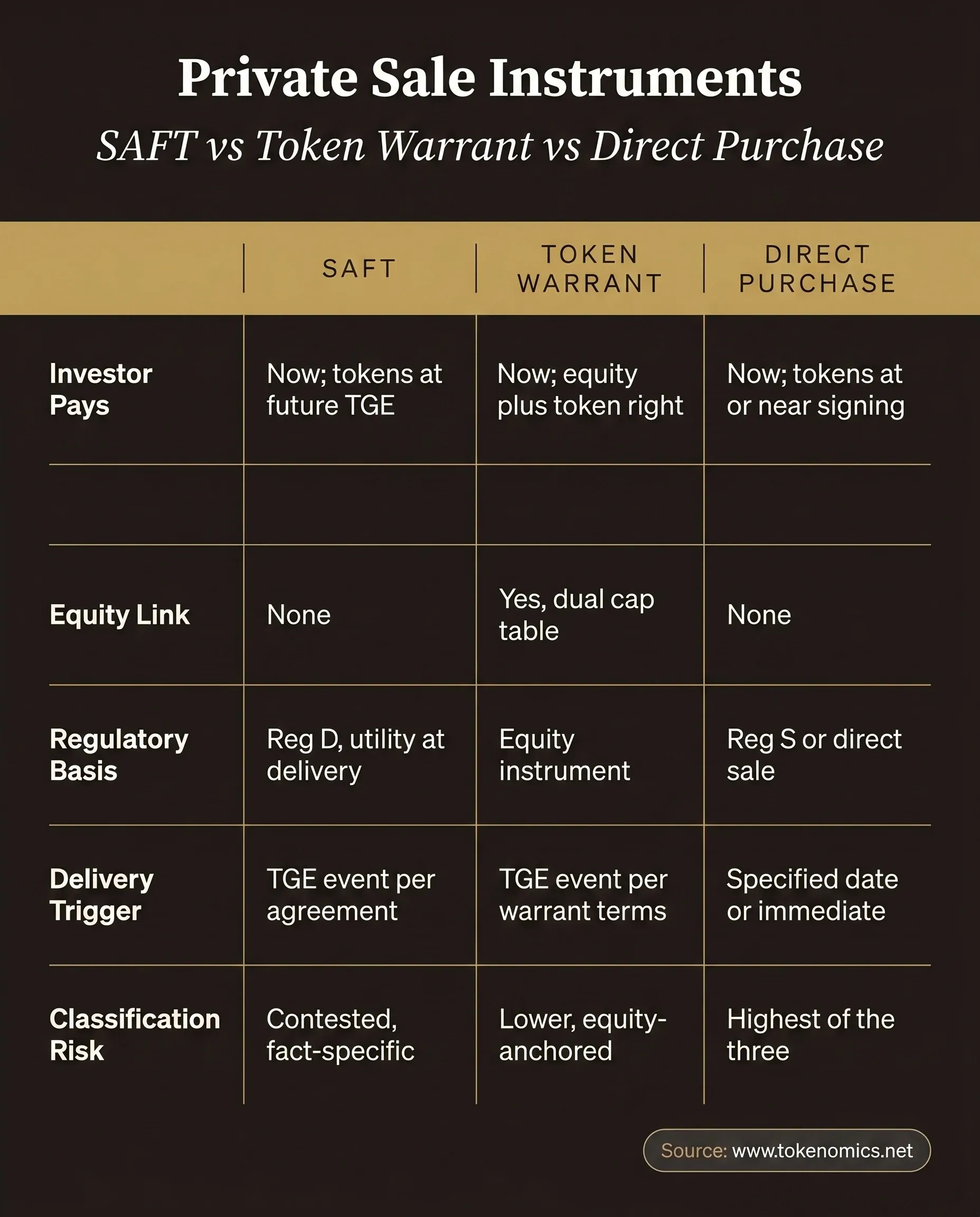
The three instruments differ on the dimensions that actually decide which one fits your raise. Read this against your token design and your TGE timeline, not in the abstract.
| Dimension | SAFT | Token warrant | Direct purchase agreement |
|---|---|---|---|
| Legal status | Investment contract during the agreement phase; intended utility token at delivery. Contested premise, fact-specific. | Equity-linked right; the warrant rides on a priced equity instrument. | Direct sale of the token itself; highest classification risk of the three. |
| Investor protection | Discount or valuation cap, pro-rata, MFN, defined delivery trigger. | Equity upside plus token optionality; anti-dilution can carry into token delivery. | Price-per-token certainty and lockup terms, but no future-delivery cushion. |
| Jurisdictional fit | US Reg D for accredited investors; Reg S for non-US. | Common in priced US VC rounds; increasingly used standalone outside the US. | Cleanest where a direct Reg S sale to non-US accredited investors is preferred. |
| Cap table impact | Token-only dilution at TGE. | Dual cap table, equity plus token, which adds real modeling complexity. | Token-only, but recognized at or near the agreement date rather than deferred. |
| Standard use case | Early private round with a defined TGE timeline and genuine token utility. | Priced equity round where the fund wants both profiles. | Later-stage round close to TGE, or a token already issued. |
#The investor terms that matter in a private token sale
This is where generic "how to run a private token sale" content stops and the real work begins. Institutional capital, the VCs and crypto funds that anchor most serious rounds, has specific term expectations that rarely show up in surface-level coverage. Institutional and venture capital flowing into crypto rose meaningfully through 2025, a pattern tracked across sector research from groups like Galaxy Research, and the capital arriving in that wave is more disciplined than the 2021 cohort. We've advised 100+ projects through these negotiations, and the same terms decide outcomes again and again.
Pro-rata rights. The right to participate in future rounds at the same terms, which protects the investor from dilution. Not standard in every SAFT. Institutional investors who do not ask for it are leaving protection on the table, and the sophisticated ones always ask.
Most Favored Nation (MFN) clause. If the project later issues a SAFT or token warrant on better terms, the MFN holder receives those improved terms retroactively. This matters most in multi-tranche private rounds, where early money does not want to be outclassed by later money.
Lockup and vesting alignment. Institutional investors increasingly require that founder and team vesting schedules run at least as long as investor lockup periods. Misalignment reads as a red flag, and a deserved one.
Anti-dilution protection. Particularly relevant when a token warrant is attached to equity. Full-ratchet versus weighted-average anti-dilution has a material effect on post-TGE allocation, and the difference is not academic.
Information and governance rights. Some instruments include governance rights, which creates a securities-law complication. Founders should know whether their instrument carries these, and understand why institutional investors sometimes waive them deliberately rather than take on the characterization risk.
Here's what most founders miss: they focus on the discount rate. Institutional investors focus on the protective terms. The discount rate sets the cost of the capital. The protective terms decide who controls the outcome if things go sideways. If you want the round to hold up under institutional scrutiny, you build it with both in view, which is what the complete data room is for.
#What institutional investors want in your private sale deal room
The deal room is the difference between a close and a pass. Institutional capital does not commit on a conversation. It commits on documents that let counsel and the investment committee do their work without chasing you for follow-ups.
A private round deal room that holds up generally includes the token distribution model: supply schedule, allocation breakdown, and vesting schedules for every holder class. A legal opinion on token classification, which is not optional for institutional capital. A cap table showing pre- and post-TGE dilution from the private round. A draft of the proposed instrument, whether SAFT, token warrant, or DPA, ready for counsel review. A use-of-proceeds breakdown. And a TGE timeline with milestones and go/no-go criteria.
The legal opinion deserves a closer look, because it is the line item projects skip most often. Across our data room engagements, the single most common gap is not weak content, it is missing content: a team builds detailed financial models, then walks into an investor meeting without an opinion on how the token is classified. Institutional investors read that absence as unreadiness, and the meeting gets shorter.
The pattern is consistent: many projects send a pitch deck and call it a data room. Institutional capital does not close on pitch decks. Get your house in order before you open the round, and the deal room has to hold up under institutional scrutiny, not just look polished in a first read.
#Common mistakes we see in private token sale structures
After advising 100+ projects, the failure patterns in private rounds are predictable. They rhyme with the broader tokenomics mistakes that sink launches, but the private-round versions show up earlier, before any token trades. Here's what we see most.
Choosing an instrument by default, not by design. Most teams reach for a SAFT because it is the most familiar name. If the token design includes revenue-sharing or profit-distribution mechanics, the SAFT's regulatory premise gets harder to hold, and the default choice becomes a liability.
Leaving protective terms out of the first tranche. Sophisticated investors will ask for MFN and pro-rata in later tranches. If you did not establish them in the first tranche, you are negotiating from behind, and that is an asymmetry the project rarely wins.
Misaligning vesting between founders and investors. When institutional investors see founder tokens unlocking before investor lockup expires, they read it as a misaligned incentive structure. Deals die on this, and they die quietly.
Treating the legal opinion as optional. A legal opinion on token classification is not a luxury line item. It is one of the first documents institutional investors request, and arriving without one signals you are not ready.
Raising at a valuation disconnected from the token model. A SAFT valuation cap that implies a post-TGE FDV the token model cannot support creates a pricing problem at launch that hurts every investor in the round. The damage shows up after the money is in.
These aren't edge cases. They're the patterns we see most often in private rounds that fail to close, or that close and then create problems at TGE.
#Frequently Asked Questions
What is the difference between a SAFT and a token warrant in a private token sale?
A SAFT is a standalone agreement in which an investor pays now and receives tokens at a future TGE, typically at a discount or valuation cap, with no equity component. A token warrant is a token-delivery right attached to an equity investment, giving the holder both company equity and future token optionality. The choice depends on whether the project is raising an equity round alongside the token and on the regulatory analysis specific to the token design and jurisdiction.
What documents do institutional investors expect in a private token sale deal room?
Institutional investors typically require a token distribution model covering supply schedule and vesting, a legal opinion on token classification, a pre- and post-TGE cap table, a draft instrument (SAFT, token warrant, or direct purchase agreement) ready for counsel review, a use-of-proceeds breakdown, and a TGE timeline with defined milestones. The legal opinion is the document most commonly missing and the one that most frequently causes a pass or a delayed close.
How do lockup and vesting terms typically work in a private token sale?
Lockup periods restrict when investors can sell or transfer tokens after TGE, commonly ranging from six months to two years depending on the round and jurisdiction. Institutional investors increasingly require that founder and team vesting schedules run at least as long as the investor lockup period. The institutional investor terms that anchor most private rounds, pro-rata, MFN, vesting alignment, and a legal opinion on classification, are the same ones that decide whether the round closes. Misalignment, where founders unlock before investors, is treated as a structural red flag and regularly causes deals to stall or fail.
What is a SAFT?
A SAFT, or Simple Agreement for Future Tokens, is a contract in which an investor pays now and receives tokens at a future token generation event, usually at a discount to the public price or under a valuation cap. The SAFT is treated as an investment contract during the agreement phase, with the delivered token intended to function as a utility token at TGE. That premise rests on the Howey test and is contested, fact-specific, and jurisdiction-specific. Whether a SAFT fits is a question for your legal team, not a default.
How do you structure a private token sale?
Structuring a private token sale comes down to three decisions. First, the exemption you raise under (typically Reg D for accredited US investors, Reg S for non-US investors), which determines which instruments are available to you. Second, the instrument itself: SAFT, token warrant, or direct purchase agreement, chosen to fit your token design and TGE timeline. Third, the term sheet, where discount or valuation cap, pro-rata rights, MFN, and a defined delivery trigger get negotiated. The instrument choice is your securities attorney's call, but the structure you walk in with shapes what they can do.
When should you run a private sale before a TGE?
A private sale fits when you have a designed token model, a defined path to TGE, and a restricted pool of accredited or institutional investors. It is the wrong move when the token model is incomplete, because you would be raising on information you cannot yet stand behind, and institutional investors can tell. The private sale funds the path to TGE; the token model determines whether those investors make money. Build the model first, then raise against it.
What are the legal requirements for a private token sale?
A private token sale must rest on a valid securities exemption, most commonly Reg D for accredited US investors or Reg S for non-US investors. The instrument has to match the exemption and the token's characterization, and that characterization is fact-specific and jurisdiction-specific. Institutional capital expects a legal opinion on token classification before committing, which is the single document projects most often skip. This is the regulatory framework, not legal advice; the classification call belongs to counsel in your primary jurisdiction.
#Where the private sale fits in your token launch strategy
The private sale is not the starting point. It follows from a designed token model and a defined TGE strategy. Founders who arrive at the private round without a complete model are raising on incomplete information, and institutional investors can tell.
The private sale funds your path to TGE. The token model determines whether those investors make money. Build the model first. Private sale terms, especially vesting and lockup, have to align with the liquidity planning inside your tokenomics audit checklist, or the round you closed on paper creates a launch you cannot execute.
Institutional capital is more sophisticated than it was in 2021. The projects that close private rounds in 2026 are the ones with the instrument structured correctly, the deal room complete, and the terms aligned with what investors expect. The bar keeps rising, and it does not move back down.
If you're building onchain and need your private token sale structure to hold up under institutional scrutiny, book a discovery call. We'll assess your project and tell you whether we're the right fit. Sometimes we're not. We'll tell you that too.