Token Launch Strategy: Why Most Fail (And What Works)
A token launch strategy fails at five structural points before TGE. Learn the failure patterns, what works instead, and how to stress-test your plan.


Token launch strategy governs when, how, and at what price a token enters public circulation. Most launches fail not because of market conditions but because of structural decisions locked in three to six months before TGE: under-provisioned liquidity, misaligned vesting cliffs, wrong exchange selection, low-quality community distribution, and no post-TGE support plan.
token launch strategy: the coordinated plan governing when, how, and at what price a token enters public circulation, covering liquidity depth, exchange selection, unlock schedule sequencing, and community distribution mechanics.
The decisions made months before TGE determine whether the token sustains price discovery or collapses into extended sell pressure. The founders who get this right are not smarter than the ones who don't. They've seen the failure patterns, tested their plan against them, and fixed the structural problems before launch day.
We've advised 100+ projects through this process. The patterns are consistent enough to map.
TGE (token generation event): the event at which a protocol's token is created and distributed to the public for the first time, triggering the start of vesting schedules, unlock cliffs, and secondary market price discovery.
unlock cliff: the specific date at which a tranche of vested tokens becomes transferable. A cliff event in the first 60-90 days post-TGE typically produces concentrated sell pressure if demand has not had time to build.
liquidity provisioning: the capital allocated to a trading pool (DEX or CEX) to enable price discovery and buy/sell execution at launch. Insufficient provisioning allows arbitrage bots to dominate early price action.
#What Is a Token Launch Strategy?
A token launch strategy is not a marketing plan or an exchange listing checklist. It is the complete framework that governs how your token enters public circulation: how much liquidity you provision, which exchanges you target, when stakeholder unlocks happen relative to demand-building activities, how you distribute tokens to the community, and what your post-TGE support plan looks like.
Every one of those decisions has a direct consequence for your token's price stability in the first 90 days. Miss one, and the others can't compensate.
The step-by-step mechanics of executing a TGE are covered in our TGE strategy guide. This post is about the strategic layer above those mechanics: the failure patterns that kill launches before TGE day even arrives, and the structural decisions that separate the launches that hold value from the ones that don't.
#Five Reasons Token Launches Fail Before TGE Even Happens
These are not market-conditions failures. They are design failures. Each one was locked in during a planning decision made months earlier.
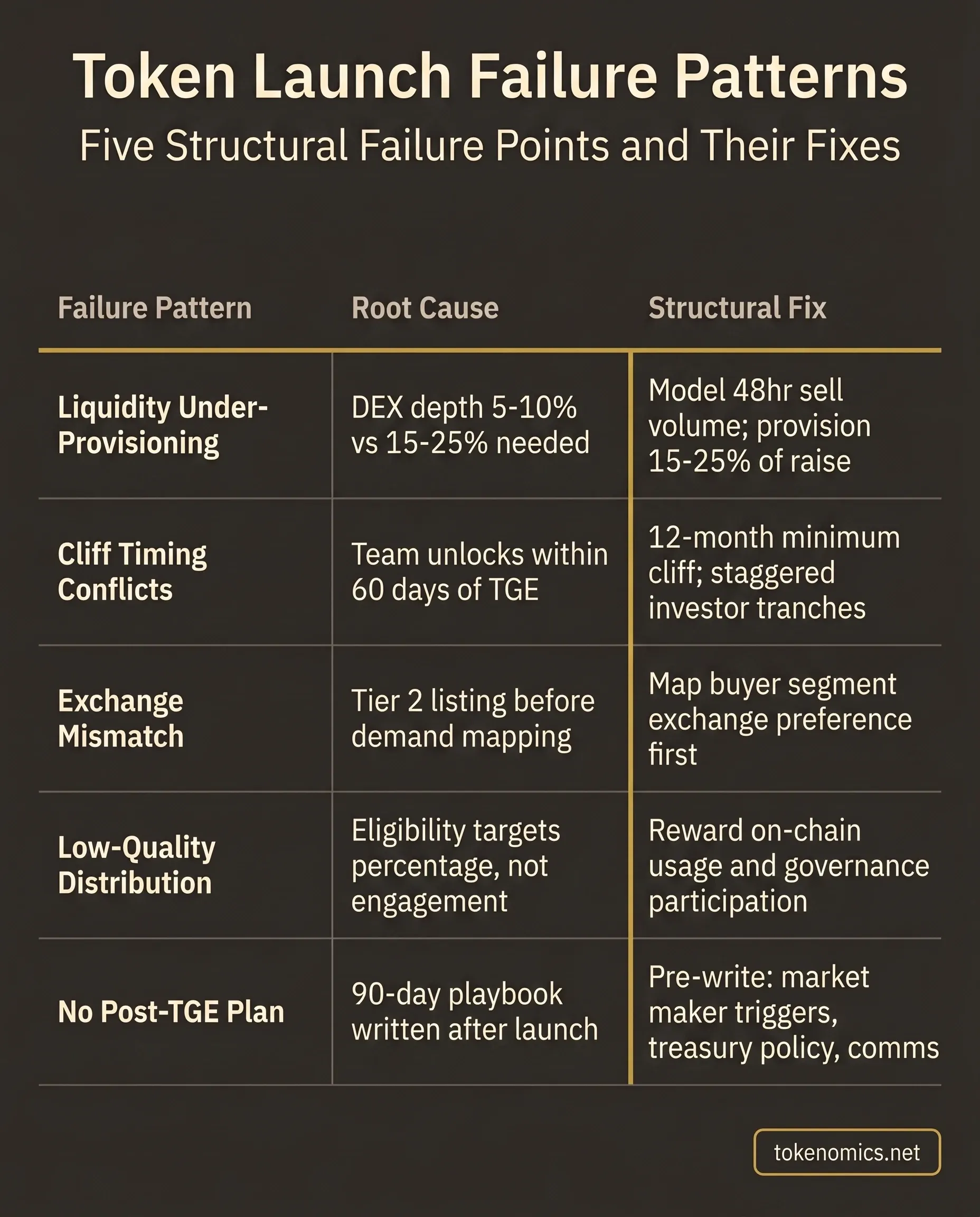
| Failure pattern | Root cause | Structural correction |
|---|---|---|
| Liquidity under-provisioning | 5-10% of raise allocated to initial DEX liquidity; arbitrage bots dominate the first 15 minutes | Model liquidity depth against expected 48-hour sell volume; provision 15-25%; delay if you cannot fund it |
| Cliff timing conflicts | Team and early-investor unlocks fire within 60 days of TGE, before organic demand builds | 12-month minimum team cliff, staggered investor tranches, scenario-model the unlock schedule before TGE |
| Exchange selection without demand mapping | Listing on a venue your actual buyer segment does not trade on; day-1 volume is bots, not buyers | Map where founders, builders, or institutional buyers in your segment actually trade, then pick the venue |
| Community distribution as an afterthought | Airdrops sized to a percentage target and farmed by sybils produce immediate sellers, not holders | Eligibility criteria that reward on-chain usage, governance participation, or verifiable contribution |
| No post-TGE support plan | No market maker agreement, treasury policy, or communication cadence for the 30 days after launch | Write the 90-day post-launch playbook before TGE: trigger conditions, treasury policy, weekly updates |
Failure 1: Liquidity under-provisioning. Most teams budget 5-10% of their raise for initial DEX liquidity. Sustainable launches need 15-25%. Under-provisioned pools get hit by arbitrage bots in the first 15 minutes of trading, destroying price discovery before organic buyers can enter. The fix is not complex: model the liquidity depth you need to absorb expected sell volume in the first 48 hours. If you can't fund it, delay. A delayed launch is recoverable. A bad first 48 hours is not.
Failure 2: Cliff timing conflicts. Team and early investor unlocks firing within 60 days of TGE create concentrated sell pressure before organic demand has time to build. This is not a launch execution failure. It's a vesting schedule failure that was locked in during the cap table design phase. Twelve-month minimum cliff for team tokens, staggered tranches for early investors, and at least one round of scenario modeling against your unlock schedule before TGE: these are not optional.
The token vesting design framework covers the allocation and cliff mechanics in detail. The short version: 12-month minimum cliff for team tokens, staggered tranches for early investors, and at least one round of scenario modeling against your unlock schedule before TGE.
Failure 3: Exchange selection without demand mapping. Listing on a Tier 2 CEX without confirming where your actual buyer segment trades is a consistent failure pattern. The symptom: strong day-1 volume driven by arbitrage bots, followed by a cliff on day 3 as genuine buyers realize they're on the wrong exchange. The diagnostic question is specific: where do the founders, DeFi protocol builders, or institutional buyers in your segment actually trade? If your buyers are primarily retail on Coinbase, listing on an offshore Tier 2 exchange first creates a geographic arbitrage gap, not a launch. That answer determines your exchange strategy, not your exchange partner's listing fee.
Failure 4: Community distribution as an afterthought. Airdrop and community allocation designed to hit a percentage target, without designing for holder quality, produce sellers, not holders. Sybil-farmed airdrops create circulating supply that exits immediately. The mechanism fix is eligibility criteria that reward genuine engagement: on-chain usage of the protocol, governance participation, or verifiable contribution, not wallet age and transaction count. This is a mechanism design failure, not a distribution logistics failure.
Failure 5: No post-TGE support plan. Launch day is not the end of your TGE plan. It is the beginning of the support window. Teams without a market maker agreement, a treasury policy for buy-side support, and a community communication cadence for the 30 days after TGE watch sell pressure compound into narrative collapse. The 90-day post-launch playbook should be written before TGE, not improvised after.
#What the Token Launches That Hold Value Have in Common
Three things are distinguishable in hindsight across the launches that sustain price discovery in the 3-6 month window post-TGE.
Liquidity depth matched to secondary volatility. Not just enough to open the market, enough to absorb the sell events the unlock schedule creates. Teams that model their unlock schedule against their liquidity depth before TGE are making a different kind of decision than teams that provision liquidity based on raise size.
Unlock schedule sequenced against revenue milestones. The launches that hold value tend to have vesting schedules calibrated against protocol milestones, not arbitrary calendar intervals. When team and investor tokens unlock in alignment with demonstrable protocol growth, the fundamental-buyers who enter post-unlock outnumber the investors who exit.
Revenue-first design underneath the token. This is the pattern that matters most. The token is infrastructure. The business is the engine. Launches that hold value in the 3-6 months after TGE almost always have an underlying protocol generating real demand for the token, whether that's transaction fees, staking requirements, governance utility, or service payments. Launches that trade purely on narrative collapse when the narrative loses momentum.
The tokenomics data room service documents this revenue-first story in a format investors and exchanges can verify before your TGE.
If you can answer the question "why does someone need to hold this token six months from now?" with a specific, revenue-grounded answer, you are in a materially different position than most of the projects in your cohort.
#When to Launch Your Token: Three Readiness Signals
Timing is a strategic question, not a market-conditions question. Here are three signals that indicate genuine readiness for TGE, independent of market sentiment.
Signal 1: Liquidity depth. Can you fund at least 15-20% of your raise as initial DEX liquidity and sustain a market maker relationship for the first 90 days post-TGE? If no, delay. The cost of under-provisioning liquidity is higher than the cost of a delayed launch.
Signal 2: Stakeholder unlock alignment. Have you modeled the first 90 days of your unlock schedule against your expected sell pressure? At minimum, a scenario analysis that asks: what happens if 20% of early investors sell at the 12-month cliff? If the answer is catastrophic, fix the vesting schedule before TGE, not after.
Signal 3: Revenue signal. Is there observable on-chain demand from genuine users of the protocol? Not a waitlist, not Discord activity, not social followers: actual on-chain usage or signed agreements with paying customers. Across the 100+ projects we've advised, launches that precede meaningful protocol usage by 12 or more months consistently underperform launches where the underlying demand is already measurable before TGE. The token can create anticipation. It cannot manufacture demand that the protocol has not yet earned.
A tokenomics audit checklist is a practical tool for running this scenario analysis before TGE.
If all three signals are green, you are in the minority of projects approaching TGE. Most teams hit TGE with one or two of these in place. The ones that go zero for three are the ones that show up in post-mortems.
#Token Launch Strategy and the Regulatory Reality
Regulatory structure is not an afterthought to your TGE plan. It is a schedule constraint.
Token classification under the Howey test determines which exchange tiers are accessible, which distribution mechanisms are available, and what your legal team needs to sign off on before you touch a public sale. Misclassifying your token or structuring a public sale without addressing the Howey analysis is not a risk you manage with a disclaimer at the bottom of your whitepaper. The SEC has charged multiple token issuers for exactly this failure in the past three years.
MiCA (Markets in Crypto-Assets) enforcement entered its active phase in 2025 and applies to any token targeting EU market participants. If your launch includes EU-based buyers, you need a compliant legal wrapper, reserve composition analysis if applicable, and registration or exemption documentation in place before TGE. The enforcement timeline is not a future risk: it is the current operating environment.
The Tokenomics.net position on this is direct: we design token models to make compliance review smoother. Whether a specific token design is compliant in a specific jurisdiction is a determination made by your legal team and the relevant regulator, not by us. What we can do is structure the token mechanics to avoid the design patterns that consistently create compliance problems.
For EU-targeted launches, MiCA compliance for token issuers is the definitive reference on what your token design determines for regulatory classification.
#What a Token Launch Strategy Engagement Actually Covers
A launch strategy engagement is documentation work as much as it is advisory work. It produces deliverables your legal team, market maker, and exchange listing team can read and act on.
The deliverables we cover in a token launch strategy engagement:
- Liquidity modeling: Initial DEX depth calculation, market maker selection criteria, and 90-day support plan based on your raise and circulating supply.
- Stakeholder unlock sequencing: Cliff and vesting schedule stress-testing against sell pressure scenarios. Produces a visual unlock map the legal team can include in investor communications.
- Community distribution mechanics: Airdrop eligibility criteria design with sybil resistance built in. Covers retroactive vs. prospective distribution decisions.
- Exchange selection framework: Tier analysis mapped to your buyer segment, not your exchange partner's pitch deck.
- 90-day post-launch playbook: Market maker trigger conditions, treasury policy for buy-side support, community communication templates for the post-TGE window.
Book a discovery call if you are 3-12 months from TGE and haven't stress-tested these five dimensions against your current plan. Sometimes you'll go through this and everything checks out. Sometimes you'll find one structural problem that was going to cost you the launch. Either way, you want to know before TGE, not after.