FIT-21 Tokenomics: What the Bill Means for Token Founders
FIT-21 splits US digital-asset oversight between the CFTC and SEC and sets a decentralization test for token classification. Here is what founders should know.


FIT-21, the Financial Innovation and Technology for the 21st Century Act (H.R. 4763), is a US House bill that would build a market structure framework for digital assets, dividing federal oversight between the Commodity Futures Trading Commission (CFTC) and the Securities and Exchange Commission (SEC). It defines a decentralization test that determines when a token is treated as a digital commodity rather than a security, which ties a project's regulatory path directly to how its supply, control, and governance are designed.
If your lawyers, investors, or advisors have started saying "FIT-21," this is the translation. What makes the bill relevant to tokenomics is that its classification path turns on design decisions founders make early: how tokens are allocated, who can change the protocol, and how much supply sits with the team.
Two caveats before the mechanics. The bill has not become law, so nothing here is a rule you can build against yet. And a favorable classification is not a substitute for a real business: it changes which regulator applies and what a project must demonstrate, but it does not replace revenue, product-market fit, or a token that has a reason to exist.
#What Is FIT-21?
FIT-21 is the shorthand for the Financial Innovation and Technology for the 21st Century Act, introduced as H.R. 4763. It is a comprehensive market structure bill that would assign federal jurisdiction over digital assets, define the categories they fall into, and set the disclosure and registration rules that follow from each.
The House passed FIT-21 in May 2024 on a bipartisan vote. Federal digital-asset market structure legislation has kept moving through Congress since then, so the bill's current status, including any Senate action or successor legislation, is worth confirming against the primary record at the time you read this. For the plain-language reference, see the FIT-21 glossary entry.
#The CFTC vs. SEC Split: How FIT-21 Divides Jurisdiction
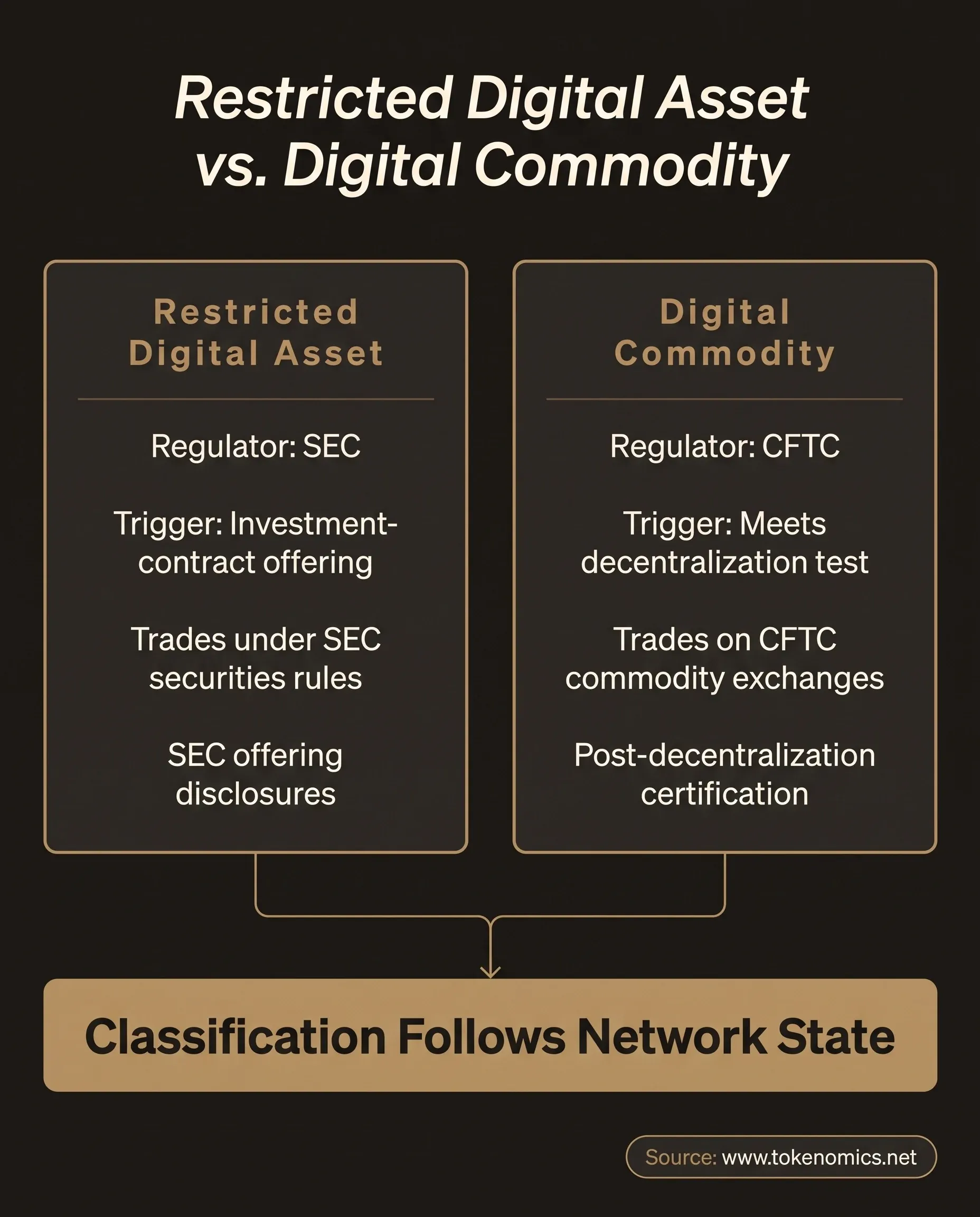
The core of the bill is a jurisdictional split into two working categories. A "restricted digital asset" is offered as part of an investment contract and falls under the SEC. A "digital commodity" sits under the CFTC once its underlying network meets the bill's decentralization criteria. The dividing line between the SEC and the CFTC is therefore not the token itself but the state of the network behind it.
Which regulator holds primary authority over a token's trading venues, disclosure obligations, and enforcement posture depends on which category it falls into, and the category is not permanent. A project can begin on the SEC side, offered while the network is still built and controlled by its founding team, then move toward digital-commodity treatment as the network decentralizes. Read the structure as a proposal, not settled law: it describes how jurisdiction would be divided, not a determination that any specific token is a commodity or a security.
#The Decentralization Test: How a Token Moves From Security to Commodity
This is the part that connects FIT-21 to tokenomics design, and where founders should spend their attention. The bill's decentralization test generally evaluates factors such as: whether any single person or affiliated group has unilateral control over the network's functionality or can unilaterally alter its transaction records; whether any person or affiliated group holds a concentrated share (in the range of 20 percent or more, with the exact threshold worth verifying against the bill text) of the token's outstanding units or voting power; and whether the network is functional and no longer dependent on the managerial efforts of a small, identifiable group.
Read that as a tokenomics checklist and the overlap is obvious. Allocation concentration, team vesting schedules, and who retains upgrade or governance authority over the protocol are the exact levers such an analysis would examine. A token with a large share of supply held by the founding team, a protocol one multisig can change at will, and a network that stops working if the core team leaves are the patterns that sit on the securities side of this test.
These are factors an analysis weighs, not a form a founder can complete to guarantee an outcome. Meeting them does not make a token "not a security," and no design choice pre-clears a classification. What founders can do is understand which decisions the test looks at and make them deliberately.
#Digital Commodity Exchanges, Brokers, and Dealers: New CFTC Registration Categories
Once a token qualifies as a digital commodity, the market around it runs through a CFTC-regulated structure the bill would create. FIT-21 establishes three registration categories: digital commodity exchanges, which operate the trading venues; digital commodity brokers, which handle the intermediary and customer-facing function; and digital commodity dealers, which take the market-making role.
A digital-commodity token would trade through these CFTC-registered intermediaries rather than under SEC securities-exchange rules. These are categories the bill would create, not mechanics in force today.
#Disclosure Requirements for Token Issuers Under FIT-21
The bill also proposes a disclosure regime for issuers offering a restricted digital asset. Those disclosures would generally cover the project's source code, its token economics (supply, allocation, and vesting), and operational information about the network and team, filed with the SEC during the offering period. It further contemplates a mechanism for a project to certify that its network has become sufficiently decentralized to transition to digital-commodity treatment, subject to a regulatory review window. Treat that certification path as a conceptual outline rather than settled procedure.
One point without overselling it: clear allocation tables, vesting schedules, and source-code and governance disclosures held in one place are the same work product a disclosure regime like this would ask for. That alignment is directional, not a guarantee that any particular package satisfies a requirement the bill has not yet enacted.
#FIT-21 vs. the Howey Test: How the Frameworks Relate
Founders often conflate FIT-21 with the Howey test. The Howey test comes from a Supreme Court case and is the judicial standard courts and the SEC use today to decide whether an arrangement is an "investment contract" and therefore a security. FIT-21's decentralization test is proposed statutory language that would sit alongside Howey, creating a defined path for a token to move out of securities treatment as its network decentralizes.
They rhyme because both ask decentralization-adjacent questions: who controls the network, and who profits from the efforts of others. The difference is legal force. Howey is current case law applied now; FIT-21's test is a bill that does not yet carry it. US token regulation runs on the first today and may run on the second later.
#Where FIT-21 Stands Today and What Founders Should Do Now
Here is the honest status separation. As an established fact, the House passed FIT-21 in May 2024, an effort advanced through the House Financial Services Committee. As of publication, verify the current status, whether Senate action, a renamed successor bill, or enactment, against the primary record before treating any status statement as current.
The practical guidance is design-level, not legal advice. Founders building today should treat allocation concentration, vesting structure, and protocol-governance control as decisions that matter regardless of which bill becomes law, because every proposed US framework so far has asked the same decentralization question, and a token still needs a real business under it either way. For the wider regulatory surface, see our guide to tokenomics compliance, and founders acting on the allocation and governance choices raised here can see how we approach tokenomics design directly.
The through-line is simple. FIT-21 would split digital-asset oversight between the CFTC and the SEC and define a decentralization test that decides which side a token lands on, and that test reads directly onto tokenomics design. Whether or not this bill becomes law, the decisions it examines are worth getting right before launch, not after. Building onchain and want your token model to hold up under regulatory and investor scrutiny? Book a strategy call. We will assess your project and tell you whether we are the right fit. Sometimes we are not. We will tell you that too.