Ondo Tokenomics: How the ONDO Token Captures Value
Ondo tokenomics explained: ONDO's fixed 10 billion supply, what Ondo's documentation does and does not cover, and why the token sits apart from OUSG yield.


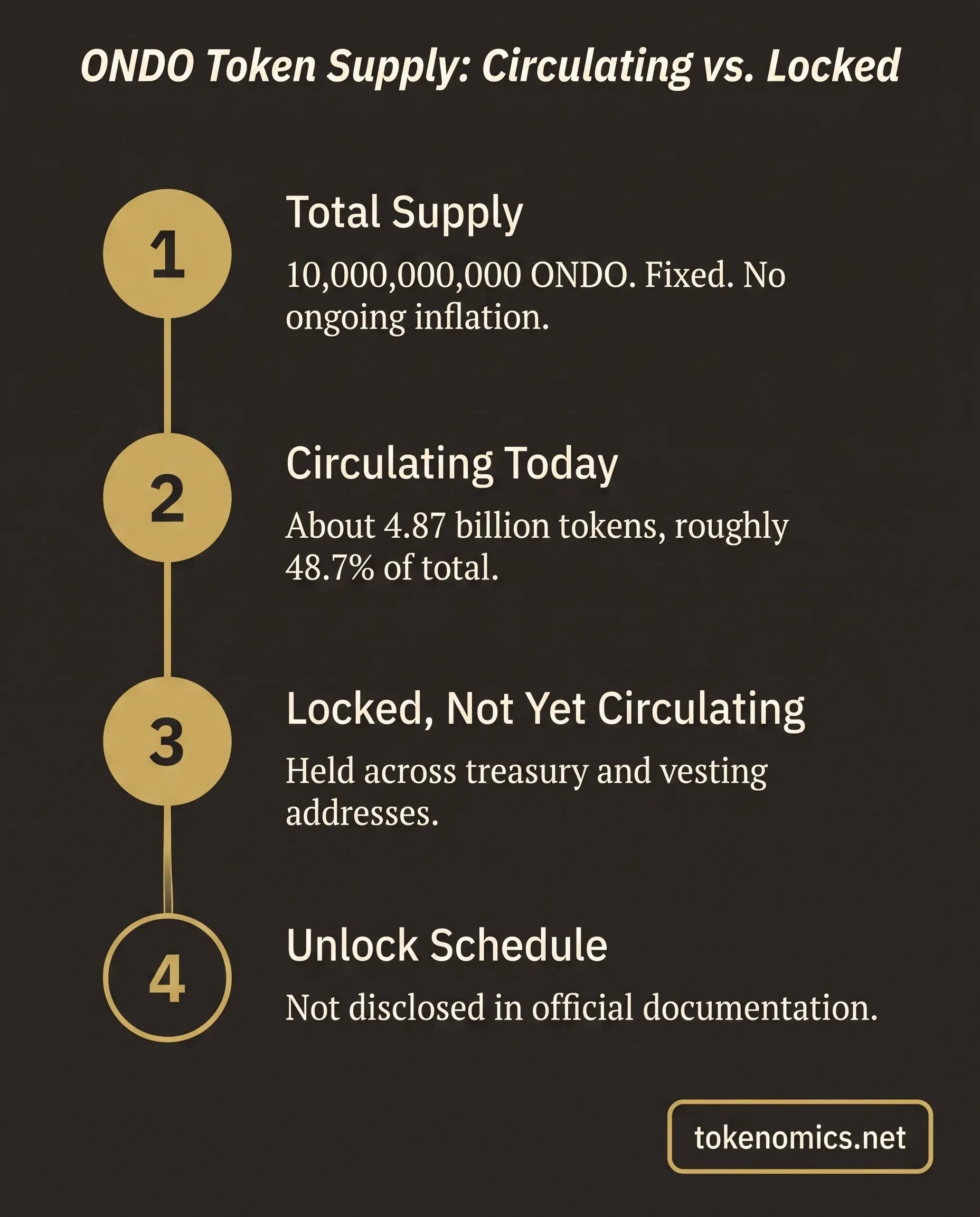
Ondo tokenomics splits token economics from product economics: OUSG, USDY, and Flux Finance generate yield for holders of those specific instruments, while the ONDO token sits one layer removed, with no confirmed direct claim on that yield. The business question that follows is whether demand for the token tracks what those products actually generate, or moves independently of the value the business creates. ONDO's total supply is a fixed 10 billion, read directly from the token contract, of which roughly 4.87 billion circulate today by CoinGecko's estimate.
Ondo tokenomics is a two-tier structure, and that single fact explains almost everything else about how the ONDO token behaves. Ondo Finance tokenized treasury products builds tokenized fixed-income and equity products for institutional and accredited demand, but the ONDO token itself sits one layer removed from those products. Understanding Ondo tokenomics means understanding that separation first, because it shapes what questions are worth asking about the token, and which of those questions actually have confirmed answers.
This post breaks down what is documented about ONDO's supply, the product stack it sits alongside, and the open questions worth researching around governance, vesting, and value capture, given what Ondo Finance has and has not published on the token side. Where the public record is thin, this piece says so directly rather than filling the gap with a plausible-sounding number.
It matters to establish the product layer before touching the token, because Ondo Finance operates several distinct on-chain products, and the real question for any token structured this way is whether it has a direct mechanical claim on what those products generate, or whether its relationship to them runs through something less direct, such as governance participation or ecosystem growth. That question, not a specific percentage or mechanism, is the one worth carrying through the rest of this piece.
#What Ondo Finance actually does
Ondo tokenomics: the economic design governing the ONDO token's supply and its relationship to Ondo Finance's product stack, where the yield generated by OUSG, USDY and Ondo Stocks is structurally separate from the token itself.
#The product stack: OUSG, USDY, Flux Finance, and Ondo Stocks
According to Ondo's documentation, Ondo Finance operates four distinct products. OUSG is a qualified-access product that wraps short-duration US Treasuries on-chain, built for institutional and accredited holders. USDY is a general-access, yield-bearing token available to a broader holder base. Flux Finance is a lending protocol inside the Ondo ecosystem, where these tokenized assets can be posted as collateral or borrowed against. Ondo Stocks is a tokenized-equities product, extending the same on-chain-wrapper approach beyond fixed income. Ondo also publishes smart contract addresses and third-party audits for its products, which is worth checking directly before relying on any of them.
For the fuller mechanics behind this product category, see our complete guide to RWA tokenization.
#ONDO token supply
#What the numbers actually are
ONDO's total supply is exactly 10,000,000,000 tokens, read directly from the token contract via an on-chain call, with no ongoing inflation mechanism built into that figure. Circulating supply is a different kind of number: there is no primary, on-chain source for it, since it depends on which treasury and vesting addresses get excluded, a judgment call rather than a contract fact. Per CoinGecko's estimate, circulating supply sits at approximately 4.87 billion tokens, or about 48.7% of the total, though circulating-supply methodology varies between data aggregators. That gap between circulating and total supply is still the single most useful number in this piece, because it means a little more than half of ONDO's eventual supply has not yet reached the open market.
#What is not public: allocation by bucket
What is not documented at the same level of specificity is how that remaining supply is split among categories such as team, investors, ecosystem funds, and community distribution. Ondo's official documentation does not publish an allocation-bucket breakdown, so this piece will not assign percentages to categories it cannot verify. The framework worth applying instead, to ONDO or any token in a similar position, is this: find out what fraction of the still-locked supply sits with insiders on a vesting schedule versus what fraction is earmarked for the ecosystem or community, because that ratio says more about future selling pressure and who the token was built to reward first than the total-supply headline number ever will.
#Vesting and unlock schedules: how to read them without a confirmed timeline
#Circulating supply versus fully diluted supply
Unlock overhang is a mechanical dilution fact, not a price prediction, and it applies to any token with a meaningful gap between circulating and fully diluted supply, ONDO included, given that its circulating supply is under half of its 10 billion total. Circulating supply is what is tradeable today. Fully diluted supply is what exists once every locked allocation has vested. A token that looks scarce on circulating-supply terms can look very different once the full unlock schedule is priced in.
#What is not public: the unlock timeline itself
Ondo's official documentation does not publish a specific cliff length, unlock cadence, or vesting schedule for team and investor allocations, so this piece will not state one. Token classes with this general shape often use a cliff followed by linear unlocks, but whether ONDO follows that pattern, and exactly when, is not something a general pattern can confirm on its own. Anyone weighing a position in ONDO should look for a primary source, a vesting contract, an audited unlock schedule, or an official Ondo disclosure, before assuming a specific date matters.
For a deeper walkthrough of cliffs, linear unlocks, and the circulating-versus-FDV gap, see our guide to reading a token unlock schedule.
#What the ONDO token is for
#Governance and staking as a token-design category
Governance rights and a staking mechanism are common utilities for tokens positioned the way ONDO is positioned, sitting apart from the yield-generating products a protocol operates. Whether and how ONDO itself implements either of those, what specifically holders would vote on, what a staking mechanism would require or return, is not detailed in Ondo's official documentation at a level this piece can cite. Rather than repeat a specific claim it cannot verify, the more useful exercise is the one to run on any token in this category: does a governance vote actually bind protocol behavior, or is it advisory. Does staking lock the token against something real, like a slashing condition or a security role, or is it closer to a holding incentive. Those distinctions determine whether governance and staking are load-bearing utility or decorative utility, and they are worth confirming against Ondo's own current documentation rather than assumed from category norms.
#The value-capture question
The question that matters most for ONDO specifically is whether the token has any direct mechanical claim on what OUSG, USDY, and Ondo Stocks generate, a fee share, a buyback, a revenue split, or whether its relationship to those products runs entirely through indirect channels like governance participation and ecosystem growth. This is not something the verified facts in this piece can settle either way, and it should not be settled by assumption. It is the single most important question to research directly, through Ondo's own current documentation, before forming a view on ONDO's tokenomics.
For the broader framework on judging whether a token's utility is load-bearing or decorative, see our breakdown of token utility design.
#The two-tier structure: what separating products from the token typically buys, and costs
#What this kind of separation typically buys a protocol
Protocols that keep yield-bearing products structurally distinct from a broader, more liquid governance token are often making a deliberate regulatory and product-market choice: the yield product stays scoped to the qualified or accredited holders it was built for, while the token can trade more freely. That is a defensible design pattern across this category, and it is a reasonable lens to bring to Ondo's product stack given the qualified-access design of OUSG specifically.
#What that separation typically costs the token
The tradeoff on the other side is that a token separated this cleanly from the yield-generating layer usually cannot rely on product growth alone to drive its own demand. If OUSG or Ondo Stocks assets under management grow but the token has no direct mechanical claim on that growth, demand for the token has to come from somewhere else: governance utility, staking utility, or a belief that ecosystem growth eventually accrues to the token some other way. Whether that link holds for ONDO specifically is the open question raised above, not a conclusion the verified facts here can settle.
This same governance-versus-yield separation shows up elsewhere in restaking design, including in EigenLayer's tokenomics.
#Governance and treasury: what to verify before relying on either
#How to check whether governance is actually decentralized
Rather than assert a specific decision scope for Ondo DAO, the honest approach is to point at what to check directly: which parameters a DAO vote can actually change, whether votes are binding or advisory, and how much of that execution is currently handled by the DAO versus coordinated by the core team at the protocol's current stage. Ondo's own governance forum and any published DAO proposal history, not this piece, are the primary source for that answer.
#How to check treasury health
The same applies to treasury size and deployment. A protocol's treasury is a reasonable proxy for how much runway it has to fund growth independent of the token's market price, but a specific figure is only useful if it is current, and this piece will not cite one it cannot verify against a live source. Check a current on-chain treasury dashboard or an official Ondo disclosure before treating any treasury number as current.
For a structured way to weigh governance execution and treasury health against a broader rubric, see our tokenomics audit checklist.
#What this means for evaluating ONDO's token design
#The core question: does token demand track protocol usage
What is confirmed about ONDO is narrow and useful: a fixed 10 billion total supply, roughly 4.87 billion tokens in circulation today, and a product stack, OUSG, USDY, Flux Finance, and Ondo Stocks, that generates yield for holders who are not necessarily ONDO holders at all. What is not confirmed, allocation by bucket, the vesting timeline, the specific scope of DAO governance, the mechanics of any staking design, and whether the token has a direct claim on product revenue, is exactly the set of questions worth researching before forming a view. Evaluating ONDO on its tokenomics means asking whether growth in the underlying products shows up anywhere in the token's design, and treating an unconfirmed answer as an open research item rather than a settled fact.
For founders weighing whether their own token needs this kind of structural review, our breakdown of how tokenomics consulting engagements work covers what to expect.
If you're evaluating a token design with the same governance-versus-yield questions ONDO raises, our tokenomics services can help you work through the structure before launch.