Monad Tokenomics: What's Confirmed About the MON Token, and What Isn't
Monad tokenomics explained: what Monad's own documentation and Foundation disclosures confirm about the MON token, and which figures are not primary-sourced.


Monad tokenomics is the token design of Monad, an EVM-compatible Layer 1 blockchain: what the MON token does on the network, how its supply is allocated, and what the protocol has actually published about both. That last clause is where most coverage of this topic falls apart.
The failure mode is predictable. Search monad tokenomics and you get two kinds of page. Crypto-media write-ups treat funding size and throughput claims as a proxy for token quality. Tracker dashboards print supply and unlock numbers with no link back to a protocol disclosure.
This post separates those two piles. Every load-bearing claim about monad tokenomics below traces to Monad's own documentation, the Monad Foundation's own material, or the token contract on chain. Where a figure does not, we say so rather than fill the gap. The token is infrastructure serving a network that has to be worth using. For a new L1, the question underneath the supply table is whether developers ship and users pay for blockspace.
#What Monad is, and why monad tokenomics is a search term
Monad tokenomics: the design of the MON token on Monad's EVM-compatible Layer 1, covering gas and staking use and how its supply is documented across primary and secondary sources.
Monad is a Layer 1 blockchain that runs EVM bytecode and speaks the Ethereum JSON-RPC interface, so an Ethereum contract deploys on it without a rewrite (Source: Monad documentation, docs.monad.xyz). The performance thesis is throughput: Monad's documentation states the network targets thousands of transactions per second with sub-second block times. Read those as the protocol's own published targets, not as independently benchmarked results.
Search demand for monad tokenomics comes from a gap. Monad documented its architecture early and in detail. Founders benchmarking their own design, and analysts doing category work, want supply and utility facts at the same resolution, from a source they can cite without hedging.
If your own project needs that same standard of primary-source discipline applied to its numbers, that is what a Tokenomics Audit delivers.
#The architecture decisions behind Monad's performance claims
#Parallel execution inside an EVM-compatible chain
Most EVM chains execute transactions one at a time, because contracts touch shared state and running them concurrently risks conflicting writes. Monad executes optimistically in parallel and re-executes any transaction whose inputs turn out to have changed, which produces the same result a serial run would have produced (Source: Monad documentation). Compatibility is preserved at the bytecode layer, so the parallelism stays an implementation detail.
#MonadBFT, deferred execution, and MonadDb
MonadBFT is Monad's pipelined consensus protocol. Validators agree on transaction ordering first, and execution happens afterward, a block behind, so the consensus round is not gated on how long execution takes. Monad calls this deferred execution and documents it alongside MonadDb, its custom state backend (Source: Monad documentation).
Here's what most founders miss: none of that stack says anything about the token. Distribution is a separate decision on a separate timeline.
#Who built Monad, and how it is funded
Monad Labs was founded by Keone Hon, James Hunsaker, and Eunice Giarta, whose stated backgrounds are in high-frequency trading and market infrastructure at Jump Trading (Source: Monad Labs team page). Latency, pipelining, and deterministic execution are trading-systems concerns before they are blockchain concerns.
The funding is disclosed. Monad Labs announced a $19MM seed round led by Dragonfly in 2023, and a $225MM round led by Paradigm in 2024 (Source: Monad Labs funding announcements). Where a valuation figure circulates without a named party disclosing it, treat it as reporting rather than as a company disclosure.
#Where Monad stands right now: network and token status
Network status is the part of any new-L1 post that ages fastest. Check it against the protocol before you rely on it. Monad ran a public testnet through 2025 before moving to mainnet, and MON is the network's native asset, used to pay gas and to stake with validators (Source: Monad documentation).
Two things follow. A token generation event having happened does not mean every tokenomics parameter is published in one place; those are separate events on separate timelines. And the live contract becomes a primary source in its own right. To know what supply exists on chain, read the token contract on a Monad block explorer.
We date-stamp this section deliberately. Anything you read about monad tokenomics that carries no date is describing a network state that may not hold anymore.
#What is publicly known about monad tokenomics, and what is not
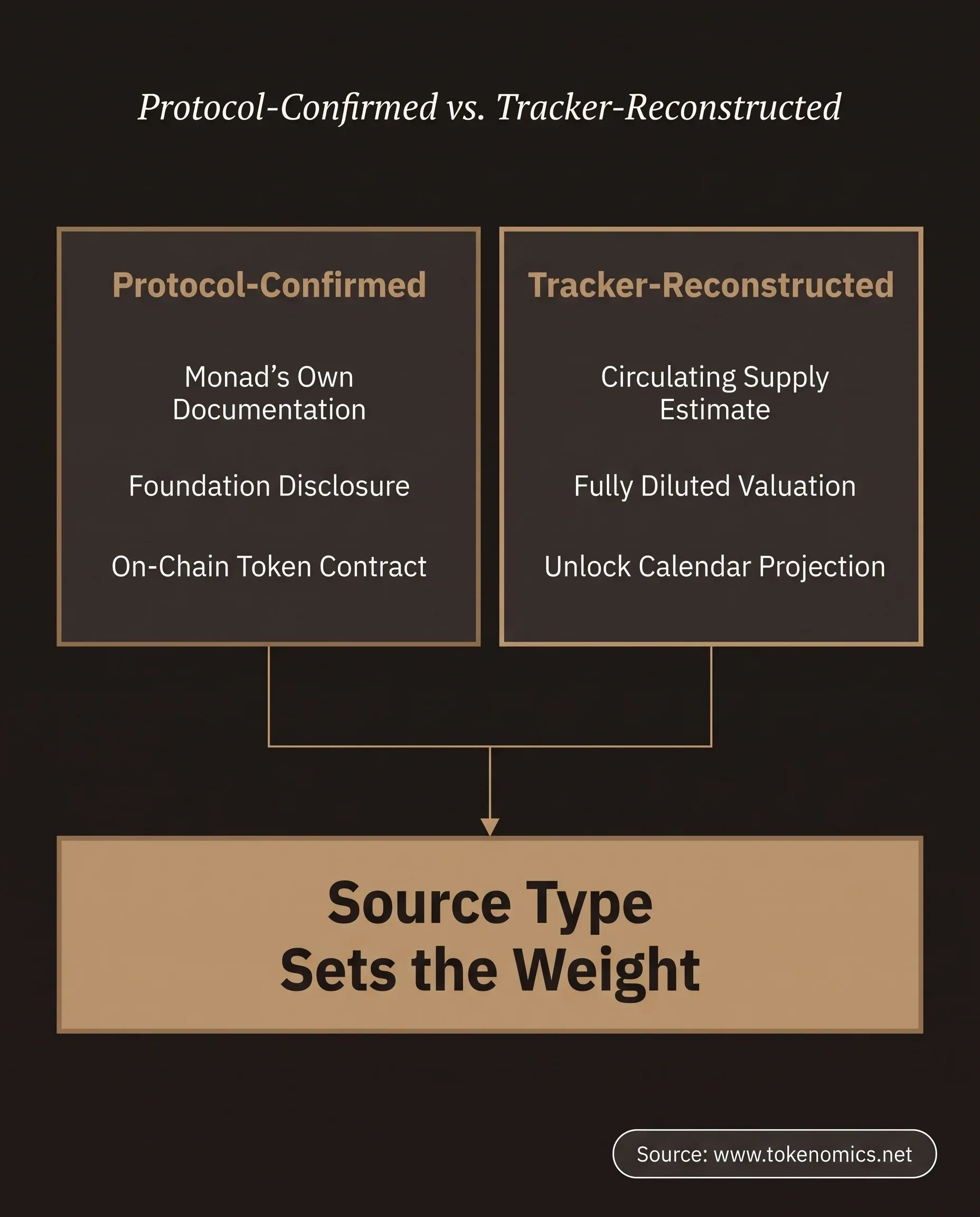
Split monad tokenomics into two piles. One holds what a Monad-native source confirms. The other holds what only a dashboard asserts.
#Confirmed by a Monad-native source
MON is the gas and staking asset. Monad's documentation describes MON paying transaction fees and securing the network through validator staking and delegation (Source: Monad documentation).
The Monad Foundation publishes its own allocation and distribution material. When you need an allocation percentage, a vesting schedule, or an unlock cliff, the Foundation's material and the token contract are the sources that carry weight. Cite them by date.
#Not confirmed by anything primary
Tracker dashboards publish circulating supply, fully diluted valuation, and unlock calendars for MON. Those are reconstructions. Each tracker models circulating supply from the balances it can see plus its own lockup assumptions, which is why their numbers disagree.
Most projects make the mistake of treating a dashboard figure as a disclosure. That doesn't work. If you cannot match a number to the Foundation's published allocation or to a balance on chain, it is a secondary read and should carry that label.
The lesson: for monad tokenomics, as for any token, the source type sets the weight the number can carry.
#How Monad's disclosure timeline compares with other high-performance L1s
Comparably positioned L1s published token detail at different points relative to launch.
Sui's tokenomics, including a 10 billion SUI total supply, the storage fund, and stake-reward mechanics, were documented by the Sui Foundation ahead of mainnet (Source: Sui documentation). Aptos launched mainnet first and published its tokenomics shortly afterward, a sequencing choice the market noticed at the time (Source: Aptos Foundation). Solana's inflation schedule, an initial rate that disinflates on a fixed curve toward a long-term floor, has sat in the protocol's own docs since launch (Source: Solana documentation).
The pattern is consistent: chains that published early gave analysts a fixed reference, and chains that published later spent months correcting estimates built in the gap. Neither order is a verdict on the chain.
For a full breakdown of how one of those early-disclosure chains structured its token, see our sui protocol tokenomics case study.
#What the sequencing means if you are designing your own token
The takeaway is not copy Monad. It is that shipping architecture ahead of finalized token economics is a real choice with costs on both sides, and monad tokenomics is a live example of it.
Publishing late buys design room. You watch how the network actually gets used before committing to emissions. Publishing early buys a citable reference, which is what analysts, exchange listing teams, and institutional investors build their own supply model from.
The tradeoff: whichever you pick, the market fills the silence with estimates. A well-funded network with no published supply page does not get a blank page in the reader's mind. It gets a tracker's guess, repeated until it reads as fact.
Get your house in order before the estimate becomes the reference.
If you're weighing that sequencing decision for your own token, that is the exact tradeoff our Tokenomics Design service is built to work through with you.
#The regulatory questions that come with any new L1 token
A new L1's native token raises a classification question that has no settled answer, and nothing here asserts one about MON.
The analytical frame is the Howey test: an investment of money in a common enterprise with an expectation of profit derived from the efforts of others (Source: investor.gov). In our view, the harder facts for any native token are the ones around distribution: how it was sold, to whom, and what the team said about future value. That is the firm's interpretation, not a legal conclusion. The analysis is fact-specific and jurisdiction-specific, and your counsel makes the call.
Every new L1 reaches the point where the market has already built its own model of the token, and the only question is whether the protocol's numbers or someone else's estimate became the reference. Documentation decides that, published early enough to be cited. It is what a reader looking up monad tokenomics is after.
If you're building onchain and need your token model and its disclosure package to hold up under institutional scrutiny, book a strategy call. We'll assess your project and tell you whether we're the right fit. Sometimes we're not. We'll tell you that too.