Canton Tokenomics Explained: How Canton Coin (CC) Actually Works
Canton tokenomics explained: how Canton Coin (CC) works as the fee and reward token on Digital Asset's privacy-enabled institutional blockchain.


Canton tokenomics is the economic design of Canton Network, a privacy-enabled blockchain built for regulated financial institutions, and of Canton Coin (CC), the token that pays for and rewards the work of running it. Digital Asset developed the network around Daml, its smart contract language.
Institutional chain economics are easy to overstate. A network can announce participants, publish an architecture, and still leave issuance, distribution, and unlock terms thinly specified. Reading Canton tokenomics well means separating what the protocol has specified from what has been announced.
That separation is a business question. Canton tokenomics is a fee-and-reward design, and a fee-and-reward token is worth what the network underneath it processes. If regulated institutions run real volume on Canton, the reward mechanism has something to distribute. If they do not, it has little. The token is infrastructure. The business running on it is the engine.
#What Canton Network is
Canton tokenomics: the economic design governing Canton Network's fee-and-reward system, in which validators, application providers, and Super Validators pay and earn Canton Coin (CC) for network work performed.
Canton Network is a set of independently operated ledgers that synchronize transactions while keeping transaction data visible only to the parties entitled to see it. Daml, the smart contract language it uses, models multi-party agreements as explicit rights and obligations rather than as shared global state.
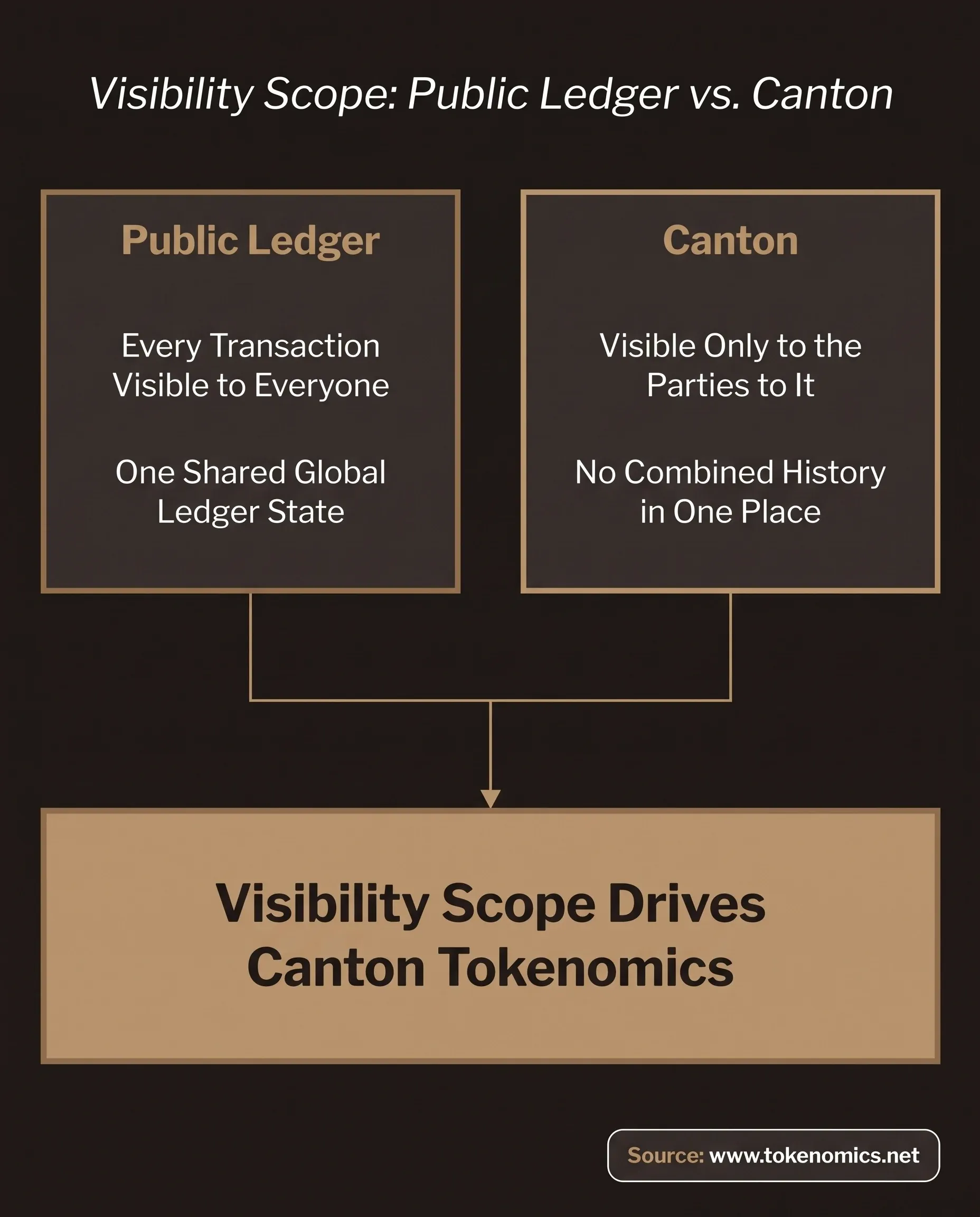
The contrast with a public L1 is narrow and specific. On a fully transparent chain, every transaction is visible to everyone. On Canton, visibility is scoped to the parties involved. That one difference drives most of what follows in Canton tokenomics.
#From Digital Asset R&D to a live institutional network
Canton grew out of enterprise work, not a retail launch. Digital Asset spent years building Daml applications for exchanges, custodians, and market infrastructure operators. Canton lets those separate applications transact with each other without collapsing into one shared public ledger.
Two specifics get repeated loosely about this network: the mainnet launch date and the roster of participating institutions. Both are verifiable, and both belong to Canton Network's own announcements, the Global Synchronizer Foundation's materials, or the named institution's own statement. We are not restating an aggregator's summary.
The positioning is the durable part. Canton was designed for regulated participants first, and Canton tokenomics follows from that choice rather than the other way around.
#How Canton's privacy and interoperability model works
Privacy on Canton is structural, not a setting. It is the precondition for everything in Canton tokenomics that follows.
#Sub-transaction, need-to-know visibility
A single transaction can involve several parties, and each sees only the portion it is a party to. A custodian sees the leg it settles. A counterparty sees its own obligation. No participant assembles a full history of anyone else's positions from the ledger, because no combined history exists in one place.
#Synchronizers and composability across applications
Independently built and independently governed applications still need to transact atomically with each other. Canton uses synchronizers to order and commit those cross-application transactions without requiring every participant to hold every application's data. Confirm the current mechanics against Canton's own technical documentation and the Daml and Canton source repositories.
#Canton Coin (CC): utility, fees, and the reward model
Canton Coin is the unit that pays for and rewards network work. Validators, application providers, and Super Validators contribute compute, storage, and synchronization capacity, and the documented model compensates them in CC while charging CC for the traffic they process.
#Fees and rewards are two sides of one meter
The structure reads closer to a metered utility than to a gas market with an open fee auction. Work performed earns CC. Work consumed costs CC. The CC token is the meter. Read the fee schedule and the reward schedule as a single system, because a change to either moves the other.
Canton tokenomics at this layer is a service-payment design. The mechanism creates that pattern. Whether that pattern fits your business is a separate question. Take the fee and reward parameters from Canton's own tokenomics documentation or a Global Synchronizer Foundation governance post with a proposal ID.
#Canton Coin supply and minting: what is specified, and what is not
This is where most Canton tokenomics writing gets ahead of the record.
Canton Coin's published materials describe a usage-linked minting model, where issuance tracks network activity rather than a fixed emission curve. That is the shape of the design. The figures underneath it, total supply, the current minting rate, the split across recipient categories, and any unlock terms, are not asserted in this post. We do not restate supply figures from recall, and CoinGecko, CoinMarketCap, DefiLlama, and Messari are not primary sources for issuance.
Three places carry the numbers: Canton's own tokenomics documentation, the Global Synchronizer Foundation's published economics materials, and the onchain issuance record through a named Canton explorer. If a figure appears in one secondary write-up and nowhere in the protocol's own record, treat it as unverified.
The gap is not in the network. It is between what a network publishes and what gets repeated about it.
#Governance, the Global Synchronizer Foundation, and validators
The shared coordination layer is governed, not ungoverned. A foundation body coordinates network-wide parameters, and Super Validators both operate infrastructure and carry weight over how it is run.
We are not calling that arrangement decentralized. The word carries specific meaning under a Howey-style analysis and under the SEC's sufficient-decentralization gloss, and using it without naming and running that framework is the loose characterization that gets quoted back at a client. Take the exact governing-body name and the current validator set from the Foundation's own governance documentation or a forum post with a proposal ID.
What matters for Canton tokenomics is the overlap: the parties who earn CC also influence the parameters that set what CC is earned for.
#Who is building on Canton
The application pattern is regulated financial infrastructure: tokenized funds, repo and collateral management, and settlement between institutions that already know each other's legal identity. That use case is why a visibility-scoped ledger exists. The Canton tokenomics story only works if those applications carry real volume.
We are not naming participants here. Institutional involvement gets announced and re-announced at different stages of commitment, and the distance between a pilot and a production deployment matters. Take each name from the institution's own announcement or Canton Network's own participant materials.
For the broader category rather than one network's version of it, the firm's RWA tokenization pillar guide covers the design pattern in full, and Ondo's tokenized-treasury model shows the same institutional logic applied to a single asset class.
If you're evaluating whether an institutional, permissioned model fits your own token design, that's exactly the kind of question our Tokenomics Consulting service works through with founders.
See our complete guide to RWA tokenization for how that same institutional-asset logic plays out across real-world asset classes.
#Canton tokenomics versus public, retail-facing L1 design
#Where a permissioned model changes incentive design
A public L1 has to pay strangers to secure it. That is why emissions, staking yields, and fee burns dominate public-chain token design. Canton starts with participants who are legally identifiable to each other, so the token's job narrows to metering and compensating work rather than bootstrapping trust among strangers. For the contrast, a public L1's supply and staking model shows the opposite set of pressures.
For that side of the equation, see our sui emission schedule and staking breakdown of how a public L1 handles the same fee-and-reward problem without permissioned counterparties.
#What this means if you are weighing institutional against retail-facing design
The narrower job is an advantage and a constraint. A metered utility token does not need speculative demand to function, and it does not generate much of it either. Value accrual depends on institutional volume, which arrives slower and leaves slower than retail flow. That is the trade-off in Canton tokenomics, and any founder designing for regulated counterparties will meet a version of it.
#Risks and open questions for founders watching Canton
Three things are worth tracking.
Operator concentration. A small set of Super Validators running shared infrastructure is efficient and concentrated at once. Watch whether that set widens.
Dependence on institutional throughput. A usage-linked reward model produces rewards in proportion to usage. Slow institutional adoption is not a token-design flaw. It is a demand problem the token cannot fix.
Secondary-market thinness. Permissioned, institution-first networks face an open question about how much secondary activity ever develops around assets issued on them. That is a pattern observation across the category, not a Canton-specific claim.
On the regulatory side, nothing here asserts that CC or any asset issued on Canton is a security, is not a security, or is compliant in any jurisdiction. That analysis is fact-specific, jurisdiction-specific, and a legal team's call. A third-party tokenomics audit is the usual way to pressure-test a design against that list.
That's precisely the pressure-testing our Tokenomics Audit service is built to run against a token design like this.
Institutional chains will keep launching, and their token models will keep getting described more confidently than they are specified. The founders who get useful answers read the protocol's own record and mark the gaps as gaps. Canton tokenomics is a clean case of that: the mechanism is legible, and the figures are where the care belongs.
If you're building onchain and need your token model to hold up under institutional scrutiny, book a strategy call. We'll assess your project and tell you whether we're the right fit. Sometimes we're not. We'll tell you that too.