JTO Airdrop Explained: Eligibility, Distribution, and Why It Is Closed
The JTO airdrop was a one-time December 2023 distribution with nothing left to claim. Who was eligible, how Jito structured it, and what founders can borrow.


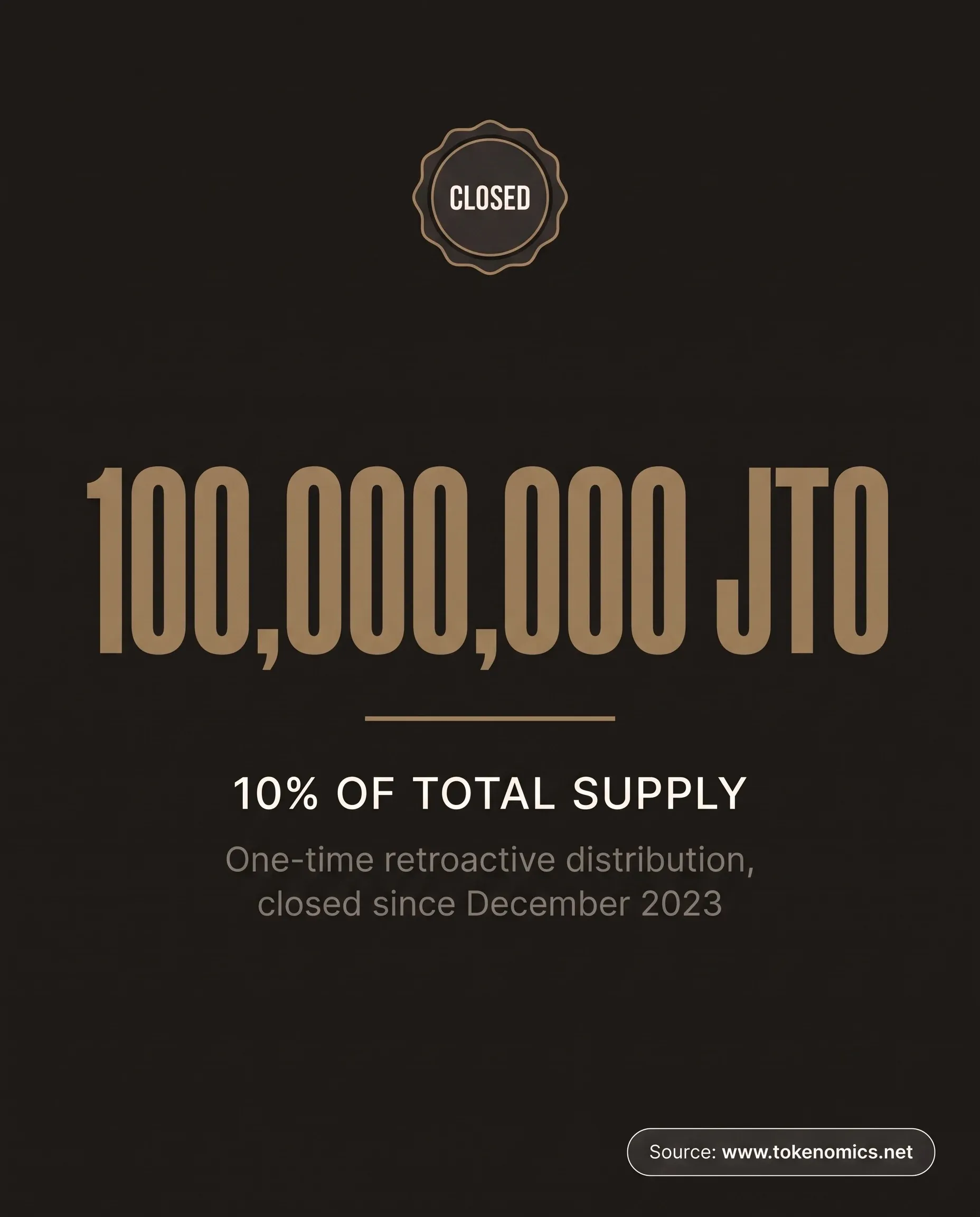
The JTO airdrop was a one-time retroactive distribution of 100,000,000 JTO, 10% of total supply, that the Jito Foundation opened for claim on December 7, 2023 (Source: Jito Foundation announcement). It is over. There is no wallet to connect, no form to complete, and no way to qualify for it now.
So read this as a case study, not a claim guide. Jito is the Solana MEV infrastructure project behind the Jito-Solana validator client, the off-chain block engine, and JitoSOL, its liquid staking token (Source: Jito documentation). The business was running and earning before the token existed. The token followed the usage. That sequence is the reason this distribution is worth studying at all, and it is the part most airdrop write-ups skip in favor of the allocation pie chart. This post describes mechanisms. It is not advice to buy, sell, or hold JTO.
#Is there still a JTO airdrop to claim?
JTO airdrop: the one-time December 2023 retroactive distribution of 100,000,000 JTO (10% of total supply) by the Jito Foundation to eligible validators, searchers, and JitoSOL holders, now closed to new claims.
No. The original distribution was a single event tied to Jito's December 2023 token generation event (TGE), and eligibility was fixed by a snapshot taken before the claim opened (Source: Jito Foundation announcement).
As of September 2026, we found no announcement of a second or incremental JTO distribution in Jito's own channels. Treat that as a point-in-time observation, not a settled fact. Distribution announcements originate with the Jito Foundation and the Jito governance forum, so check those two places directly before acting on anything you read elsewhere, including here.
That is the answer most people searching for the JTO airdrop actually need. Everything below is history and design analysis.
#What the JTO airdrop was
#Jito Labs, JitoSOL, and the MEV infrastructure underneath
JTO is the governance token of the Jito DAO. The products sit at the validator layer on Solana: a modified validator client, a block engine that auctions blockspace to searchers, and JitoSOL, which passes staking yield and a share of MEV tips through to holders (Source: Jito documentation). Validators earn. Stakers earn. The token governs what happens to the rest.
#The December 2023 token generation event
The Jito Foundation launched JTO and opened the retroactive claim on December 7, 2023 (Source: Jito Foundation announcement). Eligibility was already determined by then. The claim window was a collection mechanism, not a participation mechanism, and that distinction is the whole reason there is nothing actionable left here.
#Who was eligible for the JTO airdrop
Jito's own announcement is the record for this, and it is the only record worth reading. Aggregator and tracker summaries of it have drifted in the years since.
#Validator operators and searchers
Validators running the Jito-Solana client and searchers submitting bundles through the block engine were treated as eligible participants (Source: Jito Foundation announcement). Both groups had committed real operating work to the network before any token existed: hardware, uptime, capital at risk, and in the searchers' case competitive bidding for blockspace.
#JitoSOL holders and Jito Stake Pool depositors
The larger share went to users who had staked SOL through the Jito Stake Pool and held JitoSOL, weighted by how much was held and for how long (Source: Jito Foundation announcement). Read Jito's announcement for the exact weighting formula and cutoffs. We are describing the shape of the criteria here, not reciting arithmetic we have not re-derived.
The pattern is consistent: every eligible category maps to a durable protocol behavior with a real cost attached. Staking locks capital. Running a validator costs hardware and uptime. Neither is cheap to fake at scale, which is a different design posture than rewarding wallets for cheap, repeatable transactions.
For projects building eligibility criteria that resist exactly this kind of gaming, see how to prevent airdrop farming.
#How Jito structured the distribution
#Snapshot and claim mechanics
Jito airdrop eligibility rested on a snapshot taken before the claim opened, so nothing a wallet did afterward changed its allocation (Source: Jito Foundation announcement). The Jito airdrop claim then ran through an official page that required a wallet connection and a signature.
We are not linking that page. Claim sites for completed airdrops get retired, repointed, or cloned by phishing operations, and a URL that was correct in December 2023 is not one we can vouch for today. If you need to confirm what the portal was, start from Jito's own announcement and follow its links, never a search result.
#Lockups on the other allocation buckets
Airdropped tokens were transferable once claimed. The core contributor and investor allocations were not. Those buckets carried a lockup running from TGE followed by a vesting release (Source: Jito Foundation tokenomics documentation). Exact cliff dates and vesting lengths per bucket live in that documentation, and a tracker's summary of a vesting schedule is not the vesting schedule.
For how projects typically structure those lockups, see our guide to team investor and advisor vesting schedules.
#JTO supply and allocation
JTO total supply is 1,000,000,000 tokens, fixed at genesis (Source: Jito Foundation tokenomics documentation). The retroactive airdrop accounted for 10% of that, or 100,000,000 tokens.
The remainder sits across four named buckets: community growth, ecosystem development, core contributors, and investors (Source: Jito Foundation tokenomics documentation). We are naming the buckets rather than quoting a percentage for each one. Bucket-level splits get restated inconsistently across secondary sources, and the only figure worth citing is the one in Jito's own allocation table. Pull it from there.
Two things are worth noticing about that 10%. It was a defined carve-out, sized before launch and published alongside the rest of the allocation rather than negotiated after the fact. And it was a minority of supply, which means the airdrop was never the main event in this token's distribution. Founders who read airdrop case studies as distribution strategy tend to get that backwards.
#What happened to JTO after the airdrop
#Governance through the JIP process
JTO's ongoing function is governance. Holders vote on Jito Improvement Proposals through the Jito governance forum, covering protocol parameters and treasury decisions (Source: Jito governance forum). We are not citing a specific proposal ID, because we have not re-verified one against the forum at draft time. Read the forum directly for current and historical votes rather than trusting a secondhand summary of what the DAO decided.
#JitoSOL and where the revenue actually comes from
This is the part that matters for anyone studying the JTO airdrop as a design. Jito's value does not originate in the token. It comes from validators capturing MEV and from users wanting a liquid staking position on Solana, and JitoSOL is the product connecting the two (Source: Jito documentation).
A token without sustainable revenue mechanics is a countdown timer. Jito had the mechanics first, then distributed a governance claim over them.
For the general mechanism behind that sequencing, see how value accrues to a token.
#Key takeaways for anyone researching the JTO airdrop today
The claim window is shut. Nothing on this page changes that, and any site offering to process a retroactive claim for you is not legitimate.
If you are here as a founder designing a distribution, three things transfer. Eligibility tied to behavior that costs something to perform. A carve-out sized and published before launch instead of negotiated after it. And a token whose post-distribution job is governance over a business that already generates revenue.
Founders working through allocation, vesting, and claim mechanics for their own launch can start with our Token Allocation Vesting service.
The token followed the usage. It did not manufacture the usage, and no allocation table has ever manufactured it for anyone else. That is the lesson worth carrying out of this one.
If you are building onchain and need your distribution design to hold up under institutional scrutiny, book a strategy call. We'll assess your project and tell you whether we're the right fit. Sometimes we're not. We'll tell you that too.