Hyperliquid Unlock Schedule: How to Read and Verify It
Where to find the Hyperliquid unlock schedule, how to read each vesting row, and how to check it against primary sources before you rely on any date.


#What the Hyperliquid unlock schedule is
A token unlock schedule is a timetable that releases reserved allocations, such as core contributor tokens, into circulation over time, and the Hyperliquid unlock schedule is the version of that timetable that applies to HYPE. Whether Hyperliquid documents such a schedule, and which allocations it covers, is something to confirm in protocol documentation and onchain data, not in a blog post, including this one.
Read it as one half of a two-sided system. In a token whose value is tied to fee revenue routed to buybacks, supply release is the supply side and the buyback is the demand side, so you read the Hyperliquid unlock schedule alongside whatever buyback the protocol documents, never alone. Any date or amount here names its source and an "as of" date. Where we cannot source one, we say so and point you to where to check.
For the buyback side of that system, read Hyperliquid tokenomics explained.
#What the Hyperliquid unlock schedule covers: buckets, cliffs, and cadence
#Buckets that release on a schedule and buckets that did not
Not every allocation in a token supply vests. In many token designs, a community distribution at launch is liquid on arrival, so no schedule attaches to it, while reserved allocations, such as core contributor tokens, typically follow a vesting timetable, which is what the Hyperliquid vesting schedule is meant to cover. Confirm which bucket each HYPE allocation sits in against the protocol's launch documentation. For any token, public documentation of exact cadence can be incomplete, so keep two lists: what the protocol documents, and what a third party infers. A Hyperliquid core contributor unlock belongs on the first list only if the protocol published it.
We do not state a core contributor allocation size, cliff, or cadence here, because we have not confirmed those terms against a primary source. Take them from the protocol's own documentation and record the page date. We also do not state circulating, total, or maximum supply figures here. Aggregators such as CoinGecko list them, but an aggregator is a cross-check, not a primary source. These figures move as unlocks proceed, so confirm any figure against protocol documentation or onchain data and cite it with its date. The distance between circulating and total supply is not an unlock schedule. It does not tell you which bucket holds the tokens, when a release happens, or how large each one is, so treat it as a reason to go find those rows, not a substitute for them.
#The three fields every vesting line has
- Cliff: the date before which nothing releases.
- Cadence: how often releases repeat after the cliff.
- Amount: how many tokens each release adds.
The shape matters more than the total. One large cliff drops supply into a single moment, while steady releases spread the same total across many. Same allocation, very different design.
For how founders set these fields, see token vesting cliff design.
#Where to find the live Hyperliquid unlock schedule
Rank sources by authority. When two disagree, the higher one wins. Any copy of the Hyperliquid unlock schedule you find should trace back to one of these.
#Protocol documentation and core team statements
- Official Hyperliquid documentation. Start here and note the page date.
- Attributable core team or foundation statements: a named account or official channel you can link to, not a screenshot.
#Onchain data and named unlock trackers
- A named onchain explorer or analytics dashboard, such as the Hyperliquid explorer. Record the tool and the query so someone else can reproduce your number.
- Unlock trackers such as CryptoRank token market data, as a cross-check only. Trackers project a timetable. They do not publish one.
Confirm any date in two independent places before you treat it as settled. If a tracker and the protocol disagree, the protocol wins, and the disagreement is worth writing down.
#How to read one unlock row: a five-check reader checklist
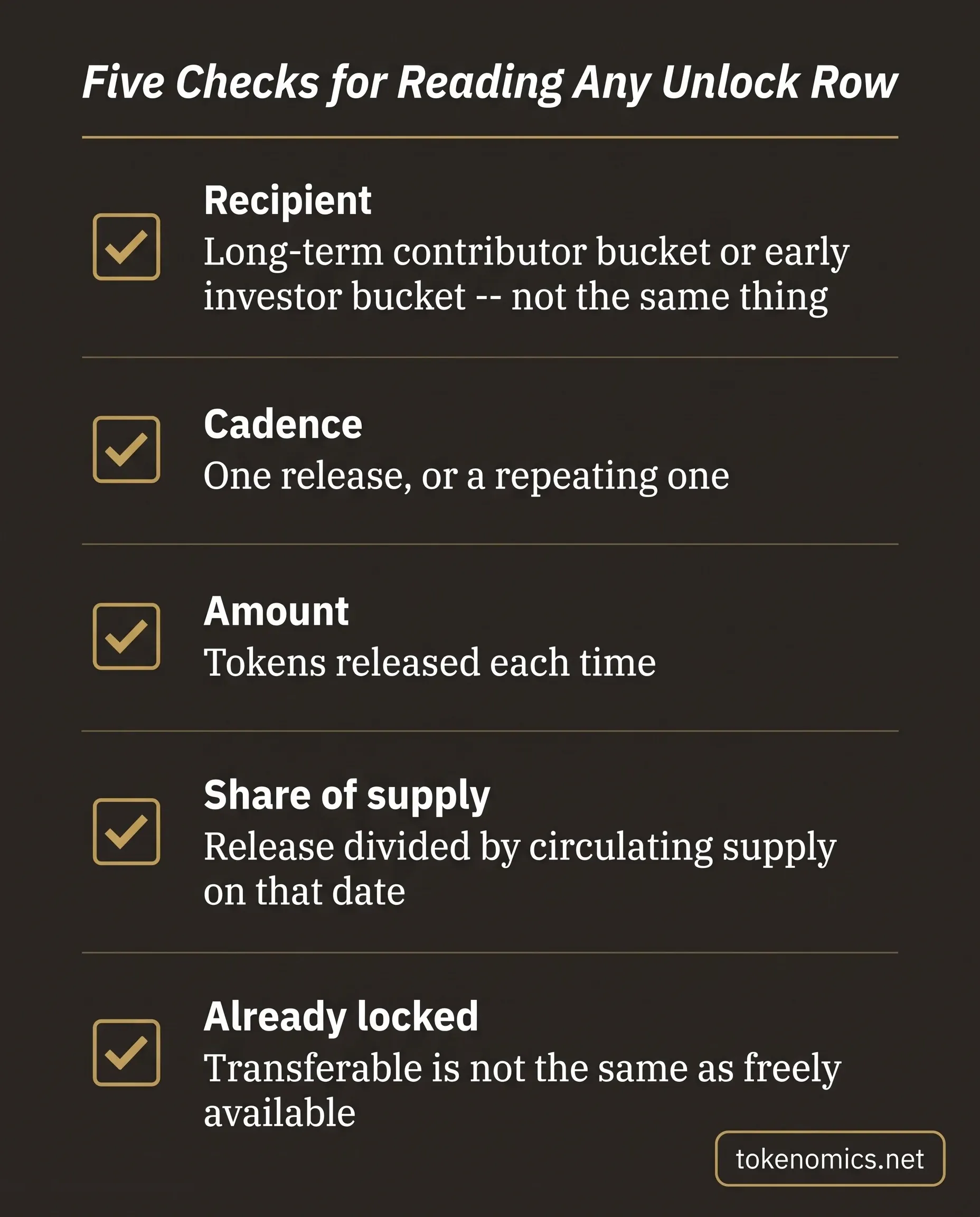
This is how to read a token unlock schedule without borrowed numbers, applied to the Hyperliquid unlock schedule one row at a time. Every row answers five questions.
#The five checks
- Who receives it? A long-term contributor bucket and an early investor bucket are different things.
- What cadence? One release, or a repeating one.
- What amount? Tokens per release.
- What share of circulating supply? Divide the release by circulating supply on that date. Most readers skip this, and it is where a large-looking release turns out small, or the reverse.
- What is already staked or locked elsewhere? Transferable is not the same as freely available. For how staking works on Hyperliquid, see the Hyperliquid staking documentation.
#A worked reading of a generic row
Take a labeled placeholder row: a reserved bucket, monthly cadence, X tokens per release, and Y tokens circulating on the date. The release is X divided by Y, expressed as a percent. These are placeholders for the method, not Hyperliquid data. Run the same division on a real row before you form any view.
Get the denominator right first: circulating supply vs total supply explains which figure to divide by.
#Unlocks against buybacks: reading gross versus net supply
#Gross unlock, buyback removal, and what is left
New supply enters on the schedule. In any fee-funded buyback design, the tokens bought back leave the market, which removes supply, and net supply is a function of both sides. How Hyperliquid runs its own version is covered in the explainer linked above, and you should confirm the current terms in protocol documentation and against onchain data on the Hyperliquid explorer. In a fee-funded design, the buyback side depends on live fee revenue, which varies, so we state no net figure here: it needs both sides sourced and dated, and the Hyperliquid unlock schedule only supplies one of them.
For the removal side, see buyback-and-burn vs fee burn.
#Why the comparison is a design question, not a trading signal
This is where the design lesson lives. A buyback is only as durable as the revenue behind it. If fees fall, removal slows while the schedule keeps running on its own calendar. That is a mechanism observation about any exchange token, not a view on where any price goes.
#Common misreads of an unlock schedule
#Treating an unlock as a sale
An unlock makes tokens transferable. It does not mean the recipient sells. Reading a release as a sale is the most frequent error, and the schedule cannot tell you what happens next.
#Treating a stale table as current
Copied tables go stale when terms are amended, so check the date on every source. Keep total, circulating, and fully diluted supply apart. Do not treat a tracker's projection as protocol documentation. Each of these errors turns a lookup of the HYPE token unlock schedule into a guess.
#What token founders can borrow from this schedule design
Use the same reading method on your own vesting. Three design questions:
- Does your cliff concentrate supply into one month?
- Does your cadence give the market time to absorb each release?
- Can you publish the schedule in a form anyone can verify?
Across 80+ projects, we treat the schedule as a design surface, not a footnote, and we keep mechanism separate from recommendation. If you want a lower-commitment first step, an independent audit of a vesting design is one.
See our Tokenomics Audit service for what that covers.
If a stranger can verify your schedule as easily as this guide asks you to verify the Hyperliquid unlock schedule, you have removed the most common source of doubt.
If you want a second read on your own vesting schedule before you publish it, book a strategy call.