Chainlink Valuation: Valuing LINK Without a Price Target
Chainlink valuation without a price target: four lenses, the inputs each needs, and the blind spots each hides, tied to what the network sells.


Chainlink valuation is the process of estimating what the Chainlink network earns from serving other protocols, how much of that reaches the LINK token, and how token supply changes over time. It is a mechanism analysis, not a price forecast. This post sets out four lenses for doing it, the inputs each one needs, and the blind spot each one hides.
That distinction matters because the topic invites a shortcut. A Chainlink valuation you can defend starts one step before price, with the business the token is attached to. If you are a founder benchmarking your own token design, the last section turns the analysis into design choices.
#What Chainlink Valuation Actually Asks (and What This Post Will Not Do)
The question behind a Chainlink valuation is not "what will LINK be worth." It is "what does this network earn, how much of that could reach the token, and what happens to the supply along the way." Blurring those three questions is how a price forecast gets dressed up as analysis.
#The business underneath the token
The token is infrastructure for a real business, and the business is the engine. Chainlink is an infrastructure network that sells data and cross-chain services to other protocols. Its customers are teams that need something a single blockchain cannot provide on its own, such as an external price or a message that crosses chains. So any Chainlink valuation begins with demand for those services and only then moves on to the token. Reverse the order and you are valuing a ticker instead of a business.
#Scope: mechanism analysis, not a recommendation
To be plain, once: this post does not predict prices, and it does not recommend buying, selling, or holding LINK. Nothing here is investment advice. What you get is a way to ask better questions in a sensible order. If a source hands you one number from one method, treat it as a narrative until it shows its inputs.
#The Revenue Engine: What Chainlink Sells and Who Pays
#Data feeds, cross-chain messaging, and the services around them
Chainlink's own documentation describes a set of service lines. The two most relevant to LINK token valuation are data feeds, which deliver external information such as asset prices to smart contracts, and a cross-chain messaging and transfer protocol. The documentation lists further services, and the list changes, so check it directly rather than relying on a summary, including this one.
Each service line has its own customers, pricing, and competition, so one blended "Chainlink revenue" figure is a weak input. Ask which services it covers and who reported it.
#Why demand comes from protocols, not from token holders
The buyer of a data feed is a protocol or an enterprise that needs the data. Holders of the token are not the customer. Demand for the service is therefore a function of how much onchain value depends on it and how many teams choose to integrate it.
This is a common place for a Chainlink valuation to go wrong. Usage and monetization are different things. Value secured and integration counts describe how widely the network is used. Revenue actually captured describes what the network is paid. A network can be widely used and modestly paid, and the gap between the two is the first thing to measure. Any usage or integration count should come with a date and a named source before it goes into a model, and this post quotes none.
For a wider view of how mechanism choices decide whether usage turns into protocol value, see our guide to DeFi tokenomics mechanism design.
#Supply as an Input: Max Supply, Circulating Supply, and What Changes It
#Reading the supply picture without turning it into a forecast
Treat supply as an input to a Chainlink valuation, not as a story. Take max supply and circulating supply only from a dated source. The LINK token contract on Etherscan records a max total supply of 1,000,000,000 LINK. Circulating supply is not a contract value, so it has to come from a tracker: CoinGecko put it near 748.1 million on September 21, 2026, which is a dated cross-check rather than a primary figure. Those numbers move as vesting unlocks proceed, so cite any supply number with its as-of date and do not quote it from memory.
Two terms matter when you compare tokens. Fully diluted valuation applies a price to the maximum supply, while circulating market capitalization applies it only to the tokens currently in circulation. The gap between them shows how much supply has yet to enter the market, which is why setting one token's circulating figure against another's fully diluted figure produces a meaningless ratio.
#The supply-side mechanisms to check
Three mechanisms belong on the checklist, each with its own source and its own status:
- Node operator incentive payments. Operators are paid to run the network, and how those payments are funded shapes how much supply moves. Confirm the current payment structure in Chainlink's documentation before you model it.
- Staking. Chainlink's documentation describes a staking design in which tokens are locked as collateral. Check the current pool terms and status there.
- The Chainlink Reserve. A reserve that accumulates a token is one way a network can absorb supply. Whether a Chainlink reserve exists, and whether it is announced, live, or still being implemented, is a question for the primary announcement, so read it before quoting its wording.
Keep to inputs here. The full mechanism walk-through belongs in a dedicated treatment of Chainlink tokenomics. The valuation only needs to know which mechanisms are live, what they absorb, and what they release.
For a plain definition of the supply term used throughout this section, see the glossary entry on circulating supply.
#Where Value Can Reach the Token: Four Capture Channels
A network can earn revenue and still leave the token with none of it, so every Chainlink valuation has to answer a token value capture question: which channels, if any, connect the two. Confirm each channel's status (live, announced, or proposed) against its source before relying on it.
#Service fees and how they connect to LINK
Fees are the obvious channel and the least automatic. Where customers can pay for services in assets other than the token, a fee-to-token link exists only if a conversion or payment path routes value into the token. That path is a design choice, not a given. Fee-to-token linkage is the first thing to ask about, because without it revenue and token demand are two separate stories. Check the currently documented fee payment options in Chainlink's documentation before assuming any particular path.
#Staking and the security-budget argument
Staking is a security argument before it is a value argument. Tokens locked as collateral put economic weight behind service quality, and the size of that collateral relative to the value secured is the security budget. Staking matters to a holder only if the locked amount meaningfully reduces circulating supply. Confirm the current staking status before assuming any lock-up exists.
#Reserve accumulation and supply absorption
A reserve that accumulates tokens acts as a supply sink, because tokens that enter it stop being available to trade. Whether it matters depends on the pace of accumulation relative to circulating supply, and on whether the funding source is durable. Announced and live are different states, and a valuation should say which one it is assuming.
#Node operator collateral and incentives
Operators may be required to hold or lock tokens, and they receive incentive payments. Collateral requirements create demand from participants who need the token to operate. Incentive payments work in the opposite direction, adding to the flow of tokens to operators who may sell them. We do not rank the four channels by expected price impact, because no such ranking would be defensible.
For the design view of what makes a token necessary in the first place, our guide to token utility design covers it.
#Four Valuation Lenses Compared: What Each Needs and What Each Hides
#Chainlink valuation lenses: fee multiple, security budget, supply flow, and comparables
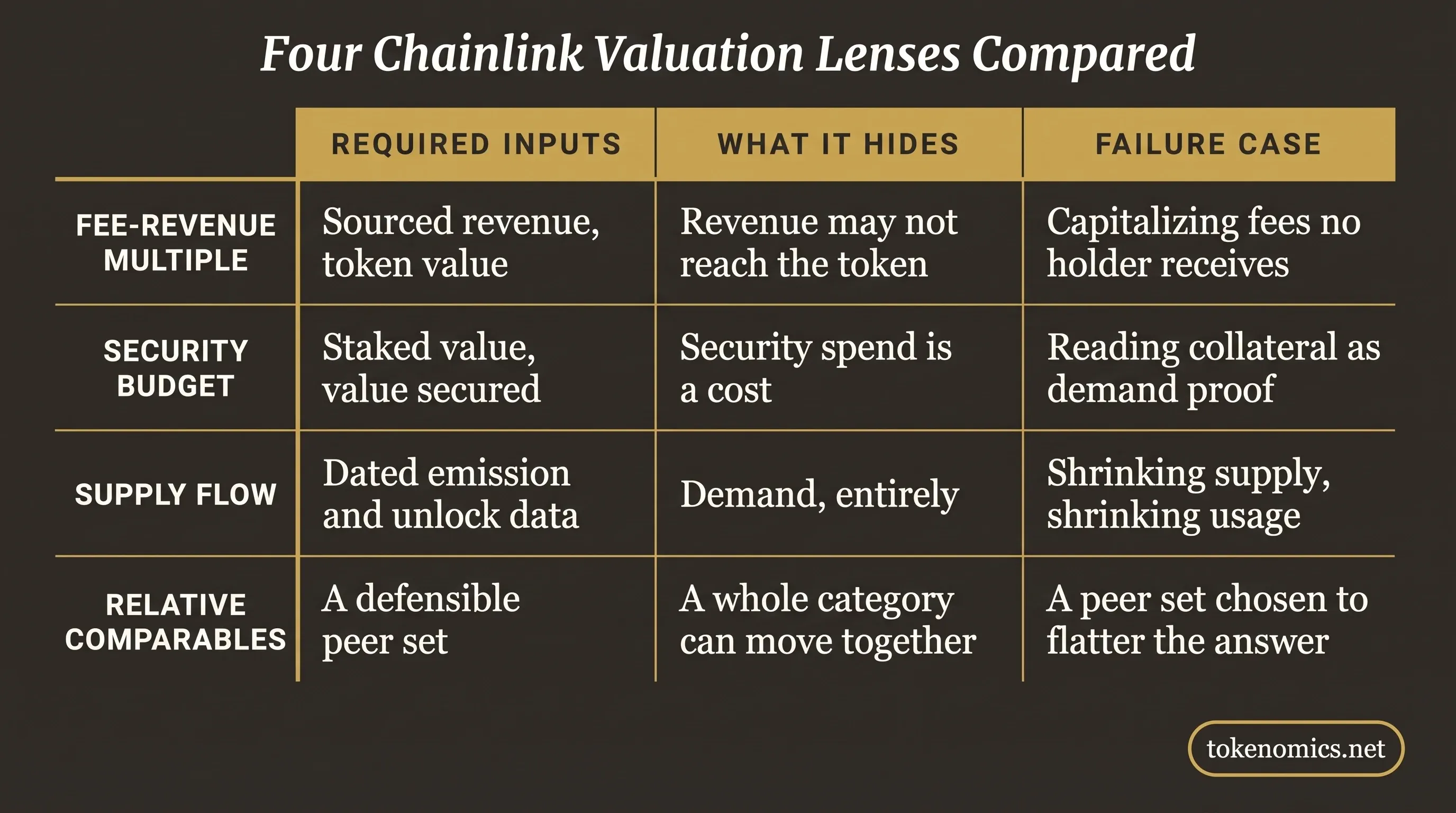
Every Chainlink valuation method in use is one of four lenses or a blend of them. Each answers a different question. The fee-revenue multiple needs sourced revenue and hides whether that revenue reaches the token. The security-budget lens needs staked value against value secured and hides that security spending is a cost, not a return. The supply-flow lens needs dated supply data and hides demand entirely. The relative-comparables lens needs a defensible peer set and hides that a whole category can be mispriced together.
No lens works alone. A Chainlink valuation built on one lens is a narrative with a spreadsheet attached. An oracle token valuation that uses all four still ends in a range of labeled assumptions, not a fact.
#Comparison table: Chainlink valuation lens, required inputs, blind spot, failure case
| Lens | Required inputs | What it hides | Generic failure case |
|---|---|---|---|
| Fee-revenue multiple | Sourced protocol revenue, token market value | Revenue may not reach the token | Capitalizing fees that no token holder receives |
| Security budget | Staked or bonded value, value secured | Security spend is a cost, not a return | Reading a large collateral pool as proof of demand |
| Supply flow | Dated emission, unlock, and accumulation data | Demand, entirely | Shrinking supply paired with shrinking usage |
| Relative comparables | A defensible peer set, comparable metrics | A whole category can move together | A peer set chosen because it flatters the answer |
#What These Frameworks Cannot Tell You
#Competition and substitutability in oracle and cross-chain services
Other oracle and cross-chain networks exist, and customers can switch or split their business between them. Fee pressure from competition can compress the very revenue that any Chainlink valuation tries to capitalize. We refer to other networks generically because a named comparison needs its own primary sources.
#Concentration, dependence on a few large integrations, and disclosure limits
If a large share of demand comes from a handful of integrations, the loss of one changes the picture more than a headline integration count suggests. Any concentration claim about a specific network needs a named source, and we make none here. From outside the network you also cannot see private commercial terms, so any revenue figure you find is an estimate or a secondary source and should be labeled as one.
#Why valuation from outside the network is an estimate
Outside observers work from public documentation, onchain data, and reported figures, each with lags and gaps. The honest output is a range with labeled assumptions. There is a difference between an observation about mechanism, such as "this fee can be paid in a non-LINK asset," and a forward claim about price. This Chainlink valuation stays on the observation side of that line, and you should be wary of any analysis that crosses it without saying so.
#What Founders Can Take From Chainlink's Design for Their Own Token
If you are building a token rather than analyzing one, the lenses behind a Chainlink valuation turn into design questions. Investors and counsel will run them on your model, so it is cheaper to run them first.
#Make the fee-to-token path explicit before launch
If demand for your token depends on protocol usage, document the path from usage to token demand in your data room. Say which fees exist, who pays them, in which asset, and where the value goes. An investor who cannot find that path will assume it does not exist.
#Treat supply schedules as a published, testable commitment
Publish emissions, unlocks, and any accumulation mechanism with dates, and stress-test them before you lock any contract. A supply schedule that cannot survive a hostile reading in a spreadsheet will not survive one in a listing review.
#Separate usage metrics from monetization metrics in your investor materials
Report integrations, value secured, and transaction counts in one block, and revenue actually captured in another. Blending them costs an informed reader's trust. Everything in this section is design guidance, not token-investment guidance.
If you want an independent read on where your own fee-to-token path stands before you commit to a design, a third-party review is the lower-commitment step.
Our tokenomics audit service is where that review happens.
Chainlink valuation, done properly, is a business question with a token attached. The token is infrastructure and the business is the engine. Whatever your own token looks like, the useful move is the same: know what the network sells, know which channels carry value to the token, and publish the supply. A Chainlink valuation that can show its inputs is worth reading, and a token design that can show them is worth building.
If you are designing a fee-to-token path for your own token and want a second opinion on it, book a strategy call.