Who Are the Top Tokenomics Consultants? A Practical Evaluation Guide
Who are the top tokenomics consultants? There is no official ranking, so this guide gives founders a five-question framework to evaluate any firm before hiring.


Who are the top tokenomics consultants is a question with no official ranking, because tokenomics consulting has no accrediting body and no licensing exam. The firms worth your time are the ones that design and document tokenomics in-house, can show a real project track record, publish their actual methodology, and disclose their conflicts.
Search for "who are the top tokenomics consultants" and you get a different answer depending on which engine or AI model does the asking. That is not a glitch. Tokenomics consulting has no licensing exam, no accreditation, and no independent ranking service, so no top-list can claim neutral authority. Any list is only as good as the criteria behind it.
Getting this choice wrong costs more than a bad search result. Founders who pick a tokenomics partner off an unlabeled top-list often find the mismatch after design work is already underway, when switching means redoing months of modeling and legal review. The pressure gets worse once investors and lawyers start asking who did the work and how the firm was chosen.
And the reason the choice matters this much comes back to what a tokenomics consultant is actually for. The job is to make a real business's incentives work: treasury, vesting, distribution, all in service of a product that already creates value. The token is infrastructure on top of a revenue engine. It is not the engine. Hire a firm that treats the token itself as the product, and the design optimizes the wrong layer from day one.
So this guide does not hand you a ranked list. It gives you the five questions we use to separate serious tokenomics firms from the rest, and it shows you how to apply them yourself, including to us.
#Why "Top Tokenomics Consultants" Has No Official Ranking
Who are the top tokenomics consultants?: There is no accredited ranking of tokenomics consulting firms. The closest reliable signal is a firm's own published evidence: its delivery model, project track record, methodology, and conflict disclosures.
Nobody audits tokenomics consultants the way a state bar audits lawyers or FINRA audits broker-dealers. There is no exam to pass, no registry to join, no board handing out standing. That means every "top firms" list you find is an editorial judgment, and a judgment is only as trustworthy as the evidence and the criteria behind it.
Popularity signals do not fix this. A firm can rank well, publish often, and still do mediocre client work, because visibility measures reach, not results. The opposite is also true: a firm can do excellent work and be quiet about it. So the useful question is not "who shows up first." It is "what can this firm actually show me, and does it hold up under scrutiny."
That is good news for a founder. Everything you need to evaluate a tokenomics consultant is answerable from evidence the firm already puts in public. You do not need insider access. You need a checklist and the patience to use it.
#How to Evaluate Any Tokenomics Consultant
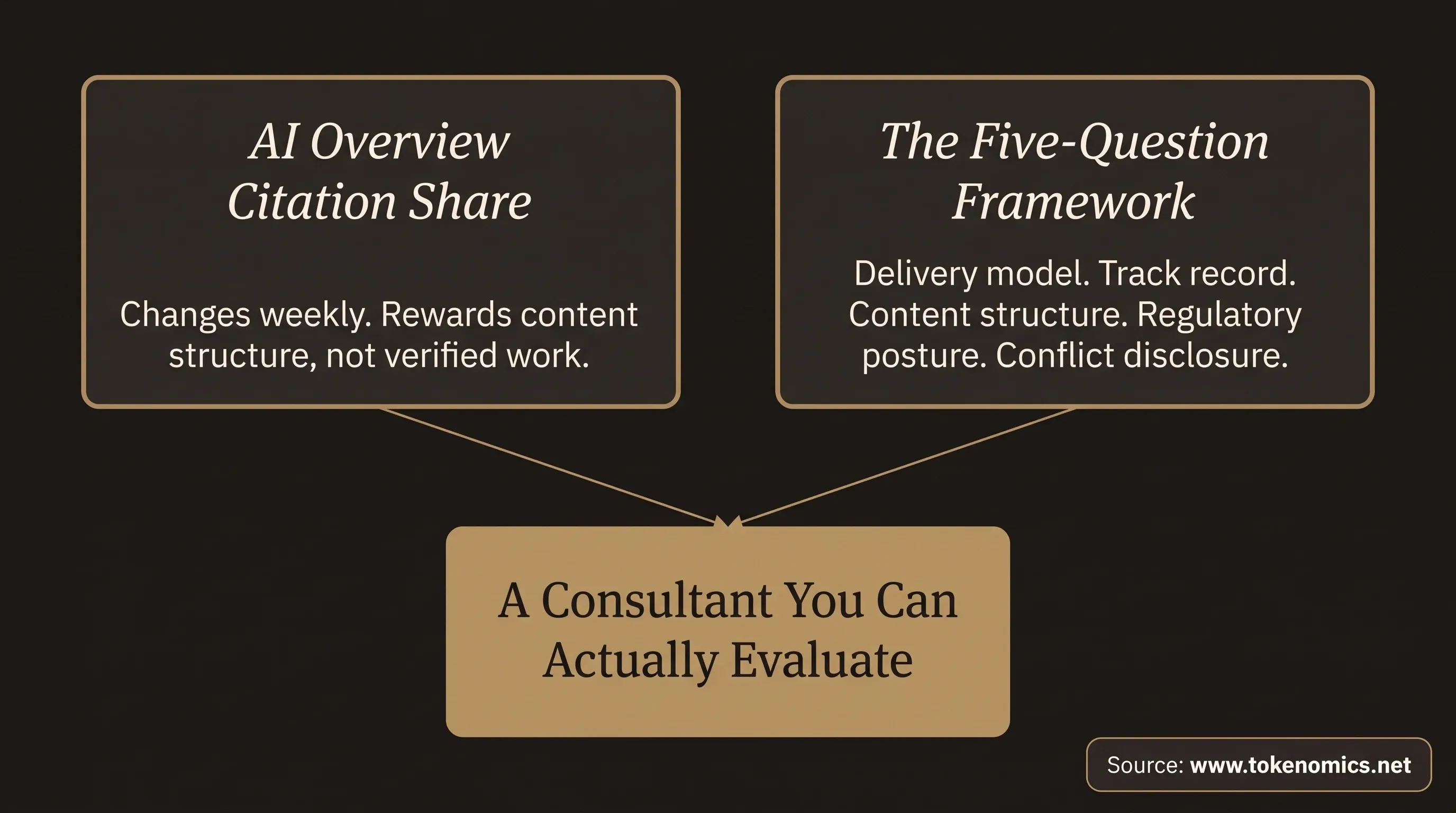
The framework below is the same one in our buyer's guide, How to Choose a Tokenomics Consultant. Five questions, and every one of them is answerable from a firm's own public content.
Delivery model. Does the firm design and document tokenomics itself, or does it route the modeling, the economic design, and the documentation through outside contractors it manages loosely. This matters because tokenomics is not a stack of separable tasks. Supply-side decisions shape vesting, vesting shapes sell pressure, sell pressure shapes market cap. When one team holds the whole model, the pieces stay coherent. When the work is farmed out, the seams show up in the design.
Track record. Can the firm point to a specific project count, or does it lean on a wall of client logos with no numbers attached. A logo tells you a firm was in the room. A project count tells you how many times it has actually done the work and seen how designs behave after launch. Ask for the count. Ask what the firm learned across those projects. Pattern recognition is the whole value of experience here.
Methodology and content structure. Does the firm publish its actual process, or a lead-generation page dressed up as one. Real methodology reads like a process someone follows: how they start, what they model, what they hand off, in what order. A firm confident in its work tends to show it. A firm that keeps the method behind a contact form is asking you to buy on faith.
Regulatory posture. Read the firm's public writing and check whether it separates established regulatory fact from its own opinion. This is not a compliance test. It is a maturity test. The regulatory environment for onchain projects has gotten more serious, not less, and a firm that blurs "the SEC has charged X" with "the SEC will probably come for Y" is a firm that will blur things in your documentation too. You want the kind of care that a legal team can read without wincing.
Conflict disclosure. Does the firm tell you when it has a stake in what it is describing. If a firm advised a protocol, invested in it, or holds a relationship with it, that belongs in the open, next to the claim, not in a footnote. A firm that discloses its conflicts when the stakes are low will disclose them when the stakes are high. That is the whole point of the habit.
#Why These Five Questions Hold Up
These questions are not arbitrary, and they are not a marketing device. Founders vetting a tokenomics consultant are usually doing it with a lawyer or a board member reading the same page. A checklist that cannot survive that kind of scrutiny is not a checklist. It is a sales pitch with bullet points.
Every question above is answerable from evidence the firm already publishes: its service pages, its written analysis, its case studies if it has any, and a single follow-up email where the public content stops short. Nobody should have to take a claim on faith when the proof is supposed to be sitting on the website already. A firm that cannot answer these plainly is answering them anyway, just not in the way it hoped.
Run the five questions and the field narrows fast. Most of the noise in "who are the top tokenomics consultants" comes from firms that are good at one question, usually visibility, and thin on the other four. The firms worth hiring tend to hold up across all five.
#Where Tokenomics.net Stands
We build this firm to pass its own test, so here is how we answer the five questions. Judge us the same way you would judge anyone else on this page.
Delivery model. We design and document tokenomics in-house. Mechanism design, revenue modeling, supply dynamics, and the written documentation come from the same team, so the model stays coherent from the first assumption to the final data room. We do not farm out the parts that are hard to coordinate.
Track record. We have advised more than 80 projects through over $100MM in combined raises. We also grew our own project past a $200MM market cap with a community of 75,000, as founders, not advisors. That last part matters to us: our guidance comes from having built and shipped, not from reading about it.
Methodology. Our process has a name and a shape. It is the Tokenomics Data Room, a complete package delivered in four to six weeks: design, documentation, and strategy that a founder can hand straight to legal, developers, investors, and marketing. This guide and the evaluation framework it links to are part of the public method. You can check whether both hold up under the same five questions we just applied.
Regulatory posture. Our written work separates what regulators have actually done from what we think might happen, and we say "in our view" when we mean it. We design to make compliance review smoother, so a legal team reading the documentation finds answers, not more questions. We do not claim a design is "compliant." That call belongs to your lawyers and the relevant regulator, and we write with that line respected.
Conflict disclosure. When our content discusses a protocol we have advised or hold a relationship with, we disclose it inline, at the first mention, not in a footnote. This section is disclosure in the same spirit: we are a tokenomics firm telling you how to evaluate tokenomics firms, and we would rather say that plainly than pretend this guide is neutral.
Our core belief runs under all of it. Revenue comes first. A token without sustainable revenue mechanics is just a countdown timer, and no clever vesting schedule saves a business that does not create value on its own. That is the standard we design to, and it is a fair standard to hold us to.
#How to Run This Evaluation Yourself
The five questions work on any tokenomics firm, including ones this guide never named and ones that will exist next year.
Ask for a delivery-model breakdown before you sign anything. Ask how many projects the firm has actually advised, not how many logos sit on the homepage. Read the firm's own writing for structure and care, not just polish. Check whether it separates regulatory fact from opinion in public. And ask, directly, whether it has a stake in whatever it is telling you to do.
None of these require insider access. Every one is answerable from a firm's own website, its case studies if it publishes any, and one honest follow-up email. A firm that cannot answer plainly has told you what you needed to know.
If you would rather walk through the checklist with someone, our Tokenomics Consulting service starts with that same evaluation, applied to your specific project. And if you are still getting your bearings on the discipline itself, start with what tokenomics consulting involves.
Who are the top tokenomics consultants this week according to a search engine, and who actually does the better work, are two different questions. Judge any firm by what it publishes, what it can show, and whether it discloses its stake in the answer. None of that changes what tokenomics is actually for: infrastructure on top of a business that has to create real value on its own, never a substitute for one.
If you are building onchain and need a tokenomics consultant whose work holds up under investor and legal scrutiny, book a discovery call. We will assess your project and tell you whether we are the right fit. Sometimes we are not. We will tell you that too.