Chainlink Tokenomics: LINK Supply and Node Incentives
Chainlink tokenomics explained: the fixed 1 billion LINK supply, launch allocation, node operator incentives, and how to read circulating supply.


Chainlink tokenomics starts with one design fact: LINK is a fixed-supply token that pays for and secures an oracle network, not a gas token for a chain. Total supply is capped at 1 billion LINK, so the useful questions concern allocation, incentives, and how much of that supply is free to trade. This is a supply-side read for founders studying how an established network structures its token, not investment guidance. One rule frames all of it: a token's supply design only matters relative to the real service demand behind it.
#Chainlink tokenomics in one paragraph: a fixed supply tied to a service network
#What LINK is, and what it is not
Chainlink is an oracle network. It delivers offchain data, such as prices and reserve attestations, to smart contracts across many blockchains. It is not a chain, and LINK does not pay transaction fees on one. LINK is the network's payment and staking asset: Chainlink's token documentation describes LINK as the asset used to pay node operators for services and to stake behind service delivery.
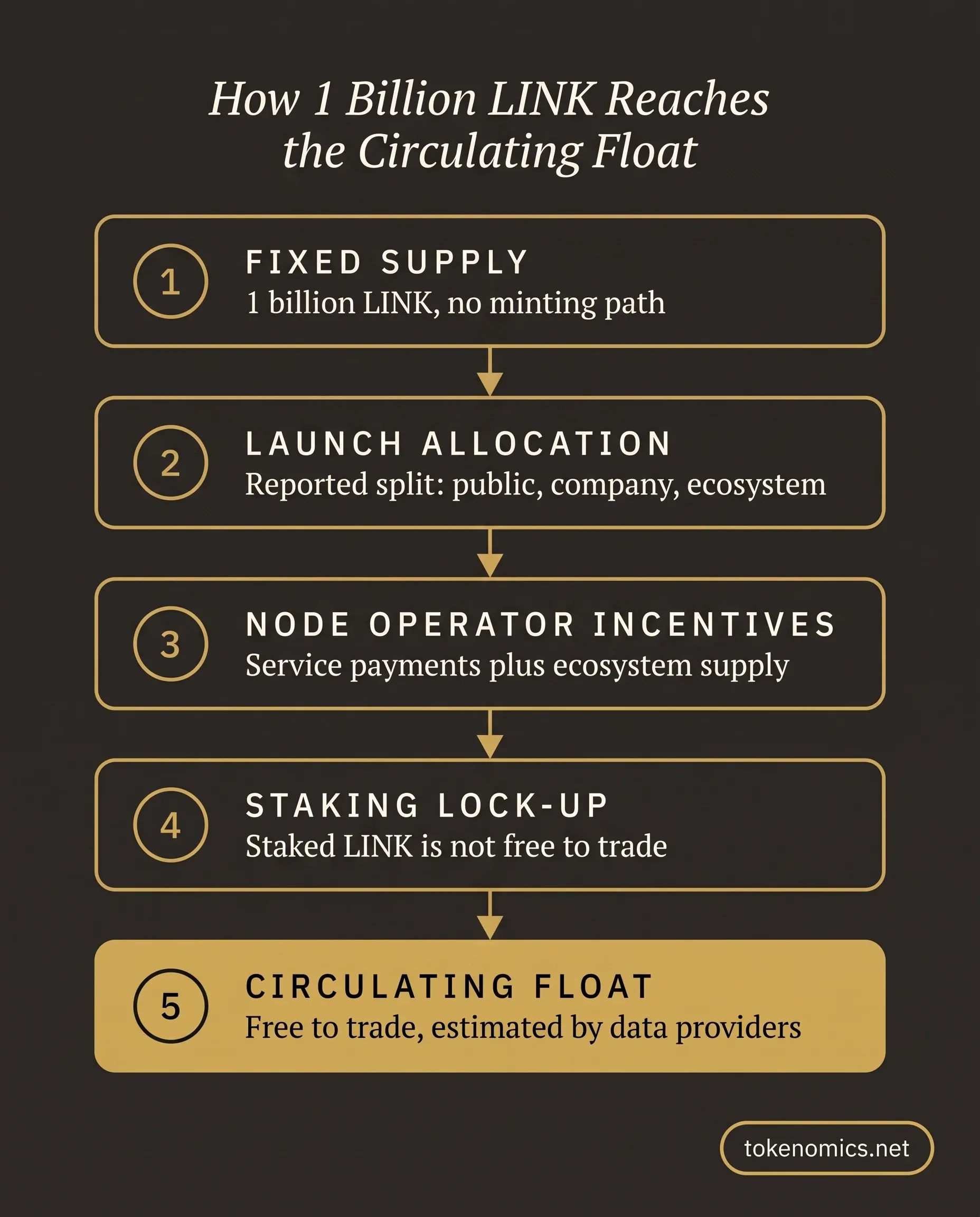
Supply is fixed at 1 billion LINK with no minting path: the LINK token contract on Etherscan records a max total supply of 1,000,000,000 LINK, checked September 21, 2026.
That makes the LINK token supply a closed system, so every design question shifts from issuance to distribution and lock-up.
If you are deciding how a fixed supply should be issued and locked for your own token, our token allocation vesting service covers that design work.
#Where the 1 billion LINK went: the launch allocation
#The three-way split at genesis
Secondary summaries of Chainlink's 2017 token sale commonly describe supply as split into three buckets: one sold to the public, one retained by the company, and one set aside for node operators and ecosystem growth. We have not confirmed that structure or its percentages against the primary sale documents, so treat it here as reported design intent rather than established fact. Read the Chainlink whitepaper and the original sale documentation before you quote any split.
#What each bucket was designed to do
Each bucket has a different job. The public sale raised capital. The company share funds the team building the software. The node operator and ecosystem share is the unusual one, because it is a standing incentive pool, not a team or investor allocation. It exists to pay for network supply, meaning the operators who deliver data.
That is a pattern worth naming for your own model: one bucket to fund suppliers, one to fund builders, one to raise capital. The launch allocation is the foundation of Chainlink tokenomics, and everything after it is a question of how those buckets behave over time.
For benchmark ranges on each bucket, see our token allocation strategy framework.
#How ecosystem allocation reaches node operators
#Service payments versus incentive supply
Node operators earn LINK two ways. The first is direct payment for oracle services, which scales with demand for the network. The second is the ecosystem allocation, which can fund incentives beyond what fees alone would pay, especially when a new data feed has little usage yet.
Keep those flows separate in your own analysis. Service payments are demand-driven. Incentive supply is a decision by the issuer. We stay at supply-flow level here and leave staking pool mechanics and slashing to our fee-capture teardown.
#Why node operators hold LINK
Holding LINK ties operator behavior to the network. Operators are paid in it, and the staking design is commonly described as putting staked LINK at risk when service is poor. We have not verified the forfeiture rules against the staking contracts, so read those onchain before you rely on the detail. The link between payment and skin in the game is the core of Chainlink node operator incentives.
One caution on evidence. Onchain data shows what is verifiable: contract balances, staking deposits, and transfers. How the ecosystem allocation is scheduled or spent depends on disclosures from Chainlink Labs. Label which of your own numbers are checkable and which rest on the team's word.
#Circulating, locked, and staked: how to read the LINK supply number
#Why "circulating supply" is not one number
Three figures get mixed up. Total supply is fixed. Circulating supply is an estimate that data providers compute by deciding which wallets count as locked, so providers can disagree. Staked supply is onchain and capped by the design of the staking pools.
To check current numbers, read the LINK contract and the staking contracts on Etherscan, then compare against token market data from a provider such as CryptoRank. We do not hardcode a figure here because it goes stale. Any supply number you cite should be rounded, sourced, and dated.
The definitions behind these three figures are covered in circulating supply vs total supply.
#What a staking lock-up changes and what it does not
A lock-up changes float, meaning how much supply can reach the market. It does not change total issuance. Locked LINK still exists, and it returns to circulation when it unlocks. For a founder, the LINK circulating supply question is a reminder to publish your own float definition before someone else guesses at it.
Unlock timing shapes float more than any other lever, and token vesting design walks through schedule patterns for team, investors, and advisors.
#The Chainlink Reserve and the buy-side mechanism
#How offchain revenue can reach the token
A reserve intended to convert service revenue, including enterprise revenue, into LINK holdings has been widely reported. We have not verified a specific announcement, a wallet address, or an accumulated balance, so treat the mechanism as reported rather than confirmed. All three are checkable onchain, and they should be read from the chain rather than from a summary.
The reason it matters is structural. A token that sits behind an enterprise revenue line gets no automatic demand from customers who pay in dollars. A revenue-to-token bridge is one way to create it, and it is a design choice a founder can study in Chainlink tokenomics without endorsing it. We make no projection about how much the Chainlink Reserve will accumulate or what that would do to price.
#What is documented versus what is still evolving
Treat the reserve as a described mechanism, not a settled one. Check chain.link for the current design and the reserve's onchain wallet for what it actually holds. Where the two differ, trust the chain. A mechanism that is announced but not observable onchain is a claim, not a supply fact.
#Where this supply design is exposed
#Token necessity when fees are paid in other assets
The standard test for any fee-generating protocol token: does the payer need the token, or can the service be bought in another asset with the token sitting behind it? Where customers pay in LINK directly, the answer is yes. Where revenue arrives in other assets and reaches LINK through the reserve, demand is indirect and depends on that bridge working as described. Name that difference in your own design.
The token necessity test is one way to run that check on your own token.
#Concentration and disclosure dependence
Reported launch allocations place part of supply with the company and an ecosystem pool, though we have not confirmed the figures against primary documents. Treat that as an observation to test against your own cap table, not a warning about LINK. Concentration is manageable when it is disclosed, scheduled, and checkable. It becomes a problem when outsiders cannot verify it.
#What founders can borrow from LINK's supply design
#Three design questions to answer before you fix a distribution
- Who supplies your network, and does a standing incentive pool for them belong in your allocation?
- Is your token paid by customers, staked by suppliers, or both, and what happens to demand if one leg is missing?
- How will outsiders verify your circulating supply? A reader who cannot check your float will not trust it.
A supply schedule is infrastructure for a real business. It does not replace one. That is the durable lesson of Chainlink tokenomics: the design succeeds or fails according to the service underneath it.
If you want a distribution model built around these questions, our tokenomics design service is where that work happens.
If you want your own distribution model pressure-tested against these questions, book a strategy call.