Hyperliquid Tokenomics Explained: How HYPE Captures Value From Perp DEX Fees
Hyperliquid tokenomics is the design behind the HYPE token and perp DEX: how trading fees fund the Assistance Fund buyback and how HYPE accrues value.


Hyperliquid tokenomics is the economic design behind the HYPE token and the perpetual-futures exchange it powers. It covers how trading fees generated on the Hyperliquid perp DEX fund a documented buyback mechanism called the Assistance Fund, how that mechanism differs from a discretionary fee-share or governance-only token, and how HYPE's supply and allocation design interacts with that fee-funded flow.
Here is the part that matters before any of the mechanics. The buyback flow only produces real value if the exchange keeps generating durable trading-fee revenue. The mechanism amplifies that revenue into token demand. It does not manufacture the revenue itself.
Hyperliquid tokenomics splits into three moving parts, and this post walks through them in order: the Hyperliquid fee model, HYPE's supply and allocation design, and the fee-to-buyback value-accrual flow. It is a teardown of one named, live protocol, not a general perp DEX explainer.
#What Is Hyperliquid Tokenomics? (Direct Answer)
Hyperliquid tokenomics: the economic design governing the HYPE token and the perpetual-futures exchange it powers, covering how trading fees fund the Assistance Fund buyback mechanism, how HYPE's supply and allocation are structured, and how the fee-to-buyback flow differs from a direct fee-share or governance token.
Three parts sit inside that definition: the token, the fee model that turns trading into revenue, and the Assistance Fund that routes some of that revenue into open-market purchases of HYPE. Each part depends on the other two.
It is worth studying because a lot of teams are now designing exchange-token or fee-buyback models, and Hyperliquid is a concrete, live reference for the tradeoffs they face.
If you are new to how DeFi token models capture value, our DeFi tokenomics mechanism design guide is the wider frame for the mechanics below.
#How the Hyperliquid Fee Model Works
The Hyperliquid fee model starts with a familiar exchange primitive. Traders pay fees to open and close positions, and a documented share of those fees routes to a mechanism that buys HYPE on the open market. Two pieces sit underneath that sentence: where the fees come from, and where they go.
#Trading fee structure on the perp DEX
Traders on Hyperliquid pay maker and taker fees on perpetual-futures trades executed against the venue's on-chain order book. Makers who post resting liquidity pay a lower rate than takers who remove it, the standard order-book arrangement. Fee revenue scales with volume. More trading means more fees, and thinner trading means fewer. According to Hyperliquid's official documentation, the fee schedule and the routing of that revenue are defined at the protocol level rather than set by discretionary team decisions after the fact.
#The Assistance Fund and the buyback mechanism
A documented portion of that fee revenue routes to the Assistance Fund. The Assistance Fund uses those proceeds to buy HYPE on the open market. That is the structural difference worth naming. The fees are not paid out to holders as a discretionary dividend, and they are not simply parked in a treasury. They buy the token itself. We are describing the documented mechanism, not predicting how much gets bought or its effect on price.
If value accrual is a new term, our value accrual glossary entry defines it before the next sections lean on it heavily.
#HYPE Token Supply, Allocation, and Distribution
Supply design is the other half of HYPE token value accrual. The fee-funded buyback works one side of the equation. Total supply, allocation, and the unlock schedule work the other. A buyback removes tokens from circulation, and the supply schedule adds them back. Both sides move at once.
#Genesis allocation, community versus team and investors
HYPE launched with a large genesis allocation directed toward the community, including a sizable airdrop to early users of the exchange, alongside allocations reserved for core contributors and future emissions. CryptoRank publishes HYPE's circulating supply, max supply, and market data, which is a useful scale reference for how much of the total is liquid today versus still reserved. The community-versus-team split is documented, and it shapes how much supply the market absorbs as reserved tokens become liquid.
#Vesting and unlock considerations
Reserved allocations do not hit the market at once. They follow a vesting schedule with unlock events spread over time. Here is an honest caveat. Public documentation on the exact unlock cadence has been incomplete at points, and schedules like these can change at the discretion of the parties who control them. Treat any single published schedule as a snapshot. What matters for the value-accrual question is the direction: buybacks pull float down, unlocks push it back up, and the net effect depends on the relative pace of both. To be direct about scope, this is mechanism description, not advice to buy, sell, or hold HYPE or any other token.
#How HYPE Value Accrual Actually Works (Fee Revenue to Buyback Flow)
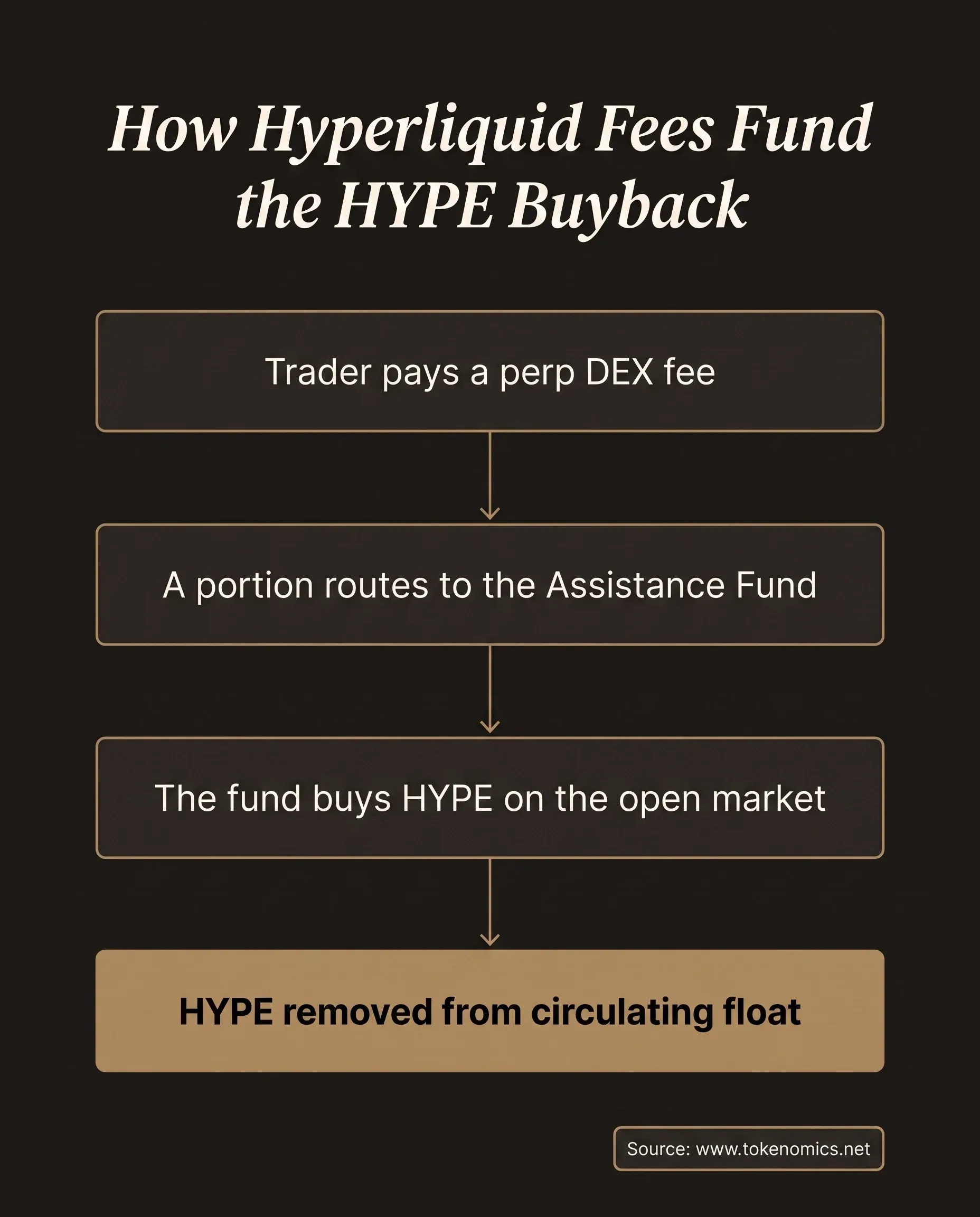
HYPE token value accrual, in the context of perp DEX tokenomics, comes down to a single flow you can trace end to end. A trader pays a fee. The fee routes to the Assistance Fund. The Assistance Fund buys HYPE on the open market. The purchased HYPE is removed from circulating float.
Set that against two other token shapes. A generic fee-share governance token distributes fees directly to holders, with no buyback and no float-reduction step. A generic utility or governance token with no fee link has neither, so its price leans on narrative rather than a mechanism tied to exchange revenue. HYPE's design sits in a third category, where fee revenue is converted into open-market demand for the token.
To keep this concrete without forward-looking numbers, DeFiLlama tracks Hyperliquid's trading volume and total value locked over time, which shows how much fee-generating activity the venue has attracted. That is a scale reference, not a basis for projecting a buyback rate, a float reduction, or a price outcome, and this post makes none of those projections.
This is where the contrast with token velocity earns its keep. A high-velocity token, churned through quickly by holders, tends to leak value. A mechanism that buys the token and pulls it out of float works the other way.
#The Perp DEX Model and Its Tradeoffs
The perp DEX model carries a specific tradeoff that any founder evaluating a similar exchange-token or buyback design should price in from the start.
#Fee concentration in a single venue versus diversified fee streams
A single order-book perp DEX concentrates fee generation into one primary revenue source: trading volume on that one venue. A fee-funded buyback like HYPE's is therefore tightly coupled to the durability of that venue's volume. When trading is active, the buyback engine has fuel. When volume thins, the buyback thins with it. A protocol with several diversified fee streams spreads that dependency, and a single-venue model concentrates it. Neither is free. Concentration buys focus and a clean revenue story at the cost of a single point of dependency.
Three tradeoff categories are worth naming. Volume concentration risk: fee revenue depends on one venue staying competitive. Order-book versus AMM operational tradeoffs: an on-chain order book carries different infrastructure and latency demands than an automated market maker. Buyback-volume coupling: buybacks scale up and down with trading activity, and they do not run independently of it.
#Regulatory posture of perpetual-futures trading venues
Perpetual-futures venues and fee-buyback token structures raise questions worth handling carefully. One framework here is the Howey test, which U.S. courts use to assess whether an arrangement is an investment contract. The firm's interpretation is that the closer a token's returns sit to a passive gain earned largely from the efforts of others, the harder that question becomes. We are not asserting that Hyperliquid, HYPE, or any perpetual-futures structure is or is not a security, or that any design is compliant with a given regulation. That is a fact-specific, jurisdiction-specific determination for a legal team and the relevant regulator.
Close the loop. The fee-to-buyback flow works only if the exchange generates real, durable trading activity. A buyback mechanism amplifies that activity into token demand. It does not manufacture the activity. If you are weighing a fee-capture or buyback design for your own token, that pressure-test is what our tokenomics design services are built for.