The Curve Wars: What veCRV and Convex Actually Taught Token Designers
The curve wars were a mechanism design experiment. What veCRV and Convex actually incentivized, what broke, and what token designers should copy or avoid.


The curve wars were a sustained contest between DeFi protocols over who directs CRV emissions on Curve Finance. The instruments were locked capital, a meta-governance layer called Convex, and an open market for votes. The mechanism underneath all of it is vote-escrowed CRV, and it has been copied widely since.
Copying a mechanism takes an afternoon. Modeling what it produces two years later takes real work, and most teams skip that part. The curve wars are the most complete public record we have of what a vote-escrow lock produces once serious money starts optimizing against it.
We are not recapping the drama. We are reading the curve wars as a closed experiment: what ve-tokenomics actually incentivized, what it broke, and which parts a founder should carry forward. We cover the broader voting-power landscape, one-token-one-vote, quadratic, and ve-tokenomics, in our governance token design guide; this post spends its full budget on the Curve/Convex-specific case. The business question sits underneath all of it. Curve's fee share worked because Curve had trading revenue to share. A lock bolted onto a protocol with no revenue copies the lock and skips the engine.
#What the curve wars actually were
Curve wars: the ongoing contest among DeFi protocols to control Curve Finance gauge-weight votes, which determine how CRV liquidity-provider emissions are split across pools.
The curve wars are a fight over gauge weights, not over CRV price. Curve Finance is an automated market maker built for swaps between similarly priced assets. Convex Finance is a meta-governance layer built on top of Curve's vote-escrow system. Most of what followed is downstream of those two facts.
The prize was emissions direction. Curve pays CRV to liquidity providers pool by pool, and veCRV holders decide how that payment gets split. Any protocol that needed deep liquidity for its own asset had a reason to want those votes. The term is retrospective. It describes what happened, not what happens next.
#The veCRV mechanism: governance priced in locked time
Curve's answer to whale governance was time, not balance. CRV holders lock tokens in the VotingEscrow contract for as little as a week and as long as four years, and receive veCRV in return. veCRV is non-transferable, and its weight decays linearly toward the unlock date, so four years of lock carries far more weight than one (Source: Curve DAO documentation).
veCRV carries four rights: voting weight in the Curve DAO, voting weight over gauge weights, a boost of up to 2.5x on the holder's own liquidity provider rewards, and a share of trading fees (Source: Curve DAO documentation). That last right matters more than it looks. Half of Curve's swap fees route to lockers, which ties governance participation to revenue the protocol actually earns rather than to inflation alone.
Measured against plain token-weighted voting, that is a real improvement, and we have compared the two models in detail in our governance model comparison for DAOs. Every other mechanic in the curve wars traces back to this one design choice.
#Gauge weights turned emissions into an auction
Each Curve pool can carry a gauge. veCRV holders vote on how the Gauge Controller splits CRV emissions across those gauges, and an address can change its vote on a given gauge once every 10 days (Source: Curve DAO documentation).
Here's what most founders miss: directing emissions to a pool raises that pool's yield, which pulls in liquidity, which deepens the pool. A gauge vote is a lever on liquidity depth, not a governance formality. That single property turned Curve governance into a liquidity acquisition auction. Any protocol that copies ve-tokenomics inherits that auction whether it designed for it or not. This is the market the curve wars were fought in.
#Convex Finance and the meta-governance layer
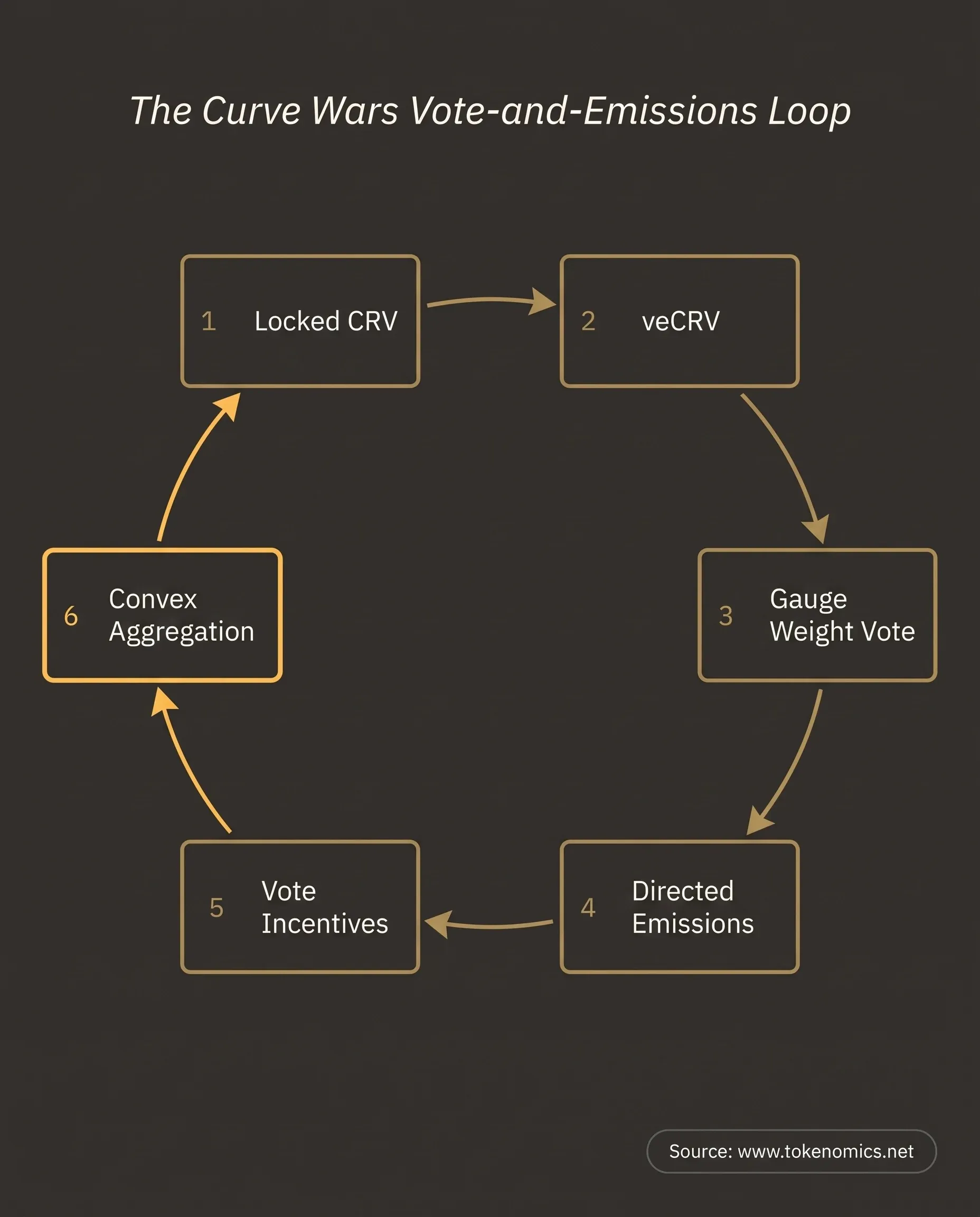
Convex Finance accepts CRV deposits, locks them as veCRV on the depositor's behalf, and issues cvxCRV, a liquid claim on the locked position, alongside its own token, CVX (Source: Convex Finance documentation). The deposited CRV stays locked. cvxCRV is what the depositor can move.
If that shape sounds familiar, it should. It is the same wrapper logic behind liquid staking tokens: take an illiquid locked position, issue a transferable receipt, collect a fee in between. We break down the same pattern in liquid staking token mechanics.
CVX holders vote-lock their CVX for 16 weeks to receive vlCVX, which directs how Convex votes with the veCRV it controls (Source: Convex Finance documentation). A wrapper with those properties tends to accumulate the dominant voting position over time, because every new deposit stacks into one locker instead of sitting in a thousand separate wallets. Convex is what that pattern looks like in practice. Curve's original design did not account for a wrapper sitting on top of the lock.
The lesson: a ve-lock that can be wrapped will be wrapped, because the wrapper captures the boost and a fee on other people's locked capital. That is a modelable outcome, not a surprise. Once Convex held the votes, the curve wars stopped being a contest among CRV holders.
#Bribe markets: when vote-buying became infrastructure
Vote incentives started informally and ended as standing infrastructure. Votium runs recurring rounds in which protocols deposit incentives for vlCVX and veCRV voters, and voters claim those incentives after directing their votes (Source: Votium documentation). The mechanism is public, the rounds are scheduled, and the pricing is visible to both sides.
The payer's logic is arithmetic. When buying votes for a round costs less than buying and locking the CRV needed to cast them, a protocol buys the votes. That arbitrage is what gave the curve wars their name.
Here is the design consequence. A ve-lock is meant to filter for long-term aligned holders. A liquid side market for the votes those locks produce partially undoes the filter, because conviction and voting behavior come apart. We describe bribe markets as observed market structure operating openly onchain. Their legal characterization is a separate question this post does not answer.
#What ve-tokenomics got right
Three parts held up.
Locked supply is supply that cannot be sold. A four-year lock removes tokens from circulating float in a way a liquid governance token does not. That is a genuine design win and the most transferable piece of the model.
Time-weighting beats balance-weighting. Tying voting weight to lock duration is a defensible answer to concentration under one-token-one-vote. It does not remove concentration. It changes who concentration favors, which is a different and more honest claim.
Fee share ties governance to revenue. Curve routes half of trading fees to lockers (Source: Curve DAO documentation). The token captures value from activity the protocol produces, not only from emissions. Revenue-first design is exactly this. The curve wars did not disprove the ve model. They stress-tested it in public.
#What ve-tokenomics broke
Three failures, in the order they showed up.
Governance became procurement. Once gauge weights set liquidity depth, outside protocols had more reason to care about Curve's votes than most CRV holders did. Emissions direction stopped tracking Curve's own liquidity strategy.
Aggregation concentrated what the lock was meant to spread. A design pitched on distributing influence produced one dominant voting bloc. Saying that plainly is more useful than defending the model.
Weekly outcomes followed the largest incentive budget. When votes are purchasable, the gauge result reflects who spent most in that round. That is a description of the mechanism, and it is the part of the curve wars most worth designing against.
#The design takeaway for founders
If you are considering a ve-lock, model two outcomes before launch instead of after. A vote market will form around whatever your gauge equivalent is. Someone will wrap your lock and aggregate the votes. Both are documented, repeatable second-order effects at this point, not edge cases.
Across the ve-tokenomics designs we have reviewed, the failure is rarely the lock itself. It is that nobody modeled who holds the votes in year two. A governance token design that ignores downstream vote custody is mechanism design with no business model under it. Reviewing that vote-custody question against your own design is exactly what our Tokenomics Design service is for. The token is infrastructure. The protocol's liquidity and revenue strategy is the engine. That is the lesson of the curve wars, and it is the one worth carrying into your own model.
Ve-tokenomics is not finished. Newer designs borrow the lock and add guardrails around the vote market, and the ones holding up are the ones that priced the aggregation layer in advance. What was an unforeseen outcome in 2021 is a design input in 2026.
If you're building onchain and need a governance model that holds up under institutional scrutiny, book a strategy call. We'll assess your project and tell you whether we're the right fit. Sometimes we're not. We'll tell you that too.
Drafted with AI assistance. The mechanism analysis was reviewed and validated by the Tokenomics.net team before publication. Specific design recommendations remain the firm's analysis.