Centrifuge CFG Tokenomics: Governance, Staking, and Fees Explained
Centrifuge CFG explained: what the token does for governance, staking, and fees, how to verify supply from primary sources, and what founders can borrow.


Centrifuge CFG is the native token of Centrifuge, an onchain credit protocol that finances real-world assets through structured pools. CFG carries three jobs inside that protocol: governance over parameters and treasury, a staking role tied to how the network runs, and use in fees. This post takes each apart and marks which claims you can source.
Most write-ups of Centrifuge CFG pull the mechanics from a market-data card and stop. Those cards restate what they are given. They lag governance decisions and flatten multiple protocol generations into one description.
The business underneath matters more than the mechanics. Centrifuge is growing real-world credit origination and financing. The token is infrastructure for that business, and the mechanics mean something only if the credit volume behind them is real.
#What Centrifuge Is and Where CFG Fits
Centrifuge CFG: the native governance, staking, and fee token of Centrifuge, an onchain credit protocol that finances real-world assets through tranched pools.
Centrifuge connects onchain capital to credit assets originated offchain, and its own protocol documentation describes how. That documentation, the governance forum, and the token contract onchain are the three sources this post treats as authoritative.
If you want the general case for tokenizing real assets first, read the RWA tokenization pillar and come back. complete guide to RWA tokenization This post assumes the category and takes one protocol's token apart.
CFG is the protocol's native token, and three utility legs matter: governance, staking, and fees. Each one below carries a sourcing note. Centrifuge has iterated its product surface more than once, and a CFG description written against an earlier generation reads current while describing a system that has moved.
#How Centrifuge RWA Pools Actually Work
Most DeFi token analysis starts at the token and works backward to find a use. Centrifuge reads better in the other direction: the pool is the product and the token sits around it.
Centrifuge RWA pools split exposure into tranches. Positions are ordered by who absorbs losses first. The junior position takes first loss and a higher return. The senior position sits behind it with lower risk and a lower return. That ordering is how a credit pool prices risk, and structured credit has priced it that way offchain for decades.
Confirm the vocabulary before you quote it. Centrifuge's pool architecture and product naming have changed across generations, and older explainers still circulate the earlier terms. The tranche logic has held. The labels have not.
A pool needs coordination no single participant owns: who creates one, what parameters bind it, who runs the infrastructure underneath. That is the gap a native token fills. For cross-protocol patterns in how real-asset pools get structured, our RWA case studies cover more designs.
#Centrifuge CFG Token Utility: Governance, Staking, and Fees
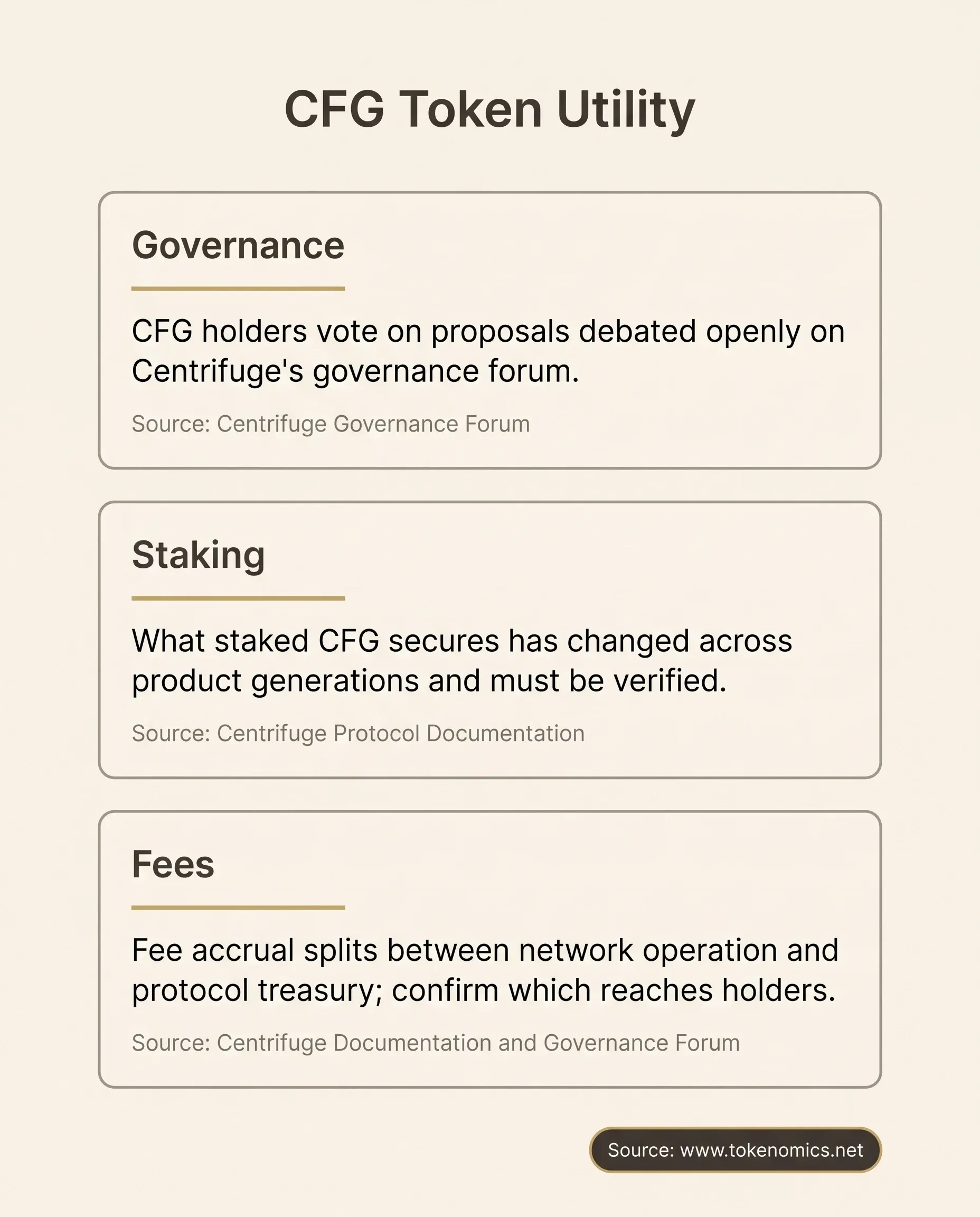
Three legs carry CFG token utility, and they are not equally well documented. Read any market-data card's Centrifuge CFG description against these three and you will find a gap.
Governance. CFG is the protocol's governance token, and Centrifuge runs proposal discussion in public on its governance forum. We are not quoting a proposal ID here: the live thread list is what's worth reading, and any single proposal we named would age badly. Judge CFG governance on contested proposals, not on a docs page describing the right to vote.
Staking. This is the leg to verify hardest. Ask a precise question: what does staked CFG secure? In a chain-native design, staking pays for network operation and block production. In a rewards-program design, it pays holders for locking supply. Those are different mechanisms carrying different regulatory weight, and a protocol can move between them across versions. We will not restate a staking mechanism we cannot confirm is current.
Fees. Two fee questions get blurred into one. The first: does CFG pay for transactions on the network it secures. The second: do fees from pool activity reach CFG in any form. A fee funding a protocol treasury is not a fee reaching a holder, and write-ups slide between the two constantly. The documentation and the governance record answer both.
The pattern is consistent: the right to vote is quick to confirm, what staking secures is harder, and fee accrual is where descriptions go stale first.
#Centrifuge CFG Supply and Emissions: What You Can Verify
Supply is the half of CFG tokenomics most likely to be wrong in secondary coverage. A figure gets pulled from an aggregator, published as fact, then repeated. Aggregators restate. They are not the record.
The record is the token contract onchain and Centrifuge's own published tokenomics. We are not printing a circulating-supply figure here. Any number we printed today would be stale before most readers arrive.
You can still assess the structure. Four questions cover it:
Is supply fixed or inflationary? A capped supply and an emitting supply produce different holder math.
Who can change it? If emissions are governance-adjustable, the schedule is policy, not a constant, and the forum decides.
Where do new tokens go? Emissions paying network operators are a cost of running infrastructure. Emissions paying holders for holding are a transfer.
What does the unlock record show? Vesting schedules and unlock cliffs are verifiable onchain, and the schedule predicts supply pressure better than narrative.
None of that is a price claim, and this post makes none. Supply mechanics describe pressure. What that pressure does depends on liquidity, demand for the underlying credit business, and execution.
#Centrifuge's Institutional Positioning and the Business Underneath
Centrifuge's institutional positioning has centered on bringing regulated asset managers and tokenized funds into onchain credit. We are not naming specific partners or funds here. A roster like that moves, and a stale partner claim costs more credibility than no claim at all. Centrifuge publishes the current one.
Institutional participation is how credit origination volume grows, and origination volume is the business. A pool with no assets funded is a mechanism with nothing running through it.
That is the test we apply to every RWA design we review. Does the token sit on a financing business that would exist without it, or must the token manufacture the demand it then captures? A token without sustainable revenue mechanics is a countdown timer.
We've advised 80+ projects on token design, and the RWA ones fail the same way: the mechanism is fine and the origination pipeline is theoretical. Here is how our Tokenomics Audit service audits RWA-native tokenomics against that test.
#Where Centrifuge Sits Among RWA Credit Protocols
Three onchain credit models get compared constantly, and they are not the same product.
Centrifuge finances credit assets through pools with tranched risk positions. Maple Finance runs institutional lending, where capital reaches borrowers through pools with a manager underwriting the credit. Ondo Finance sits in tokenized treasuries, packaging short-duration government-securities exposure as an onchain token.
The differences are structural, not a ranking. A tranche structure prices and distributes credit risk. An underwritten lending pool concentrates that judgment in a manager. A tokenized treasury product is closer to a wrapper on a regulated fund than to a credit-origination business.
Three different token design problems. A protocol distributing credit risk needs holders who can price a parameter change. A protocol wrapping a regulated fund has less to govern and more to document. For another named RWA protocol taken apart the same way, see our ondo tokenomics explained case study.
#What the Centrifuge CFG Design Teaches Founders
Three takeaways carry over to any RWA token.
Map utility to usage, not narrative. Paying network fees and operating infrastructure are jobs. "Holders get to participate" is not a job.
Say where the fee lands. Treasury accrual and holder accrual are different designs carrying different regulatory weight. Founders who blur the two get the question in diligence anyway.
Utility claims do not settle classification. Whether a token is a security is fact-specific and jurisdiction-specific, assessed against frameworks such as the Howey test, not settled by how a protocol describes its own token. We are not characterizing CFG's classification in either direction. Your legal team runs that analysis against your facts.
The token is infrastructure. The business is the engine. If you arrived here unsure where tokenization ends and tokenomics begins, the difference between tokenization and tokenomics has its own post.
A Centrifuge CFG teardown is worth only the sources behind it, and the sourcing bar in this category keeps rising. Institutional capital reads token documentation the way it reads a credit memo. A description that cannot be traced to the protocol's own record does not survive that reading.
If you're building onchain and need your RWA tokenomics to hold up under institutional scrutiny, book a strategy call. We'll assess your project and tell you whether we're the right fit. Sometimes we're not. We'll tell you that too.