Airdrop Design: A Protocol's Guide to Eligibility and Sybil Resistance
Airdrop design methodology for protocol teams: eligibility criteria, sybil resistance, retroactive vs. prospective distribution, and allocation sizing that protects your cap table.


Airdrop design is the process of defining who receives tokens, how much they receive, when they can access them, and how farming and manipulation are filtered out before distribution runs. It is a token distribution decision with direct consequences for your cap table, your post-TGE price stability, and the quality of your community.
Most airdrop campaigns underperform not because the math is wrong but because the eligibility design is wrong. Tokens flow to wallets that were manufactured to receive them, not to the users who actually built the protocol's ecosystem. The result: coordinated sell pressure in the first 24-48 hours post-TGE, a cap table full of strangers, and a retention problem that no subsequent campaign can fix.
The airdrop design methodology has five decisions, each of which connects directly to how you structure your broader token distribution model. Each one shapes who ends up holding tokens on day one and what they do with them.
Airdrop design: the structured process of defining eligibility criteria, token allocation amounts, vesting schedules, and sybil resistance filters for a token distribution campaign.
#What Airdrop Design Actually Decides
Every airdrop campaign resolves five structural questions before a single token moves.
Eligibility criteria. Who qualifies? On-chain behavior, social signals, or a composite of both. This is the first filtering layer, and most of the campaign's sybil exposure lives here.
Allocation sizing. How many tokens does each qualifying wallet receive? Flat allocations, tiered by activity level, or whale-capped to prevent single-wallet concentration are the three dominant models we see across 100+ projects.
Vesting or lock-up. Immediate claim, linear vesting over 3-6 months, or usage-gated release. This decision determines whether your airdrop recipients are long-term holders or same-day sellers.
Sybil filtering. How farming is detected and removed before the snapshot locks. Gas-spend minimums, cross-protocol activity correlation, and identity-layer tools are the three mechanical approaches in active use today.
Retroactive vs. prospective timing. A retroactive airdrop rewards past behavior based on a snapshot taken before the announcement. A prospective campaign tells users the criteria in advance. Each creates a different farming-exposure profile.
Before finalizing your distribution model, a structured tokenomics audit checklist is the right diagnostic tool for each of the five decisions above.
The "airdrop methodology" question your team needs to answer is which combination of these five decisions fits your protocol's retention model, not which combination your competitors used.
#Eligibility Criteria: On-Chain Behavior vs. Social Signal
On-chain activity thresholds are the most defensible eligibility layer. Minimum transaction counts, protocol usage volume, liquidity contribution over a defined time window, or time-in-protocol all produce eligibility signals that are objectively verifiable and much harder to manufacture at scale than social signals.
Social signal eligibility, Discord role, whitelist completion, NFT hold, can supplement on-chain criteria but should never serve as the primary filter alone. Social signals are easily farmed. A Discord role costs nothing to obtain in bulk. A whitelist can be gamed by any wallet that reads the criteria.
The Uniswap UNI airdrop (September 2020) remains the most studied retroactive distribution in the market. Eligibility was defined by historical protocol interaction with no advance announcement. The design rewarded genuine past users and produced a community of holders who had actual protocol skin in the game. (Source: Uniswap Foundation governance documentation.)
Composite scoring solves the single-layer farming problem. Two-layer eligibility stacks on-chain thresholds first, then requires social signal confirmation for wallets that meet the on-chain minimum but fall in a gray zone. Wallets that satisfy both layers receive full allocation. Wallets that meet only one layer receive a reduced allocation or are excluded.
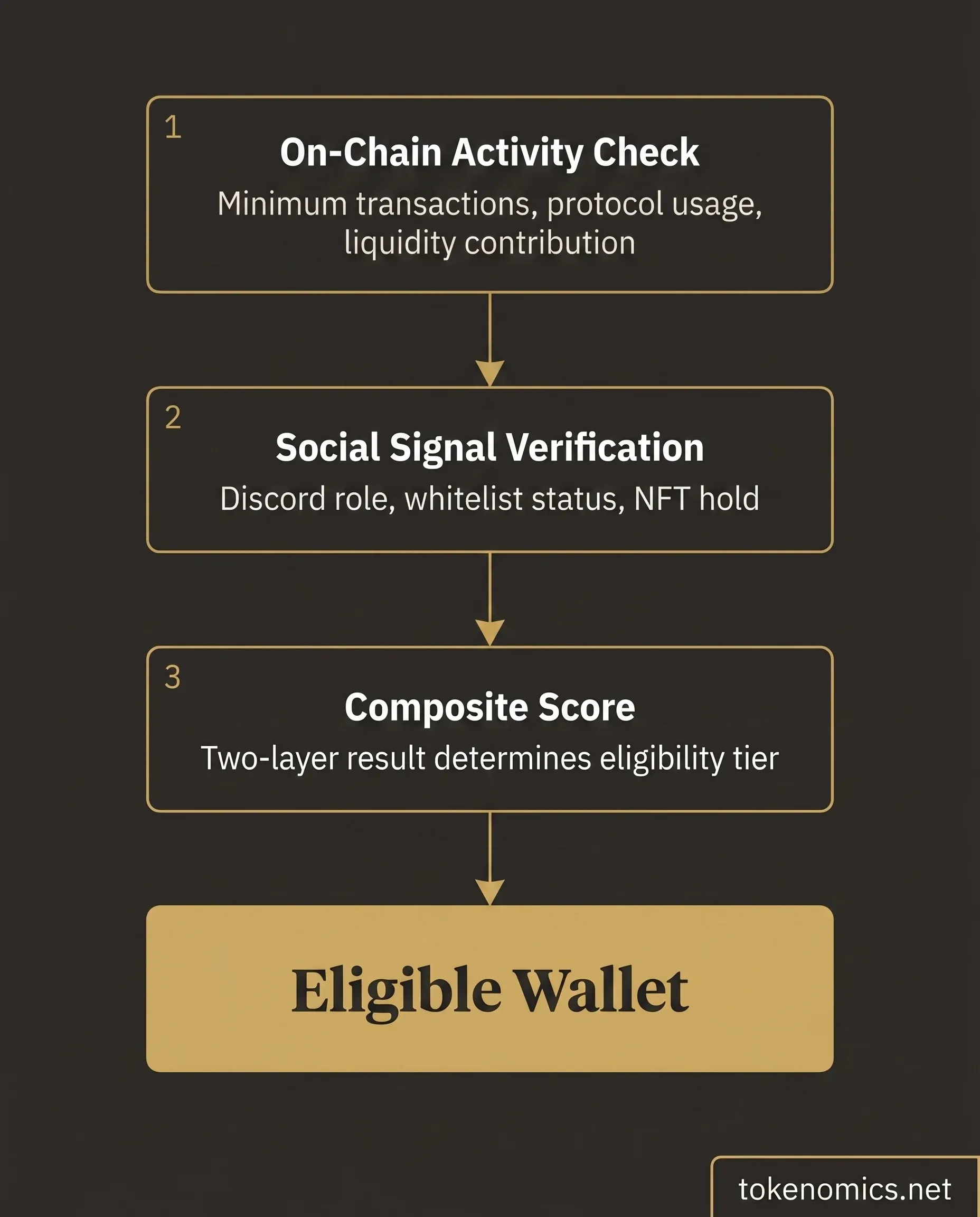
The design tension is real: tighter criteria produces fewer sybil wallets but a smaller distribution footprint. Looser criteria builds a wider footprint but increases cap-table noise. The right balance depends on your protocol's specific retention model. Most projects err toward looser criteria because the distribution numbers look better, then discover the problem six months post-launch.
The design tension is especially sharp in regulated contexts: protocols with identity-layer eligibility requirements should review the tokenomics compliance framework before locking their criteria.
#Sybil Resistance: The Design Problem No One Wants to Solve
A sybil attack in an airdrop context is one actor controlling many wallets, all of which meet your eligibility criteria. The actor receives tokens at scale, then coordinates sells. Your distribution footprint was never real users.
Three mechanical approaches to sybil resistance are in active use today.
Gas-spend minimums as friction barriers. Requiring a minimum cumulative gas spend over the eligibility window adds a real cost to wallet manufacturing. At $0.50 to $2.00 per wallet to reach common minimum thresholds, farming at scale becomes economically unattractive for most actors. It is not a complete solution. Well-capitalized farms absorb the cost and pass the threshold anyway.
Cross-protocol activity correlation. Wallets that only interacted with your protocol and nothing else, during only the eligibility window and nothing before it, are statistically suspicious. Legitimate users leave cross-protocol traces: they hold other tokens, they've transacted on other protocols, they have wallet history that predates your launch announcement. Correlation analysis against external activity can flag manufactured wallets with high accuracy at scale. (Source: Chainalysis airdrop sybil attack research, 2024.)
Identity-layer verification tools. Gitcoin Passport and similar on-chain identity aggregators assign a trust score to wallet addresses based on verified activity across multiple platforms. Requiring a minimum passport score as part of eligibility filters wallets that have never participated in anything outside your campaign. Whether any specific identity-layer tool meets your protocol's legal requirements for identity verification is a fact-specific legal question; these tools are not substitutes for KYC/AML programs in regulated contexts.
The lesson: sybil resistance is not a binary switch. It is a filter that trades permissiveness for exclusion. The goal is to minimize farming without excluding legitimate users at the margin. There is no configuration that achieves zero false positives and zero false negatives simultaneously.
Sybil resistance matters for revenue-first design because farmed airdrops produce concentrated sell pressure, not protocol retention. The tokens your sybil filters remove are the tokens that would have dumped on day one.
#Retroactive vs. Prospective Distribution: Timing as a Design Variable
A retroactive airdrop takes a snapshot of past behavior and announces eligibility after the fact. Users who already interacted with your protocol receive tokens they did not know they were earning. The design rewards genuine past behavior and gives farmers no information to target in advance.
The risk with retroactive design is not farming, it is the snapshot leak. If your eligibility criteria or snapshot block height is known before the announcement, late-stage targeted activity floods in and dilutes the distribution. Retroactive snapshots must be kept confidential until announcement. The integrity of the retroactive design depends entirely on that constraint.
A prospective campaign tells users the criteria before they start accumulating. Users who want the airdrop perform the target behaviors because they know it leads to allocation. This builds a larger distribution funnel during the campaign window, but it is an open invitation to farm. Any criteria you publish in advance will be targeted by actors optimizing for eligibility, not for genuine protocol use.
Understanding token velocity is essential context here: prospective campaigns that produce ineligible farming behavior drive velocity up immediately post-TGE, compressing value before your protocol demonstrates product-market fit.
The hybrid model, a retroactive snapshot at launch plus a prospective top-up program for ongoing users, is what we see most often on projects that want to retain existing users while also building post-launch distribution to new ones. The retroactive component anchors the original community. The prospective component creates a retention mechanic for new entrants. The tradeoff is operational complexity: running two parallel eligibility windows requires separate sybil filtering for each.
The practical guidance: if your protocol has genuine user history to reward, start retroactive. If you are pre-launch with no user base, prospective is the only option. If you have both, the hybrid model gives you the best of each at the cost of more design work.
#Allocation Sizing and Vesting: Who Gets What and When They Can Sell
The percentage of total supply reserved for community and airdrop distribution is one of the most consequential allocation decisions a token model makes. Across the 100+ projects we've worked with, community and airdrop buckets typically range from 15% to 35% of total supply, depending on how central community ownership is to the protocol's retention thesis.
Per-wallet sizing has two dimensions: the total per-wallet amount and whether wallets are tiered or capped.
Tiered allocation. Wallets that meet higher-activity thresholds receive larger allocations. This rewards your most engaged users proportionally and reduces the incentive to farm at the minimum eligibility threshold.
Whale caps. A maximum per-wallet allocation prevents single actors, even legitimate high-activity ones, from receiving a disproportionate share. Whale caps protect the breadth of your distribution footprint. Without them, a handful of power users or coordinated actors can receive the same aggregate allocation as thousands of regular users.
Vesting on airdrop recipients is the most under-used tool in post-TGE price stability. Immediate claim with no vesting produces the maximum sell pressure on day one. A 3-6 month linear vest reduces that pressure materially and gives your protocol time to demonstrate value before the distribution unlocks.
If your protocol needs institutional investors to participate in the distribution, the data room engagement provides the allocation modeling and vesting documentation they expect before committing.
Usage-gated release is the most sophisticated option. Recipients unlock additional tokens by continuing to use the protocol after TGE. A wallet that stops using the protocol forfeits the unvested portion, which returns to the treasury for future distribution. The mechanism creates a direct alignment between distribution and retention, but it requires smart contract architecture to enforce and it must be communicated clearly to recipients before they claim.
Revenue-First Design applies here directly: your vesting schedule on airdrop recipients is the single highest-leverage design decision for post-TGE price stability. Treat it accordingly.
#The Airdrop Design Checklist
Before you run the campaign, five design decisions must be locked.
-
Eligibility criteria finalized. On-chain thresholds defined, social-signal layers (if any) specified, composite scoring model tested against your actual user data for false-positive and false-negative rates.
-
Sybil filter applied and tuned. At minimum a gas-spend threshold. Ideally cross-protocol activity correlation as a second filter. Identity-layer tools assessed for fit with your protocol's legal structure.
-
Allocation model stress-tested. Total supply percentage confirmed. Per-wallet tier model or flat model confirmed. Whale cap set. Aggregate sell pressure at day-one cliff modeled against your projected liquidity depth.
-
Vesting schedule set. Immediate claim, linear vest, or usage-gated. Smart contract architecture confirmed before snapshot locks.
-
Retroactive snapshot secured. If retroactive: snapshot block height is sealed, hash-verified, and confidential until announcement. Distribution contract audited before tokens move.
If any of those five points surfaces an open design question, that is the engagement scope for a tokenomics review.