What Is Tokenomics Development? Process & Deliverables
Tokenomics development is the engineering work behind a token model: contract-ready specs, simulations, parameter sets. Here's the process and what you get.


Tokenomics development is the engineering process that converts a finished token economic model into contract-ready specifications, parameter tables, and simulation evidence a smart-contract team can build against. It follows tokenomics consulting, which designs the model, and precedes deployment, hardening the design into a testable, buildable system before real capital moves through it.
Tokenomics development is the engineering discipline that turns a finished token model into a contract-ready, testable specification. It converts supply curves, vesting logic, and incentive mechanics into explicit parameters a smart-contract team can build against without guessing.
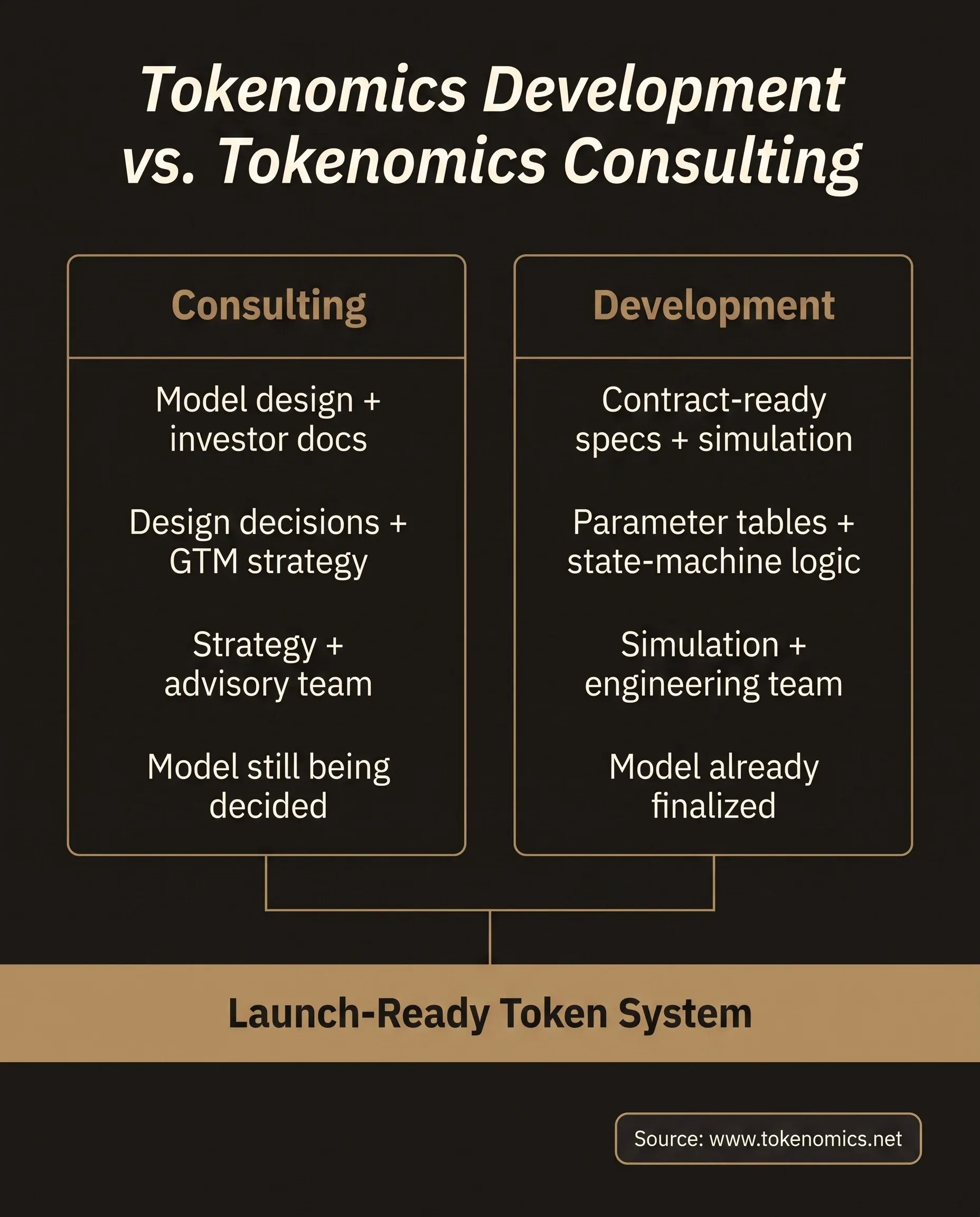
This is not the same service as tokenomics consulting. Consulting is the advisory work: the design direction, the investor documentation, the go-to-market strategy. Development is what happens after the model is decided. If you want the build side of the work in one place, start with our tokenomics development services.
Here is why the distinction matters. A token model is only as strong as the engineering that implements it faithfully. A model that looks clean on a slide can still break the first time real capital moves through it. Design without a build discipline behind it is a pitch, not a launchable system. A token without sustainable revenue mechanics is a countdown timer, and a model that was never stress-tested against real conditions is the same timer with a nicer face on it.
#What Is Tokenomics Development?
Tokenomics development: the process of translating a decided token economic model into contract-ready, testable specifications through parameterization, simulation, and engineering handoff documentation.
Tokenomics development is the process of translating a token economic model into implementation-ready artifacts. The inputs are the model's economic decisions: total supply, distribution, vesting schedule, incentive mechanics, and fee routing. The outputs are the documents a smart-contract engineering team implements against directly.
It helps to be clear about what this work is not. It is not whitepaper writing. It is not smart-contract auditing, which is a separate discipline that reviews code after it is written. And it is not the strategy conversation on its own. Token economics development is the engineering layer that sits between a decided model and a deployed contract.
Three artifact families define real development work.
Technical specification. The contract-ready parameter set and state-machine logic. Every supply, vesting, and fee-routing rule becomes an explicit, testable value, mapped to the token standard the contract will implement, most often the ERC-20 token standard. No ambiguous "TBD" fields, no assumptions a developer has to resolve on their own.
Simulation and stress-testing. Agent-based models that validate the mechanism under adversarial and edge-case conditions. We use Monte Carlo simulation to run the model across thousands of scenarios rather than a single happy-path assumption. The point is to find the failure modes before the market does.
Engineering documentation. The handoff package a smart-contract team builds from without guessing. This is the deliverable that separates a design from a system: a spec precise enough that two different engineering teams would implement the same behavior from it.
Get these three right and the model becomes buildable. Get them wrong and the gap between the design and the deployed contract fills up with quiet assumptions.
#Tokenomics Development vs. Tokenomics Consulting: The Key Difference
Most founders arrive at this question because two services with similar names show up as separate offers, and it is not obvious where one ends and the other begins. Here is the clean line.
Consulting is advisory. It decides the model: the design direction, the documentation investors and legal teams read, the positioning and go-to-market plan. Development is engineering. It hardens the model: contract-ready specs, simulation evidence, parameter documentation, and technical QA against the design.
Think of it like building a tower. Consulting is the architect's drawings and the investor pitch that raises the money. Development is the structural engineering that makes sure the building stays up once it is actually built. You need both, and you need them in the right order. Nobody pours a foundation off a mood board.
The overlap is real, and it is worth naming honestly. Many engagements need both, sequenced: consulting defines the model, development turns it into something a dev team can ship. This is not an either-or, and it is not two vendors competing for the same job. They are different phases of the same path to launch.
If your need is actually the advisory side, read what tokenomics consulting involves before you go further. And if you are weighing the strategy engagement itself, the advisory side of tokenomics consulting lays out that scope directly. This post is about the build.
#The Tokenomics Development Process
The tokenomics development process runs in five steps. Each one produces an artifact the next step depends on, so the order is not decorative.
Step 1: Model intake. We ingest the finalized token model as the spec-of-record. It might come from your internal team or from a prior consulting engagement. Either way, the model is the source of truth, and the first job is to confirm it is actually finished. Open design questions get resolved here, not three weeks into the build.
Step 2: Parameterization. We convert supply, vesting, incentive, and fee-routing logic into explicit, testable parameters. Every value gets a definition and a range. "Team tokens vest over time" becomes a specific cliff, a specific schedule, and a specific unlock event. Ambiguity that survives this step becomes a bug later.
Step 3: Simulation and stress-testing. We run the parameterized model against adversarial scenarios: sybil behavior, whale concentration, liquidity shocks, and incentive-gaming edge cases. Monte Carlo stress testing runs the model across thousands of iterations rather than one assumed path. The output is not a pass or fail grade. It is a map of where the mechanism holds and where it bends.
Step 4: Technical specification. We produce the contract-ready document a smart-contract engineering team implements against. State-machine logic, parameter tables, and transfer rules, written so an engineer can build without interpreting intent. This is the artifact that feeds directly into the documentation layer, the same one that anchors the data room investors and auditors review later.
Step 5: Engineering handoff and QA. We run review cycles with the dev team, sign off on test scenarios, and hold a revision loop before implementation begins. The model gets hardened, not just handed over once. If a test scenario surfaces a problem, it goes back to the parameter set, not into a backlog.
The pattern is consistent: each step turns something soft into something a machine can execute. That is the whole job.
#What Tokenomics Development Delivers
This is the "what am I actually paying for" section. A development engagement should hand you a defined artifact set, not a slide deck and a good conversation. Here is what you receive.
Technical specification document. Parameter tables plus state-machine and flow logic for supply, vesting, and fee routing. This is the build spec. A smart-contract team should be able to implement from it, typically on top of audited contract libraries like OpenZeppelin's, without scheduling a meeting to ask what a field means.
Simulation report. Scenario coverage, stress-test results, and the identified failure modes with their mitigations. The value here is the failure modes. A report that only shows the model working is marketing. A report that shows where it breaks and what to do about it is engineering.
Engineering handoff package. The dev-ready spec plus the test scenarios the smart-contract team validates against. This is what makes the handoff clean: the developers know not only what to build but how you will check that they built it correctly.
Revision and QA sign-off. The iteration record showing the model was hardened through review, not handed off in a single pass. This artifact matters more than it looks. It is the evidence that the parameters survived scrutiny before a line of production code was written.
One note on compliance. If your model uses a permissioned or compliance-enforcing token standard, the parameter spec is designed to make a later compliance review smoother. It documents transfer restrictions and identity-gating logic in one place so your legal team and reviewers are not reverse-engineering intent from code. A well-documented spec does not make a token compliant on its own. Whether a token is a security, and whether a structure meets a given regulation, is a determination for your legal counsel and the relevant regulator, such as the SEC, not something the spec asserts. Development makes that review easier to run. It does not replace it. This is the same reason a model that has been through development still benefits from a tokenomics audit as an independent check.
#How to Know You Need Tokenomics Development (Not Just Consulting)
Not every project needs a standalone development engagement. Some need consulting first, and some already have the engineering in-house. Here are the signals that point to development specifically.
You already have a model and need it built. The design is decided, from an internal team or a consulting engagement, and now it has to become something a dev team can ship without guesswork. That gap is exactly what development fills.
Your engineers asked for a spec, not a strategy deck. When the dev team says "give us the parameters and the state logic," they are asking for a development deliverable. A strategy document will not unblock them.
You need simulation evidence before a review. A security review, an investor's technical due diligence, or an internal risk sign-off often wants stress-test results, not just a narrative. Simulation output is a development artifact.
Two cases point the other way. If you have not finalized the model yet, you likely need consulting first, because there is nothing stable to build against. And if your in-house engineers already own parameterization and simulation, a standalone engagement may be redundant. The honest answer depends on where your model actually is, which is a conversation, not a checklist you can grade yourself against.