Governance Token vs Utility Token: A Classification Guide
Governance token vs utility token: the classification framework that shapes your token's rights, incentives, and regulatory exposure, and how to choose.


Before you design token mechanics, you have to answer a prior question: what kind of value your token is actually built to move, and who it serves as the protocol's revenue, usage, or network effects grow. Founders and their counsel often use "governance token" and "utility token" interchangeably, as if they were two names for the same thing, or as if the choice were cosmetic. It is not. The governance token vs utility token distinction determines whether the token distributes decision rights over how the protocol directs the value it creates, or gates access to the function that generates that value in the first place, and that structural choice is the first input into how the token gets treated under securities analysis later.
This is a classification framework, not a mechanism-design guide. It exists to help you sort your own token concept into a category before you get further into building it, so that the next conversation you have, whether with a consultant, your counsel, or your own team, starts from a clear premise instead of a borrowed label.
#Governance Token vs Utility Token: The Core Distinction
#What separates the two categories in one sentence
A governance token grants decision rights over a protocol: voting on proposals, adjusting parameters, directing treasury allocation. A utility token grants access rights to a protocol: paying for compute, unlocking a feature, staking for a service. That is the entire distinction in one sentence, and it is worth sitting with, because most confusion in this space comes from treating "governance token vs utility token" as a binary when it is really two different rights a token can encode, separately or together, both of them ultimately claims on the same underlying engine: the protocol's revenue, usage, or network effects, just approached from different angles, one over how that engine gets steered and the other over who gets to use it. Most real tokens blend both to some degree, which is a design fact, not an exception.
If you are working through this decision as part of a full token model, that classification work is exactly what our Tokenomics Design service covers.
#What a Governance Token Actually Does
#The rights it encodes
A governance token is a claim on protocol direction, not protocol output. It typically carries voting weight proportional to holdings, the familiar one-token-one-vote model, or adjusted for lockup duration under a vote-escrow structure. Either way, the token holder is being handed a say in what the protocol does next, not a discount on using it.
#Where it shows up in practice
Governance tokens show up wherever a protocol needs a distributed body to make ongoing decisions: adjusting fee parameters, approving treasury spend, or ratifying protocol upgrades. The mechanics of how voting weight gets calculated, one-token-one-vote versus lockup-weighted models, are a deeper design question than this post covers. If you have already decided you need a governance token and want the mechanics worked out, that is a separate conversation from this one.
#What a Utility Token Actually Does
#The rights it encodes
A utility token is a claim on protocol function, not protocol governance. It grants access: paying transaction fees, unlocking a gated feature, staking to receive a service. The test that actually matters here is simple. Does the product need the token to work, or does the product work fine without it? If the honest answer is the second one, the token is not really a utility token. It is a governance token wearing a utility label, or a security wearing one.
#Where it shows up in practice
Utility tokens show up wherever a protocol has a real, ongoing function to gate: compute access, premium features, fee payment for a service that exists independent of the token's price. The function has to be load-bearing. A utility claim attached to a feature nobody uses, or a feature that would exist identically without the token, is not utility. It is decoration.
For a closer look at what makes a utility claim load-bearing rather than decorative, see our breakdown of utility token design patterns.
#Side-by-Side: How Governance Token vs Utility Token Compares
#Rights, incentive, distribution, and regulatory posture
Governance tokens encode decision rights. The holder incentive is influence over outcomes, and distribution tends to skew toward long-term aligned holders: the team, the treasury, an active community. Utility tokens encode access rights. The holder incentive is discounted or gated function, and distribution tends to skew toward users who actually need the function, not holders speculating on protocol direction.
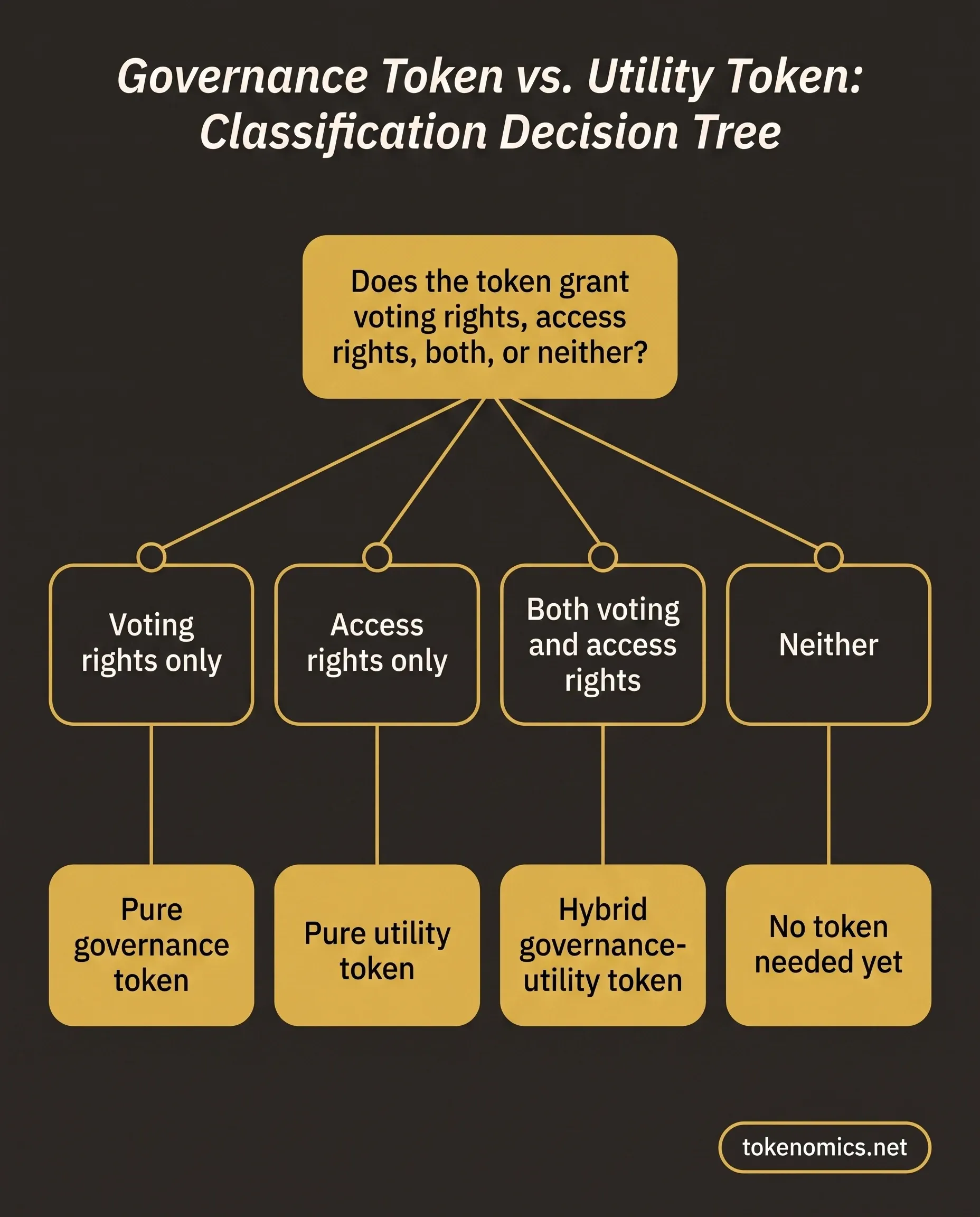
This is the section worth screenshotting and using to sort your own design. If your incentive story is "hold this and you get a say," you are describing governance. If it is "hold this and you get access," you are describing utility. If your honest answer touches both, you are describing a hybrid, and that carries its own tradeoffs, covered below.
#Can a Token Be Both? Hybrid Governance-Utility Models
#Why most real tokens are not pure-category
Hybrid design is common. A token that pays protocol fees and also carries a governance vote is a familiar pattern, and there is nothing wrong with combining the two rights on paper. But combining them is a deliberate design choice with its own consequences, not a default that lets a founder avoid picking a lane.
#The design tension this creates
A token that carries both voting rights and access rights concentrates more of the characteristics that draw regulatory scrutiny, not fewer, because it now presents more of the features enforcement analysis has historically weighed. Treat hybrid design as a decision you are making with eyes open, with your counsel involved early, not a hedge that avoids having to choose.
If the governance side of a hybrid model is the harder design question for you, we cover choosing a governance model for your protocol in more depth.
#Why the Distinction Matters for Regulatory Classification
#What the Howey test actually asks
The label on a token has been used informally, historically, as a defense against securities classification: call it a utility token and the argument follows that it should not be treated as a security. In our view, that framing has not held up well under Howey-test scrutiny in practice. The test itself asks about investment of money, a common enterprise, and an expectation of profit from the efforts of others. It does not ask what the token is called in its own marketing.
#Why "utility" is not a legal shield
The firm's interpretation is that governance rights alone do not make a token a security, and utility framing alone does not make a token exempt from being one. The analysis is fact-specific and jurisdiction-specific, weighing how the token was marketed, how it was distributed, and what holders were led to expect. Naming a specific enforcement action or filing here would suggest a level of legal certainty this framework is not equipped to give; a founder relying on this distinction should get that citation from counsel rather than a blog post.
For the fuller mechanics of that fact-specific test, see our breakdown of how token classification works.
#How to Decide Which Model Fits Your Protocol
#The questions that actually resolve the decision
Two questions do most of the work. Does the protocol need decentralized decision-making to function, or to satisfy a genuine decentralization thesis? If yes, governance rights matter. Does the protocol have a real, ongoing function a token can gate or discount? If yes, utility rights matter. If neither answer is a clear yes, the token may not need to exist yet, and that is a legitimate conclusion to reach, not a failure to design something.
If you want a second set of eyes on where your own token lands before you commit to mechanics, that is exactly what our Tokenomics Consulting service is for.
#Common Mistakes Founders Make When Choosing
#Reaching for "utility" as a compliance workaround
Bolting a utility label onto a token with no real, load-bearing function is the single most common mistake in this category, and it is the one most exposed under Howey-test scrutiny. If the function would exist without the token, the label is not describing anything.
#Adding governance rights with no real decisions to govern
The mirror mistake is issuing governance rights over decisions the team never actually delegates: a cosmetic DAO that votes on nothing that matters while the team keeps real control. This creates the appearance of decentralization without the substance, and both regulators and sophisticated holders tend to notice the gap.
If you have run your own token concept through this framework and want a second opinion on where it lands before you commit to mechanics, that conversation is worth having early rather than after the design is set. Book a strategy call to talk it through.