RWA Tokenization Compliance: What Issuers Need to Know
A stage-by-stage map of RWA tokenization compliance for issuers: asset classification, jurisdiction, KYC/AML, transfer restrictions, and disclosure rules.


If you are past the "should we tokenize" question, you are already standing in the middle of RWA tokenization compliance, whether or not anyone on your team has named it that yet. Tokenization is infrastructure sitting on top of a real asset, real estate, private credit, receivables, treasuries, and the compliance work exists to protect that asset's legitimacy, not to decorate the token. The token itself is not the product. The asset is.
The fear worth naming directly is discovering a compliance gap after tokens are already in investor wallets, not before. By then the fix is not a design change, it is a legal problem, and it usually surfaces at the worst possible moment: an auditor asking a question your documentation cannot answer, or a listing venue flagging a transfer restriction you never built. This is a stage-by-stage map of the compliance surface an RWA issuer actually hits, written before that moment, not after it.
#What "RWA tokenization compliance" actually covers
RWA tokenization compliance is the combined set of obligations a tokenized real-world asset has to satisfy across securities classification, jurisdictional scope, investor verification, transfer restrictions, and disclosure, each of which can sit under a different regulator and a different rulebook depending on the asset and the investor base.
#It is not one rulebook, it is a stack of them
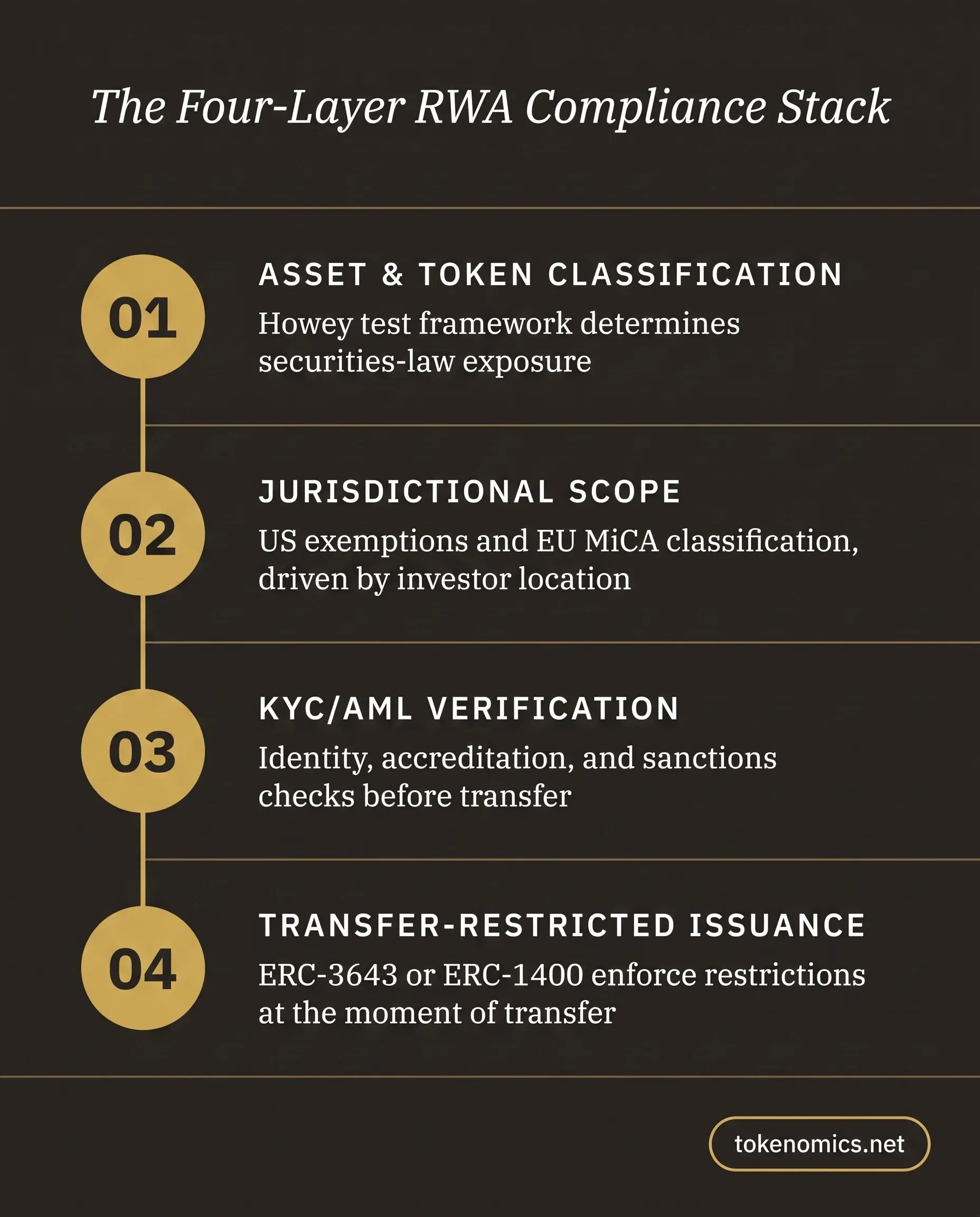
There is no single "RWA compliance certificate" a project earns once and moves on from. Securities law asks one set of questions. KYC and AML frameworks ask a different set. Transfer-restriction requirements are a third layer, and disclosure obligations are a fourth. An issuer can clear one layer cleanly and still fail another, which is why treating this as a checklist item rather than a stack tends to produce the gaps that surface later.
#Why this matters before you touch a smart contract, not after
Decisions made at the classification stage determine which token standard you need, which in turn determines what your smart contract has to enforce. Building the contract first and retrofitting compliance logic onto it afterward is the more expensive path, both in engineering time and in the documentation rework that follows.
For the fuller stack-by-stack breakdown of what protects a launch across all four layers, see RWA Token Compliance: Legal Frameworks That Protect Your Launch.
#Step one: classify the asset and the token before anything else
#The Howey-test question every RWA issuer has to answer
Under U.S. law, whether a token is a security is typically analyzed through the Howey test framework: an investment of money in a common enterprise with an expectation of profit derived from the efforts of others. Most tokenized real-world assets fit that description, since the return an investor expects usually depends on the issuer's management of the underlying asset, not the investor's own labor. This is a framework-named analysis, not a universal rule, and the outcome for any specific offering is fact-specific.
#Why asset type changes the answer (real estate vs. private credit vs. treasuries)
Asset type shapes which disclosure and registration exemptions are realistically available. A fractionalized real estate interest, a private credit note, and a tokenized treasury product raise different structuring questions even though all three commonly fall inside the same rwa token compliance requirements conversation. Classification is the input that determines the rest of the stack, which is why it has to happen first.
#The jurisdictional split: US securities law and MiCA, side by side
#What the SEC framework asks for
The U.S. track generally centers on registration or a recognized securities exemption. Which exemption category fits typically depends on factors like who the investors are, where they are located, and how the offering is structured, not on a preference the issuer picks for convenience, and each exemption category carries its own investor eligibility rules and disclosure obligations.
#What MiCA asks for, and why the timing matters
Mica compliance for rwa issuers runs through a different structure entirely. The EU's Markets in Crypto-Assets regulation classifies tokens into categories, asset-referenced tokens, e-money tokens, and other crypto-assets, and layers issuer authorization and whitepaper disclosure requirements on top of that classification. In our view, any issuer with EU investor exposure should treat this analysis as a near-term priority rather than something to revisit later, since authorization and disclosure obligations attach before an offering reaches EU investors, not after. Applicability depends on where investors are located and how the offering is structured, not solely on where the issuing entity is incorporated.
For the full category breakdown and what each one determines for your token design, see MiCA Compliance for Token Issuers.
#KYC and AML: who has to be verified, and when
#Why RWA tokens rarely qualify for permissionless distribution
Because most tokenized real-world assets carry securities-law exposure, investor verification typically has to happen before a token changes hands, not after. A permissionless transfer defeats the purpose of that verification the moment the token moves off the platform where the check happened.
#What a defensible KYC/AML process looks like at the token-issuance layer
Kyc aml for token issuance means documenting identity verification, accredited-investor confirmation where the offering requires it, and sanctions screening, and tying that documentation to the smart contract's transfer logic rather than leaving it as an off-chain spreadsheet nobody checks at the moment of transfer.
#Transfer restrictions and the token standards built for this
#Why an unrestricted ERC-20 is the wrong tool for a security-classified RWA token
A plain ERC-20 token transfers freely between any two addresses with no identity check and no restriction logic. For a token that carries securities-law exposure, that openness is a liability, not a feature. It means the verification work done at onboarding has no way to persist once the token leaves the platform.
#ERC-3643 and ERC-1400 as the compliance-aware alternatives
Transfer restricted token standards like ERC-3643 and ERC-1400 build identity registries and transfer-restriction rules into the contract itself, along with provisions for forced transfer or recovery in defined circumstances. Each enforces those checks at the moment of transfer rather than relying on an external process. Worth stating plainly: the standard supports enforcement of restrictions an issuer has already decided it needs. Adopting one does not, by itself, certify that a given offering is compliant with any specific framework.
For the full mechanics of each standard, see ERC-3643: The Standard for Compliant Security Tokens and ERC-1400: Security Token Standard for Regulated Assets.
#Disclosure and documentation issuers underestimate
#What investors, auditors, and regulators each expect to see
Disclosure obligations vary by exemption and jurisdiction, but the pattern across most RWA engagements repeats: documentation gets treated as something to produce after the token design is locked, when it should shape the design from the start. A complete set typically includes asset valuation methodology, the custody arrangement, redemption mechanics, and risk factors, each written for the audience that will actually read it, not as one generic document trying to serve all four at once.
#Why "we'll document it later" is the most common RWA compliance failure
Documentation written after the fact tends to describe the token as it was built rather than justify the choices that went into it. When a regulator or an auditor asks why a particular mechanism works the way it does, "we'll document it later" is not an answer that survives that conversation.
A checklist helps make sure nothing in that set gets skipped; see Tokenomics Data Room Checklist: What to Include for what a complete one covers.
#Ongoing compliance after issuance
#What changes once tokens are live
Compliance is not a gate an issuer passes once at launch and then forgets. Asset revaluation, investor reporting, and transfer-restriction maintenance keep running for as long as the token exists, since identity data and accreditation status change over time even when the underlying asset does not.
#The reporting cadence issuers tend to miss
The most common post-launch failure is treating the compliance program as finished at the token generation event instead of as infrastructure that runs for the life of the token. Reporting cadence and the specific triggers that require an update are set by the exemption and jurisdiction the offering relies on, which is one more reason classification has to happen correctly at the start.
If you are still mapping which layer of this stack applies to your specific asset and investor base, that is worth talking through before design decisions lock it in, not after.