Quadratic Voting vs Token-Weighted Voting: Which Governance Model Holds Up?
Quadratic voting vs token-weighted voting: a side-by-side mechanism breakdown and decision framework for protocol founders choosing the right governance model.


Quadratic voting and token-weighted voting are the two dominant on-chain governance mechanisms. Token-weighted voting gives every token holder one vote per token held. Quadratic voting gives every holder a vote weight equal to the square root of the tokens they commit, making each additional vote more expensive than the last. Both systems are designed to aggregate stakeholder preferences into binding protocol decisions. They make different bets about which stakeholders should carry the most weight, and those bets have consequences.
The failure modes are not symmetric. Token-weighted governance fails toward plutocracy when token supply concentrates. Quadratic voting fails toward Sybil exploitation when identity verification is weak. Understanding which failure mode is more dangerous for your specific token distribution is the actual decision you are making when you pick a governance model. The same dynamic drives the token velocity problem that undermines value capture across DeFi protocol designs.
This post breaks down how each mechanism works, where each one breaks, and how to choose between them based on your protocol's supply structure and operational constraints.
Quadratic voting vs token-weighted voting: quadratic voting allocates governance power as the square root of tokens spent on votes, making each additional vote incrementally more expensive, while token-weighted voting assigns one vote per token held, scaling voting power linearly with the holder's balance.
#How Token-Weighted Voting Works
Token-weighted voting is the default governance model for most live protocols. One token equals one vote. Voting power scales linearly with token holdings.
The implementation is straightforward: a snapshot proposal queries wallet balances at a specific block height. Holders vote yes, no, or abstain. Proposals pass when a quorum threshold is met and the winning side clears a required majority. Compound, MakerDAO's early governance design, and the original Uniswap governance model all ran on this structure.
The stated logic is defensible: large token holders have the most economic exposure to protocol decisions, so their votes should carry more weight. Skin in the game, concentrated.
The tradeoff: token concentration maps directly to vote concentration. If the top 10 wallets hold 47% of circulating supply, those wallets can pass or block any proposal without coordination with anyone else. This is not a hypothetical. It is the observed supply distribution for a significant share of protocols in our portfolio.
The pattern is consistent: token-weighted governance doesn't just reflect concentration, it compounds it. Smaller holders, recognizing that their votes are marginal, stop participating. Voter apathy among the long tail accelerates as a result.
See how allocation and vesting interact with governance concentration in our token distribution model framework.
#How Quadratic Voting Works
Quadratic voting changes the cost function for casting votes. Casting N votes costs N^2 tokens. One vote costs 1 token. Two votes cost 4. Ten votes cost 100.
The economic logic: under this structure, whales can still outspend smaller holders, but the cost of dominance rises quadratically. A holder with 100 tokens who wants to cast 10 votes spends all 100. A holder with 10 tokens who casts 3 votes spends 9. The quadratic formula is designed to reveal preference intensity, not just token holdings.
The originating theory comes from economist Glen Weyl and was adapted for crypto governance contexts by Vitalik Buterin in his "Quadratic Payments: A Primer" (2019). The most widely cited deployment is Gitcoin's Quadratic Funding rounds, which use a related mechanism to allocate grant capital based on number of individual contributors rather than contribution size.
Here's what most founders miss: pure quadratic voting and quadratic funding are not the same mechanism. Gitcoin's model funds public goods by matching based on the breadth of support. Protocol governance using pure QV requires each voter to spend tokens to vote, which introduces a separate problem: voting becomes a cost center, not a right, and participation rates can fall.
The Achilles heel of QV is Sybil resistance. If a whale can split one large wallet into many small wallets, the quadratic formula favors them even more than token-weighted voting would. Without robust identity verification, either through something like BrightID, proof-of-personhood, or a wallet-age proxy mechanism, QV is not safer than token-weighted voting. It is more exploitable.
#Side-by-Side Comparison: The Decision Criteria
Choosing between these models means working through five specific criteria. None of them has a universal answer.
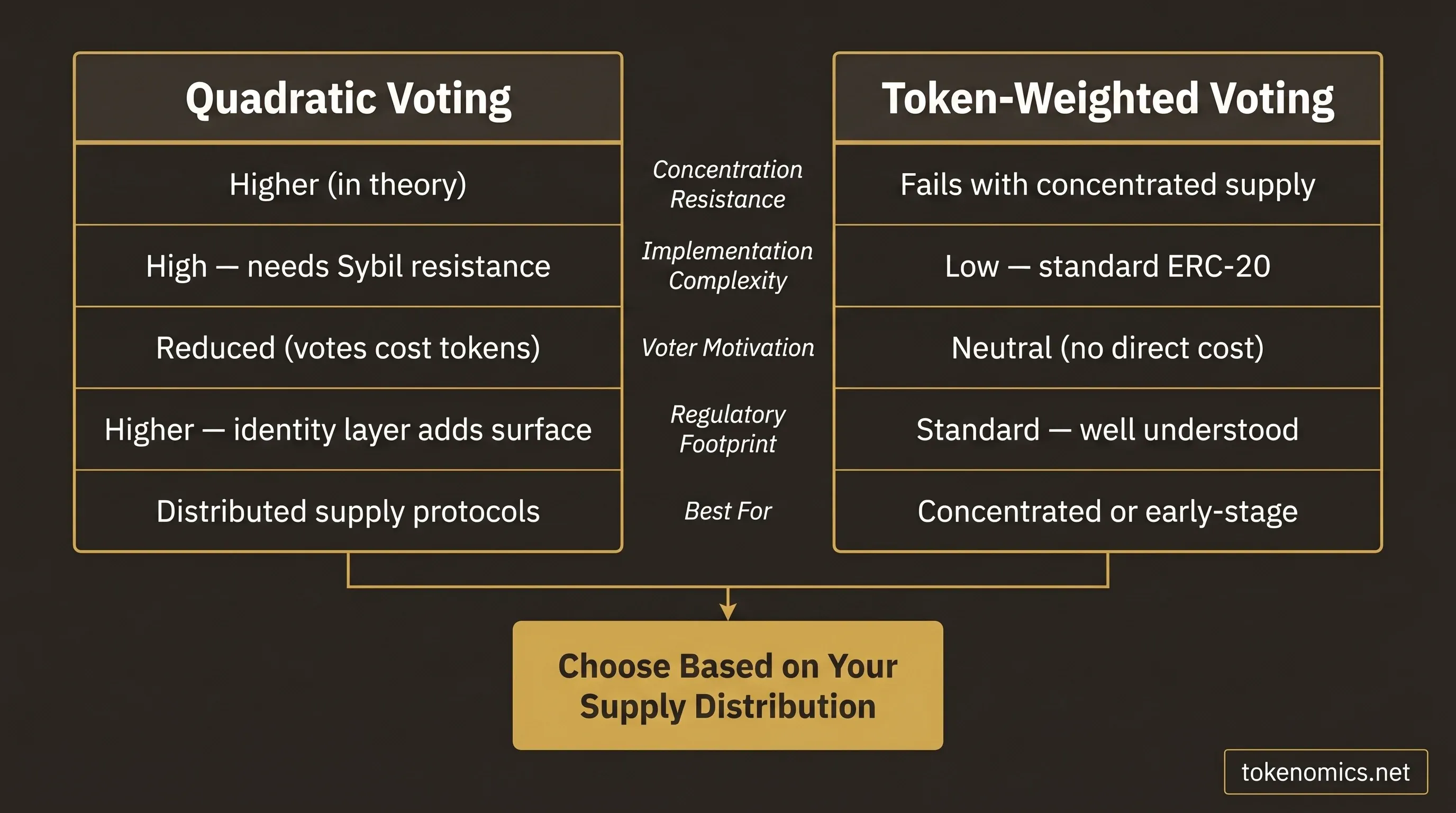
Concentration resistance. QV outperforms token-weighted governance in theory when supply is concentrated. In practice, this only holds if Sybil resistance is in place. Without it, token-weighted governance is more predictable.
Implementation complexity. Token-weighted voting is standard ERC-20 infrastructure. Most protocols can deploy it with a Snapshot space and minimal contract work. QV requires an identity layer that adds attack surface, UX friction, and ongoing maintenance. The simpler choice has real value when your team's operational bandwidth is constrained.
Voter motivation. Both mechanisms suffer from low participation. QV's cost structure can make this worse: asking token holders to spend tokens to vote creates a real cost barrier that token-weighted governance does not. Voter apathy compounds when small holders realize their quadratic spend is marginal relative to large holders anyway.
Regulatory footprint. Token-weighted governance is well-understood by legal teams reviewing protocol structure. QV's identity verification requirements intersect with KYC/AML where the protocol operates in regulated markets. If your legal team is already navigating securities questions, adding a novel identity-verification layer to your governance design widens the review surface. This is worth flagging before you commit to QV.
Match to your supply distribution. The right choice depends on what your supply looks like at steady state, not at launch. A protocol with a heavily airdropped, widely distributed supply has a defensible case for token-weighted governance. A protocol where the top five wallets will hold 60% of supply post-TGE is building a plutocracy with token-weighted governance by design.
#The Failure Modes We See in Practice
We've watched governance design break down in predictable patterns. Four appear repeatedly.
"We'll add QV later." Teams treat governance model selection as a post-launch improvement. Token-weighted governance locks in early because it is the default, and it concentrates power during the period when token distribution is most unequal. Retrofitting QV after concentration sets in requires a governance upgrade that the current concentrated-power holders must approve. That vote rarely passes.
QV without Sybil resistance. Deploying quadratic voting without a working identity layer does not reduce whale dominance. It eliminates the linear cost constraint while leaving wallet-splitting unchecked. A holder who can create 100 wallets and distribute 1 token to each of them can cast 100 votes at a cost of 100 tokens. Under token-weighted governance, those same 100 tokens yield 100 votes. The Sybil attack makes QV strictly worse.
Designing for launch distribution, not post-unlock distribution. The governance model that looks balanced at token generation may be completely lopsided 12 months later. If your team and early investors unlock in the same window, governance concentration can spike sharply and remain elevated until tokens diffuse further. Design for the post-unlock steady state, not the day-one snapshot.
Treating governance model selection as politically neutral. It is not. Token-weighted governance encodes the view that economic stake should determine governance power. Quadratic voting encodes the view that preference intensity matters more than stake size. Both are value judgments about which stakeholders should have the most influence over protocol direction. Choose the one whose assumptions match your protocol's actual stakeholder structure, and document that reasoning.
Each of these failure patterns surfaces in a structured pre-launch review. Our tokenomics audit checklist covers governance design as one of the seven dimensions.
#Choosing the Right Model for Your Protocol
We use what we call the Three-Question Governance Fit Check when we evaluate governance design for a new project.
Question one: what does your post-TGE supply distribution look like? If your top 10 wallets will hold more than 40% of supply after the first major unlock, token-weighted governance is a plutocracy by construction. QV or a hybrid model deserves serious evaluation. If your supply is broadly distributed from day one, token-weighted governance is defensible and simpler to implement.
Question two: can you implement and maintain a Sybil-resistance layer? This is not a one-time setup. Identity verification requires ongoing maintenance as wallet behavior evolves and new attack vectors emerge. If your team does not have the operational capacity to maintain that layer, do not deploy pure QV. The mechanism only holds if the identity verification holds.
Question three: does your governance scope include decisions that affect small participants disproportionately? QV's preference-intensity signal is most valuable when governance outcomes differ materially for large and small stakeholders. If all governance decisions have roughly proportional effects on all holders, token-weighted governance captures the relevant information without the added complexity.
The honest answer for most early-stage protocols: token-weighted governance is the default because Sybil resistance is unsolved at scale for most teams. Hybrid models, including delegation systems, conviction voting, and ve-tokenomics variants, often outperform both pure archetypes in real deployments by combining elements of each.
Governance is not a neutral infrastructure choice. It determines which stakeholders can shape protocol direction and how institutional capital evaluates the protocol's decision-making structure. Investors who review governance design for institutional capital allocation will ask these questions. Have the documentation ready before the conversation starts.
Governance structure is one of the seven components we review in our data room engagement, because investors evaluating governance design for institutional capital allocation need a documented rationale, not just a mechanism choice.
#Frequently Asked Questions
What is the difference between quadratic voting and token-weighted voting?
Token-weighted voting gives each token holder one vote per token held, scaling influence linearly with token balance. Quadratic voting allocates voting power as the square root of the tokens committed, making each additional unit of influence more expensive than the last. The key difference is how each model treats large holders: token-weighted concentrates power proportionally, while quadratic slows that concentration at a cost that requires Sybil resistance to enforce.
Does quadratic voting prevent whale dominance in DAOs?
Quadratic voting makes whale dominance more expensive but does not eliminate it. A holder with a large balance can still outspend smaller holders; the quadratic formula raises the marginal cost of influence. More critically, quadratic voting fails entirely without a robust Sybil-resistance layer. If a whale can split one large wallet into many small wallets, the quadratic formula amplifies rather than reduces their advantage. Identity verification — through systems like BrightID or proof-of-personhood — is a prerequisite, not an optional upgrade.
Which governance model should I use for my DeFi protocol?
It depends on three factors: your post-TGE supply distribution, whether you can implement and maintain a Sybil-resistance layer, and whether your governance decisions affect small and large participants differently. If your top wallets will hold more than 40% of supply after major unlocks, token-weighted governance embeds a plutocracy from day one. If you cannot maintain identity verification infrastructure, quadratic voting is more exploitable than token-weighted. Most early-stage protocols default to token-weighted governance or hybrid delegation models because Sybil resistance at scale remains operationally difficult.
If you're building onchain and need your governance design to hold up under institutional scrutiny, book a discovery call. We'll assess your project and tell you whether we're the right fit. Sometimes we're not. We'll tell you that too.