How to Choose an IDO Launchpad: Evaluation Framework
A framework for evaluating an IDO launchpad: track record, allocation mechanics, fees, and compliance posture before you commit your token launch.


Choosing an IDO launchpad means evaluating a distribution channel, not filling out a listing form. The founders who get it right check four things before they sign anything: verified post-TGE track record, allocation mechanics that fit their own vesting plan, transparent fee and liquidity terms, and a compliance posture that protects both sides of the deal.
This is a framework for running that evaluation on your own shortlist. It is not a ranked list of platforms, and it does not name any specific launchpad, because the criteria below hold regardless of which one you are looking at. What matters is whether a given launchpad can answer these questions in specific, verifiable terms, or only in marketing language.
IDO Launchpad, defined: a platform that runs a tiered or gated token sale to its own existing community ahead of the token trading publicly on a DEX or CEX, typically using a staking, lottery, or tier-based model to determine who gets an allocation. The community sitting behind that launchpad becomes the token's initial holder base, so the platform's real value to a raise is whether that base ends up serving the business behind the token, not just trading its price.
#What an IDO launchpad actually is (and why picking one is a liquidity decision, not a listing checkbox)
An IDO launchpad is not a technical integration you bolt on near the end of a raise. It is a distribution channel, and the community sitting behind that launchpad becomes your initial holder base. Evaluating an IDO launchpad means evaluating who those holders are, how they behave after TGE, and whether that behavior serves the business underneath the token, not just the token itself.
#How IDO launchpads differ from CEX listings and direct DEX launches
A launchpad-run IDO differs from a straight DEX listing in one structural way: allocation. A DEX launch has no gatekeeper deciding who gets tokens first, it is open to whoever shows up with liquidity. A launchpad instead runs a defined sale, often staking-gated or tier-based, to its own registered community before the token ever touches a public pool. A CEX-run IEO differs again: the exchange itself handles KYC, custody, and the sale mechanics internally, folding the launch into its own listing process rather than routing it through a separate third-party platform.
#Why launchpad choice is inseparable from your marketing and liquidity plan
Marketing is liquidity. The launchpad you pick hands you a starting set of holders, and that starting set shapes your early trading volume, your community composition, and how much sell pressure hits the market in the first weeks after TGE. Treating launchpad selection as a separate, later decision from your liquidity and marketing plan is how founders end up with an allocation audience that has no relationship to the business they are launching.
That responsibility sits inside a broader token launch strategy, and launchpad selection should never be decided apart from it.
#The launchpad landscape: what the major categories look like
Before you can evaluate an individual launchpad, it helps to know what category it falls into, because the categories behave differently by design.
#Community-staking launchpads vs. tier/allocation launchpads vs. CEX-native launchpads
Community-staking launchpads gate allocation behind staking a native token, weighting access toward committed, longer-term participants. Tier and allocation launchpads sort applicants into tiers, often by a lottery or a raffle mechanic, spreading smaller allocations across a wider pool of wallets. CEX-native launchpads sit inside an exchange's existing KYC and custody infrastructure, drawing on that exchange's user base rather than a standalone community built around the launchpad itself.
#Where each category tends to fit by project stage and chain
Typical raise size, allocation structure, and audience composition all differ by category, and no category is inherently the right one. A staking-gated launchpad tends to suit a project with an audience already comfortable locking capital. A lottery-model launchpad tends to suit a project prioritizing wide, small-allocation distribution over concentrated committed holders. None of this is an endorsement of any named platform in either category, it is a description of the shape each category takes, which you then weigh against your own launch goals.
#Track record and audience quality, not follower count
This is where most evaluations go wrong. A launchpad's social following is not evidence of anything about how its IDO launchpad allocations actually perform once tokens are trading.
#What to actually verify before a launchpad gets access to your token
Ask for post-TGE performance patterns across the launchpad's last five to ten launches, not a highlight reel built around its single strongest outcome. A launchpad with a real track record can describe the range, including the launches that underperformed, not just the ones that worked. If a launchpad can only offer marketing screenshots and follower counts in response to that question, it is telling you it does not track its own outcomes closely enough to answer it.
#The difference between reach and holders who stay
Day-30 and day-90 onchain holder retention tells you more about audience quality than Telegram member count or follower totals ever will. A launchpad can have a large channel and a thin, fast-churning holder base once the token actually starts trading. Ask specifically for retention data, not just allocation and raise totals, and treat a launchpad's unwillingness or inability to produce it as meaningful information on its own.
#Allocation mechanics and what they do to your token's early price action
The allocation model a launchpad uses is not a back-office detail, it directly shapes your token's day-one holder distribution and its early sell-pressure curve.
#Fixed allocation vs. lottery vs. staking-weighted models
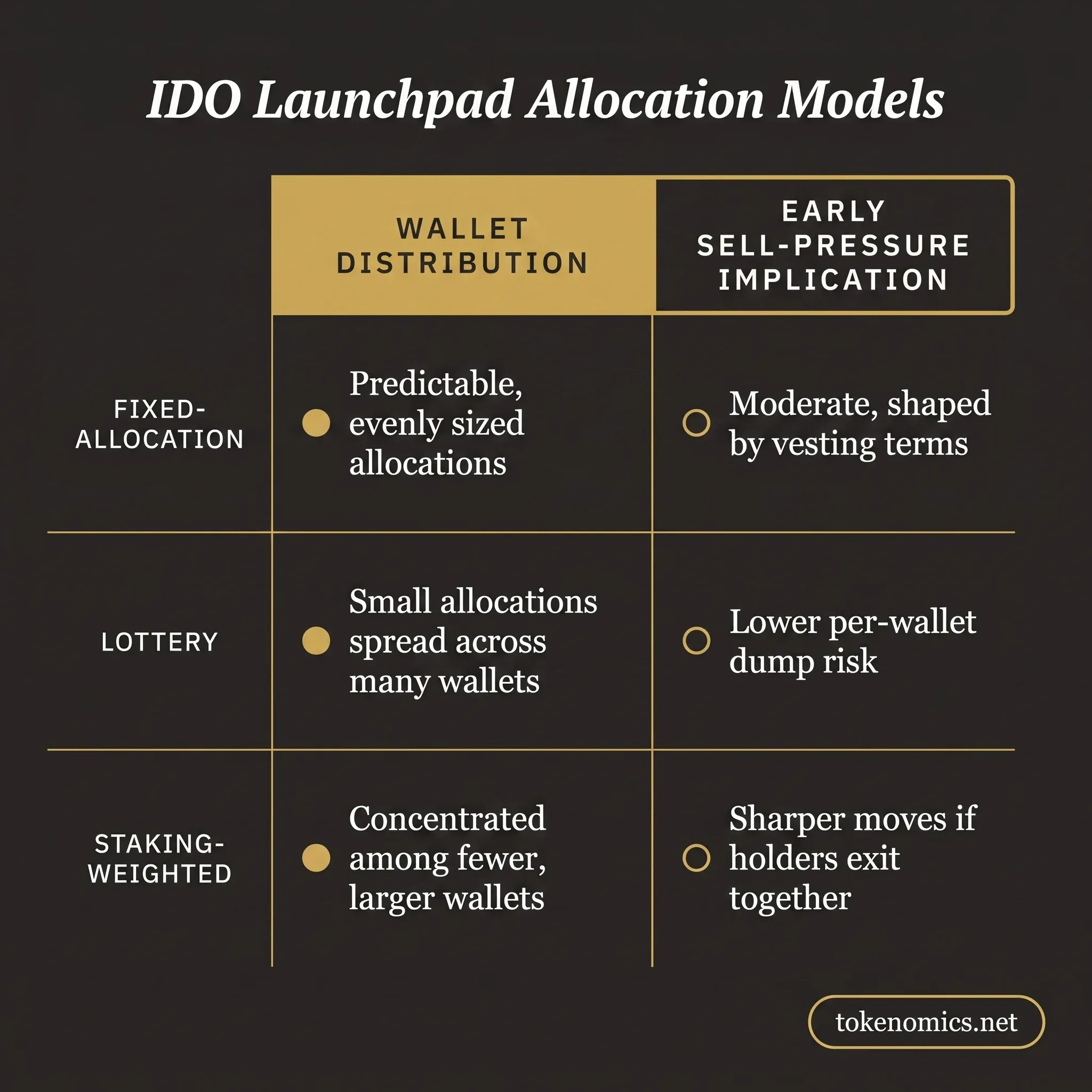
Each model produces a different distribution. Lottery models spread small allocations across many wallets, which lowers per-wallet dump risk but makes it harder to build a base of committed holders. Staking-weighted models reward larger, longer-committed capital, which concentrates allocation among fewer, larger wallets that can move price more sharply if they exit together. Fixed-allocation models sit in between, offering predictable access at the cost of some of the screening a lottery or staking gate provides.
#How allocation design interacts with your vesting and float
None of these models should be chosen independently of your own vesting schedule and initial float. A concentrated, staking-weighted allocation paired with a short cliff and a large unlock at TGE is a materially different risk profile than the same allocation model paired with a longer, linear vesting curve. Model the launchpad's allocation mechanics against your own token design before you commit, not after.
Working out how to design token vesting schedules for your own team, investors, and advisors before you approach any launchpad keeps this modeling from happening backward.
#Fees, terms, and the deal structure founders miss
The headline fee a launchpad quotes is rarely the full cost of the engagement, and the terms most founders skip past are usually the ones that matter most later.
#What launchpads actually charge for
Launchpad compensation typically blends a cash fee with a cut of token allocation, and sometimes both at once. Ask for both numbers in writing before agreeing to anything, and confirm whether that allocation cut is subject to the same vesting terms as public participants or carries different terms entirely.
#Questions to ask about liquidity requirements and lockup terms
Some launchpads require a minimum initial-liquidity commitment, or a lockup on a portion of the funds raised, both of which directly affect your treasury planning after TGE. Bundled "marketing packages" attached to a launchpad deal are frequently services you could source directly elsewhere, so price the bundle against sourcing those services independently before accepting it as part of the terms.
Running these numbers against your own raise plan before you sign is exactly the diligence our Tokenomics Consulting service is built to support.
#Compliance and jurisdiction: diligence that runs both directions
Compliance diligence on a launchpad deal is not a one-way check the launchpad runs on you. It runs both directions, and treating it as only the platform's problem is a common and costly mistake.
#KYC/AML posture and geo-restriction handling
A launchpad with no KYC process, or no geo-fencing for restricted jurisdictions, is a liability the founder inherits, not only the platform's. Ask specifically how the launchpad handles US persons and OFAC-restricted jurisdictions, and get a direct answer, not a general reassurance. Note the distinction: no launchpad's KYC and AML process should be described as "compliant," since compliance is a legal determination, not a vendor claim. The honest framing is that a process is compliance-oriented, or reviewable by counsel, and a launchpad's willingness to use that framing rather than overclaim is itself a useful signal.
#What a launchpad's own regulatory exposure means for your launch
You are underwriting the launchpad's compliance posture just as much as it is underwriting your project. If the launchpad's own regulatory footing is unclear or untested, that exposure attaches to your launch by association, regardless of how carefully your own team has prepared.
#Red flags that should end a launchpad conversation
Some signals are strong enough that they should end the evaluation on their own, regardless of how the rest of the conversation went.
#Deal-structure red flags
Pressure to lock a launch date before your tokenomics and vesting schedule are finalized is a structural red flag, not a scheduling convenience. So is vague scope language that leaves room for "that's a separate fee" surprises once you are already committed to the relationship.
#Communication and diligence red flags
A launchpad unwilling to share post-TGE performance patterns from its past launches is withholding the exact information you need to evaluate it. Evasive or vague answers on KYC and AML process, upsell pressure toward paid marketing add-ons before basic terms are settled, and any promised-outcome language about price or trading volume are all reasons to walk away. Promised-outcome language in particular is worth naming directly: no one, including the launchpad itself, controls how a token trades once it is live, and a platform that implies otherwise is signaling something about how it operates more broadly.
Launchpad category is only one layer of that decision; see the difference between ICO, IDO, and IEO for how it compares to the other paths to market.
If you have already run your shortlist through this framework and want a second read on it, that conversation is worth having before you sign a launchpad agreement, not after. Across our own 80-plus token engagements and $100MM-plus in combined raises, launchpad selection is consistently one of the decisions founders revisit too late to change. Book a strategy call and we will pressure-test your shortlist before you sign.