Sybil Resistance: How to Stop Airdrop Farmers
How sybil resistance actually works for a token launch: the four mechanism types, their trade-offs, and how to choose the right one for your airdrop.


Sybil resistance is what stands between your airdrop allocation and a handful of operators running thousands of wallets to claim it. The core problem fits in one sentence: one person, many wallets, one allocation meant for many distinct people. If your distribution event does not account for that from the start, the tokens meant to reward your real community end up concentrated in a few hands within days of claim opening.
The reason this matters goes beyond stopping bad actors. The tokens in an airdrop are not free money for the team distributing them, they represent a claim on the value the underlying business is trying to build, and who ends up holding that claim determines whether the business has a real, engaged community behind it or a warehouse of wallets waiting to sell. Sybil resistance protects the integrity of the allocation going to real users and real long-term holders, which is what makes a token's initial distribution defensible later and keeps the value the product creates from leaking out to farming operations instead of the people using it. A distribution that is quietly farmed by a small set of operators is a distribution that undercuts its own stated purpose, and that gap tends to surface at the worst possible time, usually when a partner, an exchange, or your own community starts asking who actually holds the token.
This is a guide to the mechanism landscape, not a pitch for any single approach. It assumes you already know you need an airdrop and are now trying to pick a sybil-resistance mechanism, weigh its trade-offs against your specific launch goals, and know how to tell after the fact whether it worked.
#What sybil resistance actually means for a token launch
Sybil resistance is the set of mechanisms that make it costly or impossible for one actor to claim an allocation meant for many distinct participants. It is not a plug-in added the week before claim opens. It belongs in the distribution model itself, decided alongside eligibility criteria and the distribution curve, because those three decisions constrain each other.
This is a design decision, not a security patch. A team that finalizes eligibility rules and a claim mechanism first, then asks "how do we stop bots" afterward, has already limited its own options. Activity-based eligibility and stake-weighted eligibility are sybil-resistance decisions dressed up as distribution decisions. Get the sequencing backward and you are retrofitting resistance onto a structure that was not built to support it.
#Why token launches and airdrops are a sybil-attack magnet
Any distribution event with a free claim and no cost-of-identity is a target by default. Wallet addresses are cheap to generate, which means "one wallet, one entry" by itself is not a sybil-resistance mechanism. It is the absence of one.
What makes an allocation event exploitable comes down to a few structural facts: the claim is free or near-free, identity is anchored to a wallet address rather than to a person, and prior large airdrops have already set a precedent that farming pays off. That precedent raises the baseline attack pressure on every subsequent launch, because farming operators build and reuse tooling across projects.
At scale, farming looks less like a single bad actor and more like an operation. Hundreds to thousands of wallets perform the same qualifying actions in the same patterns, often funded from a small number of source addresses and often timed close enough together to look automated because it is. A launch with no resistance mechanism in place is not hoping to avoid this. It is choosing to absorb it.
#The core sybil-resistance mechanism types
There are four broad categories worth knowing before you design anything, and each one raises the cost of an attack in a different way.
#Proof-of-personhood and identity-based approaches
Proof-of-personhood mechanisms, biometric or identity-verification protocols, raise the cost of creating a new "person" rather than a new wallet. This is the most direct answer to the wallet-generation problem, because it moves the unit of scarcity from an address to a human.
#Activity and reputation scoring
Activity and reputation scoring looks at behavioral depth over time: transaction history, protocol interaction diversity, and account age, rather than a single qualifying action. A wallet that shows a real pattern of use is harder to fake at scale than a wallet that performed one qualifying transaction.
#Stake-weighted and cost-of-capital approaches
Stake-weighted approaches make the allocation proportional to capital or time already committed. This is expensive to fake at scale because it requires an operator to actually deploy capital across every farmed wallet, not just generate addresses.
#Social-graph and attestation-based approaches
Social-graph and attestation approaches lean on existing trust networks, verified credentials, vouching, or web-of-trust structures, to flag clusters of related wallets. Rather than scoring each wallet in isolation, this approach looks at the relationships between wallets.
Each of these mechanisms fails differently, which is exactly why the next question is not "which one is best" but "which one fits this launch."
#Matching the mechanism to your launch goals
There is no single best sybil-resistance mechanism. There is only the mechanism that fits your specific trade-offs, and the honest way to evaluate that is against four axes: cost to implement, user friction, false-positive rate, and decentralization posture.
Proof-of-personhood buys strong resistance but adds real onboarding friction, plus a privacy and centralization trade-off depending on the provider. Activity-based scoring is friction-free for genuine users but needs enough historical data to be reliable, which by design excludes brand-new users. Stake-weighted approaches are cheap to implement but bias the allocation toward capital-rich actors, which can undercut a "reward real users" goal if it is not balanced against other signals. Social-graph approaches scale well but can produce false positives against genuinely unconnected new users who happen to look, structurally, like a cluster.
Working through this trade-off matrix against your specific launch goals is exactly what our Token Launch Strategy service is built for.
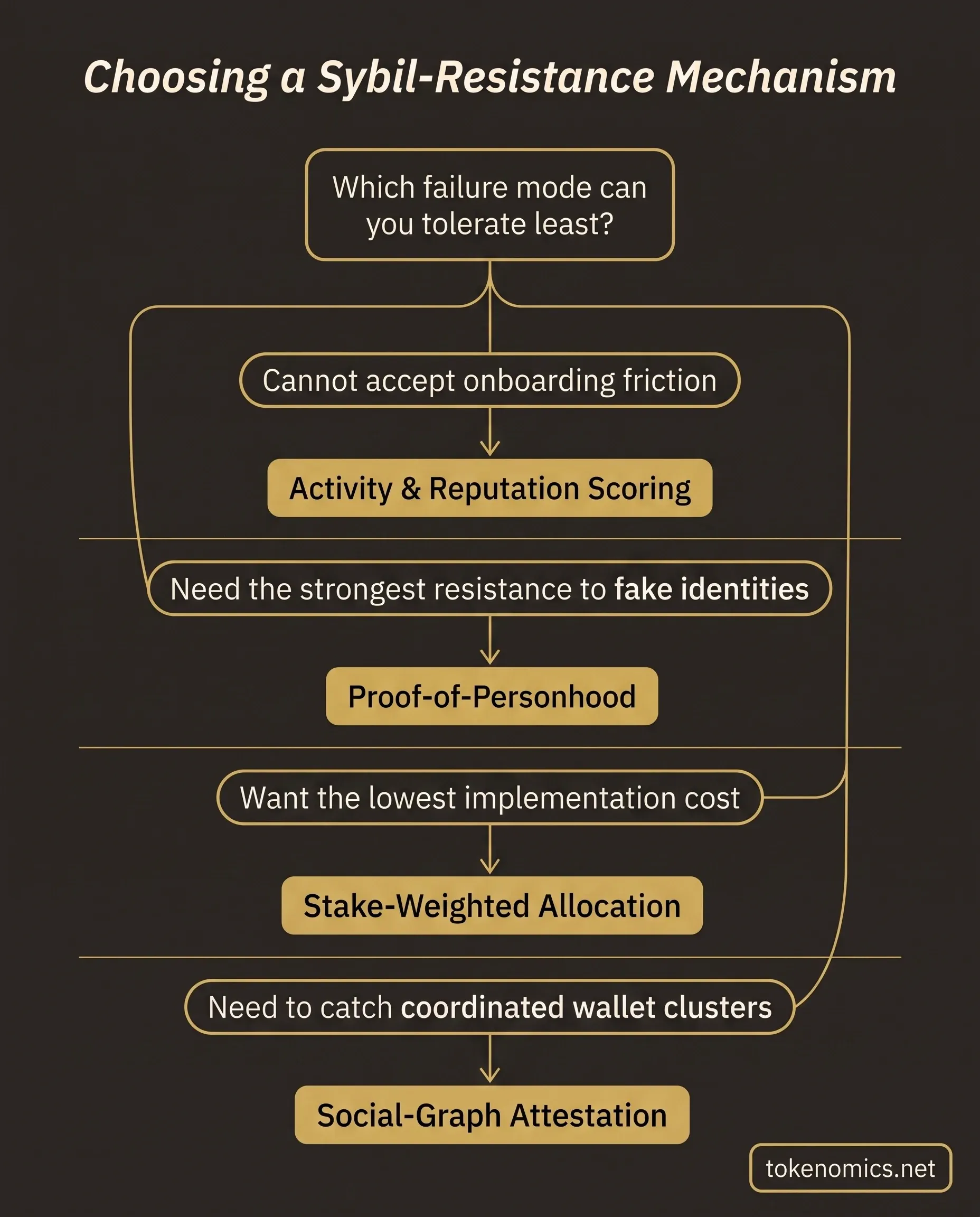
The right choice depends on which failure mode your team can tolerate least, not which mechanism is newest. A launch optimizing for a broad, low-friction claim will lean toward activity scoring. A launch optimizing for maximum resistance at the cost of some friction will lean toward proof-of-personhood. Neither answer is wrong in isolation. The mistake is picking one without naming, in advance, which failure mode you are choosing to accept. Whichever mechanism you choose, the goal underneath it is the same: protect the pool of real holders that gives the underlying business a distribution worth building revenue and community on.
If an airdrop is your chosen distribution mechanism, our airdrop design guide covers the eligibility and claim-mechanism decisions this interacts with directly.
#Common sybil-resistance mistakes founders make
The most common mistake is relying on a single signal. Stacking mechanisms, activity scoring plus a light stake-weighted floor, for example, is dramatically harder to game than any one signal alone, because defeating one mechanism does not defeat the others.
The second common mistake is only detecting sybils after the claim, not before. Clawing back tokens after the fact creates legal and community-relations exposure that pre-claim resistance avoids entirely, and it rarely recovers the full extent of what was farmed. Treating sybil resistance as a one-time filter rather than an ongoing posture misses the fact that farming tooling adapts between launches. What worked to catch farmers on your last distribution will be circumvented by the next one unless the approach evolves with it.
Sybil resistance is one piece of a larger launch sequence; see our TGE strategy guide for how it fits alongside eligibility design and the claim mechanism.
#How to measure whether sybil resistance worked after launch
The standard post-launch check is wallet-clustering analysis on claimed addresses: shared funding sources, near-identical transaction timing, and identical activity patterns across groups of wallets. This is the same kind of analysis used to identify farming in the first place, applied retroactively to the final claimed set.
A meaningfully lower concentration in the claimed distribution, relative to what an unfiltered baseline would have produced, is a useful directional signal, described here in aggregate terms only. A spike in claim-then-immediate-sell behavior across a wallet cluster is also worth flagging, not because it proves anything about future token value, but because it is a strong farming signal worth feeding into the design of your next launch.
#Where sybil resistance intersects with compliance posture
Identity-adjacent mechanisms raise different questions than purely on-chain ones. Proof-of-personhood and KYC-adjacent mechanisms introduce data-handling and jurisdictional questions that stake-weighting and activity scoring, being purely on-chain signals, do not.
This is not a section that resolves those questions. It flags them. Any resulting documentation should be described as compliance-ready or reviewable by counsel, never as compliant outright, since compliance is a legal determination and not a vendor or founder claim.
Our tokenomics compliance guide covers how these documentation and jurisdictional questions typically get resolved in practice.
If you are designing an airdrop or points program and want a second opinion on which sybil-resistance approach fits your specific launch goals, that is a conversation worth having before claim opens, not after.
Book a strategy call and we will walk through which approach fits before you finalize your claim mechanism.