
What Real-World Assets Can Be Tokenized, and Which Owners Have a Case

In short
Almost anything with clear ownership and a legal wrapper can be tokenized. Far fewer owners have a case for doing it. This is what real estate, private credit, funds, art and commodities each need, plus the three tests that decide whether your asset belongs in the conversation at all.
Almost any asset with clear ownership, a defensible value and a legal wrapper can be tokenized: real estate, private credit, funds and company stakes, art, and commodities. Whether it should be depends on the owner. The asset needs enough buyers, a route back out, and paperwork that holds up. A token supplies none of the three.
That gap is where most of these conversations go wrong. The question an owner arrives with is "can my asset be tokenized", which is nearly always yes, and the question that decides anything is "do I have a case", which is usually no. Both get called the same thing.
So start with the business reason. You are raising money, or creating a way for part-owners to get out, or both. Name the amount and name what it is for. Then compare what you are considering with a loan, a share sale, a joint venture partner or a straight sale, because those routes are older, cheaper to arrange and understood by everyone you will have to convince. If tokenizing does not beat them on something specific, you have an interesting project rather than a financing.
We have advised 100+ companies on this work, and the pattern is consistent: the asset type rarely decides it. The owner's situation does.
#The asset has to carry the token, not the reverse
A token is a record of who owns what. It is a good record, it moves faster than a transfer agent, and it can enforce rules about who is allowed to hold a slice. What it cannot do is produce demand for the slice.
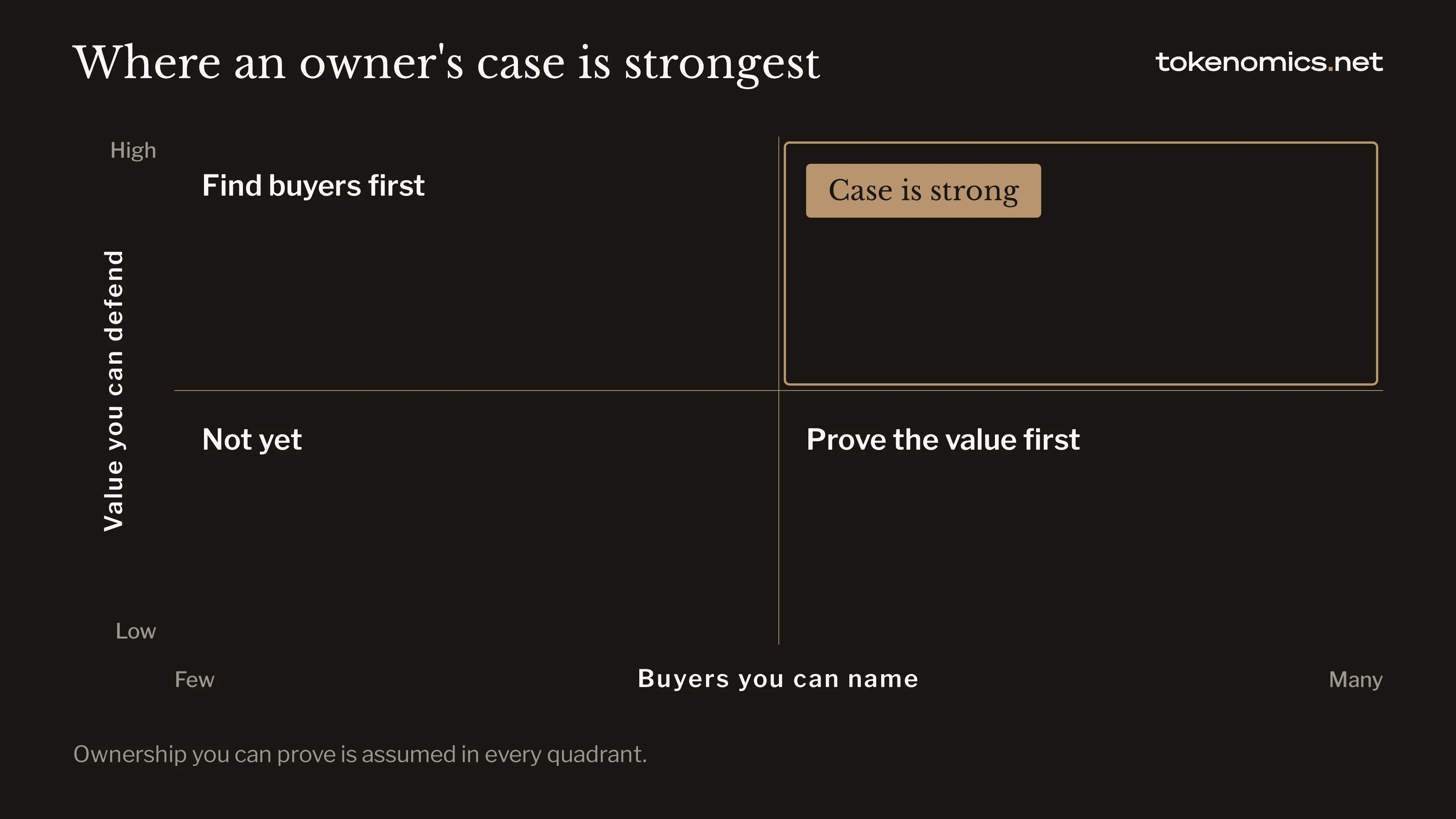
Three things have to be true before the record is worth building. You can prove who owns the asset. You can defend what it is worth to someone who is not you. And you can name people who would buy part of it. Those are the tests in the table further down, and an asset type that passes the first two can still fail the third completely, which is the case with most of the assets owners are proudest of.
#Asset types and what each one needs
Five categories, with the thing that makes each one easier and the thing that makes it harder.
#Real estate
Title is a public record, so the ownership test is usually the cheap one. A single building is also straightforward to value, because comparable sales exist and a valuer will put a number on paper that a buyer will argue with but recognize.
The harder part is the debt and the co-owners. A mortgage almost always restricts transfers and changes of control, and the lender's consent is a conversation you have before you build anything, not after. Our write-up on tokenizing real estate covers the structure, and how the law treats a tokenized property interest covers the legal treatment.
#Private credit and loan books
Credit is the asset type this work suits most naturally, and the reason is dull: a loan is already a contract with a written payment schedule, so the cash flows are documented before anyone turns up with a blockchain. Buyers can see what they are buying.
The harder part is assignment and servicing. Loan agreements often restrict who the lender can transfer to, borrower consent may be required, and somebody still has to collect payments, chase arrears and report. How tokenized private credit works goes through the mechanics.
#Fund interests and company stakes
The machinery already exists. There is a cap table, a subscription process and a register, and interests already transfer by agreement rather than by a market.
The harder part is that this is securities work from the first sentence. Transfer restrictions in a limited partnership agreement or a shareholder agreement decide what is possible, pre-emption rights decide who gets asked first, and the offering itself is a legal structure your counsel designs. Valuation between formal marks is the second problem, since a buyer wants a price today and the fund's number is from last quarter.
#Art and collectibles
One object, one owner, no tenants, no borrowers. On paper the least complicated thing in this list to hold.
The harder part is that a painting pays nobody anything. A buyer's entire return is resale, so exit is not a secondary feature of the deal, it is the deal. Add custody, insurance and provenance, each of which a buyer will want evidence of, and the honest version is that art tokenization is a demand problem wearing a structuring problem's clothes.
#Commodities
Value is the easy test here, because gold, silver and most agricultural commodities have public prices nobody has to be persuaded of.
The harder part is that the token is a claim on something stored somewhere. The warehouse, the auditor, the insurer and the redemption terms are what a buyer is actually pricing, and if the redemption terms are vague the discount shows up immediately. The metal is not the asset. The claim is.
#The three tests that decide it
Score your own asset honestly. A fail is useful, and it is cheaper now than after the legal fees.
| Test | What passes | What fails |
|---|---|---|
| Ownership you can prove | A title, register entry, executed contract or filing that names you, plus any consents a transfer needs | Shared ownership with no agreement, an unrecorded interest, or a lender who has not been asked |
| Value you can defend | A number a third party will stand behind, from a comparable, a cash flow or a public price | A figure you believe, or an appraisal nobody else would use |
| Buyers you can name | Five real conversations with real people, prices they said out loud, and a route by which they sell again | "There is demand for this category" |
The third row fails most often, and it is the one owners resist testing because the answer is checkable in a week. Five phone calls. Ask what they would pay and whether they would need to sell it again within three years. Write down what they say, including the objections, especially the objections.
#Examples of tokenized assets
By category: residential and commercial property, private credit portfolios and individual loans, fund limited partnership interests, equity in private companies, single works of art, and stored commodities including precious metals. Invoices, royalty streams and equipment leases show up too, and they behave like credit because that is what they are.
We do not name products or issuers in a post like this, and the reason is practical rather than coy. An owner reading a list of other people's deals learns what was possible for somebody else's asset, in somebody else's jurisdiction, with somebody else's lender. The three tests above travel. A deal list does not.
One category to be careful with: tokenized treasuries and tokenized stocks get counted in the same market totals as everything above, and they are a different business. Those are investment products built by issuers for buyers. If you are curious, what tokenized treasuries are explains the structure, but it is not the job an owner with a building is trying to do.
#Frequently Asked Questions
#What real-world assets can be tokenized?
Real estate, private credit and loan books, fund interests and company stakes, art and collectibles, and commodities are the categories owners bring us most often. The common requirement is ownership you can prove, a value you can defend and a legal wrapper that holds the asset.
#What are examples of tokenized assets?
By category: residential and commercial property, private credit portfolios, fund limited partnership interests, single works of art, and stored commodities such as gold. We do not name products or issuers here, because an owner's decision depends on their own asset rather than somebody else's deal.
#Can you tokenize art?
Structurally yes, and art is one of the easier assets to hold because it is one object with one owner. The hard part is that a painting earns nothing, so a buyer's only return is resale, which makes exit the entire case.
#Can you tokenize a business?
Selling tokenized interests in a company is a securities question before it is a technology question, in every jurisdiction we have worked in. The cap table and the transfer restrictions in your shareholder agreement decide what is possible, and counsel decides the offering.
#Can you tokenize gold?
A gold token is a claim on metal somebody else is storing, so the custodian, the audit and the redemption terms are the asset. Buyers price those terms, not the metal, because the metal already has a public price.
#Next step
If your asset cleared all three tests, the next question is whether tokenizing beats the ordinary routes for your specific situation, and that is the subject of our owner's decision test in should you tokenize your asset.
If you would rather run the checks yourself first, the free course publishes the method, and the first stage of it is designed to end in a no when a no is the right answer. When you want it run properly on your asset, our tokenization advisory team starts with exactly that question.
Tokenomics.net is an advisory and education firm for token issuers and asset owners. The asset has to carry the token. Not the reverse.
Bring the question to a call
Thirty minutes with the team that wrote this, on your token or your asset. You leave knowing what to fix first.