What Are Tokenized Treasuries? How They Work
A clear definition of tokenized treasuries: what gets tokenized, how yield accrues on-chain, and where live treasury products sit in the RWA landscape.


Tokenized treasuries are blockchain-issued tokens that represent a claim on a fund holding US Treasury securities or short-term money-market instruments, not the underlying bond itself. This design pattern matters because the token is infrastructure, not the source of value; the value creation depends on the fund's own income-generating engine, the Treasury or money-market yield the fund actually holds, which the token just moves and settles on-chain. The token is a digital wrapper on a traditional fund structure, not a new asset class invented by crypto. If you are evaluating on-chain yield or collateral options and keep running into the term, this is what it actually means and how the mechanics work underneath the label.
#What "tokenized treasuries" means
#The short definition
A tokenized treasury is a digital token, issued on a public or permissioned blockchain, that represents a proportional claim on a fund whose assets are US Treasury bills, notes, or short-term government-backed instruments. Holding the token is economically similar to holding a share in a money-market fund. The novelty is the settlement layer, not the underlying instrument, and not the source of the yield either.
#What gets tokenized (the fund share, not the bond itself)
This distinction matters more than it sounds like it should. Nobody has put an individual Treasury bond on a blockchain. What gets tokenized is the fund share, the claim on net asset value, that a traditional fund administrator already tracks in a registry. Tokenization replaces or supplements that registry entry with an on-chain token. The Treasury security itself stays exactly where it has always lived: in custody, under existing fund administration rules.
#Why tokenized treasuries exist now
#The yield gap DeFi protocols were solving for
Stablecoin issuers and DeFi treasuries have historically held meaningful reserves that earned nothing while sitting idle on-chain. Moving that capital off-chain into a yield-bearing instrument meant breaking the on-chain workflow entirely. Tokenized treasury products closed that gap: a yield-bearing place to park capital without leaving on-chain rails or fragmenting a protocol's treasury operations across multiple systems.
#Institutional interest in on-chain distribution rails
From the other direction, traditional asset managers were not chasing higher yield by tokenizing. Treasury yield is Treasury yield regardless of wrapper. What tokenization offers an asset manager is a faster settlement and distribution rail, and access to a new class of on-chain-native buyers who were previously unreachable through traditional fund distribution channels. The framing on both sides is infrastructure, not a yield enhancement.
#How tokenized treasury products work
#The custody and issuance chain
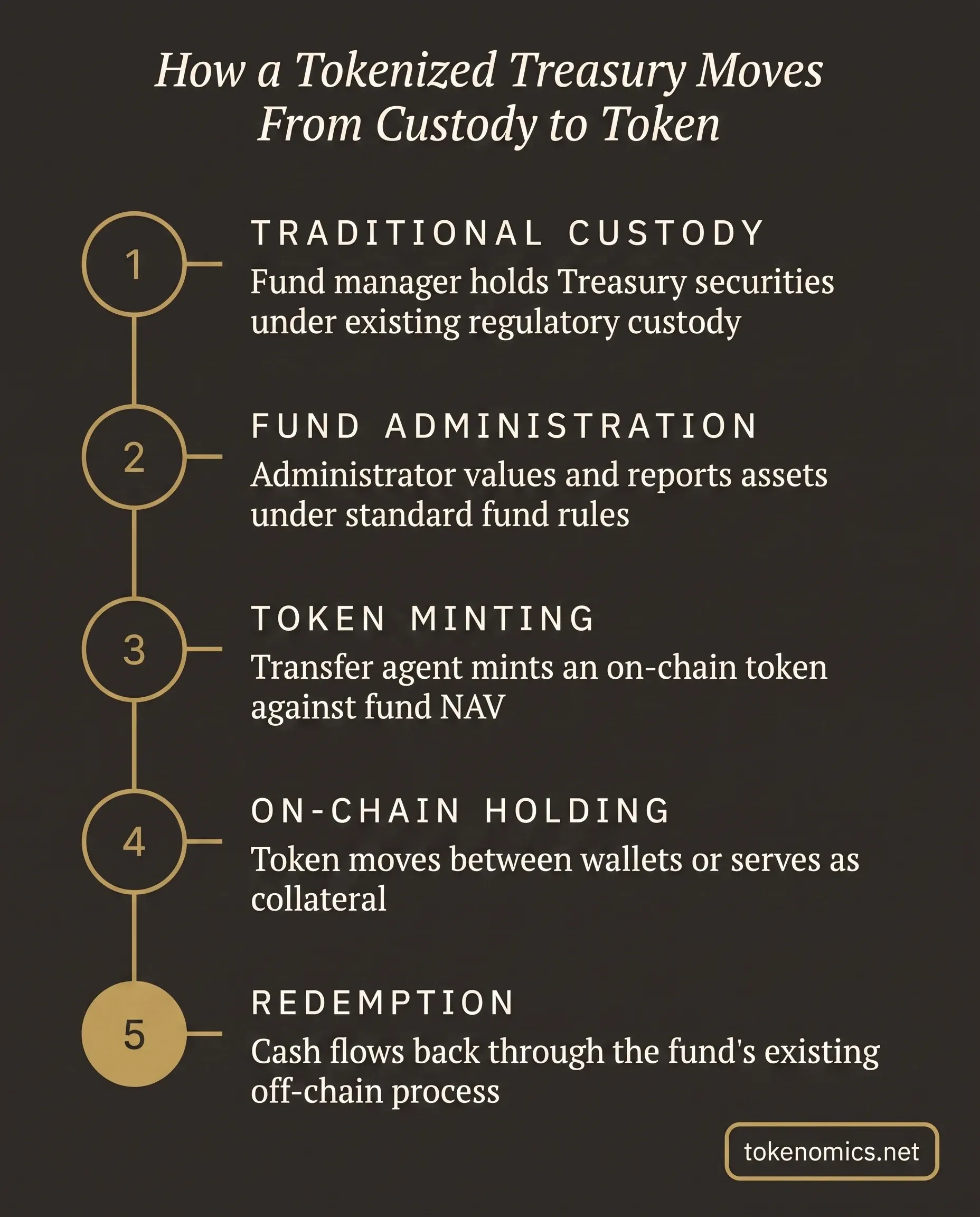
An authorized fund manager holds the actual Treasury securities in traditional custody, under the same regulatory framework that governs any registered fund. Nothing about that custody arrangement changes because a token exists. The fund's assets are held, valued, and reported the way any comparable fund's assets would be.
#On-chain share representation
A transfer agent or fund administrator mints an on-chain token that represents a proportional claim on the fund's net asset value. That token can move between wallets, be used as collateral, or be held directly, depending on the product's permission model. Redemption, converting the token back into cash, generally flows back through the same off-chain rail the fund already uses. In most current designs, the token is not itself instantly redeemable for cash on a decentralized exchange the way a stablecoin might be; redemption still runs through the fund's existing operational process and cutoff windows.
For the broader design space this narrower topic sits inside, see the tokenized treasuries pillar guide on RWA tokenization.
#Where the major tokenized treasury products sit today
Live tokenized treasury products today generally fall into two structural categories, and the difference is about permissioning and composability, not quality.
#Bank-and-asset-manager-issued products
the Franklin Templeton BENJI tokenized money market fund is an example of an asset-manager-issued product: a registered fund with an on-chain share class layered on top of an existing, regulated fund structure. Transfer restrictions and eligibility checks generally mirror what a traditional fund of the same type would require.
#DeFi-native tokenized treasury protocols
Ondo Finance tokenized treasury products represent a more DeFi-native approach, designed with composability across on-chain protocols in mind from the start. The structural tradeoff is usually broader on-chain integration in exchange for its own set of permissioning and eligibility rules. Neither structure is inherently better; they solve for different distribution priorities. Founders weighing how a tokenized treasury product fits into a broader token model often start with a Tokenomics Design engagement to map the tradeoffs.
#How yield actually accrues and gets distributed
#Rebasing tokens vs. accruing NAV tokens
Tokenized treasury products distribute yield in one of two mechanical patterns. Some increase the holder's token balance directly over time, a rebasing model, so the number of tokens in a wallet grows while the price per token stays roughly constant. Others keep the token balance fixed and let the net asset value per token rise instead, an accruing NAV model. Both represent the same underlying economics through a different accounting presentation.
#What "yield" means when the underlying asset is a T-bill, not a protocol emission
The yield itself is the Treasury coupon or money-market rate the fund earns, passed through to token holders minus fund fees. It is not a protocol incentive or emission schedule set by a DeFi team. That means the yield on a tokenized treasury product moves with Federal Reserve policy and Treasury market rates, not with the tokenomics of any protocol layered around it.
#Regulatory and compliance considerations
#Why most tokenized treasury products are permissioned, not permissionless
Transfer restrictions and KYC gating on most tokenized treasury products exist because the underlying fund share is typically a security. That is a structural fact about the instrument, not a design preference by the issuer. Permissionless transfer of a fund share that has not cleared the relevant eligibility checks would create a compliance problem for the issuer, so gating is built into the token itself.
#The securities-law question underneath the wrapper
The underlying legal question is whether the token, or more precisely the fund interest it represents, meets the definition of a security under the Howey test, with the SEC as the primary regulator of that determination in the United States. No tokenized treasury product should be described as outright "compliant." The more accurate framing is that a given product is structured to meet, or reviewable against, existing securities frameworks, since compliance is a legal determination made by regulators and courts, not a claim a vendor or issuer gets to assign to itself. The same classification logic applies well beyond treasuries; see commodities vs securities for how the Howey test analysis plays out across token types.
#Risks and limitations founders should understand
#Liquidity and redemption-timing risk
On-chain settlement speed for the token itself does not remove the underlying fund's redemption windows and cutoff times. A token can move instantly between wallets while the actual cash redemption still takes the same amount of time it would for a traditional fund share, because the fund's operational process has not changed underneath the token.
#Smart contract and custodial counterparty risk
Wrapping a fund share in a token adds a smart-contract and bridge attack surface on top of the traditional custodial risk that already existed in the underlying fund. It does not eliminate that traditional risk; it adds a layer next to it. Evaluating a tokenized treasury product means evaluating both the fund's custodial and administrative soundness and the smart contract's security posture, not one in place of the other.
#Where tokenized treasuries fit in a broader RWA strategy
Tokenized treasuries are a narrow, comparatively low-volatility instrument type inside a much larger real-world asset tokenization design space that also covers real estate, private credit, and commodities. For a founder or treasury manager evaluating on-chain yield options, tokenized treasuries are a useful building block to understand on their own terms, not a standalone allocation decision to make in isolation from the rest of an RWA strategy.
If you are weighing tokenized treasuries as one instrument inside a broader RWA or tokenomics strategy, that scoping conversation is worth having early. Book a strategy call to walk through where it fits.