
How to Choose an Asset Tokenization Advisor: Eight Questions to Ask

In short
Eight questions separate an advisor who guides the whole job from one selling a platform. Ask them before you sign. Book a call with Tokenomics.net.
Choose an advisor with eight questions: can step one end in a no, who does the work, in what order counsel and platform choices happen, what is written about buyers and exit, how many whole jobs they have run, who checks their work, how they are paid, and what you keep if you stop.
The money at stake is yours and the asset is yours, so start from what you are buying. You are not buying technology. You are buying the order of work, because the order is what determines whether the paperwork supports the offering, whether your lender is asked before or after something has already moved, and whether anyone tested demand before you paid for a build.
Here is the awkward part. Everyone in the conversation is selling something, including us. Advice is hard to tell apart from a pitch when both arrive in a deck. The eight questions below are useful precisely because they are hard to answer well without having actually run the job, and you can ask them on a first call for free.
#Why the choice matters more than the platform
Nobody tokenizes an asset twice. There is no reason you would already know the sequence, and that asymmetry is where the cost sits.
The technical layer is the part that is closest to solved. Issuing a token against a register of owners is routine engineering. What goes wrong goes wrong earlier: an entity set up before a lender was asked, an offering structured before anyone established that buyers existed at a price, a token standard chosen before counsel had seen the terms it was meant to encode. Those are sequencing failures, and they cost months because the fix is to go back and redo the paperwork underneath.
So the thing to evaluate is judgment about order. The eight questions are all, in one way or another, about that.
#Question 1. Can step one end in a no?
Ask it directly, and listen for whether stop is an outcome they have actually delivered.
A strong answer: yes, step one tests whether you need the money and whether buyers exist, and if the answer is no we tell you, and the engagement can end there. A weak answer moves straight to design, structure or chain selection, because that framing has already assumed the project proceeds.
This is the first question for a reason. An advisor whose first step cannot end the project is not evaluating your asset, they are scoping work. Everything else on this list can be answered well by someone who has not run the job. This one cannot.
#Question 2. Who does the work?
You want to know whose hands are on the deliverables, and what happens at each handover.
A strong answer names who does what and makes clear that you keep talking to the same people from start to finish, with specialists arriving already briefed on your deal. A weak answer describes a network, a marketplace or a set of partners you will be passed along to, which means the sequencing judgment you are paying for stops at the first handover.
Ask what happens if counsel and the platform disagree about a term. The answer tells you who is actually holding the job.
#Question 3. In what order do counsel and platform choices happen?
The right answer is buyers, paperwork, then tokens. Ask and see whether you get it.
A strong answer puts demand testing first, then consents and the legal wrapper, then the owner register and buyer checks, and the token issuance last, because a token can only record what the documents already say. A weak answer starts with a chain, a token standard or a platform, and treats the legal work as something that gets layered on afterwards.
There is a tell here. If the technical choice is already made on the first call, before anyone has read your loan documents or your co-ownership agreement, that choice was not made about your asset.
#Question 4. What gets written down about buyers and the exit?
Not opinions about demand. Named buyers, their prices, and a route by which they get back out.
A strong answer commits to writing down five real conversations with prices and objections, and to stating plainly whether a resale path exists for a deal like yours. A weak answer talks about investor appetite in a category, cites a platform's user count, or is silent on resale entirely.
Exit is the one we see skipped most often, and it is the one that moves your price. Buyers discount a slice they cannot sell again, so a vague answer on exit is a quiet reduction in what you raise.
#Question 5. How many whole jobs have they run?
Pieces of the job are common. Start to finish, for owners like you, is rarer.
A strong answer gives a count and describes what went wrong on at least one of them, because anyone who has run several has a story about a consent that arrived late or a buyer who walked. A weak answer presents a logo wall, a transaction-volume figure for a platform, or experience in a category adjacent to yours.
Ask what they learned, not just how many. Pattern recognition is most of what experience buys you here.
#Question 6. Who checks the work?
Somebody other than the person who produced it, and counsel among them.
A strong answer describes counsel reviewing the structure and a second internal review before anything goes to you, and can say who signs off on what. A weak answer is that the work is reviewed internally, with no named role and no second pair of eyes outside the team that built it.
This one matters more than it sounds. Tokenization documents get read later by people who are not on your side, which is exactly when an unreviewed assumption surfaces.
#Question 7. How are they paid?
The answer should arrive unprompted and in plain words, before you have to ask twice.
A strong answer states the payment arrangement up front and separates what you pay for advice from anything that is being sold to you. A weak answer is vague, defers the question, or ties the fee to a build going ahead, which puts the no outcome in question 1 under pressure.
You do not need a number in the first conversation. You need the shape of the arrangement, clearly stated, with any interest in what happens next disclosed rather than discovered.
#Question 8. What do you keep if you stop?
Ask what is in your hands on the day you walk away mid-engagement.
A strong answer: your documents and your findings, in a form you can use with anyone, including the buyer notes, the consent correspondence and whatever legal structure was drafted. A weak answer leaves you with access to a platform, a draft that lives in someone else's system, or nothing usable.
A no from a feasibility study should still leave you better off than you were. You finish with the loan terms, the share sale terms and a documented reason the ordinary route won, which is a real asset the next time someone pitches you.
#A one-page scorecard
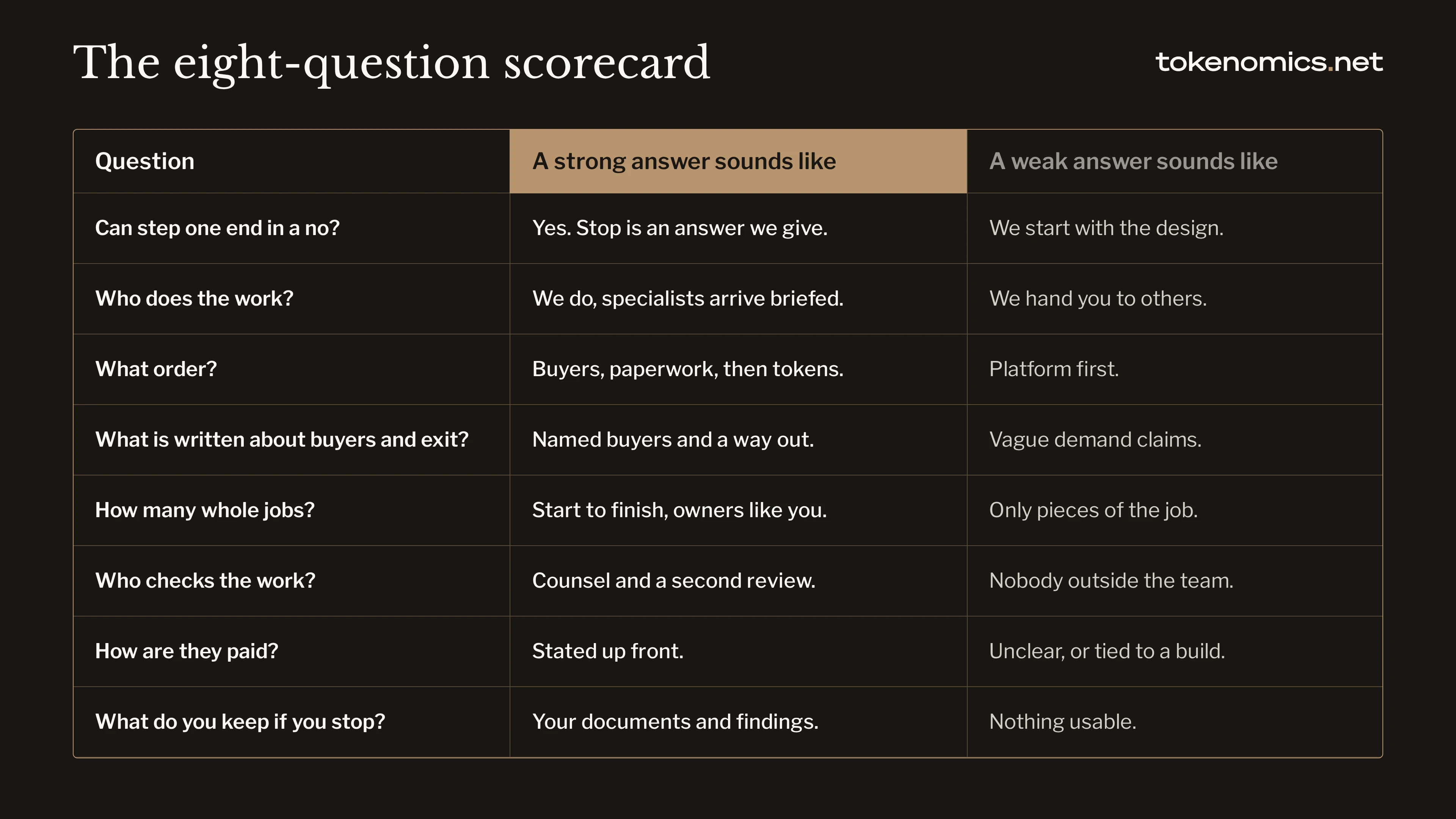
| Question | A strong answer sounds like | A weak answer sounds like |
|---|---|---|
| Can step one end in a no? | Yes. Stop is an answer we give. | We start with the design. |
| Who does the work? | We do, specialists arrive briefed. | We hand you to others. |
| What order? | Buyers, paperwork, then tokens. | Platform first. |
| What is written about buyers and exit? | Named buyers and a way out. | Vague demand claims. |
| How many whole jobs? | Start to finish, owners like you. | Only pieces of the job. |
| Who checks the work? | Counsel and a second review. | Nobody outside the team. |
| How are they paid? | Stated up front. | Unclear, or tied to a build. |
| What do you keep if you stop? | Your documents and findings. | Nothing usable. |
Take it to every first call. The answers sort themselves.
#Where Tokenomics.net fits
Here is how we answer the eight, so you can hold us to the same list.
Step one can end the engagement, and we say no when the answer is no. You talk to us from start to finish, and the specialists we bring in arrive briefed on your deal. Nothing gets built before the paperwork supports it. Our method has three steps and they run in this order: Validate the why, Make it real, Make it liquid. We have 100+ companies advised behind that method, and the whole of it is published free as 67 lessons, so you can audit how we think before you speak to us.
The order is the service. That is the claim, and the eight questions are a fair way to test it.
#Frequently Asked Questions
#Who are the best asset tokenization advisors?
There is no ranking to point you at, and the right advisor depends on your asset, your jurisdiction and where you are in the order of work. Judge the ones you meet against the eight questions above, and weight the first one heaviest: can step one end in a no.
#What does an asset tokenization advisor do?
They hold the order of work. First, validate why you need the money and whether buyers exist. Second, turn that into paperwork a court would recognize. Third, map how your buyers turn a slice back into cash, since that sets the price you get today.
#Do I need a lawyer and an advisor?
Yes. Counsel is required for the structure, the offering and your lender's consent, and nothing an advisor says replaces that. The advisor's job is the sequence: who is engaged when, what gets decided before anything is built, and which question has to be answered next.
#How do I know an advisor is independent of a platform?
Ask two questions and listen for specifics. How are you paid, and what do you build or resell? An answer that names the payment arrangement up front and separates advice from anything being sold tells you more than any claim of independence.
#What should I bring to a first call?
Three things: the asset, the reason you need the money with a figure attached, and who you think the buyers are. If you have already asked five people what they would pay, bring those notes too, because that is the most useful document in the room.
#Where to start
If you want to run the first checks yourself before you speak to anyone, the free course publishes the step one checks, free with an account.
When you are ready, book a strategy call with our Tokenization Advisory team. Bring the asset, the reason you need the money, and who you think the buyers are. If you are designing a token rather than tokenizing an asset you own, our guide on how to choose a tokenomics consultant is the version of this for that job.
Tokenomics.net is an advisory and education firm for token issuers and asset owners. Ask us the eight questions.
Bring the question to a call
Thirty minutes with the team that wrote this, on your token or your asset. You leave knowing what to fix first.