
The Downsides of Asset Tokenization for an Owner

In short
Asset tokenization carries real costs for the owner: thin resale, legal duties, ongoing admin. See seven and how to size each one. Run the free tests.
The main downsides of asset tokenization for an owner are that a token does not create buyers, the offering carries legal and reporting duties, ownership records need ongoing administration, the exit depends on a thin resale market, and costs arrive before any money is raised. Each one can be sized before you commit.
#Why the downsides matter more than the upside
The upside of tokenization is widely published and reasonably well understood. The costs are not, which means the owner's real risk is not that tokenization fails. It is that it works, slowly, on an asset that never needed it.
Here is the business question to hold on to while you read the rest of this. Tokenization is a way to sell part of something you own. So the comparison is not tokenization against doing nothing. It is tokenization against the other ways of raising the same money, which for most owners means a loan against the asset or an ordinary sale of shares to a handful of people. If one of those is cheaper, faster and sufficient, it wins, and saying so out loud is part of honest tokenization advisory for asset owners.
What follows is seven costs, each with a line on how to put a number against it before you commit to anything.
#Seven costs an owner carries
#1. A token does not create buyers
This is the one that catches people. Tokenizing an asset makes an interest in it easy to transfer. It does nothing at all to make someone want it. Demand comes from the asset, the price and the terms, in that order, and the token sits downstream of all three.
The symptom is a technically complete offering with almost nothing sold. We have seen that version more than once, and the diagnosis is always upstream.
How to size it. Call five people who could plausibly buy and ask two questions. Would you buy a slice of this, and at what price. Five real names with five real numbers is a result. Five maybes is a no.
#2. Legal structure and consents
The asset usually has to move into its own company before any interest in it can be sold, and other people often have a say in whether it can move. Lenders, co-owners, ground lessors and some tenants may hold consent rights, and a mortgage or loan agreement can restrict a transfer outright.
This work happens early, costs real money, and produces nothing you can show investors. Owners consistently underestimate it because it looks like paperwork rather than a decision.
How to size it. Have a lawyer read your title documents, your loan agreement and your partnership or shareholder agreement, and come back with a list of every person whose written consent you need. The length of that list is the cost.
#3. Legal and reporting duties on the offering
Selling interests in an asset to outside investors is, in most places, a regulated activity. That brings duties before the sale, around disclosure and investor eligibility, and duties after it, around what you report to the people who now own part of your asset and how often.
The after part is where owners get surprised. A raise closes. The reporting obligations do not.
How to size it. Ask counsel for the list of obligations that continue after closing, with a frequency against each one. Then ask who inside your business will do them.
#4. Ongoing administration of the owner list and transfers
Someone has to maintain an accurate register of who owns what, process transfers, handle the buyer who lost access to their wallet, and make distributions to a list that changes. With a small number of owners this is a spreadsheet. With a few hundred it is a function.
The cost here is not large per transaction. It is that it never stops, and it has to be right, because the register is the record of who owns your asset.
How to size it. Estimate your likely number of owners, then decide who keeps the register and what you pay them to keep it. If the answer is "us, somehow," that is not an answer yet.
#5. A thin resale market
Your buyers will eventually want out. If there is no realistic route for them to sell, that absence does not wait until later to cost you. It shows up in the price you get today, because a buyer who cannot exit discounts the entry.
In our view this is the single most underestimated cost in the whole exercise, and the gap between how it is discussed and how it behaves is wide. Transferability is a technical property. Liquidity is a market, and a market requires other people.
How to size it. Write down the specific route a buyer takes to sell their interest in year three, naming who they sell to. If you cannot finish that sentence, assume the discount and model it.
#6. Pricing and valuation disclosure
Selling a fraction means publishing a value for the whole. That number then follows you. It is visible to your lender, relevant to your tax position, and it becomes the reference point for every later transaction in the asset, including ones you have not planned.
If the asset is unusual or has no comparable sales, defending the number is harder than producing it, and buyers are entitled to ask how you got there.
How to size it. Get the valuation you would actually put in front of investors, and ask the valuer which assumptions a hostile reader would attack first.
#7. Dependence on records and systems you do not control
The offering will run on technology, and that technology will be operated by someone. Contracts live on a chain whose rules you do not set. Interfaces, custody and reporting tools belong to providers who have their own commercial lifespans.
None of this is a reason to avoid tokenizing. It is a reason to know, in advance, what you would do if any single piece of it stopped being available, and to make sure your own legal register does not depend on anyone else staying in business.
How to size it. For every system in the plan, answer one question in writing. If this stops operating next year, where is the authoritative record of who owns what, and who holds it?
#What the upsides are, honestly
If buyers exist and the structure is sound, the upside is real and worth the work. A wider pool of people can participate, because the minimum purchase can be much smaller than a traditional sale allows. You can sell part rather than all, and keep operating control. Record keeping and transfer administration can be faster and cheaper to run once set up than their paper equivalents. Every one of those benefits sits behind the same conditional clause, which is why the conditional clause gets the first half of this post.
#How to size each downside before you commit
The pattern across all seven is the same. Each cost has an owner and a question, and none of them require you to spend much before you know the answer.
| Downside | Who can size it | The question to ask |
|---|---|---|
| No buyers | You, by phone | Would you buy a slice, and at what price? |
| Structure and consents | Your lawyer | Whose written consent do we need? |
| Offering duties | Your lawyer | What continues after closing, and how often? |
| Register and transfers | You, plus an administrator | Who keeps the register, and at what cost? |
| Thin resale | You | Who does a buyer sell to in year three? |
| Valuation disclosure | Your valuer | Which assumption gets attacked first? |
| System dependence | Your advisor | If this provider stops, where is the record? |
Doing all seven in one piece of work, before committing to anything, is what a feasibility study is for. We cover what it should answer in what a tokenization feasibility study is, and the wider process sits in our asset tokenization guide.
#Frequently Asked Questions
#What is the downside of tokenization?
The three costs owners feel most are that a token does not create buyers, that the offering brings legal and reporting duties that do not end at closing, and that your buyers need somewhere to sell later or they will price that problem into what they pay you today.
#What are the risks of asset tokenization?
For the owner, the risks are spending money before raising any, carrying new duties to a group of outside owners, and depending on records and systems you do not control. For buyers, the risk is holding an interest they cannot easily value or sell.
#What are the benefits of asset tokenization?
If buyers exist and the paperwork is sound, tokenization can widen the pool of people who can buy, let you sell in smaller slices than a traditional sale allows, and make transfers and records faster to administer. Each of those is conditional on the first clause.
#Who is tokenization not suitable for?
Owners who cannot name real buyers, owners whose title or consents are unresolved, and owners for whom a loan or an ordinary share sale would do the same job with less work.
#Can tokenized assets be sold easily?
A token is easy to transfer technically. Finding someone who wants to buy it at a price you accept is the hard part, and that part is not solved by the technology.
#Where to start
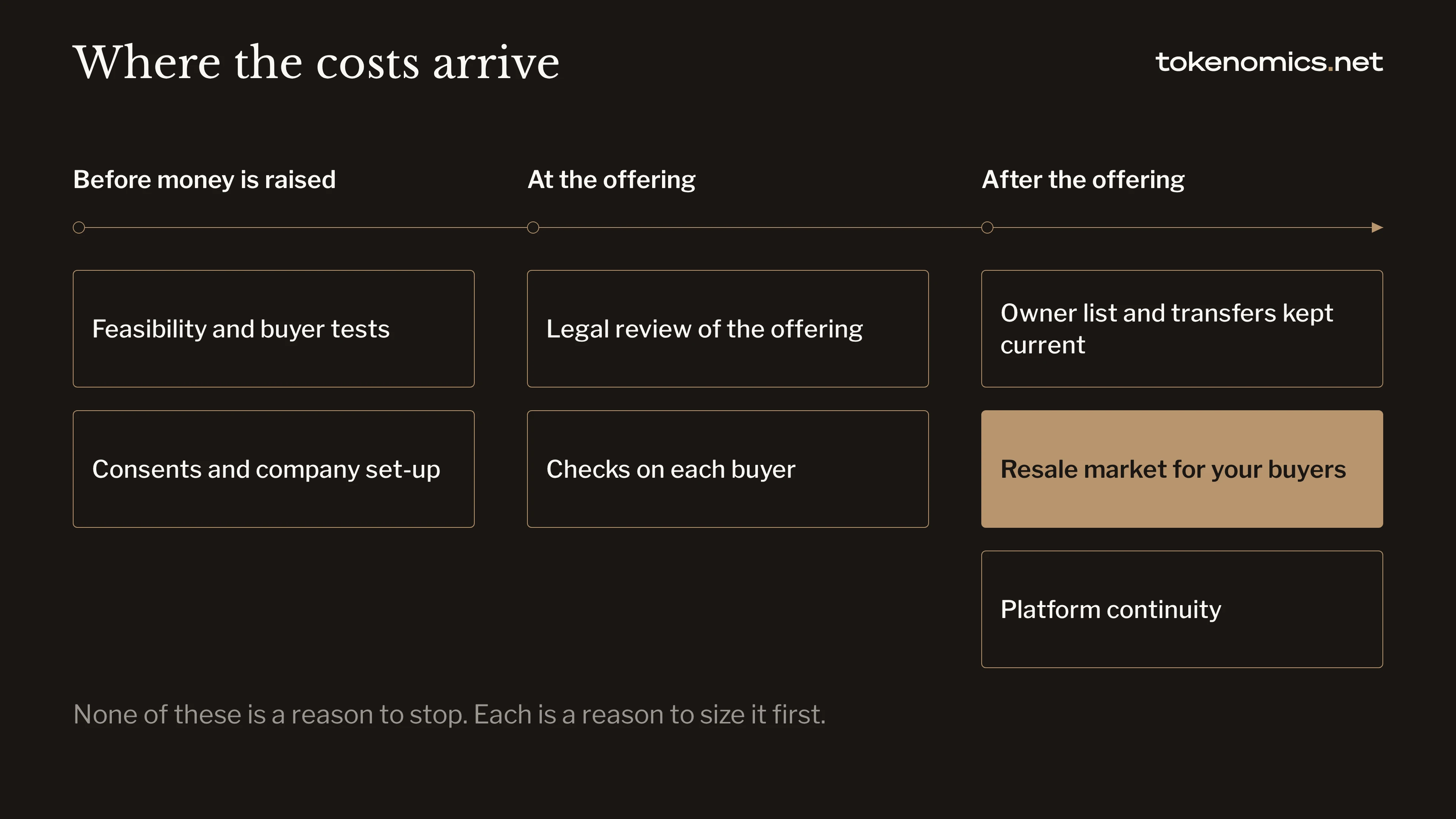
None of the seven is a reason to stop. Each is a reason to size it first, and the sizing is cheap compared to the committing.
Tokenomics.net is an advisory and education firm for token issuers and asset owners. The tests in the free course walk through the same questions in the table above, and you can read about the team that built them. If you would rather have someone work through them with you, that is what our tokenization advisory for asset owners does, including telling you to stop when stopping is the right answer.
Bring the question to a call
Thirty minutes with the team that wrote this, on your token or your asset. You leave knowing what to fix first.