
Should You Tokenize Your Asset? A Decision Test for Owners

In short
Four questions decide whether tokenizing a real asset makes sense. Run your own asset through them, then book a strategy call.
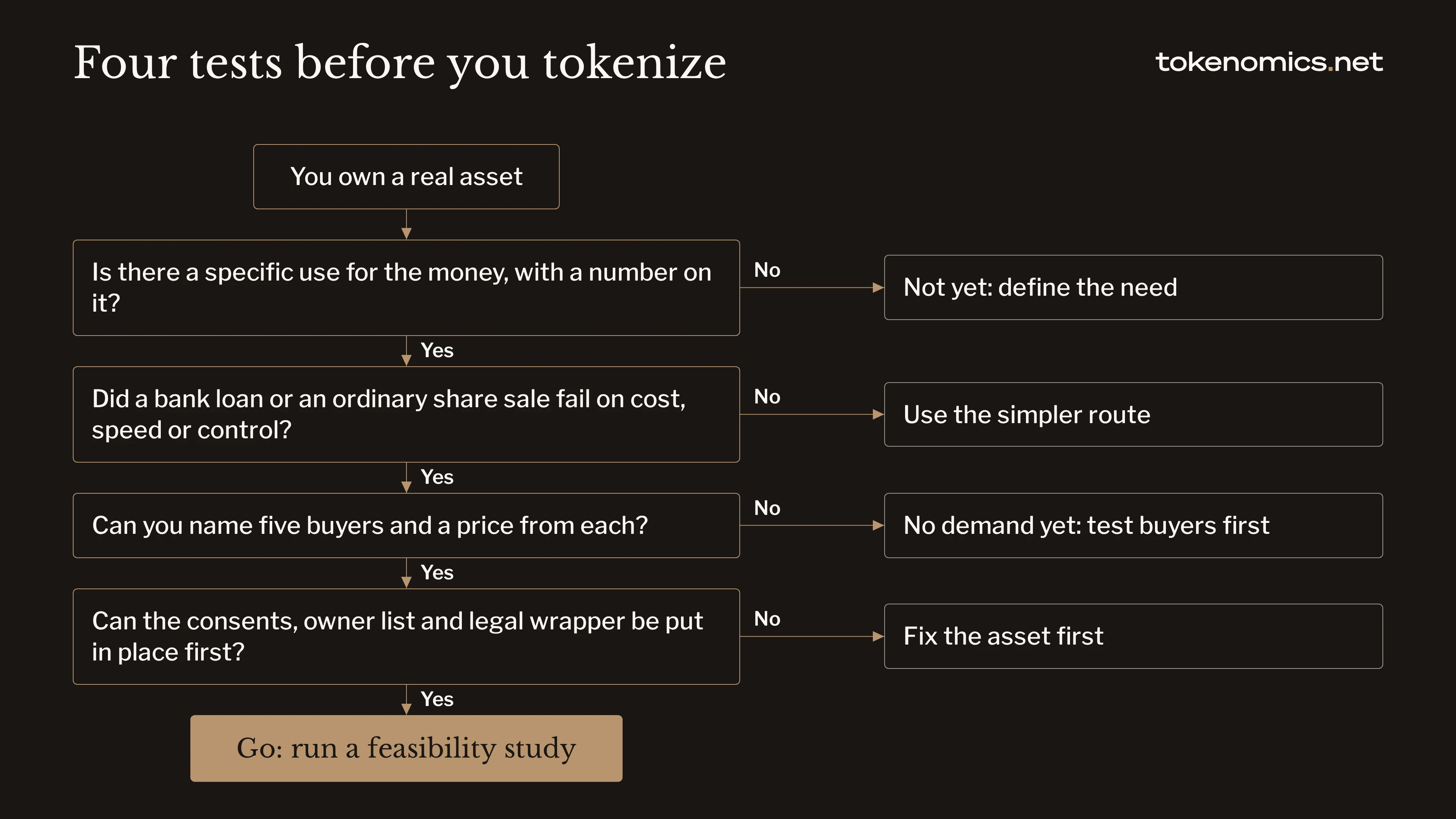
Tokenize an asset only if four things are true. You need money for a specific purpose. A bank loan and an ordinary share sale have been tested first. At least five real buyers would pay a named price for a slice. And the paperwork can be put in place before any token exists. If one answer is no, stop.
The question underneath has nothing to do with blockchains. It is whether your asset can earn its keep for somebody other than you, and whether you need the cash badly enough to hand over a piece of it. We have advised 100+ companies, and the owners who got something out of tokenizing had answered that long before anyone said the word token.
The four tests below are the ones we run in step one of our tokenization advisory for asset owners. They cost phone calls. Running them on your own asset first is the cheapest hour you will spend on this, and sometimes it ends the project, which is a result worth having early rather than late.
#What tokenizing an asset changes, and what it does not
A token is a record of who owns which slice. That is the whole of it. A token splits and transfers without anyone redrafting a shareholder list by hand each time, and for the right asset that saves real work.
Here is what it does not do. It does not create buyers. It does not move legal title. It does not settle what your asset is worth. Owners get sold on the record and forget that the record is the last thing you build, not the first. The asset earns the money. The reason you need the money comes next. The token is a filing cabinet with better hinges, and a filing cabinet has never raised a round.
#Test 1. Do you need the money, and for what?
A specific use with a number on it, or you are not ready.
"Raise capital" is not a reason. It is a wish with a finance word in front of it. A real reason sounds like this: we need the cash to buy out a partner whose exit date is already fixed in writing, and we know the amount to the dollar. Or: we have a signed lease on the unit next door and the fit-out has a price. The number has a document behind it.
In our experience this test fails more often than the other three put together, and it fails quietly, because nobody wants to say out loud that they are exploring tokenization because it came up at a conference. If you cannot write the use of funds in one sentence with a figure in it, the rest of the work has nothing to aim at.
#Test 2. Did a bank loan or an ordinary share sale fail first?
Test the ordinary routes and let them lose on their merits, not on your enthusiasm.
| Route | Cost to set up | Time to cash | Control you keep | Who can buy |
|---|---|---|---|---|
| Bank loan | Lowest of the three | Shortest | All of it, while you keep paying | One lender, on its terms |
| Ordinary share sale | Middling | Medium | Less, and you gain a partner with a vote | A few buyers you negotiate with one at a time |
| Tokenized offering | Highest | Longest | Less, spread across many holders | More buyers, if the offering actually reaches them |
Read that table honestly and tokenization looks like the expensive option, because it is. It earns its place in one situation: when the asset is worth more sold in slices than whole, and the slices need to reach people you cannot negotiate with one at a time. That is a narrow condition. It is also real, and it is why this work exists.
One distinction worth getting straight, because the two words get used as if they were interchangeable. Securitization pools financial assets and sells a new instrument whose payments come out of the pool. The Securities Exchange Act of 1934 sets out that shape at section 3(a)(79), where an asset-backed security is defined as a security collateralized by a self-liquidating financial asset, with the holder's payments depending primarily on cash flow from that asset. Tokenization is narrower. It records who owns which slice of one asset, or of the company holding it. You can tokenize interests in a securitization. They are layers, not alternatives.
#Test 3. Can you name five buyers and a price?
Five names, five numbers, from five conversations you have actually had.
Call five people who would plausibly buy a slice. Ask two things: what would you pay, and what would stop you. Write down what they say. If nobody names a figure, you do not have a demand problem you can fix with better plumbing, you have no demand yet, and a token will not conjure it. The people who buy slices of real assets are not waiting for a smoother transfer mechanism. They are waiting for an asset they understand at a price they like.
The answers to "what would stop you" are the more useful half. Lock-up fears, resale worries, a lender's consent nobody has asked for yet. Every one of those is cheaper to find out now than in month four.
#Test 4. Can the paperwork be done first?
If the ownership documents cannot be put in order, there is nothing for a token to record.
The order is fixed, and it is the part owners most want to skip:
- Written consent from anyone with a claim on the asset, which means your lender, your co-owners and anyone holding a lien.
- The asset into its own company.
- Share terms, the owner list and the transfer agent.
- Checks on each buyer.
- Tokens last, because they only copy what the paperwork already says.
Selling slices of an asset to people who expect to profit from your work is, in most cases, a securities offering. The Supreme Court set the test in SEC v. W.J. Howey Co. in 1946: an investment contract is a transaction where a person invests money in a common enterprise and is led to expect profits solely from the efforts of the promoter or a third party. The Court added the line that matters most here. It said it is immaterial whether the shares in the enterprise are evidenced by formal certificates or by nominal interests in the physical assets. The form of the record does not decide the question. That is general information rather than advice on your deal, and whether any specific offering is a security is fact specific and jurisdiction specific. Your counsel makes that call, which is why counsel comes before the build and not after it.
For the same sequence worked through on a building, see how to tokenize real estate.
#Who benefits most, and who does not
Owners of assets that are valuable but hard to sell in slices benefit most, together with buyers who want a small share of something they could never buy whole. Tokenization is a plumbing upgrade for ownership records, so the owners it helps are the ones whose problem is genuinely the plumbing.
The case tends to be strong when:
- The asset produces income with a history somebody outside your company can check.
- You have more interested small buyers than you can handle through one-at-a-time paperwork.
- A whole-asset sale is blocked because almost nobody can write a check that size.
- Your lender and co-owners are reachable and likely to consent.
The case tends to be weak when:
- It is one home, and you live in it.
- Your lender's consent is unlikely and you have not asked.
- Nobody outside your industry can check what the asset is worth.
- What you actually want is a valuation mark, not cash.
#Frequently Asked Questions
#Is asset tokenization worth it?
It is worth it when all four tests pass: a specific use for the money, an ordinary route already tested and rejected, five buyers who name a price, and paperwork that can be put in place first. It is not worth it when a loan or a plain share sale does the job.
#Who should tokenize their assets?
Owners with a specific funding need, buyers who have already said what they would pay, and ownership clean enough to document. Owners who are missing any one of those three are better off fixing that first.
#Who benefits most from tokenization?
Owners of assets that are valuable but hard to sell in slices, and buyers who want a small share of something they could not buy whole. The further an asset sits from either of those, the thinner the case gets.
#What is the downside of tokenization?
You take on cost and paperwork before any money arrives, you gain a group of part-owners with claims on information and decisions, and resale depends on a venue that may not exist for your deal. We cover each one in our post on the downsides of asset tokenization.
#How do I tokenize my assets?
Reason and buyers first, paperwork second, tokens last. The token only copies what the ownership documents already say, so it is the final step, not the first. Our walkthrough of how to tokenize real estate shows the order on a property.
#What to do next
Work your own asset through the four tests using the free course that covers the same four tests, which publishes the whole method as 67 lessons and is free with an account.
Or bring the asset to us and we will run step one with you, starting with whether you should do this at all. Book a strategy call and come with three things: the asset, the reason you need the money, and who you think the buyers are.
Tokenomics.net is an advisory and education firm for token issuers and asset owners. The asset earns the money. The token only records who owns a piece of it.
Bring the question to a call
Thirty minutes with the team that wrote this, on your token or your asset. You leave knowing what to fix first.