
Can You Tokenize Your House? What Owners Need to Know

In short
Tokenizing a house changes little about who owns it. Learn what can be tokenized, what lenders and law require, and what to do first. Read the guide.
A token does not move legal title to your house. What can be tokenized is an ownership interest in a company that holds the property. Selling that interest is usually a securities offering in the US, which needs legal review, any lender's consent and buyers who want a slice. For most homeowners another route fits better.
Before any of the mechanics, the question worth asking is what you want the money for. Owners arrive at this topic because they have equity in a property and a use for cash, and tokenizing is one of several ways to turn the first into the second. It is the most involved of them. Whether it beats a loan depends entirely on your reason for raising, which is why that comes first and the technology comes last.
This is general information about how the pieces fit together, not advice on your property. The specifics belong to a property lawyer who has read your mortgage.
#The short answer for a homeowner
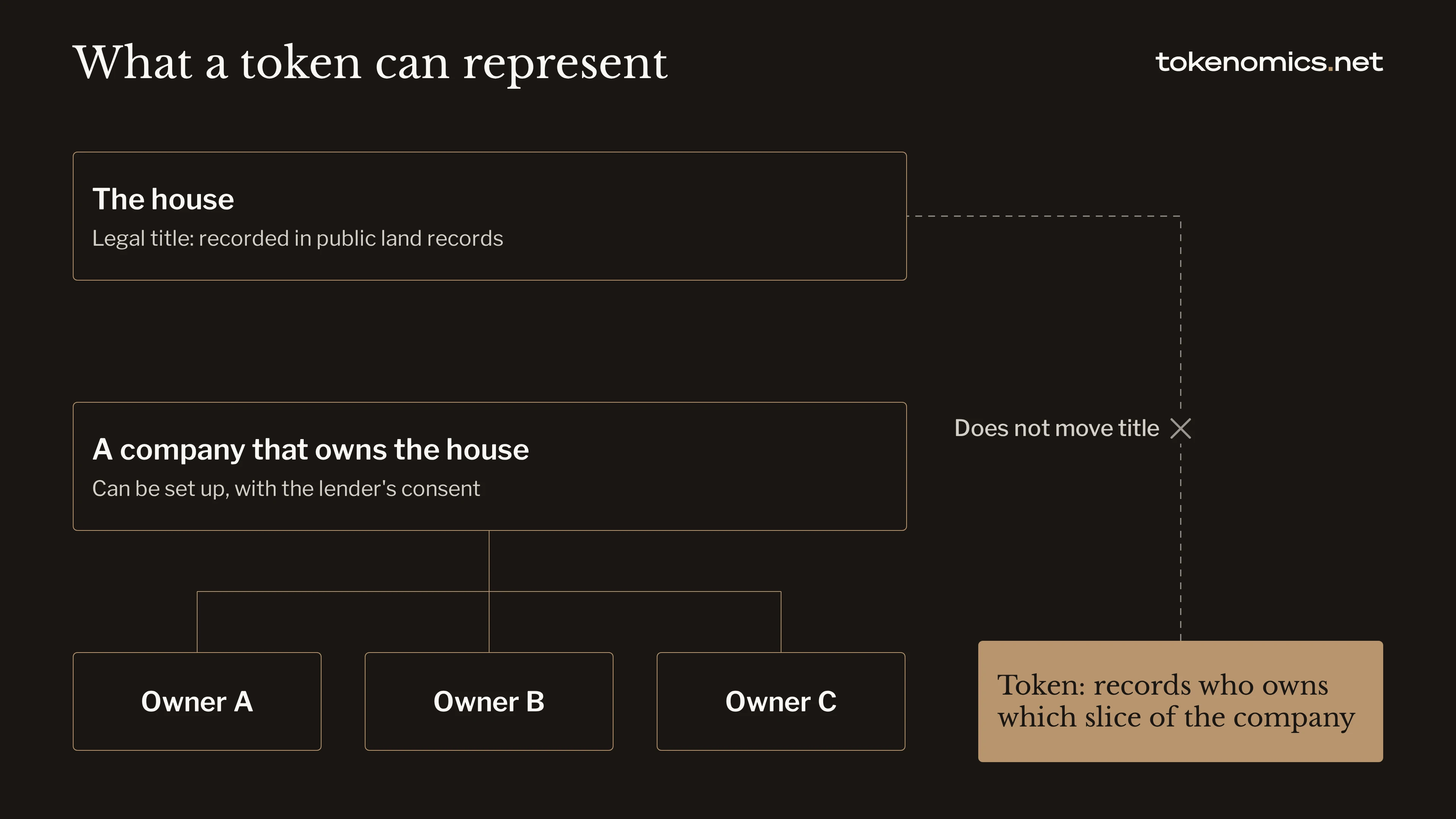
You cannot put a house on a blockchain. You can put a company on one, and have that company own the house.
Three things stand between an owner and a tokenized property, and none of them is technical. The first is title, which lives in public land records and does not care what any other system says. The second is your lender, who has almost certainly reserved the right to react if the property or an interest in it changes hands. The third is buyers, because a slice of one house is not an obviously attractive thing to own, and someone has to want it at a price you would accept.
Clear all three and the structure is available. In our experience most homeowners do not clear the third one, and quite a few stop at the second.
#What a token can and cannot represent
| Layer | What it is | Can it be tokenized |
|---|---|---|
| Legal title to the property | The ownership record held in public land records, changed by recording a transfer | No. A token is an entry in a different record system and does not alter the land records |
| An interest in a company that owns the property | Shares or membership interests in an entity holding the asset | Yes, this is what tokenized real estate usually means |
| A right to income from the property | A contractual claim on rent or proceeds, set by the agreement that creates it | Yes, but it is the contract that defines the right, not the token |
The whole of the idea sits in row two. The token records who owns which slice of the company, and the company owns the house. That is why the paperwork comes first: a token can only reflect what the company's documents already say. Issue one against documents that say nothing, and you have published a spreadsheet.
#Your mortgage lender and the property rules
If there is a mortgage on the property, read the loan contract before you read anything else about tokenization.
Most mortgages contain what the law calls a due-on-sale clause. Federal law defines it directly. Under 12 U.S.C. 1701j-3, part of the Garn-St Germain Depository Institutions Act of 1982, a due-on-sale clause is a contract provision that authorizes a lender, at its option, to declare due and payable the sums secured by its security instrument if all or any part of the property, or an interest in it, is sold or transferred without the lender's prior written consent. The phrase "or an interest therein" is the one to notice. It is not limited to selling the whole house.
The same section says lenders may enforce those clauses notwithstanding contrary state law, and that when the option is exercised, the rights of lender and borrower are governed by the terms of the loan contract.
There is a carve-out, and it is worth knowing its edges. For a loan secured by residential property with fewer than five dwelling units, the statute lists transfers on which a lender may not exercise the option. The list covers things like a subordinate lien that does not transfer occupancy rights, a transfer to a spouse or children, a transfer on the death of a joint tenant, a short leasehold without a purchase option, and a transfer into a living trust where the borrower remains a beneficiary. Moving a property into a company you set up so you can sell interests in it is not on that list. What that means for your particular loan is a question for your lawyer and, in practice, for your lender's servicing department, because subsection (b)(2) points back to the loan contract.
Condominium and homeowner association rules can also restrict transfers, and they are separate from anything federal law says. Check those too.
In our view, this is the step owners most often leave until last and should do first. One phone call to the lender reorders the whole project.
#Is it worth it for a single house
Compare it against what you already have access to.
- A home equity loan or a cash-out refinance leaves title and your single lender relationship where they are, and the paperwork is a known quantity.
- A sale ends the question. It also ends your ownership, which may be the point or may be the thing you were trying to avoid.
- A co-ownership agreement with one or two people you know can achieve fractional ownership with a lawyer and a contract, and no token at all.
Set those next to tokenizing: a new entity, a lender consent, counsel on a securities offering, buyer checks, an owner register, and a resale venue that may not exist for a slice of one house. In our view, for a single home the process is rarely proportionate to what it returns, and we say that to owners on first calls regularly. The structure is real. The question is whether your asset is the kind that needs it.
#When it makes more sense
The case gets stronger as the asset gets larger, more income-producing and more obviously divisible.
A building with tenants and a rent roll somebody can verify is a different proposition from a family home, because the thing being sold has a cash flow attached and a price that can be checked. More than one buyer wanting in at the same time is the other condition. If you have a waiting list and a property that generates income, the ownership plumbing is the actual bottleneck, and that is the problem tokenization is for.
For the issuer-side view of designing property tokens, see tokenizing real estate. For the sequence on a property you own, see how to tokenize real estate, and for the decision itself, whether you should tokenize your asset.
#What to do first
- Call your lender and ask what a transfer of the property, or of an interest in it, would trigger under your loan. Get the answer in writing.
- Speak to a property lawyer in the state where the property sits, and ask about both the transfer and the offering.
- Ask five people whether they would buy a slice, and what they would pay. Write down what they say.
The third step costs nothing, and in our experience it ends more of these projects than the first two combined. Our tokenization advisory for property owners starts with the same three questions, and the free course publishes the checks as 67 lessons, free with an account, if you want to run them yourself first.
#Frequently Asked Questions
#Can I tokenize my house?
Not the house itself. What can be tokenized is an ownership interest in a company that holds the property, and selling those interests to investors is generally treated as a securities offering in the US. That takes counsel, your lender's consent, and buyers who want a slice.
#How do I tokenize my real estate?
Company and paperwork first, tokens last. The consents, the entity, the share terms and the owner list come before anything is issued, because a token only copies what those documents already say. Our walkthrough of how to tokenize real estate sets out the order.
#Does tokenizing a house change who owns it?
No. Legal title sits in public land records and changes when a transfer is recorded there. A token is an entry in a different record system, so issuing one does not alter what the land records say about your house.
#Do I need my lender's permission?
Ask your lender and a lawyer before you move anything. Most mortgages contain a due-on-sale clause, which under 12 U.S.C. 1701j-3 lets a lender declare the loan due if the property or an interest in it is sold or transferred without the lender's prior written consent.
#Is tokenizing a house legal?
No US law bans it, and no law pre-clears it either. Requirements apply to the offering, the entity and the mortgage, and whether a specific plan meets them is a fact-specific question for your counsel. Our post on how the law treats tokenized real estate goes deeper.
#Where to start
Run the four tests in the free course on your own property, then book a strategy call if the answers hold up. Come with the mortgage, the reason you want the money, and the five buyer conversations.
Tokenomics.net is an advisory and education firm for token issuers and asset owners. More about Tokenomics.net and the method we work through.
Bring the question to a call
Thirty minutes with the team that wrote this, on your token or your asset. You leave knowing what to fix first.