Tokenized Private Credit: How the Market Actually Works
How tokenized private credit actually works: structure, platforms, regulatory posture, and the tokenomics decisions that determine whether it holds up.


Tokenized private credit is the practice of representing a loan, or a pool of loans, as a token that settles onchain while the underlying lending relationship stays exactly what it was before any token existed: a borrower who owes money, on terms an underwriter set in advance. The token is the wrapper. The loan is still the asset. That distinction sounds obvious until you watch how often it gets skipped in a pitch deck, where "tokenized" starts doing the work that "underwritten" should be doing.
This matters because trust in the credit product is what makes the underlying lending business work at all: borrowers get financed, loans perform, and capital keeps flowing to fund the next loan. A tokenized credit platform's revenue and its ability to raise capital both follow from that trust, not the other way around. That trust is not a function of the token existing; it is a function of the tokenomics decisions built into the platform, the same tranche, redemption, and default-handling choices covered later in this piece, not a marketing layer sitting on top of a loan book. The market for tokenized private credit is not theoretical anymore. Platforms with real loan books are live and operating, not concept pieces waiting for a whitepaper to become a product. If you are evaluating whether to build in this category, or whether to allocate into it, the difference between a well-structured tokenized private credit product and a thin one comes down to the specifics that determine whether that trust is earned, specifics most surveys of "RWA tokenization" never get into.
#What "tokenized private credit" actually means
#How it differs from tokenized treasuries and tokenized real estate
Private credit as an asset class means direct lending that happens outside public bond and loan markets, typically to businesses that do not have easy access to bank financing or public debt issuance. Tokenization adds three things to that lending relationship: fractional ownership of the loan or pool, faster settlement between lender and holder, and programmable distribution of interest and principal payments as they come due.
That is a different animal from a tokenized treasury product like the Franklin Templeton BENJI tokenized money market fund, which represents a claim on short-term government debt and therefore carries sovereign credit risk, the risk that a government defaults, not borrower credit risk. A tokenized private credit note carries the risk of a specific borrower or pool of borrowers failing to repay. Moving that claim onchain does not remove the credit analysis; it just changes how the claim settles and trades.
#The loan, not the token, is the underlying asset
This is the point worth repeating because it is where a lot of category confusion starts: the token represents a claim on a loan or a loan pool. It does not replace the need to underwrite that loan. If the underwriting was weak, the token inherits that weakness, dressed up in a cleaner settlement layer.
#Why institutional capital is moving into this category
Private credit already draws institutional interest offchain, for yield and portfolio diversification reasons that have nothing to do with blockchain. Allocators have been building private credit exposure for years because it offers returns and risk characteristics that public credit markets do not.
What tokenization adds to that existing appetite is settlement speed and the possibility of secondary-market liquidity, something traditional private credit funds structurally lack given their typical multi-year lockup periods. That combination, an asset class allocators already want, paired with a liquidity profile the traditional structure cannot offer, is the actual mechanism behind institutional interest in this category. The right question for evaluating that interest is not how large the category has grown, since a reliable current figure is not something to assert without a live source, but whether a specific platform's loan book, underwriting track record, and liquidity structure hold up to scrutiny. What "moving in" looks like in practice today is a small number of operating platforms with real loan books, expanding gradually, not a claim about total market size.
#How the mechanics actually work
Origination and underwriting still happen offchain, and that is by design, not by limitation. A borrower applies for financing, a credit team evaluates the borrower's financials, collateral, and repayment capacity, and a loan gets structured with specific terms. None of that changes because a token will eventually represent a claim on the result.
#The tokenized note or pool-token structure
Once the loan or loan pool exists, it gets represented onchain as a note or a pool token. Interest and principal payments flow back to token holders on a defined schedule, tracked and distributed programmatically rather than through a manual servicing process. This is private credit blockchain lending in its most literal form: the servicing layer moves onchain, the credit relationship does not change shape.
Tranching, senior versus junior structures, shows up often in this category, and it directly shapes risk and yield per tranche. A senior tranche gets paid first and absorbs less risk in exchange for a lower yield. A junior tranche absorbs losses first and carries a higher yield to compensate. This structure is the direct setup for the tokenomics decisions covered further down, because tranche design is a token design decision, not just a legal one.
#The platforms that have actually built this
#What Centrifuge, Maple Finance, Goldfinch, and Credix each prove about the model
A handful of platforms are operating in this category with real loan books rather than pitch decks, including Centrifuge on-chain credit markets and Maple Finance institutional lending, both of which run permissioned pools with restricted access for accredited or institutional participants. Other platforms sometimes named alongside them, including Goldfinch and Credix, take different structural approaches to underwriting and disclosure, though this piece does not independently verify their current loan-book or permissioning specifics. tokenomics.net has no affiliation with any of these platforms; they are referenced here as examples of tokenized private credit platforms operating in this category, not as an endorsement or a ranked comparison.
What these platforms prove collectively is that the model works at a mechanical level: loans can be originated offchain, represented onchain, tranched, and serviced through programmable distribution. What they do not prove, individually or collectively, is that any specific design choice is the right one for a new entrant's specific borrower base and jurisdiction. For a broader view of how these structural choices play out across real-world-asset classes beyond private credit, see our complete guide to RWA tokenization.
#The regulatory reality: why this is securities-adjacent
#Why "tokenized" does not change the legal analysis of the underlying loan
Putting a loan claim onchain does not change what that claim legally is. Whether a specific tokenized private credit instrument constitutes a security typically requires jurisdiction-by-jurisdiction legal analysis, and that analysis depends on the specific offering structure, not on the fact that it happens to settle on a blockchain. Treat any claim that a tokenized structure automatically sits outside securities law as a claim to verify with counsel, not a fact to build on.
#What the Howey test means for a tokenized credit instrument
In the United States, the Howey test is the framework regulators and courts use to evaluate whether an arrangement constitutes an investment contract: an investment of money, in a common enterprise, with an expectation of profit derived from the efforts of others. It is a framework for analysis, not a checklist a founder can self-administer and treat as a final determination. A tokenized private credit note that pools capital from multiple holders and pays returns generated by a manager's lending and servicing decisions has characteristics that typically warrant that analysis before launch, in whatever jurisdiction the offering targets. We cover the classification question in more depth in our companion piece on how token classification works.
#The tokenomics decisions that determine whether the model actually works
#Tranching, redemption, and liquidity design
This is the section where tokenomics for private credit stops being an abstraction and becomes the thing that determines whether the product actually holds up under real conditions. Tranche structure determines who absorbs first losses if a borrower underperforms. Redemption and liquidity design determines whether a token holder can actually exit a position before the underlying loan matures, or whether the "secondary liquidity" advantage of tokenization is more marketing claim than working mechanism.
#What happens on default, and why that has to be designed, not improvised
Default handling is the part most often left vague in early-stage designs, and it is exactly the part that cannot be improvised after the fact. What happens to token holders if a borrower misses a payment. Who has authority to restructure or pursue recovery. How losses get allocated across tranches when they occur. These questions need answers embedded in the token design and the legal documentation before the first loan gets originated, not worked out during the first default event.
The frame worth holding onto here: tokenomics in this category is infrastructure that determines whether the credit product is trustworthy, not a marketing layer sitting on top of a loan book. Get the tranche, redemption, and default design right, and tokenized private credit functions the way it is supposed to. Get it wrong, and the token adds complexity to a lending business without adding the resilience that complexity should buy. If you are working through tranche, redemption, or default-handling decisions for a private credit token, our Tokenomics Design service is built around exactly this kind of structural decision-making.
#Tokenized private credit vs. the alternatives
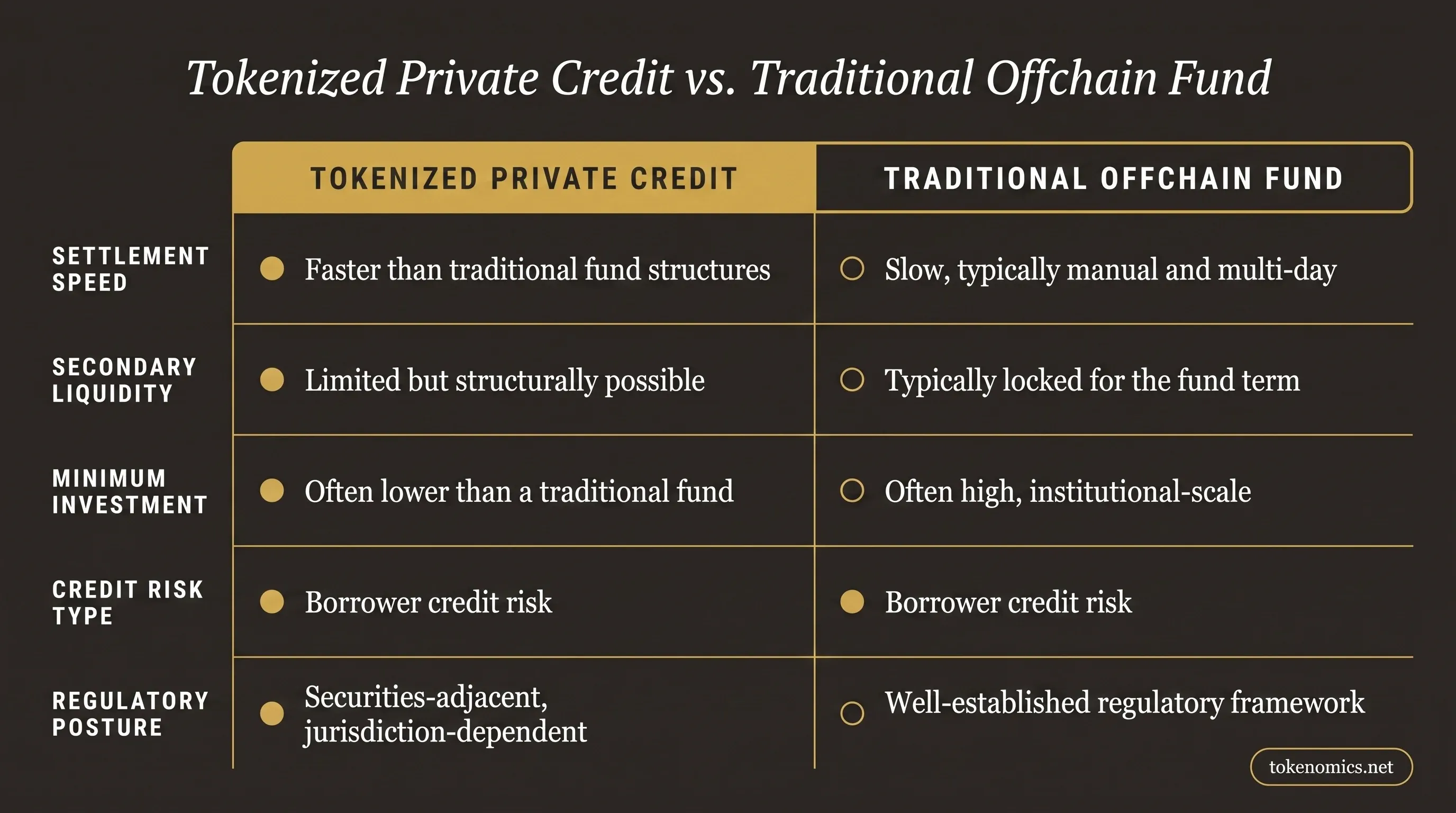
#Comparison table: tokenized private credit, tokenized treasuries, and a traditional offchain private credit fund
| Factor | Tokenized private credit | Tokenized treasuries | Traditional offchain private credit fund |
|---|---|---|---|
| Settlement speed | Faster than traditional fund structures | Fast, near-instant in most implementations | Slow, typically manual and multi-day |
| Secondary liquidity | Limited but structurally possible | Generally limited, varies by platform | Typically locked for the fund term |
| Minimum investment | Varies by platform, often lower than a traditional fund | Varies by platform | Often high, institutional-scale minimums |
| Credit risk type | Borrower credit risk | Sovereign credit risk | Borrower credit risk |
| Regulatory posture | Securities-adjacent, jurisdiction-dependent analysis required | Generally lower regulatory complexity given underlying asset | Well-established fund regulatory framework |
This table is the clearest artifact for anyone doing category diligence, because it isolates the variable that actually matters for evaluation: credit risk type does not change between tokenized private credit and its offchain equivalent. What changes is settlement mechanics and, potentially, liquidity.
#What to evaluate before you build or allocate here
#Questions a founder should be able to answer before designing the token
Before a token design gets built, a founder in this category should be able to answer: does the underwriting process exist independently of the token, with a credit team and a defined methodology. Is the tranche structure actually specified, with clear rules for who absorbs losses first. Is there a defined default-handling path written into the design, not left as a future decision. Has legal reviewed the offering structure against the target jurisdiction's framework.
#Questions an allocator should ask before committing capital
An allocator evaluating a tokenized private credit platform should ask a parallel set of questions: who underwrites the loans, and what is their track record independent of the token wrapper. What is the actual tranche and default-handling structure, not just the marketing description of "onchain liquidity." What legal review has the offering gone through, and in which jurisdictions. And what happens, specifically, if a borrower in the pool defaults. These are the same questions our Tokenomics Audit service is designed to answer before capital moves.
If you are scoping a tokenized private credit product and want a second read on whether the tranche structure, redemption design, and default handling actually hold up before you build, that is a conversation worth having early. Book a strategy call and we'll walk through it together.